

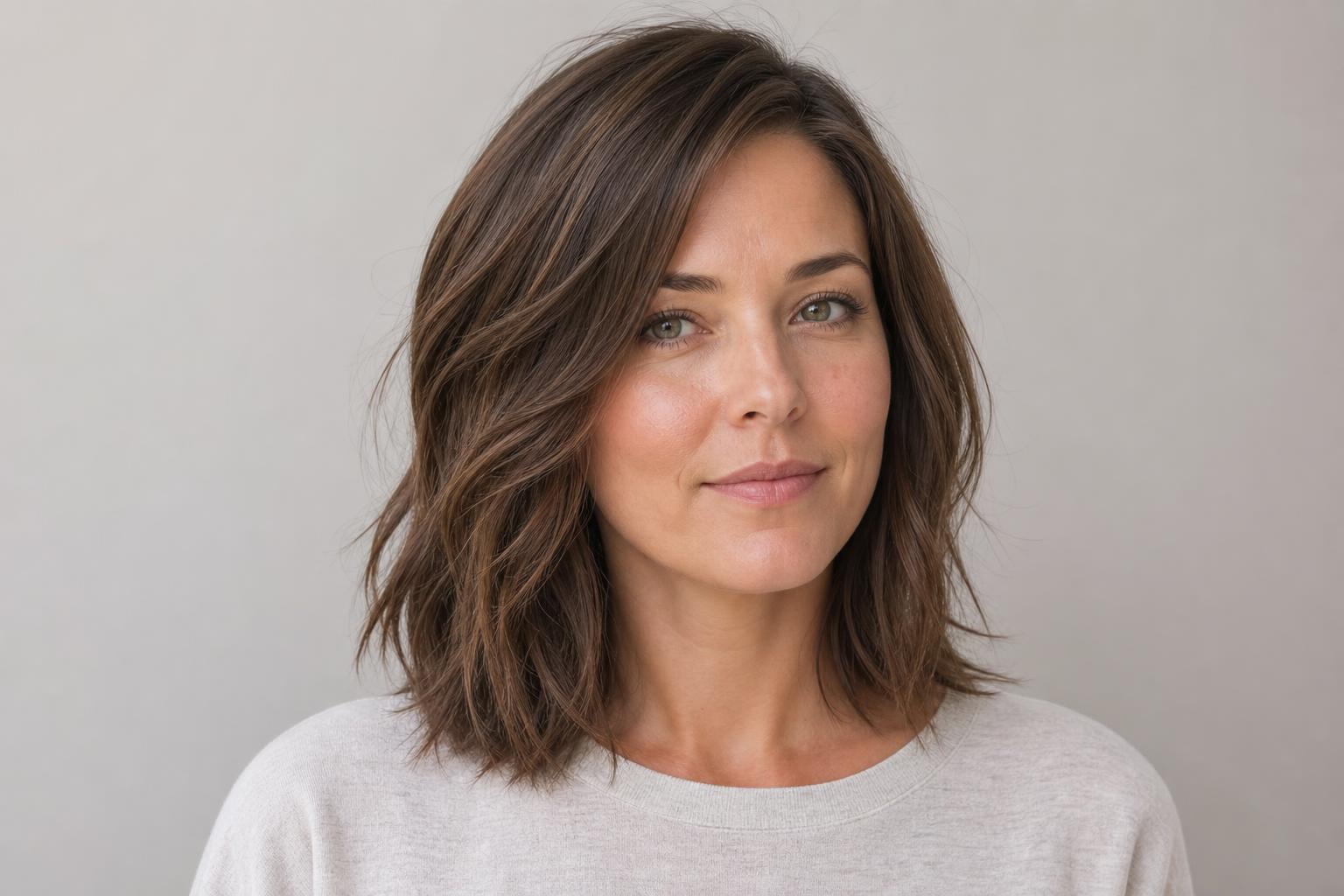
Medium length runs from the collarbone to roughly two inches below the shoulder, and it is the only length where the weight of the hair holds a shape without either fighting gravity or disappearing into it.
That weight is why medium cuts suit more hair types than any other length: there is enough to build movement into and not so much that fine hair collapses or thick hair swells. The decision within the range is not really about inches but about where the layers start, because a collarbone cut with layers beginning at the chin behaves nothing like the same length layered from the jaw down. Below are 35 medium haircuts grouped by hair type and structure.
The gallery moves through layered lobs, shags and wolf cuts, options built specifically for fine and for thick hair, and finishes with bang and face-framing variations. After the entries there is a face shape table, the exact language to use at the salon, a maintenance schedule with honest numbers, and a section on when medium length is the wrong call.
| Factor | Details |
|---|---|
| Length range | Collarbone to two inches below the shoulder |
| Best for | Almost every hair type; the most adaptable length available |
| Layer placement | Chin level for volume, jaw level for movement, below the shoulder for weight removal only |
| Maintenance | Trim every 8 to 12 weeks; 5 to 20 minutes of daily styling |
| Avoid if | Your hair is very fine and heavily layered, or you want zero styling time |
| Salon time | 45 to 75 minutes for a cut; add 2 to 3 hours for color |
Layered Lobs and Collarbone Cuts
The lob sits at the shorter end of medium and is the most requested cut in this range because it keeps enough length to tie back while still holding a defined shape. What separates one lob from another is almost entirely the layering: none at all gives a blunt, heavy line, while layers from the jaw down give movement. These eight cover the useful spread.
1. Blunt Collarbone Lob
One clean line at the collarbone with no layers at all, which concentrates every strand at the perimeter and creates the illusion of density. Fine to medium hair gains the most from this, since nothing is removed from the ends.
2. Long Layered Lob with Face-Framing
Layers start at the jaw and lengthen gradually toward the back, with the shortest face-framing pieces cut at the cheekbone. Round and square faces both gain from the vertical line those front pieces create. Ask for the framing to start at the cheekbone rather than the chin, which is where most stylists default.
3. A-Line Lob Angled Toward the Front
Cut shorter at the back and gradually longer toward the face, so the front pieces fall an inch or two below the back. The angle draws the eye down the neck and forward, which lengthens the appearance of the jaw. Straight and slightly wavy hair holds the angle cleanly; tight curls lose it to shrinkage.
4. Textured Lob with Point-Cut Ends
The perimeter is broken up with the scissor tips held vertically, so the bottom line softens without losing weight. Thick hair that looks heavy at a blunt length is the main beneficiary. This is a small technical change with a large effect, and it is worth naming specifically rather than asking for a general texturized cut.
5. Choppy Lob with Visible Layers
Layers are cut deliberately uneven and left obvious rather than blended, which builds a piecey, deconstructed line. Medium-density straight hair carries it best. The distinction between this and a softly blended cut is significant enough that choosing between internal and visible layers is worth settling before you sit down.
6. Center-Parted Lob with Soft Bends
A middle part with the ends bent outward using a flat iron gives a relaxed, slightly undone finish. Oval and heart-shaped faces suit a center part most easily, since it emphasizes symmetry.
7. One-Length Cut with Internal Weight Removal
The outside stays a single line while weight is taken out from underneath, invisible from the surface. This is the answer for anyone with thick hair who wants a blunt look without the triangular shape dense hair produces at medium length. Say “remove weight from underneath, keep the perimeter blunt” to get it.
8. Lob with a Slight Undercut at the Nape
A small section at the nape is clipped shorter and hidden under the length, which removes bulk at the heaviest point without changing the outline. Very thick or coarse hair sits noticeably flatter afterward.
Shags, Wolf Cuts and Textured Medium Styles
Shag-family cuts trade a clean perimeter for movement, using short layers at the crown that graduate down through the length. They suit anyone whose hair has natural texture to work with and anyone who wants to stop blow-drying. The trade-off is that these cuts need product to look deliberate rather than neglected.
9. Modern Medium Shag
Soft blended layers begin around the cheekbone and continue through to the ends, giving movement without hard steps. Wavy 2a to 2c hair is the natural home for this cut, because the wave fills the layers on its own. A texturizing spray on damp hair and air-drying is the whole routine.
10. Shoulder-Length Wolf Cut
Sharper contrast than a shag, with genuinely short layers at the crown against a longer perimeter, plus wispy bangs. Medium-density straight-to-wavy hair holds the contrast best. Grow-out is faster than a shag because the crown layers flatten around week six, so budget for trims every eight weeks rather than twelve.
11. Butterfly Cut with Two Layer Lengths
Short face-framing layers sit over long ones, creating the illusion of much shorter hair while keeping the length underneath. It gives volume at the front without committing to a real cut, and it grows out into a straightforward layered shape. The exact request matters here, and the wording for a butterfly cut is worth having ready.
12. Razored Shag with Airy Ends
A razor rather than scissors thins the ends into a feathered finish that flips outward on its own. Coarse, thick hair takes this well, and fine hair does not, since the razor removes too much from strands that have little to spare. Ask directly whether your stylist works with a razor, because not all do.
13. Curtain-Bang Shag
The layering runs continuously from a center-split fringe into the face-framing pieces, so there is no visible break between bangs and length. It is the most forgiving version of bangs at this length, since growing them out simply returns you to face-framing layers. Style by drying the fringe outward with a round brush for about twenty seconds.
14. Lived-In Shag with Grown-Out Layers
Deliberately cut to look a few weeks past its trim, with longer, softer layer spacing than a classic shag. Anyone who dislikes the sharp look of a fresh cut will prefer this.
15. Shag with a Heavy Crown
Layers are kept longer at the crown and shorter through the mid-lengths, which reverses the usual arrangement and suits hair that already has volume up top. Curly and very thick hair benefits, since the standard short-crown shag adds height where these textures need none. This is a specific request most stylists will not offer unprompted.
16. Textured Mid-Length with Flipped Ends
Layers stop at the shoulder and the ends are encouraged to turn outward rather than under, giving a light, slightly retro finish. Straight hair needs a flat iron to hold the flip; wavy hair often does it unprompted. The flip breaks the horizontal line the shoulder creates, which is what stops shoulder-length hair from looking blocky.
Medium Cuts for Fine and Thin Hair
Fine hair at medium length has one enemy, which is weight loss at the ends. Heavy layering scatters the limited density and leaves the perimeter wispy, so every cut in this group keeps the outer line intact and builds movement in other ways. Length matters too: past the shoulder, fine hair usually loses whatever body it had.
17. Blunt Shoulder-Skimming Cut
A single line hitting just at the shoulder, with nothing removed from the ends, so the full density sits at the perimeter where it reads as thickness. This is the most reliable fine-hair cut at this length. Keeping it exactly at the shoulder rather than below matters, because the shoulder itself props the ends up slightly.
18. Soft Graduated Lob
A gentle graduation at the back builds a rounded shape that lifts where fine hair falls flattest, with the front left longer. Anyone whose hair has thinned at the crown gets visible benefit from the redistributed weight. The graduation should be subtle enough that no step is visible when the hair is down.
19. Fine-Hair Lob with Internal Layers Only
All the layering happens inside the shape, invisible from the outside, so movement is created without touching the perimeter line. It is the compromise cut for fine hair that feels flat but cannot afford visible layers. The difference between this and a fully layered version is dramatic on fine hair and negligible on thick.
20. Medium Cut with a Deep Side Part
Shifting the part well off-center forces the hair at the crown to lift as it crosses over, which produces root volume without any product. It is free height for anyone with fine hair, and it takes two seconds.
21. Collarbone Cut with Root-Lifting Blowout
Cut plainly at the collarbone and styled with the volume built at the root rather than through the length. Twenty minutes with a round brush produces more apparent thickness than any cut alone, and learning how to build a blowout at home changes what fine hair can do. The cut is deliberately simple because the styling does the work.
22. Wispy Layers Starting Below the Chin
Very light layers beginning well below the chin add just enough movement to break up flatness without stripping the ends. The instruction that matters is where they start: layers beginning at the cheekbone will thin fine hair badly. Specify the starting point rather than asking for light layers.
23. Medium Cut with Long Face-Framing Only
The entire cut is one length except for two front sections cut to the collarbone, which frame the face and move independently. Nothing is removed from the bulk of the hair, so density is preserved everywhere it counts.
Medium Cuts for Thick, Coarse and Curly Hair
Dense hair at medium length has the opposite problem: too much weight in the wrong place, which produces the triangular silhouette that widens at the ends. Every cut here removes bulk without removing the length, and for curls the technique matters as much as the shape.
24. Thick-Hair Lob with Heavy Internal Thinning
Substantial weight is removed from underneath while the surface stays blunt, which collapses the triangle and keeps the line sharp. This is the single most useful cut for coarse, dense hair at medium length. Ask for the thinning to be done with scissors and slide cutting rather than thinning shears, which leave a fuzzy regrowth line.
25. Long Graduated Cut with Removed Corners
The corners where the perimeter meets the sides are cut back so the shape narrows rather than flaring outward. Thick straight hair that swells at the jaw benefits immediately.
26. Curly Medium Cut Shaped Dry
Curls are cut at their resting length, curl by curl, so the stylist can see exactly where each spring sits before removing anything. A wet cut on 3a to 3c hair routinely comes out two inches shorter than intended once it dries. This is a non-negotiable request rather than a preference.
27. Medium Curly Shape with Weight at the Crown
Leaving more length at the crown and taking width off the sides counteracts the natural tendency of curls to build outward at the mid-lengths. The result is a rounder, more balanced outline. Diffusing on low heat with the head upright, rather than flipped forward, keeps the volume where the cut put it.
28. Coily Medium Cut with a Shaped Perimeter
Tighter 3c to 4b textures hold their shape through the outline rather than through internal layering, so the stylist shapes the outer edge and leaves the density inside alone. Length is best judged stretched rather than shrunken.
29. Wavy Medium Cut with Long Layers
Long layers on 2b to 2c hair encourage the wave to clump rather than frizz, since the varied lengths give the pattern room to form. Too many short layers do the opposite and produce a halo. The relevant decision is layer length, and the difference long and short layers make is more consequential on wavy hair than on any other texture.
30. Thick Hair Cut with an Undercut Section
A hidden section removed at the nape or behind the ears takes out real bulk while the outline stays untouched. Anyone whose ponytail feels heavy or whose hair takes an hour to dry gets a practical benefit rather than only a visual one.
Medium Cuts with Bangs and Face-Framing
Bangs change a medium cut more than the length itself does, because they set the frame around the eyes and forehead. The five below span the range from the least to the most committing, and each grows out differently, which is worth knowing before you sit down.
31. Curtain Bangs on a Medium Lob
Split down the center and swept outward, with the shortest point at the cheekbone. They flatter nearly every face shape and grow out into face-framing layers, which is why they remain the safest bang to try. Blow-dry them outward and downward with a round brush to set the curve.
32. Wispy Bangs with a Textured Mid-Length
Light, thin bangs cut just below the brow with plenty of gaps, so they sit softly rather than as a solid block. Fine hair suits them because they use very little of the available density.
33. Blunt Bangs with a One-Length Cut
A solid horizontal line at the brow paired with a blunt perimeter creates a strong graphic shape. It suits straight, glossy hair and oval or long faces, since the horizontal line shortens the face. Blunt bangs need trimming every three to four weeks, which is by far the shortest cycle in this article.
34. Side-Swept Fringe on a Layered Medium Cut
A longer fringe cut on a diagonal and worn to one side, blending into the face-framing layers. The angle suits round faces particularly well because it lays a slanted line across the forehead. It is also the easiest fringe to grow out, since it merges into the layers with no awkward stage.
35. Birkin Bangs with a Grown-Out Shag
Long, slightly heavy bangs that graze the lashes, paired with soft layers through the length. The look is deliberately undone and works best on hair with some natural texture.
How to Choose a Medium Length for Your Face Shape
At medium length the two variables that interact with face shape are where the perimeter falls and where the shortest layer sits. A cut ending at the jaw widens the face at that point; one ending at the collarbone lengthens it. The same logic applies to layers, which draw attention to wherever they start. If you have not established which category you fall into, the guide to working out which cut suits you covers the measurements.
| Face Shape | Best Medium Cut | Where Layers Start | Avoid |
|---|---|---|---|
| Oval | Almost any version, including blunt | Anywhere from chin to shoulder | Very heavy bangs that hide the proportions |
| Round | Long layered lob past the collarbone | Cheekbone, angled toward the front | Jaw-length blunt cuts, which add width |
| Square | Soft shag or textured lob | Below the jaw, softly blended | Blunt perimeter ending level with the jaw |
| Heart | Collarbone cut with fullness at the ends | Chin level, building weight low | Volume at the crown, which widens the forehead |
| Oblong | Shoulder-length cut with curtain bangs | Cheekbone, with horizontal movement | Long straight one-length cuts with no bangs |
| Diamond | Layered lob with face-framing at the jaw | Jaw level, adding width low and high | Slicked-back styles that expose a narrow forehead |
What to Tell Your Stylist
Medium length is the range where vague requests go furthest wrong, because “shoulder length with some layers” describes about twenty different cuts. Name three things instead: where the perimeter should fall, where the shortest layer should sit, and whether you want the layers visible or hidden. A complete request sounds like “Perimeter two inches below the shoulder, shortest layer at the cheekbone at the front, and I want the layers blended rather than choppy.”
Stylist tip: ask your stylist to cut the perimeter with your head upright rather than tipped forward. Hair cut with the head down sits lower at the back than expected once you stand up, which is the usual reason a cut that looked right in the chair reads as uneven at home. On medium length this is the difference between a clean line and one that dips at the back.
Bring photos of the cut styled the way you actually intend to wear it. A shag photographed after a professional blowout and the same shag air-dried are two different results, and the gap between them is where most disappointment lives. Mention up front how you dry your hair, and how you present reference photos changes the consultation more than the photos themselves do.
Maintenance and Styling
Medium hair is the length where trim frequency varies most, because it depends entirely on how much layering there is. A blunt cut loses its defining feature the moment the line softens, while a shag was designed to look grown out and can be left alone for three months. Daily styling ranges from five minutes to twenty depending on whether the shape relies on the cut or on a dryer.
| Cut | Trim Frequency | Daily Styling | Key Products | Grow-Out Behavior |
|---|---|---|---|---|
| Blunt lob | 8 weeks | 10 to 15 minutes | Heat protectant, smoothing serum | Line softens visibly from week 7 |
| Layered lob | 10 weeks | 10 minutes | Volumizing mousse, light oil on ends | Forgiving; layers blend as they drop |
| Shag or wolf cut | 8 to 12 weeks | 5 minutes | Texturizing spray, sea salt spray | Crown layers flatten first, around week 8 |
| Curly medium cut | 10 to 12 weeks | 10 minutes plus drying | Leave-in conditioner, curl cream | Widens outward before it drops |
| Any cut with blunt bangs | 3 to 4 weeks for the fringe | Add 3 to 5 minutes | Dry shampoo at the roots | Reaches the lashes by week 4 |
Stylist tip: book the fringe trim separately from the full cut. Most salons will trim bangs between appointments for a small charge or none at all, which lets the rest of the cut run on its natural ten-week cycle instead of being dragged forward every month by the bangs. Ask about it when you book rather than assuming it is unavailable.
Medium hair also sits at the length where overnight styling starts to pay off. A loose braid or two flat twists before bed sets a soft wave by morning with no heat at all, which suits shags and layered lobs particularly well. Several overnight methods for building waves without heat work best specifically in this length range, since shorter hair slips out and longer hair takes too long to set.
When Medium Length Is the Wrong Choice
Medium suits more people than any other length, and there are still clear cases where it works against you.
- Very fine hair combined with heavy layering. The layers scatter the limited density and leave the ends wispy; either keep the perimeter blunt or go shorter, where the weight concentrates.
- Tight 4b to 4c coils cut without a shaped outline. Medium length on very tight texture builds width faster than length, and an unshaped cut reads as a triangle. The perimeter has to be deliberately shaped.
- A hairline under strain from daily tight ponytails. Medium length is exactly long enough to tie back and exactly short enough that the tension concentrates at the front, which is a common cause of thinning at the temples.
- Zero styling time. Most medium cuts need five to fifteen minutes to look intentional; the exception is a well-cut shag on naturally wavy hair, which genuinely air-dries.
- Hair that is currently damaged through the mid-lengths. Medium cuts put the damaged section on display at the perimeter, where it looks thinnest. Cutting shorter and growing back is usually faster than treating it.
FAQ
What Counts as a Medium Length Haircut?
Medium runs from roughly the collarbone to about two inches below the shoulder. Anything above the collarbone is generally treated as a lob or bob, and anything past the middle of the back is long. The lob sits at the boundary and is usually described as medium when it is cut at or below the collarbone.
What Is the Most Popular Medium Haircut Right Now?
A layered lob with face-framing pieces and soft blended layers is the most requested version, followed closely by the medium shag with curtain bangs. Both work across a wide range of hair types, which is why they dominate. The layered lob is the more conservative of the two and grows out more predictably.
Are Medium Haircuts Good for Fine Hair?
Medium length works well on fine hair as long as the perimeter stays blunt and any layering happens internally. Fine hair loses apparent thickness quickly when layers are cut into the outer line, since there is little density to spare at the ends. Cutting to hit exactly at the shoulder rather than below it also helps, because the shoulder props the ends up.
How Often Should Medium Length Hair Be Trimmed?
Every eight to twelve weeks depending on how much of the cut relies on a clean line. Blunt cuts need trimming at eight weeks because the perimeter is the whole shape, while shags can stretch to twelve since they are built to look grown out. Bangs are the exception and need their own trim every three to four weeks.
Can I Get a Medium Haircut with Curly Hair?
Curly hair suits medium length well, and the cut must be done dry so the stylist can see where each curl actually falls. A wet cut on 3a to 3c hair routinely comes out around two inches shorter than intended once shrinkage takes effect. Ask about the stylist’s experience with your specific curl pattern rather than curly hair in general.
Does Medium Length Hair Suit a Round Face?
It does, provided the perimeter falls below the collarbone and the layers start at the cheekbone or lower. Length past the jaw creates the vertical line that balances a round face, while a blunt cut ending level with the jaw adds width exactly where it is least wanted. An angled cut, longer at the front, strengthens the effect further.
What Should I Ask For to Get a Medium Cut with Movement but No Thinning?
Ask for internal layers with a blunt perimeter, and specify no thinning shears. Internal layering removes weight from inside the shape while leaving the outer line intact, which produces movement without the wispy ends that visible layers create. Point cutting along the perimeter is the one exception worth allowing, since it softens the line without removing real weight.
Medium haircuts for women succeed on two measurements rather than one: where the perimeter falls and where the shortest layer starts. Decide both before your appointment, be specific about whether you want the layers seen or hidden, and be honest about how you dry your hair, because a shag that air-dries beautifully on wavy hair needs a very different cut on straight. Take two or three photos from this collection and ask your stylist which version suits your density.
Hair results vary based on your natural hair type, texture, density, and condition. Always consult with a licensed hairstylist before making significant changes, especially with chemical treatments or dramatic length changes. Photos may show styled results that require professional tools and products to replicate.

2 responses