
Every short cut for Black men is three decisions stacked together: the fade or taper on the sides, the texture left on top, and how sharp the line-up is.
Change any one of those three and the cut becomes a different style with a different name, which is why the same barbershop menu can list thirty options that are really combinations of a much smaller set. A skin fade with sponge twists and a squared line-up and a low taper with a short afro and a soft hairline are the same cut architecture with every variable moved. Below are 30 short shapes covering the useful range of those combinations.
The gallery groups cuts by what carries the look: the fade itself, a brushed wave pattern, defined coils and twists, clipper-only shapes, and detail work like parts and designs. After the entries you will find the three building blocks explained, the barber script that names all of them, a maintenance schedule that separates the line-up from the fade, and an honest note on when these cuts do not serve you.
| Factor | Details |
|---|---|
| The three variables | Fade height and finish, top texture, line-up sharpness |
| Length on top | From a number 1 buzz to about four inches of coil |
| Line-up cycle | Every 7 to 10 days, separate from the fade |
| Fade cycle | Every 2 to 3 weeks; a taper stretches to 5 |
| Nightly | Durag or satin bonnet if the top holds a pattern |
| Avoid if | You get razor bumps, or cannot get to a shop fortnightly |
Fades and Tapers That Carry the Cut
When the sides do the work, the top can stay simple. These eight differ in where the blend starts and whether it finishes at skin or at a guard, which between them changes the whole balance of the head. Fade height matters more than any other single choice here.
1. Low Taper with a Short Natural Top
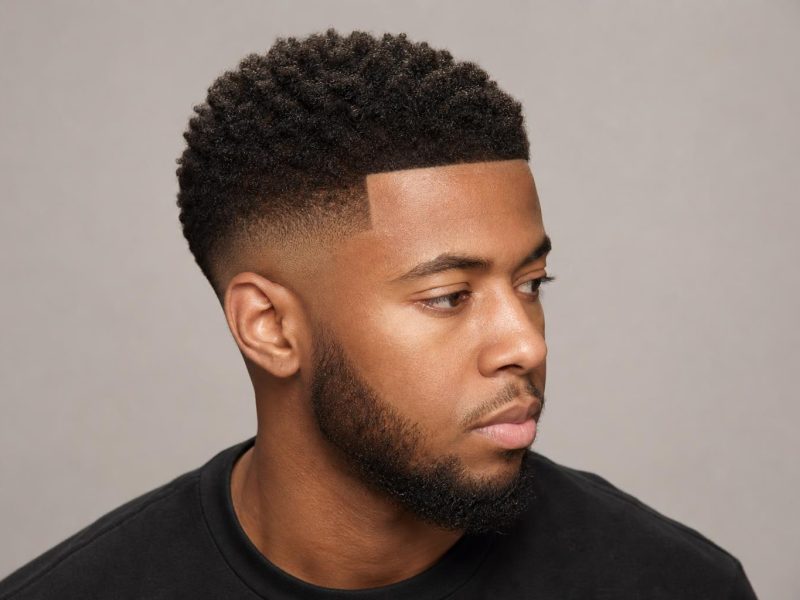
The sides shorten gradually just above the ear with no skin exposed, and about an inch of natural texture stays on top. It is the most conservative cut on this list and the easiest to maintain, stretching to five weeks between visits. Anyone starting from scratch should try this before anything sharper.
2. Mid Fade with Two Inches of Coil
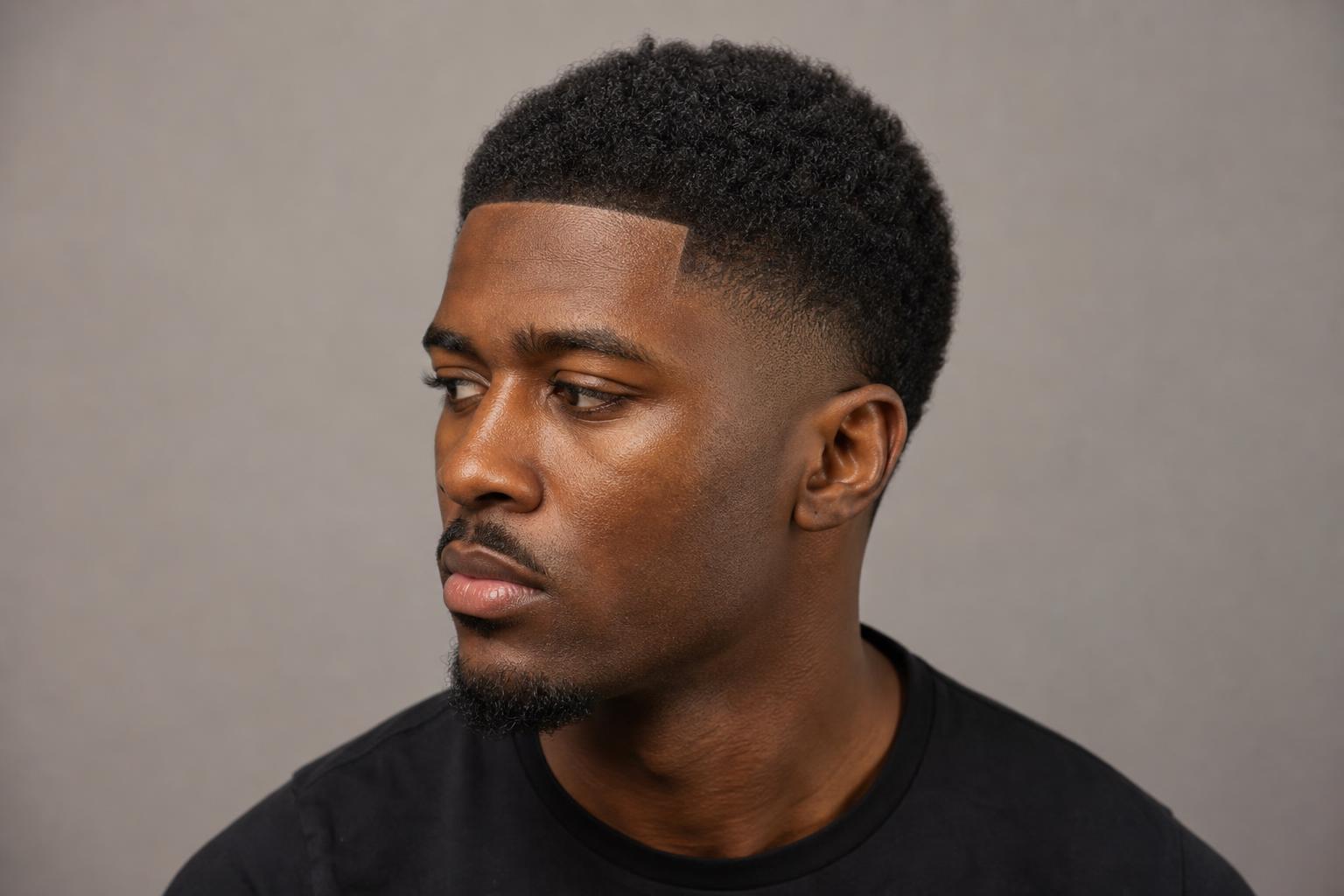
Blending from the temple downward puts the boundary at eye level, which suits most face shapes without committing to high contrast. The technical detail behind a mid fade on type 4 hair covers why shrinkage makes guard numbers read shorter here than on straight hair. Two inches is enough coil to define with a sponge.
3. High Skin Fade with a Flat Top Edge
Nearly the whole side goes to skin, leaving a defined block of texture up top with a squared-off upper edge. Round faces gain the most, since removing width at the widest point pushes the eye upward. This is the shortest maintenance cycle on the list at roughly two weeks.
4. Burst Fade Around the Ear
Rather than a horizontal line, the fade radiates in an arc around the ear and leaves weight at the back and nape. Curly and coily texture suits it because the curve follows the shape of the head under the volume. It also grows out less obviously than a straight-line fade.
5. Drop Fade with a Curved Line
The fade line arcs downward behind the ear, following the skull rather than cutting straight across it. Barbers who work primarily with scissors may call it a drop taper, so use both terms. It softens a square hairline without losing the sharpness of the blend.
6. Temple Fade with Length Kept at the Back
Only the corners at the temples are taken short, leaving the sides and back fuller. It removes the sparse patch that draws the eye when a hairline has started to recede at the corners, and there are more shapes built around a receding hairline if the recession has moved further back.
7. Bald Fade with a Sponge-Defined Top
Taking the blend to bare skin gives the maximum contrast against defined coils, and it is also the version most likely to irritate the skin along the fade line. Stopping at a zero guard delivers nearly the same look, and what a bald fade commits you to is worth reading before choosing skin over a zero.
8. Taper Fade with a Beard Connection
The fade runs down and joins the beard line rather than stopping at the jaw, so the head and face read as one continuous shape. It needs a barber comfortable with both, and it is worth asking directly whether they do beard work. The connection point is the detail that separates a good version from an awkward one.
Wave and Brush Patterns
Waves are built rather than cut: consistent brushing in one direction over a short, even length trains the coil to lie in a repeating pattern. The cut supports it by staying uniform, and the fade frames it. Patience is the requirement, since a visible pattern takes weeks of daily work.
9. 360 Waves with a Low Taper
The pattern runs all the way around the head with the taper keeping the outline clean without cutting into it. Ask for a single consistent guard on top rather than any tapering there, because uneven length breaks the wave. Brushing twice daily and covering at night is what builds it.
10. Waves with a Mid Fade
Raising the fade to the temple concentrates the visible pattern on the upper half of the head, which reads sharper than a full 360. It also means less surface area to maintain. The trade is that the pattern has fewer rows and needs to be crisp to work.
11. Short Waves on a Number 1
Starting the pattern at a very short length makes it appear faster, since less hair means less to train into place. It is the sensible entry point for anyone starting waves for the first time. Expect the first visible pattern within three to four weeks of consistent brushing.
12. Waves with a Squared Line-Up
A hard, squared hairline against a curved wave pattern creates deliberate contrast between the geometry of the edge and the movement of the top. Square jaws carry this best. The line-up is what dates quickly here, so it runs on a seven to ten day cycle.
13. Wave Pattern with a Burst Fade
Keeping weight at the nape while fading around the ear gives the pattern more room to run down the back of the head. Coarse 4a texture holds the definition longest under this arrangement. Use a medium-bristle brush rather than a soft one while the pattern is still forming.
Sponge Coils, Twists and Defined Texture
This group keeps the natural coil pattern and makes it deliberate, which is the direction most barbershop requests have moved. All of them need moisture rather than hold products, and all of them need covering at night.
14. Sponge Coils with a Mid Fade
A curl sponge worked in small circles over damp hair pulls the coils into defined uniform curls in about two minutes. Apply a leave-in first and work lightly, since pressing hard tangles rather than defines. It is the fastest route from a plain top to a finished-looking cut.
15. Short Two-Strand Twists Over a Taper
Twisting sections of two to three inches gives a defined, low-maintenance top that holds for a week or more while the sides stay clean. The twists and the fade run on separate schedules, so expect to visit for the sides while the top is still fine. Keep the front sections loose to avoid tension at the hairline.
16. Twist Out with Faded Sides
Twists installed, left overnight, then taken down to leave defined coils with more volume than a sponge produces. It takes longer to set and gives a softer, fuller result. Take them down on completely dry hair, since unravelling damp twists collapses the definition.
17. Short Starter Locs Above a Skin Fade
Locs in their early stage sit as defined coils on top with the sides taken tight, which keeps the shape controlled while the locs mature. The fade needs recutting far more often than the locs need retwisting. This is a long-term commitment on top and a fortnightly one at the sides.
18. Comb Coils with a Low Fade
A fine comb rotated at the root creates individual coils that are tighter and more separated than sponge work, and they last several days. It suits shorter lengths of around an inch and a half. This method takes longer than a sponge and produces a cleaner, more uniform result.
19. Curl Definition on Looser 3c Texture
Looser curl patterns define with a leave-in conditioner and finger coiling alone, without needing a sponge at all. The fade should be a taper rather than a skin fade, since a hard line against looser curl looks uneven within days. Air-dry rather than towel-drying, which disrupts the pattern.
20. Twists with a Temple Fade
Taking only the temples short leaves fullness through the sides so the twists read as part of a larger shape rather than sitting on a bare head. It is a softer option than a full fade and grows out more forgivingly. Useful if you want defined texture without high contrast.
Afros, Caesars and Clipper-Only Shapes
Not every cut needs a texture routine. These six rely entirely on the cut itself, which makes them the practical choice for anyone who wants a defined look with no daily work beyond moisturizing.
21. Short Rounded Afro with a Taper
Two to three inches of unaltered texture cut level all round, with the sides tapered so the shape stays deliberate. Cutting the top level is harder than it sounds on coily hair, because shrinkage hides unevenness until it dries. A pick used at the root builds height without disturbing the coil.
22. Caesar Cut with a Straight Front Line
Short all over with the front cut straight across, sitting high on the forehead. It is the most direct way to work with a high hairline and needs no styling at all. Modern versions soften the front line slightly so it does not read as severe.
23. Buzz Cut with a Sharp Line-Up
A single short guard over the whole head where the entire effect rests on the outline being cut precisely. It takes ten minutes in the chair and needs a visit roughly every three weeks. Scalp tone and head shape carry it, so try a number 2 before a number 1.
24. Box Cut with Squared Corners
The top is cut flat and the corners at the temples left square rather than rounded, producing a defined geometric shape. It needs enough density to hold the flat plane. Barbers may need the request spelled out, since rounding the corners is the default.
25. Low Fade with a Number 2 Top
A very short uniform top over a gradual fade, giving a clean look with no product and no routine. It is the lowest-effort cut in this article by a clear margin. Knowing which guard corresponds to which length makes this cut easy to repeat at any shop.
26. Frohawk with Tapered Sides
The center strip is left full while the sides are taken short, concentrating volume in a vertical band. It narrows the head visually and suits round faces. Related shapes in the mohawk and fade family vary mainly in how hard the sides are taken.
Parts, Designs and Detail Work
Detail work sits on top of any of the cuts above and is what most people notice first. It also carries the shortest lifespan, since razored lines blur within about ten days. Treat these as an addition to a cut rather than a cut in themselves.
27. Hard Part Above the Temple
A single razored line roughly an inch and a half long, breaking the top into two masses and adding an angle. It pairs with almost any fade here. Keep it short, since a long hard part starts competing with the rest of the cut for attention.
28. Curved Design Along the Fade Line
A shaved pattern following the arc of a burst or drop fade, which emphasizes the curve rather than adding a separate element. Simple curves age far better than complex geometry as they grow. Ask the barber to keep the lines wide enough to stay legible for a week.
29. Line-Up with a Squared Hairline
The forehead and temple corners cut to right angles rather than following the natural curve, which is the sharpest finish available. It is worth being cautious here, because each squaring takes a fraction of hairline that does not return. Ask the barber to follow your existing line rather than straightening it.
30. Faded Design with a Beard Line
A shaved detail near the temple carried down into a defined beard edge, tying the two together. It needs both skills from the same barber and looks unbalanced if only one side is precise. This is the highest-maintenance combination in the article at roughly ten days.
The Three Building Blocks
Reduced to their parts, every cut above is a fade choice, a top choice and a line-up choice. The fade sets the contrast: low for conservative, mid for balanced, high or skin for maximum. The top sets the character: buzzed, natural, sponge-defined, twisted or loc’d. The line-up sets the finish: soft and following your natural hairline, or squared and geometric.
Deciding those three separately is more useful than picking a style name, because names travel badly between shops while the three variables do not. A barber who hears “mid fade, sponge coils on top about two inches, line-up following my natural hairline” knows exactly what to do without ever needing the style called anything.
What to Tell Your Barber
Name the three, then add whether the beard connects. A complete request sounds like this: “Mid fade starting at the temple, take it to a zero rather than skin, leave about two inches on top and I will sponge it, line-up following my natural hairline, and keep the beard separate.” That is fifteen seconds and it removes every guess.
Stylist tip: ask for the fade to be checked with your hair fully dry and your head upright before you leave the chair. Coily hair compresses while damp from a spray bottle and springs back as it dries, so unevenness that was invisible during the cut appears the next morning. Standing up and looking from both sides costs thirty seconds and catches most problems while they can still be fixed.
Guard numbers travel better than descriptions. If you liked a previous cut, the numbers used are more useful than any photograph, because shrinkage means a length in inches means something different on your hair than on the head in the picture. Write them down after a cut you liked and you will never have a bad first appointment at a new shop.
Maintenance
The mistake that makes these cuts feel expensive is treating the fade and the line-up as one appointment. They run on different clocks, and most shops charge considerably less for a line-up alone.
| Element | Frequency | Notes |
|---|---|---|
| Line-up | 7 to 10 days | Softens well before the fade does; book it alone |
| Skin or high fade | 2 weeks | Contrast disappears fastest at this height |
| Mid fade | 2 to 3 weeks | The most forgiving of the fade heights |
| Low taper | 4 to 5 weeks | No hard line to grow out |
| Moisturize the top | Daily or alternate days | Coily hair loses moisture along the shaft fastest |
| Night covering | Every night | Required for waves, twists and sponge definition |
Stylist tip: if you are building a wave pattern, brush at the same two points in the day rather than whenever you remember. The pattern trains through repetition at consistent intervals, and irregular brushing produces an irregular pattern. Morning and evening, five minutes each, beats twenty minutes once.
When These Cuts Do Not Work
The architecture suits most heads, and a few situations argue for something different.
- Recurring razor bumps along the fade line or jaw. Coarse coils cut to skin can grow back into the skin, so stop at a zero guard and skip the line-up entirely during a flare.
- A schedule that cannot absorb a shop visit every two to three weeks. A low taper with a natural top holds for five weeks and is the honest alternative.
- Thinning at the crown. A high-contrast fade against a sparse top emphasizes the difference; specific shapes built around a thinning crown manage the contrast deliberately.
- Scalp scarring or uneven pigmentation at the temple. A mid or high fade takes hair shortest exactly where that sits, putting it on display.
- Wanting waves without the brushing commitment. A wave pattern takes weeks of twice-daily work to appear and fades quickly without it; sponge coils give a defined look in two minutes a day instead.
FAQ
What Are the Best Short Hairstyles for Black Men?
The most versatile combinations are a mid fade with two inches of sponge-defined coil, a low taper with a short natural afro, and a skin fade with short twists. Each pairs a fade height with a top texture and a line-up, which are the three variables that define every cut in this category. Start with a low taper if you are unsure, since it is the most forgiving on both upkeep and appearance.
How Do I Get Waves in My Hair?
Brush consistently in one direction over a short, even length, twice a day, and cover your hair at night with a durag or satin bonnet. Ask your barber to keep the top at a single uniform guard rather than tapering it, because uneven length breaks the pattern. A visible pattern usually appears within three to four weeks of daily brushing on hair cut to a number 1 or 2.
What Is the Difference Between a Fade and a Taper?
A fade blends from longer down to very short or bare skin over a large area of the side, while a taper shortens the hair gradually only around the ears and neckline and leaves the sides largely intact. The practical difference is upkeep: fades need recutting every two to three weeks while a taper holds for four or five. Tapers also grow out with no visible line.
How Often Do I Need a Line-Up?
Every seven to ten days, which is roughly twice as often as the fade itself needs attention. Most shops charge much less for a line-up alone, so booking the two separately keeps the cut sharp without paying for a full fade every week. Ask your barber to follow your natural hairline rather than squaring it further each time.
Do Sponge Coils Work on All Hair Types?
A curl sponge works best on 4a through 4c texture, where the coils are tight enough for the sponge to catch and define. Looser 3c curls define better with a leave-in conditioner and finger coiling. Use the sponge on damp hair with a leave-in applied first, and work lightly, since pressing hard tangles the hair rather than defining it.
Should I Get a Skin Fade or Stop at a Zero Guard?
A zero guard is the safer default on coarse coily hair, because cutting to bare skin leaves a sharp hair tip that can curl back into the skin and cause raised bumps. The visual difference between the two is minimal at conversational distance. Try a zero first and move to skin at a later appointment if you want more contrast.
Which Short Cut Needs the Least Maintenance?
A low taper with a short natural top, which holds its shape for four to five weeks and needs nothing beyond moisturizing. Anything with a skin fade, a wave pattern or a squared line-up runs on a much shorter cycle. The general rule is that the sharper the cut looks on day one, the sooner it needs redoing.
Short hair black men hairstyles come down to three decisions rather than thirty style names: how high the fade goes and whether it finishes at skin, what texture stays on top, and how sharp the line-up is. Decide those separately, give your barber the guard numbers rather than a description, and book the line-up on its own schedule. Write down the numbers from a cut you liked and you will be able to repeat it anywhere.
Hair results vary based on your natural hair type, texture, density, and condition. Always consult with a licensed hairstylist before making significant changes, especially with chemical treatments or dramatic length changes. Photos may show styled results that require professional tools and products to replicate.