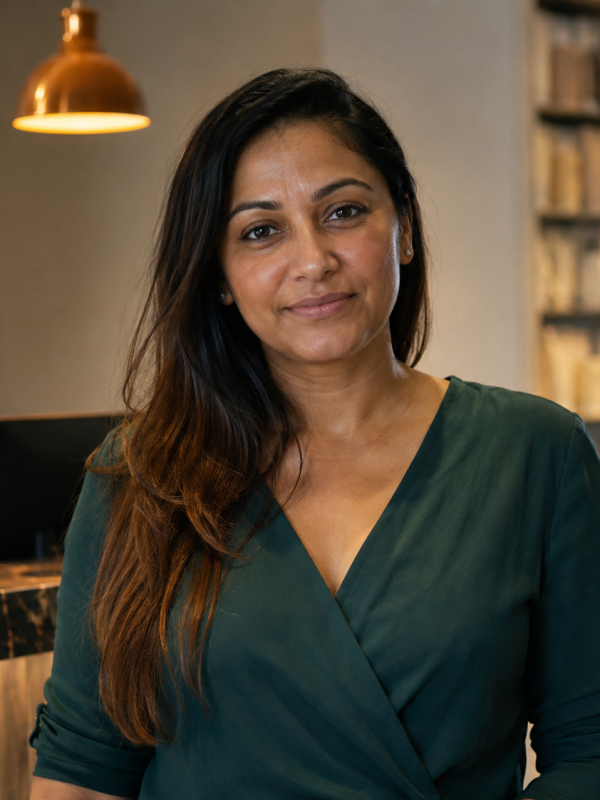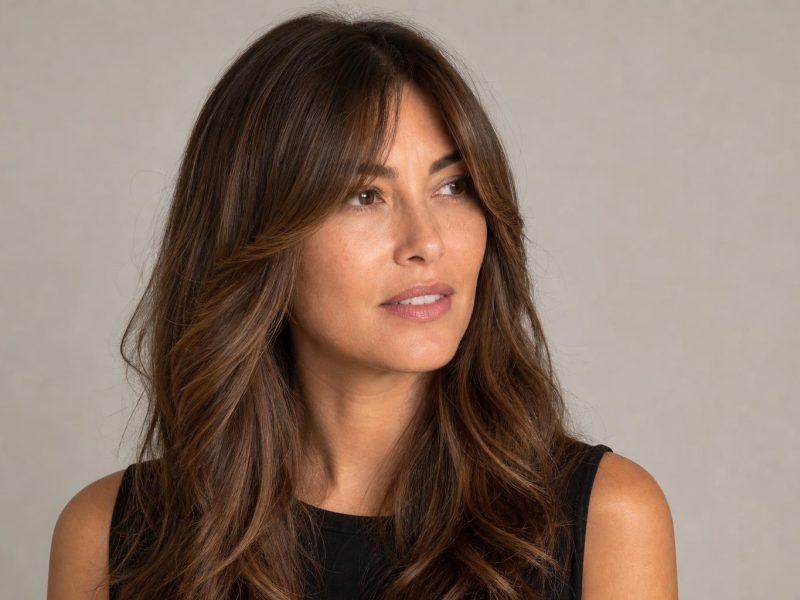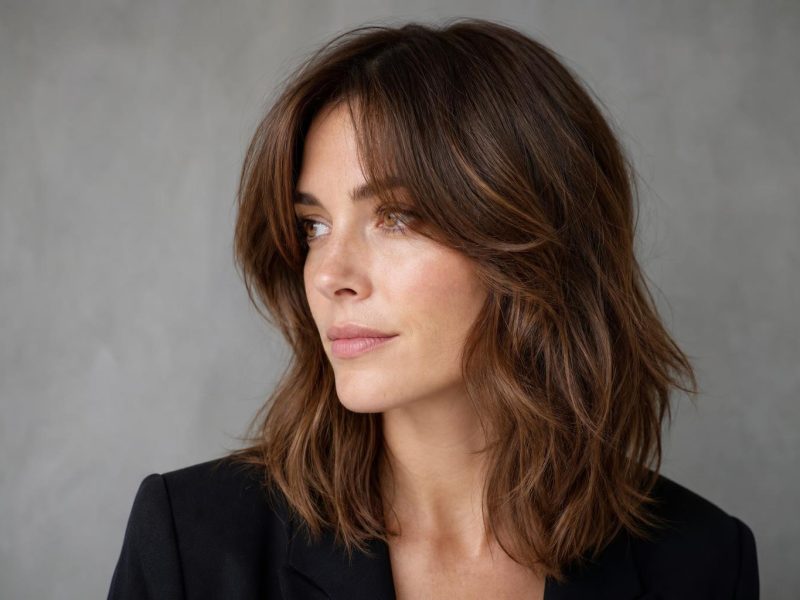


Curtain bangs are defined by one measurement: the shortest point sits at the center, between the eyes, and every piece gets longer as it moves outward toward the face.
That single rule is what separates them from a blunt fringe, which is cut level, and from a side-swept fringe, which is longest on one side only. It also explains why they suit almost every face shape and grow out without an awkward stage: the outer pieces are already long enough to blend into face-framing layers, so there is never a length that looks wrong. Below are 30 versions grouped by hair length and then by texture.
The gallery runs from curtain bangs on short cuts and bobs through medium and long lengths, then covers the adjustments each texture needs. After the entries you will find where the shortest point should sit for your face shape, the round-brush technique that takes about ninety seconds, the wording to use at the salon, and a realistic account of growing them out.
| Factor | Details |
|---|---|
| Defining feature | Shortest at the center, lengthening outward on both sides |
| Shortest point | Between the eyebrow and the cheekbone, depending on face shape |
| Best for | Almost every face shape; the most forgiving fringe available |
| Styling | 90 seconds with a small round brush, drying away from the face |
| Trim frequency | Every 6 to 8 weeks, longer than any other fringe |
| Grow-out | Blends into face-framing layers with no awkward stage |
Curtain Bangs on Short Cuts and Bobs
At short lengths the bangs and the cut have to be planned together, because there is not much length behind them to absorb the transition. The shortest center point usually needs to sit higher than it would on long hair, and the outer pieces blend directly into the perimeter rather than into layers.
1. Curtain Bangs on a Chin-Length Bob
The center sits at the brow with the sides sweeping to the jaw, so the fringe merges into the bob’s own line. Straight and slightly wavy hair holds this cleanly. Ask for the outer pieces to finish exactly where the bob does, which is what stops the fringe reading as a separate element.
2. Soft Curtain Fringe on a French Bob
A shorter, above-the-chin bob paired with a light split fringe gives a softer alternative to the blunt fringe usually worn with this cut. It suits round and heart-shaped faces particularly well. Keep the fringe thin, since a heavy version overwhelms a short bob.
3. Curtain Bangs with a Pixie Grow-Out
If you are growing out a pixie, cutting the front into a curtain shape gives the awkward stage a deliberate front while the back catches up. The center point should sit high, around the eyebrow. It buys several months of a cut that looks intentional rather than in transition.
4. Curtain Fringe on a Textured Lob
Point-cut ends on both the fringe and the perimeter mean the two blend without a visible boundary. Thick hair benefits, since the texturizing removes the weight that would otherwise make the fringe sit heavily. This is the most forgiving short-hair version on grow-out.
5. Wispy Curtain Bangs on a Blunt Bob
A very light fringe against a hard perimeter line creates a deliberate contrast between soft and sharp. Fine hair suits it because the fringe uses very little density. On thick hair the same request needs substantial thinning or the softness disappears.
6. Curtain Bangs with an A-Line Bob
The forward angle of an A-line and the outward sweep of the fringe run in the same direction, which reinforces the line toward the face. It works on straight and wavy hair. Tight curls lose the angle to shrinkage and do better with a rounded shape.
7. Short Shag with a Split Fringe
The layering of a shag continues straight into the fringe, so there is no separate bang section at all. It is the lowest-maintenance version here, since growth simply lengthens the layers. Texturizing spray on damp hair is the entire routine.
Curtain Bangs on Medium Length
Medium length is where curtain bangs work best, because there is enough length behind them for the outer pieces to blend into layers rather than stopping abruptly. This is also the range where the fringe does the most for the face, framing the cheekbones with the length still able to tie back.
8. Classic Curtain Bangs on a Layered Lob
Center at the brow, sides to the cheekbone, blending into layers that start at the same height. It is the most-requested version of this cut and the safest starting point for anyone new to bangs. Ninety seconds with a round brush is all it needs daily.
9. Curtain Bangs with a Modern Shag
The fringe and the shag layering form one continuous shape with no break between them, which is why the two are so often cut together. Wavy hair fills the layers without styling. Trims every eight to ten weeks keep the spacing from blurring.
10. Long Curtain Bangs to the Chin
Cutting the outer pieces down to chin level makes the fringe more of a face-framing feature than a fringe, which suits anyone nervous about the commitment. It can be tucked behind the ears and disappears entirely. This is the version to ask for on a first attempt.
11. Curtain Bangs with a Deep Side Part
Moving the part off-center makes one side of the fringe noticeably heavier than the other, adding asymmetry that suits round faces. Check where your hair naturally splits before committing, since a part cut against your growth needs resetting daily. The fringe follows the part rather than the other way around.
12. Feathered Curtain Bangs
Heavier point cutting through the fringe produces separated, feather-like pieces rather than a smooth sweep. Coarse and thick hair carries this well. It reads as more relaxed than a smooth curtain and forgives an uneven blow-dry.
13. Curtain Bangs on a Butterfly Cut
The short face-framing layers of a butterfly cut begin at the fringe and continue down, giving the impression of much shorter hair while the length stays underneath. Growth returns you to a straightforward layered shape. The fringe is what makes the two layer lengths read as deliberate.
14. Curtain Bangs with a Middle Part
The fringe splits exactly on the center parting and sweeps symmetrically, which suits oval and heart-shaped faces where symmetry is already the strength. Straight hair holds the split; wavy hair needs a moment with the dryer to set it. Keep the shortest point at the brow rather than higher.
15. Curtain Bangs on a Collarbone Cut
A simple one-length cut at the collarbone with the front sections carved into a curtain, adding movement to an otherwise plain shape. It is the least committal way to change a long-standing cut. Nothing behind the front sections is touched, so density is preserved.
Curtain Bangs on Long Hair
On long hair, curtain bangs solve a specific problem: length worn one-length with no fringe hangs as two flat panels either side of the face. The fringe breaks that panel and gives the front some structure without shortening anything. Anyone with a lot of length to manage gets more from this cut than from any other small change.
16. Long Curtain Bangs with Face-Framing Layers
The fringe continues into progressively longer front layers so the whole face-framing section reads as one graduated sweep. It is the standard long-hair version and grows out invisibly. Ask for the shortest piece at the cheekbone and the longest at the collarbone.
17. Curtain Bangs with Very Long Straight Hair
Mid-back length worn straight with a curtain fringe as the only shaping, which keeps the length intact while breaking the flat panel at the front. It suits fine hair, where layering elsewhere would remove needed density. A trim every eight weeks maintains the fringe alone.
18. Bardot-Style Curtain Bangs
Heavier and fuller than a modern curtain, with more density taken into the fringe and a soft bend at the ends. It needs thick hair to look full rather than sparse. This version reads as more done, which is either the appeal or the reason to skip it.
19. Curtain Bangs with Long Layers
Long internal layers through the length with the fringe starting the graduation at the front. Thick hair particularly needs the layering, since dense long hair without it builds outward. Ask for weight removed from the interior rather than layers cut into the surface.
20. Curtain Bangs on a Long Shag
Layers running from the cheekbone down through the full length, with the fringe as the shortest point of a continuous system. Wavy and curly textures suit it. It is one of the few long cuts that never reads as a flat curtain from the front.
21. Grown-Out Curtain Bangs Worn Tucked
Once the fringe passes the cheekbone it can be worn tucked behind the ears entirely, functioning as face-framing rather than as a fringe. Many people settle here permanently and never trim back to a true curtain. It is the most flexible stage of the cut.
22. Curtain Bangs with Long Hair and a Center Part
The parting runs from the hairline through the fringe so the two halves are symmetrical and fall away evenly. Straight coarse hair holds this most easily. Fine hair may need a light texturizing spray at the root to stop the fringe collapsing flat.
Curtain Bangs by Hair Texture
Texture changes how the fringe is cut, not whether it works. The principle across all of them is that curl and density move the shortest point downward, because hair that springs up or sits heavily needs more length to fall correctly.
23. Curtain Bangs on Fine Hair
Keep the fringe light and take very little density into it, since a heavy fringe on fine hair strips the rest of the front. The shortest point can sit as high as the brow because there is no weight pulling it down. A dry texturizing spray at the root holds the shape better than any cream.
24. Curtain Bangs on Thick Hair
Weight has to come out of the interior of the fringe or it sits as a solid block rather than sweeping. Ask for internal thinning underneath the surface, not thinning shears across the top. The shortest point should sit at or below the cheekbone to let the weight work with the sweep.
25. Curtain Bangs on 2b to 2c Waves
Waves supply the outward bend on their own, which is exactly the direction a curtain fringe is meant to go, so this texture needs the least styling of any. Cut slightly longer than the target to allow for the wave lifting it. Air-drying works; a dryer is optional rather than required.
26. Curtain Bangs on 3a to 3b Curls
Cut dry, curl by curl, because a curly fringe cut wet will sit an inch or more higher once it springs back. The shortest point should be judged at resting length rather than stretched. Curl-specific shapes like the curly wolf cut and its layer placement follow the same rule for the same reason.
27. Curtain Bangs on 3c Curls
Tighter curls need the fringe cut noticeably longer, since shrinkage is more severe and the sweep has to survive it. Leave the outer pieces at chin length or below. A leave-in conditioner applied to soaking hair defines the fringe better than anything applied later.
28. Soft Fringe on Coily Type 4 Hair
A true curtain shape is difficult above 4a, since shrinkage is too severe for a predictable sweep, but a shaped front section that frames the face achieves a similar effect. Judge the length stretched rather than shrunken. Perimeter shaping does the work that layering would do on looser textures.
29. Curtain Bangs on Coarse Straight Hair
Coarse hair holds a cut line cleanly and resists the outward bend, so the sweep usually needs a round brush daily or a light perm to set it. Without one the fringe falls straight down as a center-parted panel. The cut itself is the easiest part on this texture.
30. Curtain Bangs on Hair with a Front Cowlick
A cowlick at the hairline pushes the fringe in one direction regardless of intention, and the fix is to cut with that direction rather than against it, which usually means an asymmetric curtain. Point out the cowlick before anything is cut. Fighting it means restyling every few hours and losing.
Where the Shortest Point Should Sit
The center length is the one decision that changes how the fringe interacts with your face, and it moves depending on what you want the fringe to do. Higher shortens the visual length of the face; lower softens width at the cheeks. If you have not established which category you fall into, measuring your face shape takes about two minutes.
| Face Shape | Shortest Point | Outer Pieces | Why |
|---|---|---|---|
| Oval | Brow to cheekbone | Jaw or below | Nothing needs correcting; choose by preference |
| Round | Cheekbone or lower | Below the jaw | Longer pieces create vertical lines that narrow the face |
| Square | Cheekbone | Past the jaw, softly layered | Soft outward sweep breaks up a strong jawline |
| Oblong | At the brow | Cheekbone | A higher fringe shortens the visual length of the face |
| Heart | Brow to cheekbone | Jaw, with weight kept low | Covers forehead width and adds fullness near the chin |
| Diamond | At the brow | Jaw or below | Adds width at the forehead where the face is narrowest |
How to Style Them in Ninety Seconds
Work on damp rather than soaking hair, and dry the fringe first before anything else, because once it dries in the wrong direction nothing will fully correct it. Take a small round brush, roughly one inch, and dry the fringe away from your face, brushing it back and toward the side rather than downward. When you release it, the hair falls forward and the bend it took on the brush becomes the outward sweep.
Stylist tip: use a small barrel rather than a large one. An oversized round brush cannot create a tight enough bend in a short section, so it flattens the fringe or over-curls the ends into a roll. A one-inch barrel is the right scale for a fringe, even if you use something much larger for the rest of your hair, and this single mismatch is behind most complaints that curtain bangs will not hold.
A blast of cool air at the end sets the shape, which matters more on fine hair that drops within an hour. Skip product on the fringe itself; anything applied there adds weight and pulls the sweep flat. If you want more hold, a very light mist of hairspray on the brush rather than on the hair works better. The broader technique for building direction at the root is covered in the guide to doing a blowout at home.
What to Tell Your Stylist
Name three things: where the shortest point should sit, where the outer pieces should finish, and how much density to take into the fringe. A complete request sounds like this: “Curtain bangs, shortest point at the cheekbone, outer pieces down to the jaw blending into my layers, and keep them light rather than heavy.”
Stylist tip: ask for the fringe to be cut longer than your target on the first appointment. Curtain bangs can always be taken shorter at the same visit, and going too short is a three-month wait rather than a fix. Any stylist who cuts to the exact target immediately, particularly on curly or wavy hair, is skipping a step that costs them thirty seconds and you a season.
Say how much time you will spend on them. A fringe cut for someone who blow-dries daily and one cut for someone who air-dries are different cuts, with the air-dry version usually needing more length and more texturizing so it falls acceptably without help. This is the sentence most people leave out.
Growing Them Out
Curtain bangs are the easiest fringe to grow out, which is a large part of their appeal. Because the outer pieces are already long, the fringe simply becomes face-framing layers as it lengthens rather than passing through a stage where it sits awkwardly in the middle of the forehead. Most people find the transition takes three to four months and never looks unfinished.
Two habits help. Ask your stylist to soften and blend the fringe into your lengths at each appointment rather than trimming it back to the original line, which speeds the transition without a visible step. And use a deep side part or tuck the front behind one ear during the middle weeks, which hides the point where the fringe is longest but not yet blended. Trim frequency during a grow-out drops to zero for the fringe itself while the rest of the cut continues on its normal schedule, which is covered in the general guidance on how often different lengths need cutting.
When Curtain Bangs Do Not Work
This is the most broadly flattering fringe available, and a few situations still argue against it.
- Very fine hair at the front with visible thinning at the temples. Taking density into a fringe removes it from where it is already scarce.
- Type 4 coils. Shrinkage is too severe for a predictable sweep, and a shaped face-framing section achieves more than a true curtain shape.
- A strong front cowlick you are unwilling to work with. The cowlick decides the direction, and cutting against it means restyling several times a day.
- Anyone who will not blow-dry and has coarse straight hair. That texture will not take the outward bend on its own, so the fringe falls as a flat center-parted panel.
- Very short cuts where there is no length behind the fringe for the outer pieces to blend into. The short cuts that need least upkeep mostly avoid a fringe for this reason.
FAQ
What Exactly Are Curtain Bangs?
A fringe cut so the shortest point sits at the center, between the eyes, with every piece getting progressively longer toward the sides of the face. That shape is what makes them sweep outward and part in the middle. It also means the outer pieces are already long enough to blend into face-framing layers, which is why they grow out without an awkward stage.
Do Curtain Bangs Suit Every Face Shape?
They suit more face shapes than any other fringe, and the adjustment is where the shortest point sits rather than whether to have them. Round faces do better with the center at the cheekbone or lower so the longer pieces create vertical lines; long or oblong faces want the center higher, at the brow, to shorten the face visually. Only the placement changes.
How Do I Ask My Stylist for Curtain Bangs?
Specify three things: where the shortest point should sit, where the outer pieces should finish, and how light or heavy you want them. Say something like “shortest at the cheekbone, outer pieces to the jaw blending into my layers, kept light.” Ask for them cut longer than your target on the first attempt, since they can be shortened at the same appointment but not lengthened.
How Do You Style Curtain Bangs?
Dry the fringe first, while the rest of your hair is still damp, using a one-inch round brush and drying away from your face rather than downward. Release the section and the hair falls forward with the outward bend already set. Finish with cool air and skip product on the fringe itself, since anything applied there weighs the sweep flat.
How Often Do Curtain Bangs Need Trimming?
Every six to eight weeks, which is considerably longer than a blunt fringe needs at three to four weeks. Because the shape is graduated rather than a straight line, growth softens it rather than ruining it. Many salons trim a fringe alone between full appointments for a small charge.
Do Curtain Bangs Work on Curly Hair?
They work well on 2b through 3b patterns and need cutting dry so the stylist can see where each curl rests, since a wet cut lands an inch or more too short. Cut the fringe longer than the target to allow for shrinkage, and keep the outer pieces at chin length or below on tighter curls. Above 4a a shaped face-framing section works better than a true curtain.
Are Curtain Bangs Hard to Grow Out?
They are the easiest fringe to grow out, because the outer pieces are already long enough to read as face-framing layers as the whole section lengthens. The transition takes about three to four months and never passes through an obviously awkward stage. Ask your stylist to blend the fringe into your lengths at each appointment rather than trimming it back.
A curtain bangs haircut succeeds on two measurements: where the shortest point sits at the center and where the outer pieces finish. Pick the center height from your face shape rather than from a photo, ask for them cut longer than your target on the first attempt, and use a one-inch round brush drying away from your face. Everything else about this fringe is forgiving, including growing it out.
Hair results vary based on your natural hair type, texture, density, and condition. Always consult with a licensed hairstylist before making significant changes, especially with chemical treatments or dramatic length changes. Photos may show styled results that require professional tools and products to replicate.