

After 70 the question is not which cut looks best in the salon chair, it is which cut still looks right at 7 a.m. after a towel and a comb.
Wash and wear haircuts for over 70 are cuts that dry into their finished shape on their own, which in practice means a strong perimeter line or built-in layers, a length that does not need a round brush, and weight placed where the hair has thinned rather than where it has not. Hair changes in this decade in ways that make the over-60 advice slightly wrong: white hair grows in coarser and wirier, the crown thins faster than the sides, and cowlicks that were manageable at 55 push harder now. The 30 cuts below are built around those changes and sorted by how much you actually do in the morning.
The gallery opens with cuts that need nothing but a towel, moves through bobs that want one product and a comb, then air-dry layers and lobs, and finishes with cuts for curly, wavy and coarse white hair. After it you get a plain explanation of why some cuts air-dry well and others never will, a table matching cuts to the specific concerns that show up after 70, the words to use with your stylist, a list of situations where wash and wear is the wrong promise, and a maintenance schedule that assumes you would rather visit the salon every 10 weeks than every 5.
| Factor | Details |
|---|---|
| Best for | Fine or thinning hair, coarse white hair, natural wave or curl, anyone who does not want to hold a dryer up |
| Core rule | The cut supplies the shape; the most you add is one product on damp hair |
| Morning time | 0 to 5 minutes, no heat tools |
| Avoid if | You want a smooth, set, salon-finish look every day; that needs a dryer or rollers no matter the cut |
| Salon visits | Every 6 to 8 weeks for pixies, 8 to 12 weeks for bobs and layers |
Towel-and-Go Pixies and Crops for Women Over 70
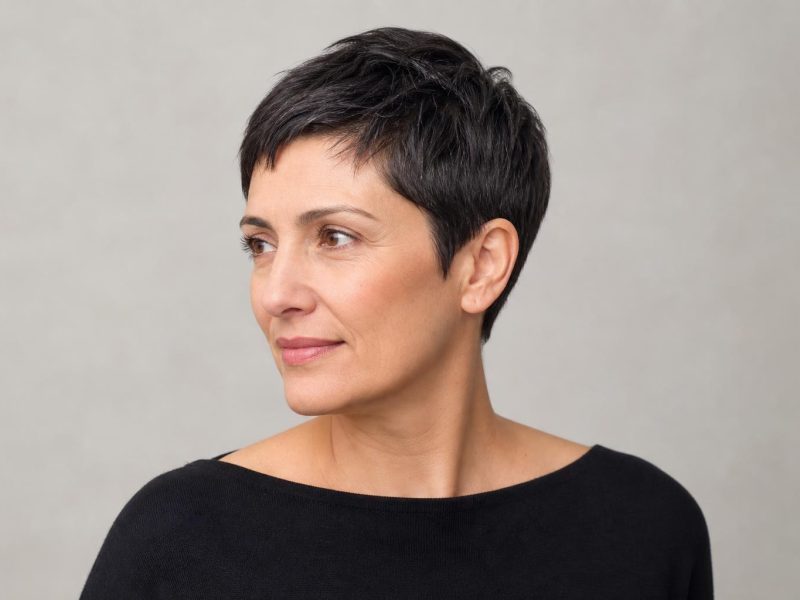
Short cuts are the purest form of wash and wear, because there is not enough length to fall wrong. The catch after 70 is that a pixie exposes the crown, which is exactly where hair thins first, so every cut in this section keeps length or layers over the crown and takes the weight off the nape and sides instead. Most of these dry in under 10 minutes and need a fingertip of product at most.
1. Layered Pixie with Length Left Over the Crown
The top is left two inches long and layered so it falls forward and covers the crown, while the nape and sides are tapered close with scissors. Thinning at the crown disappears under the forward layers without any backcombing.
2. Soft Cropped Pixie for a Round Face
Round faces gain length from a crop that stays flat at the sides and lifts slightly at the front hairline. The sides are cut close over the ears and the fringe is swept to one side at eyebrow level. Fine white hair holds this shape without product because the short sides cannot fall out of place.
3. Wispy Pixie for Very Fine Hair
Very fine hair after 70 looks best with the ends point-cut into soft wisps rather than blunt, because a blunt edge on sparse hair shows the scalp through it. The cut is short all over with wispy pieces at the nape, temples and fringe. Nothing to do in the morning except run damp fingers through it.
4. Pixie with a Deep Side Part and No Product
Comb a deep part on the heavier side while the hair is damp and let it dry where it lands, which is the whole routine. The deep part throws the longer top across the crown and covers a thin spot better than a center part ever will. Ask for the part to be cut in so the hair falls there on its own.
5. Cropped Cut That Grows Out for 10 Weeks
Salon trips stretch to 10 weeks on this crop because it is cut with graduated layers rather than a hard outline, so it does not develop a visible grow-out line. The length is around two inches on top and an inch at the sides. It gets slightly softer every week rather than suddenly looking overdue.
6. Silver Pixie with a Clear Gloss
Coarse white hair on a short cut can look dull and wiry, and a clear gloss at each salon visit smooths the cuticle so the silver reflects light instead of absorbing it. The cut is a classic short pixie with a little height at the front. Between visits a violet-toned shampoo once a week keeps the white from yellowing.
7. Brushed-Back Pixie for a Strong Cowlick
Tell your stylist “cut with the cowlick, not against it” and ask for the front to be left long enough to brush straight back over the crown. Cowlicks at the front hairline strengthen as hair coarsens, and a cut that pushes everything backward turns the cowlick into the style. A damp comb-through and it stays.
8. Longer Pixie with a Side Sweep for Glasses
Compared with a fringe that lands on the frames, a side-swept front piece cut to the cheekbone clears glasses and hearing aids and still softens the forehead. The rest is a pixie with the sides tapered but not shaved, so the hair over the ears lies flat against the arms of the glasses. Dries into place in 10 minutes.
One-Product Bobs for Women Over 70
A bob air-dries well when the perimeter is strong and the length is short enough that the ends cannot flip in two directions. Chin to jaw is the sweet spot after 70, because the hair is short enough to dry straight and long enough to cover the neck and jawline. One product on damp hair, a light cream or mousse, and a wide-tooth comb are all these need.
9. Chin-Length Blunt Bob on White Hair
One straight perimeter cut at the chin gives fine white hair a thickness it does not have, because every end lands at the same line. Comb it straight from a center or side part while damp and it dries flat and even.
10. Jaw-Length Bob with a Soft Face Frame
Square jaws and strong chins soften under a bob whose front pieces are cut a half inch shorter than the back and angled inward. The frame draws the eye to the cheekbones rather than the jawline. A pea of smoothing cream on the ends stops the front pieces flicking outward as they dry.
11. Rounded Bob for Thick Coarse Hair
Thick hair that has turned wiry with age needs internal weight removed or a bob dries into a triangle, so this version has the bulk thinned from underneath with point cutting while the outer layer stays intact. The outline is rounded at the nape. It dries smooth and full instead of wide.
12. Stacked Bob That Lifts a Flat Crown
Comb the back upward with your fingers while it is damp and the graduated stacking at the nape holds that lift as it dries. Stacking is the wash-and-wear answer to a crown that has gone flat with age, because the shape is cut in rather than blown in. Front length stays at the jaw.
13. Bob with a Wispy Fringe That Hides the Hairline
Upkeep on this one means a fringe trim every 4 to 5 weeks, which most salons do free between appointments, while the bob itself runs 8 to 10 weeks. The wispy fringe covers a hairline that has thinned or receded at the temples, and the wisps dry soft rather than in a hard line. Our gallery of hairstyles over 60 with bangs has more fringe options that suit a mature hairline.
14. Gray-Blended Bob with Natural Dimension
Women still coloring at 70 often find a chin bob is the easiest place to stop, because the length is short enough that grown-out roots become the style within three or four months. A stylist can speed the transition with lowlights that match the incoming gray, and gray blending on dark hair makes the middle stage painless.
15. Angled Bob That Clears the Collar
Ask for “an angled bob, shorter at the back, longest at the chin, clearing the collar so it does not flip.” Hair that touches a collar or scarf all day flips outward by afternoon, and a back cut above the collar stays put. The forward angle keeps the softening length at the face.
16. Wavy Bob Left to Air-Dry
Unlike the smooth bobs above, this one is cut a little longer at the jaw with light layers so a natural wave dries into soft bends rather than being combed flat. Scrunch a light mousse into damp hair and leave it alone. Wave that appeared or strengthened with age is an asset here, not something to fight.
Air-Dry Layers, Shags and Lobs for Women Over 70
Length past the jaw can be wash and wear, but only when layers do the shaping. A one-length lob on fine hair dries limp and a one-length lob on coarse hair dries wide, so every cut in this section has movement built into it. These need a leave-in conditioner and a wide-tooth comb, then time. Expect 20 to 40 minutes of air-drying, which is fine over breakfast.
17. Soft Shag with Layers Starting at the Cheekbone
Layers that begin at the cheekbone and run to the collarbone give fine hair the appearance of double its density, because every layer creates its own edge. The shag dries with movement whether the hair is straight or wavy. It is the cut stylists reach for most on thinning hair over 70, and our roundup of short shaggy haircuts over 60 shows how far it can be shortened.
18. Collarbone Lob with a Center Part for an Oval Face
Oval faces can carry a simple collarbone lob with a center part and long face-framing layers without any of the corrective angling other shapes need. The length is enough to tuck behind the ears or tie back on a day when even air-drying feels like effort.
19. Layered Lob for Coarse White Hair
Coarse white hair at lob length needs weight taken out through the mid-lengths with slide cutting so it dries soft rather than stiff, and a hydrating leave-in every wash to keep the cuticle down. The layers are long and blended, not choppy. This is the length at which wiry white hair looks its best, because the weight of the hair helps it lie down.
20. Wispy Layered Cut with Side-Swept Bangs
Style it by combing the bangs to the side while damp and leaving everything else to fall. The layers are wispy and point-cut through the ends, and the side bangs cover the forehead without needing a round brush.
21. Shoulder-Length Layers for a Long Face
Long and oblong faces gain width from layers that flare at the cheekbone and a side part that breaks the vertical line. The cut is shoulder-length with the shortest layer at the cheek and a soft side fringe. Air-dried with a little mousse at the roots it adds fullness exactly where a long face needs it.
22. Razor-Cut Layers That Grow Out for 12 Weeks
Salon visits every 12 weeks are realistic on a razor-cut layered shape, because razored ends have no hard line to grow out of. The layers are cut through the whole length for a feathery finish. Razor cutting is only right for medium and coarse hair, since it removes too much from fine strands.
23. Long Layers with a Low-Maintenance Silver Blend
Silver, white and steel-gray strands mixed through shoulder-length layers look like expensive highlights, and they are free. A clear gloss every second salon visit and a violet shampoo weekly keep the mix bright. The layers keep the length from dragging the face down, which is the main risk of long hair after 70. The silver hair guide covers how to keep the tone clean.
24. Mid-Length Cut Tied Back Without a Hard Line
Ask for “collarbone length, long layers, and a soft face frame that still looks finished when it is tied back.” Many women over 70 wear hair up more days than down, and a cut with face-framing pieces looks styled in a low clip with no other effort.
Wash-and-Wear Cuts for Curly, Wavy and Coarse White Hair Over 70
Natural texture is the best friend of wash and wear, and after 70 many women find they have more of it than they did, because coarser white hair holds a wave it never held before. The cuts here are made for that hair. They are all cut dry or checked dry so the stylist sees where the curl actually lands, and all of them use a leave-in as the only product.
25. Curly Pixie Cut Dry to the Curl
Cutting curls dry lets the stylist see each curl at its resting size, which is the only way a curly pixie comes out the right length. The cut is short at the nape and sides with two to three inches of curl on top.
26. Curly Bob at the Jaw for a Heart Face
Heart-shaped faces with a narrow chin benefit from curl volume landing at the jaw, which is where a chin-length curly bob puts it. Curls are cut in long layers so they stack rather than triangle. Wash, leave-in, air-dry, no touching until it is fully dry, which is the rule for curls at any age. There are 25 more in our gallery of hairstyles for women over 60 with curly hair.
27. Wavy Shag for Hair That Went Wavy With Age
Hair that turned wavy as it turned white is common and often unwelcome, because a cut made for straight hair now dries in odd bends. A wavy shag with layers from the cheekbone down turns those bends into the style. Scrunch damp hair with a light mousse and let it dry however it likes.
28. Coarse White Hair in a Softened Crop
Wiry white hair stands up on its own, which is a problem on a smooth style and a gift on a textured crop. The crop is cut short with the ends point-cut so the coarse texture looks deliberate rather than untidy. A leave-in on damp hair softens it enough to lie in one direction.
29. Soft Curl Bob Grown Out From a Perm
Trims every 8 weeks keep a permed bob soft as the perm relaxes, and the layered cut means the growing-out roots blend rather than showing a straight band. The bob is cut just below the chin with long layers so the curl falls in loose spirals. Leave-in and air-dry only, because heat flattens a perm fast.
30. Shoulder-Length Waves With a Deep Side Part
Unlike the shorter wavy cuts, this one keeps enough length that the wave forms full bends, and a deep side part gives the flatter side a lift it would not have with a center part. Long layers keep the ends light. It dries in about 40 minutes with a leave-in and is the longest cut in the gallery that still qualifies as wash and wear.
Why Some Cuts Air-Dry Well After 70 and Others Never Will
A cut is wash and wear when its shape comes from where the hair is cut, not from how it is dried. Blunt perimeters, graduated stacking, layers that start at a specific point, and lengths short enough to fall in one direction are all shapes the scissors create. A smooth rounded bob with turned-under ends, a full bouffant crown, or a sleek straight lob on hair that wants to bend are shapes the dryer creates, and they cannot be made wash and wear no matter how good the cut.
Three changes after 70 tip that balance. White hair has a different cuticle structure and grows in coarser, which makes it stand away from the head and resist lying flat, so cuts that rely on smoothness get harder and cuts that use texture get easier. The crown and the front hairline lose density before the sides and back do, so weight has to move to the top. And the arms get tired holding a dryer overhead, which is the honest reason most women in this decade want a cut that dries itself. The general wash-and-wear haircuts for over 60 still apply in principle, but the specific cuts shift shorter on top and softer at the ends.
Stylist tip: Bring a photo of your hair the way it dries when you do nothing to it, not just a photo of the cut you want. A stylist who sees your cowlicks, your natural wave and where the hair thins can cut a shape that works with them. A stylist who only sees the inspiration photo cuts a shape that needs a dryer to copy it.
Matching the Cut to the Concern
The concerns that drive haircut decisions after 70 are specific and mostly unaddressed in galleries aimed at younger women. This table pairs each with the cut features that solve it.
| Concern | Cut feature that solves it | Avoid |
|---|---|---|
| Thinning crown | Forward layers left long over the crown, stacked graduation at the back, deep side part | Center parts, very short crown layers, slicked-back styles |
| Receding or sparse hairline | Wispy fringe or side-swept bangs, soft face-framing pieces | Hair pulled straight back, blunt fringe that shows gaps |
| Coarse, wiry white hair | Weight removed internally, textured or point-cut ends, jaw length or longer, regular clear gloss | Blunt one-length cuts, razor cutting, very short sides that stick out |
| Cowlick at the front or crown | Cut in the direction the cowlick grows, longer over the cowlick, brushed-back or side-swept front | Straight fringes across a front cowlick, short crown over a crown cowlick |
| Glasses and hearing aids | Sides tapered flat over the ears, fringe cleared to the side or above the frames | Full fringes at the eyebrow, bulk over the ears |
| Tired arms, limited reach | Short or stacked cuts that dry in shape, one product applied with hands | Any cut that needs a round brush or rollers |
| Infrequent salon visits | Graduated or razored shapes without a hard line, layered bobs, shags | Blunt bobs and short pixies, which show grow-out by week 5 |
What to Tell Your Stylist
Say “wash and wear” at the start and then say what it means for you, because stylists hear it from clients who still blow-dry daily. A clear version sounds like “I towel-dry and comb, no dryer, so I need a cut that dries into shape on its own. My crown is thinning and I have a cowlick here, and I want to come in every 8 to 10 weeks.” Then name the length you want in inches or by a landmark such as chin, jaw or collarbone. If you have white hair that has gone coarse, say so, and ask whether a gloss would help.
Two questions to ask before the cut starts: where the shortest layer will land, and whether the cut will look right if you do nothing at all. If the answer to the second one is “with a bit of blow-drying,” it is not the cut you asked for. It also helps to ask how the cut will look at week 8, since a good stylist plans the grow-out as part of the shape.
Stylist tip: Ask the stylist to let the cut air-dry in the chair for five minutes before the final check, or at least to check the crown and cowlick areas dry. A cut that is only ever seen wet and blow-dried has never actually been tested as wash and wear.
When Wash and Wear Is Not the Right Promise
A few hair situations cannot be made effortless by a cut, and it is better to know before the appointment than to be disappointed after it.
- Very fine, very straight hair that you want to look full. Air-dried fine hair lies flat, and the only genuine fix is a short stacked cut or three minutes with a dryer at the roots. Choose one, because a longer cut will not give you both.
- Hair you want smooth and set every day. A polished, turned-under look is a styled look. A wash-and-wear cut can be tidy and soft, but it will not be sleek.
- Curl or wave you dislike. Wash and wear means letting the texture show. If you plan to straighten it, the cut needs to be designed for straightened hair instead, which is a different shape.
- Hair loss that is patchy or sudden rather than gradual thinning. That needs a doctor before a stylist, and a cut can only work around it, not fix it.
- A pixie on a scalp that burns easily. Very short cuts expose the scalp to sun, and a hat becomes part of the routine, which some women would rather avoid with a slightly longer cut.
Maintenance and Styling
Wash and wear does not mean no upkeep, it means the upkeep moves from the bathroom to the salon and happens less often. These are honest numbers for someone who washes two or three times a week and does nothing with heat.
| Cut | Salon visit | Morning routine | Products | Grow-out |
|---|---|---|---|---|
| Pixie or crop | Every 6 to 8 weeks | Towel, fingers, 1 minute | Optional fingertip of light paste | Shape softens from week 6, nape gets untidy first |
| Blunt or angled bob | Every 8 weeks | Comb through damp, 2 minutes | Smoothing cream on the ends | Perimeter stays clean to week 8, then flips at the collar |
| Stacked bob | Every 6 to 8 weeks | Finger-lift the back while damp, 2 minutes | Light mousse at the roots | Stacking loses lift after week 7 |
| Shag or layered lob | Every 10 to 12 weeks | Leave-in, comb, air-dry, 3 minutes of effort | Leave-in conditioner, mousse if wavy | Graceful; layers blend as they grow |
| Curly cut | Every 10 to 12 weeks, cut dry | Wet, scrunch, leave alone, 2 minutes | Leave-in, light gel or mousse | Curls hide grow-out almost completely |
Product choice narrows to three things after 70: a hydrating leave-in for coarse or curly hair, a light mousse for fine hair that needs body at the root, and a clear gloss or violet shampoo for white hair that yellows. Heavy oils and serums coat white hair and turn it dull, and strong-hold sprays make coarse hair crunchy, so both stay on the shelf. If the wash-day question is how far apart to space trims, the answer changes by cut, and our guide to how often to cut hair gives the numbers for each.
FAQ
What Is the Best Wash and Wear Haircut for a Woman Over 70?
A layered pixie with length left over the crown, or a chin-length bob with a strong perimeter, is the safest choice for most women over 70 because both dry into shape without a dryer and both cover a thinning crown. Which one wins depends on texture. Fine straight hair suits the bob, and coarse or wavy hair suits the pixie or a soft shag.
What Haircut Makes Thin Hair Look Thicker After 70?
A blunt chin-length bob makes fine hair look thickest at the ends, and a stacked or layered pixie makes it look thickest at the crown. Long hair does the opposite, because the weight pulls fine hair flat and the ends look sparse. A deep side part and forward layers over the crown add fullness where thinning shows most.
Should Women Over 70 Have Bangs?
Yes, if they are wispy or side-swept rather than blunt and full. A soft fringe covers a hairline that has thinned at the temples and softens forehead lines without needing a dryer. Blunt bangs need daily smoothing and show gaps on fine hair, so they are the version to skip.
How Do I Keep White Hair From Looking Yellow?
A violet-toned shampoo once a week and a clear gloss at every second salon visit keep white hair bright. Yellowing comes from mineral deposits, product buildup, sun and smoke, so a clarifying wash every month helps too. Use the violet shampoo only weekly, because more often leaves a lavender cast on very white hair.
Can I Have Long Hair Over 70?
You can, and collarbone to shoulder length with long layers is the longest that stays easy to air-dry. Past the shoulder, fine hair looks sparse at the ends and coarse hair gets heavy, and both drag the face downward. Keep layers through the length and a soft face frame, and tie it back on the days it is not cooperating.
Why Does My Hair Feel Coarser Now Than It Used To?
White hair grows in with a thicker, rougher cuticle and less natural oil than pigmented hair, so it feels wiry even when the strand is fine. It also often carries a wave it did not have before. A hydrating leave-in every wash, a clear gloss at the salon, and a cut that uses texture rather than fighting it are the three things that make it manageable.
How Often Should a Woman Over 70 Get a Haircut?
Every 6 to 8 weeks for pixies and stacked bobs, and every 8 to 12 weeks for layered bobs, shags and curly cuts. Shorter cuts show grow-out at the nape first, and layered shapes blend as they grow. Choosing a graduated or layered cut over a blunt one is the single easiest way to stretch the time between visits.
The best wash and wear haircuts for over 70 are the ones that account for what hair actually does in this decade: thinner at the crown, coarser as it whitens, wavier than it was, and less willing to hold a blow-dried shape. Take one photo from this gallery and one of your own hair dried naturally, tell the stylist how long you want to go between visits, and ask to see the cut dry before you leave. A cut that looks right with nothing done to it is the only real test.
Hair results vary based on your natural hair type, texture, density, and condition. Always consult with a licensed hairstylist before making significant changes, especially with chemical treatments or dramatic length changes. Photos may show styled results that require professional tools and products to replicate.