
Which twist you can get is decided by how many inches you have on top, not by which photo you bring in.
Comb coils start working at about an inch and a half, two-strand twists need roughly three inches to hold a rope shape, and anything that swings or hangs needs five or more. Below are 25 twist styles for men sorted by the length each one actually requires, so you can find the ones your hair can do today rather than the ones it could do in four months.
The gallery moves from cropped comb coils up through mid-length two-strand twists and long hanging twists, then covers the fade and taper pairings that change the silhouette more than the twists themselves do. After the styles you will find the length requirements laid out side by side, the exact language to use at the barber, a retwist calendar with realistic weeks, and an honest look at where twists cross over into starting locs.
Short Twists Under Three Inches
Short hair twists as single strands rather than as pairs, which is why almost everything in this range is a comb coil or a sponge twist. The hair is too short to wrap around itself, so a comb or a twist sponge does the rotating and the natural coil pattern holds the shape. Definition here comes from the curl pattern itself, which means tighter type 4 hair actually performs better than looser texture at this length.
1. Cropped Comb Coils With a Clean Line-Up
A rattail comb rotates each small section clockwise against the scalp until it locks into a coil, and at an inch and a half the coils sit up rather than lying down. Sharp corners at the temples and a straight front line keep the top looking deliberate instead of unfinished. Ask for the line-up first and the coils second, because a barber cannot square the hairline once the coils are set.
2. Sponge Twists on a Short Afro
Rotating a twist sponge in small circles over damp hair drags each section into a spiral, which produces dozens of even coils in about ten minutes. Coarse type 4a to 4c hair grips the sponge holes best; looser curl patterns slip and end up uneven. It is the fastest route to defined texture on a two-inch afro and needs no skill beyond keeping the pressure light.
3. Micro Coils With a Shadow Taper
Sections about the width of a pencil eraser create coils so small they read as heavy texture rather than as separate pieces. Round and full faces get the most from this pairing, because the shadow taper keeps the sides tight and pushes the visual weight upward. The whole effect depends on precise, even sectioning, so this is worth paying a barber for the first time.
4. Twist Sponge Coils on Color-Treated Hair
Lightened tips catch the light along the outer curve of each coil, which makes short twists look considerably deeper than a single flat color does. Honey and caramel tones sit best on darker natural hair without needing more than one lift. Bleached ends are also drier ends, so a leave-in on the twists every other day stops the coils fraying at the tips.
5. Coily Twists With a Sharp Beard Connection
Running the taper down into a lined-up beard turns the twists and the facial hair into one continuous shape, and the eye reads the whole thing as intentional grooming rather than as a hairstyle sitting on top of a face. Longer and narrower faces benefit most, since the connected line adds width at the jaw. Expect a barber visit every two weeks to keep the connection clean, which is more often than the twists themselves need.
6. Starter Coils for a Loc Journey
Coils set at this length are how most locs begin, and the difference between a style and a commitment is whether you comb them out at the end of the week. Tell your barber or loctician which one you mean, because the sectioning pattern for locs is planned to last years and the sectioning for a one-week style is not.
Mid-Length Two-Strand Twists, Three to Six Inches
Three inches is where two-strand twisting becomes possible, and it is the length most of the styles people picture actually live at. Two sections of hair wrap around each other into a rope, and the weight of that rope is what makes the twist lie down and stay put. This range also gives you the most options, because the twists are long enough to have direction and short enough to hold their shape without support.
7. Classic Medium Two-Strand Twists
Two even sections rotate around each other from root to tip, and at four inches the finished rope has enough weight to fall rather than stick out. Sections about the width of a fingertip give the balance most men are after between definition and coverage. Damp hair with a light twisting cream holds far better than dry hair with gel.
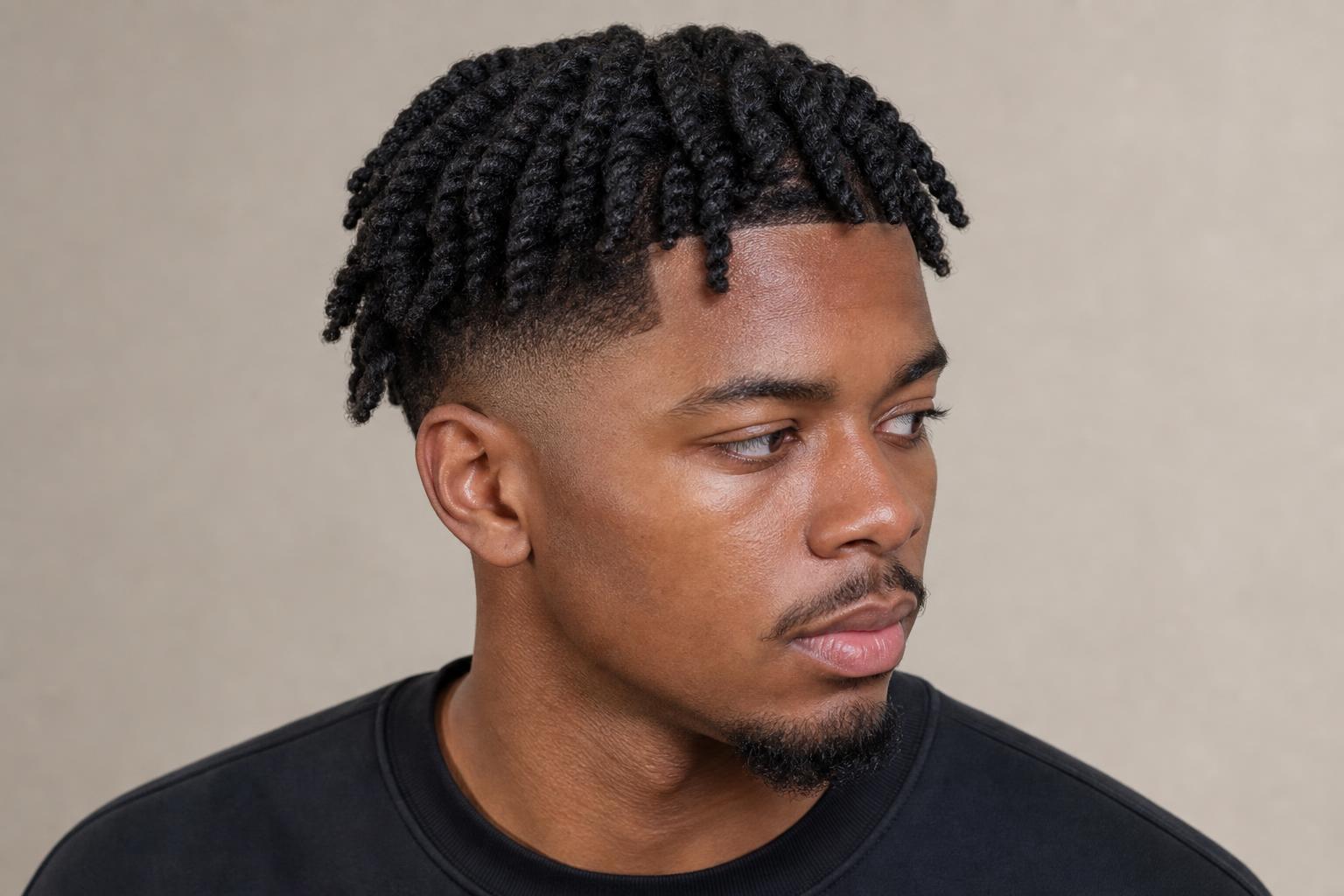
8. Chunky Twists With Visible Parts
Larger sections mean fewer twists, and the scalp between them becomes part of the design rather than something to hide. Square and angular faces carry the geometry well, since the straight parting lines echo a strong jaw. Fewer, thicker twists also install in under half an hour, which is the practical argument for them.
9. Twists With a Middle Part
Splitting the top down the center and twisting each half away from the parting creates symmetry that suits an oval or long face by adding width across the temples. The part has to be genuinely straight to work, so ask the barber to comb it in before any twisting starts.
10. Flat Twists Along the Crown
Flat twisting keeps each rope attached to the scalp as it travels, the way a cornrow does, but with two strands instead of three. The technique is faster than braiding and gives a softer surface, though it also loosens sooner. Anyone who already wears cornrow patterns and knows the parting language will find the same vocabulary works here.
11. Twist-Out for Loose Defined Texture
Unravelling a set of twists once they are fully dry leaves the wave pattern behind without the rope structure, giving volume and definition at the same time. Four to five inches produces the best stretch, and the result lasts two or three days before it needs re-setting. Separate the unravelled sections with your fingertips rather than a comb, which would erase the pattern entirely.
12. Twists With Auburn or Copper Tips
Color placed only on the last inch or two follows the rope down and highlights the twist direction, which reads as depth rather than as a dye job. Warm copper and auburn shades hold better on type 4 hair than ash tones, which tend to pull brassy. Refreshing the tips every eight to ten weeks keeps the contrast without lifting the same hair repeatedly.
13. Twists Under a Durag Set Overnight
Tying a satin durag over freshly installed twists for the first night flattens the roots, smooths frizz and sets the direction each twist falls in. Skipping it is the single most common reason twists look messy on day two rather than day ten. Keep using it nightly and a set that would last two weeks stretches closer to four.
14. Twists With a Hard Part
A razored line cut into the side gives a crisp edge that contrasts with the soft texture of the twists, and the effect is much stronger on medium-length twists than on short coils. Compared to a middle part, which splits the whole top, a hard part is a single line that breaks the shape without reorganizing it. The line needs recutting roughly every two weeks.
Long Twists Past Six Inches
Past six inches the twists start to hang, and hanging changes everything about how the style behaves. Weight pulls the roots straighter, the twists swing when you move, and the whole silhouette gets longer. Length also means installation time climbs sharply, so most men in this range twist their own hair or accept a two-hour appointment.
15. Shoulder-Length Hanging Twists
At eight inches or more the twists hang past the jaw and move independently, which is a very different look from anything cropped. Denser hair carries the length better, because sparse hair at this length shows scalp between the ropes whenever they separate. The weight also means each twist needs to be a little thicker or it will unravel from the bottom.
16. Long Twists Pulled Into a Bun
Gathering hanging twists into a high bun keeps the length off your neck and turns the twists into visible texture rather than a curtain. Use a fabric-covered elastic rather than anything with a metal clasp, and keep it snug rather than tight, since long twists are heavy and the weight already pulls at the hairline.
17. Half-Up Twists With the Rest Down
Taking the top and crown twists back while leaving the sides hanging opens up the face, which suits heart and diamond shapes by putting width at the jaw instead of the forehead. The style also solves the practical problem of twists falling forward when you look down.
18. Twists With Length Kept and Ends Trimmed
Long twists hide split and thinning ends so effectively that many men do not notice the damage until they unravel them. Ask your barber to dust the ends before installing, which costs almost no length and stops the twists fraying from the tip upward. The general trim intervals in our guide to how often to cut hair by length and goal apply here even when the hair is in a protective style.
19. Long Twists Over a Faded Back
Keeping full length on top and through the crown while fading the back and sides gives a strong vertical shape without the width that long hair usually adds. Whether the fade sits high, mid or low changes the whole balance, and the comparison in our collection of high fade haircuts and how to ask for one shows where each height lands.
20. Free-Hanging Twists Left to Mature
Left alone for months, long twists begin to knit at the roots and eventually become locs whether or not that was the plan. Some men want exactly that, and the styles that come out of it are covered in our guide to freeform locs and natural growth. If you do not want it, twists need combing out every four to five weeks without exception.
Twists Paired With Fades and Tapers
The fade underneath does more work than most men expect. Twists on their own read as texture; twists over a clean fade read as a haircut. Height is the main variable, and it changes the proportions of your face far more than the size of the twists does. Everything in this section works at any length from the sections above.
21. Twists With a Low Taper Fade
Dropping the fade low, just above the ear, keeps most of the density on the sides and gives the softest transition into the twists on top. Round faces do best here, because keeping side volume avoids the wide, flat look a high fade can produce. Our gallery of low fade haircuts and what to ask for covers where the line sits on different head shapes.
22. Twists With a High Skin Fade
Taking the sides to skin well above the temple creates maximum contrast, so the twisted section reads as a distinct block sitting on top. Longer faces should approach this one carefully, since the vertical stack adds height. Skin fades also grow out fastest, needing a barber every seven to ten days to stay sharp.
23. Twists With a Burst Fade Behind the Ear
A burst fade curves around the ear in a semicircle and leaves the back weight intact, which lets long twists at the back stay full while the sides stay tight. Ask specifically for a burst rather than a drop fade; the two sound similar and produce very different back profiles.
24. Twists With a Temple Taper Only
Tapering just the temples and the nape while leaving the sides full is the lightest possible cleanup, and it suits men growing their hair out who still want the front to look sharp. Growth is forgiving, so six weeks between visits is realistic rather than optimistic.
25. Twists With a Drop Fade and Lined Neck
A drop fade follows the curve of the head downward behind the ear, so the shortest point sits lower at the back than at the front. Paired with a blocked or tapered neckline, the result frames the twists from below and keeps the outline tidy from the back, which is the angle you never check and everyone else sees.
How Much Length Each Twist Type Needs
Length is the gatekeeper for every style above. Measure the hair on top when it is stretched straight, not as it sits, because type 4 hair shrinks by half or more and most men underestimate what they have.
| Twist Type | Minimum Stretched Length | Install Time | Best Curl Pattern |
|---|---|---|---|
| Sponge twists | 1 inch | 10 to 15 minutes | Type 4a to 4c; slips on looser curl |
| Comb coils | 1.5 inches | 30 to 60 minutes | Type 4, where the coil holds itself |
| Flat twists | 2.5 inches | 45 to 90 minutes | Type 3c to 4c |
| Two-strand twists | 3 inches | 1 to 2 hours | Type 3c to 4c |
| Twist-out | 4 inches | Overnight set plus 10 minutes | Type 3b to 4b |
| Hanging twists | 6 inches and up | 2 to 3 hours | Any type 4, denser is better |
What to Tell Your Barber
Walking in and asking for twists leaves too much open, because the four decisions that shape the result are all made before any twisting starts. Name the twist type, the section size, the fade height and whether you are keeping them long term, and the appointment goes the way you pictured it.
- “Two-strand twists, sections about the width of my index finger, on damp hair with a twisting cream.”
- “Low taper fade, starting just above the ear, and leave the top full.”
- “Line up the front and the temples before you start twisting.”
- “These are a style, not starter locs, so I will be combing them out in three weeks.”
Stylist tip: Bring two photos rather than one, and pick a second that shows the back of the head. Barbers can read the twist size and the fade height from the front shot, but the neckline and the back fade are where most disappointments actually happen.
Maintenance and the Retwist Calendar
Twists are a protective style, which means the hair is meant to be left alone, but the roots still need attention on a schedule. Loosening starts at the root and works downward, so a retwist restores the parts and the definition without redoing the whole head.
| Task | How Often | Notes |
|---|---|---|
| Durag or satin cap overnight | Every night | The single biggest factor in how long a set lasts and how much lint it collects |
| Light oil or leave-in on the lengths | Every 2 to 3 days | Keeps the ropes soft; heavy butters cause buildup inside the twist |
| Scalp cleanse with diluted shampoo | Weekly if you train, otherwise every 10 to 14 days | Apply to the scalp only and rinse gently so the twists stay intact |
| Retwist the roots | Every 3 to 4 weeks | Only the new growth; retwisting the full length repeatedly thins the roots |
| Take down and comb out | By week 4 to 5 | Past this point shed hair starts matting at the root and takedown gets destructive |
| Fade or taper touch-up | 7 to 10 days for skin, 2 to 3 weeks for taper | Independent of the twists; the fade is what looks untidy first |
Stylist tip: Retwist damp, never soaking and never bone dry. Soaking hair swells and the twist loosens as it dries; dry hair needs so much product to grip that the roots end up coated. A spray bottle and a lightweight cream is the whole toolkit.
Twists as Starter Locs Is a Different Commitment
Two-strand twists are one of the standard ways to begin locs, which means the same style can be a three-week look or a three-year decision depending only on what you do next. The physical difference shows up around week five, when shed hair that would normally comb out begins knitting into the twist at the root. Once that knitting is established, combing out means significant loss, so the choice quietly stops being reversible.
Decide before the first install, and tell whoever is doing your hair, because sectioning differs between the two paths. A style can be parted freehand and redone differently next month, while locs need a deliberate grid you will live with for years. Men going the loc route should also expect a budding and frizzing stage in months three to six that looks worse than the starting twists did, and men who are not should put a comb-out date in the calendar. Everything about the longer-term version, including how the shape develops, sits in our overview of wicks and thicker loc formations.
When Twists Are Not the Right Call
Twists suit most type 4 and tighter type 3 hair, but there are situations where they will not deliver and forcing them causes damage. Check this list against your own hair before booking.
- Straight or loosely wavy hair. A twist holds because the curl pattern grips itself, and type 1 and 2 hair simply unwinds within an hour regardless of product. Textured cuts hold shape better on that hair, and our gallery of men’s haircuts sorted by curl type covers what works where.
- A receding or thinning hairline. Twists pull at the follicle continuously for weeks, and the front hairline is where that shows first. Larger sections and a lower-tension install reduce the risk, but a fade with loose natural texture is the safer choice if the line is already moving.
- Under three inches for two-strand twists. Short sections spring apart no matter how much gel is used. Comb coils or sponge twists do the same job at that length, and the hair is not fighting you.
- Daily helmets, hard hats or headgear. Constant friction on the same points flattens twists and works lint deep into them. A cropped fade holds up far better, and the options in our collection of short hairstyles for Black men are built for exactly this.
- No intention of a nightly routine. Twists worn without a durag or satin cap look rough by day three, which is not the style failing but the upkeep being skipped.
FAQ
How Long Does Hair Need to Be for Twists?
Two-strand twists need about three inches of stretched length, and comb coils or sponge twists work from roughly an inch and a half. Measure stretched rather than as it sits, because tightly coiled hair shrinks by half or more and a two-inch afro is often four inches of actual hair. If you fall short, sponge twists give you a defined twisted look immediately while you grow into the longer options.
How Long Do Men’s Twists Last?
A set typically holds two to four weeks with nightly protection, and stretches toward five with a root retwist in the middle. Smaller sections last longer than chunky ones because there is more contact holding each rope together. Past four or five weeks, shed hair starts matting at the root and takedown becomes damaging rather than routine.
Do Twists Damage Your Hair?
Not when they are installed loosely and taken down on schedule, and they generally protect hair by keeping it tucked away from friction. Damage comes from three specific habits: twisting too tightly at the root, retwisting the full length instead of just the new growth, and leaving a set in long enough for the roots to mat. Any soreness or small bumps along the hairline means the tension is too high and the set should come out.
Can I Wash My Hair With Twists In?
Yes, and you should if you train or work outdoors, but change how you do it. Dilute shampoo with water in a bottle, apply it directly to the scalp between the parts rather than scrubbing the twists, and rinse under low pressure while squeezing rather than rubbing. Dry with a microfiber towel by blotting, then let the twists air-dry fully before tying anything over them.
What Is the Difference Between Twists and Locs?
A twist is two strands wrapped around each other and it can be combed out; a loc is matted hair that cannot. Two-strand twists are one of the common starting methods for locs, so the same head of hair can be either depending on whether it is taken down or left to knit. The crossover happens around week five, which is why the comb-out deadline matters so much.
Are Twists Better Than Braids for Men?
Twists install faster and put less tension on the scalp, while braids last longer and hold a sharper pattern. For a two to three-week style with minimal commitment, twists win on time and comfort. For a month-long protective style that keeps crisp parts throughout, braids hold up better, and the parting language for both is much the same when you talk to a barber.
What Products Work Best for Men’s Twists?
A lightweight twisting cream or curl custard for the install, a light oil for the lengths afterward, and a diluted clarifying shampoo for the scalp. Avoid thick butters and heavy waxes, which build up inside the rope where you cannot see them and make takedown much harder. Anything that leaves a white residue when you rub it between your fingers is too heavy for twists.
The right twist hairstyle for men starts with an honest measurement of stretched length, then a decision about how long you plan to keep the set in. Match the twist type to what your hair can actually hold today, name the section size and fade height at the barber rather than just asking for twists, protect them nightly, and put a comb-out date on the calendar before the roots start matting. More options for pairing texture with a clean outline sit across our men’s haircuts collection.
Hair results vary based on your natural hair type, texture, density, and condition. Always consult with a licensed hairstylist before making significant changes, especially with chemical treatments or dramatic length changes. Photos may show styled results that require professional tools and products to replicate.