

Curl cream works on wavy hair when you use less than feels right and put it on wetter hair than feels right; most flat, frizzy wave days come from getting one of those two wrong.
Curl cream for wavy hair is a leave-in styler that softens strands, groups them into wave clumps and calms frizz, with little or no hold. On type 2A to 2C waves, a pea-sized to dime-sized amount per section, raked through soaking-wet hair and scrunched upward, is usually enough. Waves are looser and lighter than curls, so the full palmful that curly routines call for will pull a 2A or 2B pattern straight and leave the roots flat by lunchtime.
This guide explains what is in a curl cream and why it behaves differently on waves, how much to use by wave type and density, when to apply it wet versus damp, how it compares with mousse and gel, how to spot a heavy formula on the label, and how to fix waves that come out limp, greasy or frizzy.
| Factor | Details |
|---|---|
| What it does | Softens, clumps waves together, reduces frizz and flyaways |
| Hold | Light to none on its own; add mousse or gel for waves that drop |
| Best for | 2B and 2C waves, medium to thick density, dry or frizz-prone ends |
| Typical amount | Pea-sized per section on fine hair, dime-sized on medium, quarter-sized on thick |
| Avoid if | Fine 2A hair that already lies flat, or an oily scalp, unless you keep it to the ends |
What Curl Cream Actually Does on Wavy Hair
A curl cream is essentially a thick leave-in conditioner with a small amount of film-forming hold. Its conditioning ingredients are positively charged, so they cling to the negatively charged hair surface and cut the static that makes waves frizz. A review of hair cosmetics in the International Journal of Trichology describes exactly this mechanism for cationic conditioning agents, and leave-in products work the same way as rinse-out conditioners, just without the rinse.
The rest of a typical formula is humectants such as glycerin or aloe that attract water, emollients such as shea butter or plant oils that soften, and sometimes a light polymer for hold. Research summarized in Polymers shows that this conditioning film flattens the cuticle and reduces friction between strands, which is why waves look smoother and group into clumps instead of separating into fuzz. The same review notes that damaged hair holds more of that film, so bleached or heat-styled ends absorb more product than the healthier hair near the roots.
Here is the catch for wavy hair. Waves are an S-shape rather than a spiral, and they have much less internal spring than curls. Every drop of cream adds weight, and past a certain point that weight stretches the S-bend flat. Curly hair can carry a heavy cream and still coil, while a 2A wave often cannot.
Stylist tip: Rub the cream between your palms until your hands look almost dry before touching your hair. An emulsified thin layer spreads over far more strands than a blob, which is how a pea-sized amount covers a whole section without leaving one clump greasy.
How Much Curl Cream to Use by Wave Type
Amount depends on two things: how loose the wave pattern is and how much hair you have. A loose 2A wave on fine hair needs a fraction of what a thick 2C head needs, even at the same length. Split your hair into 4 sections for shoulder length, 6 for longer hair, and use the per-section amounts below as a starting point. If you are not sure which pattern you have, our curl type chart shows 2A through 2C side by side.
| Wave Type | Fine Hair | Medium Density | Thick Hair |
|---|---|---|---|
| 2A (loose, flat at the root) | Skip cream or use half a pea on the ends only | Pea-sized per section, mid-lengths down | Pea to dime per section |
| 2B (clear S-waves from mid-length) | Pea-sized per section, then mousse | Dime-sized per section | Dime to nickel per section |
| 2C (defined waves from the root, some loose curls) | Dime-sized per section | Nickel-sized per section | Quarter-sized per section |
Start at the lower amount for two wash days before adding more. Waves that dry soft, defined and still move when you shake your head mean the amount is right. Waves that dry flat at the top and heavy at the ends mean you used too much, even if the ends look nice.
Soaking Wet or Damp Hair Gives Different Results
Brands disagree on this, and both camps are partly right. Wave shape is set by weak hydrogen bonds inside the hair that break when hair is wet and re-form as it dries. Research on hair’s shape memory in the Biophysical Journal explains that these water-set shapes are temporary and depend on water breaking and re-forming those bonds. Whatever shape your waves hold while they dry is the shape they keep until the next wash or a humid day.
Soaking Wet Application Gives More Definition and Clumping
Applying cream to hair that is still dripping thins the product out, spreads it evenly and lets wave clumps form before any frizz can. It suits 2B and 2C waves that frizz easily and people who want clearly separated waves. The trade-off is a longer drying time and slightly less root lift.
Damp Application Gives More Volume with Less Definition
Towel-blotted hair takes the cream more slowly and holds more air between strands, so the finish is fuller and softer. This works better on fine 2A waves that go flat under any weight. If you apply to damp hair, use slightly less product, because there is less water to dilute it.
How to Apply Curl Cream to Wavy Hair
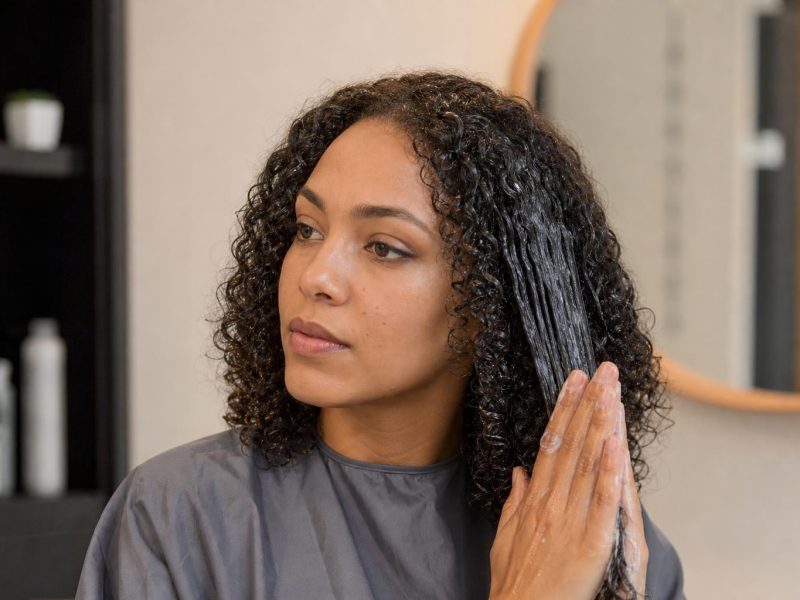
The method matters as much as the amount. Raking it in with your fingers spreads the product evenly, while scrunching pushes the S-shape back into the hair. Doing both, in that order, is what makes waves clump rather than fluff.
Step 1: Section While Hair Is Still Dripping
What you need: Wide-tooth comb or your fingers, 2 or 3 clips.
How: Skip the towel. Split hair into 4 to 6 sections straight out of the shower and flip your head to one side.
Why: Waves start forming as soon as you stop combing, and sectioning now means every part gets product before it dries.
Common mistake: Rubbing hair with a regular towel first, which roughs up the cuticle and breaks up clumps before they form.
Step 2: Rake the Cream from Mid-Length to Ends
What you need: Curl cream, emulsified between your palms.
How: Glide your fingers through each section from about ear level down to the ends, keeping the top 2 to 3 inches near the scalp product-free.
Why: Roots already get oil from the scalp. Keeping cream away from them preserves lift.
Common mistake: Starting at the roots, which is the fastest route to flat, greasy-looking waves by day two.
Step 3: Scrunch Upward Toward the Scalp
What you need: Clean hands.
How: Cup the ends in your palm and press them up toward the scalp for 2 to 3 seconds, then release. Repeat around the head until you hear a slight squish.
Why: Scrunching compresses the wave pattern so it sets in an S-shape as it dries.
Common mistake: Running fingers through again after scrunching, which separates the clumps you just formed.
Step 4: Add Hold if Your Waves Drop
What you need: A lightweight mousse or gel.
How: Scrunch a golf-ball-sized amount of mousse or a coin of gel over the cream while hair is still wet.
Why: Cream softens but rarely holds, so waves that fall out by noon need a hold layer on top.
Common mistake: Putting the gel under the cream; hold products work best as the final layer.
Step 5: Dry Without Touching
What you need: A cotton t-shirt or microfiber towel, and a diffuser if you blow-dry.
How: Blot excess water with the t-shirt, then air-dry or diffuse on low speed. Our guide on diffusing without frizz covers the hover-then-cup technique.
Why: Touching wet waves breaks the pattern while the hydrogen bonds are re-forming.
Common mistake: Brushing out a crunchy finish with a brush. If gel left a firm cast, scrunch it out with your hands once the hair is completely dry.
Curl Cream vs Mousse vs Gel for Waves
These three products are not interchangeable, and many wavy routines use two of them. Cream controls frizz and softness, mousse adds volume and light hold, and gel gives the strongest hold. Fine waves usually do better with mousse alone, while thick 2C waves often need cream plus gel.
| Feature | Curl Cream | Mousse | Gel |
|---|---|---|---|
| Hold | None to light | Light to medium | Medium to strong |
| Weight | Heaviest of the three | Lightest | Light once dry |
| Frizz control | High | Low to medium | High while the cast holds |
| Root volume | Reduces it | Adds it | Neutral |
| Best wave type | 2B to 2C, medium to thick | 2A to 2B, fine | Any wave that drops by midday |
| Layering order | First, after any leave-in | Over cream, or on its own | Last |
If you already own a full lineup of curl products, our breakdown of what each curly hair product does explains where leave-ins, oils and custards fit alongside these three.
How to Spot a Heavy Curl Cream on the Label
Ingredients are listed from highest to lowest concentration, so the first six or seven tell you most of what you need. Wavy hair does best with a formula where water, humectants and light conditioners lead and butters appear lower down.
- Light conditioners such as polyquaternium ingredients or behentrimonium chloride near the top soften and fight frizz without much weight.
- Humectants such as glycerin, aloe or panthenol attract water, which helps definition in moderate weather but can cause puffiness in high humidity.
- Butters and heavy oils such as shea butter, cocoa butter or coconut oil in the top five usually mean the cream is built for curls and coils, not waves.
- Silicones such as dimethicone smooth and add shine; they are fine on waves if you use a clarifying shampoo every 2 to 4 weeks to prevent buildup.
- Proteins such as hydrolyzed wheat or silk protein add a little structure, which helps fine or bleached waves that go limp.
Porosity shifts the picture too. High-porosity hair drinks in richer creams, while low-porosity waves leave product coating the surface and look greasy. A quick hair porosity test tells you which side you are on before you buy.
Fixing Waves That Come Out Wrong
Most problems with curl cream on wavy hair come down to amount, placement or the weather. Change one thing at a time for two wash days so you can tell which fix worked.
| Problem | Likely Cause | Fix |
|---|---|---|
| Waves flat at the top | Too much cream or product on the roots | Halve the amount and start at ear level |
| Greasy by day two | Butter-heavy formula or low-porosity hair | Switch to a lighter cream or use mousse only |
| Frizzy halo | Applied to hair that was too dry, or touched while drying | Apply on dripping-wet hair and leave it alone until dry |
| Waves gone by noon | No hold layer | Add mousse or gel over the cream |
| Crunchy or stiff | Gel cast left on | Scrunch the cast out once fully dry |
| Dull and coated after a few weeks | Product buildup | Clarifying shampoo every 2 to 4 weeks |
Humidity deserves its own mention. On sticky summer days, glycerin-heavy creams pull moisture from the air and waves swell into frizz. A cream with glycerin lower on the list, topped with a gel, holds up better. Our tips on fixing frizzy hair go deeper on weather-proofing.
When Curl Cream Is Not the Right Product
Curl cream is sold as the default styler for anything with texture, but some wavy hair is better off without it. If any of these describe you, try the alternative first.
- Fine 2A waves that lie flat at the root: any cream adds weight the pattern cannot carry, so a volumizing mousse scrunched in gives more wave.
- An oily scalp that needs daily washing: cream migrates toward the roots as you sleep, so a lightweight gel on the ends is easier to live with.
- Waves that only appear after a salt spray or braids: this usually means straight hair with a slight bend, and texture sprays suit it better.
- Very humid climates with glycerin-rich creams: the humectants make frizz worse, so choose a humectant-light formula or a gel-only routine.
- Hair coated from silicone-heavy products: adding cream on top compounds the buildup, so clarify first and then reintroduce products one at a time.
Stylist tip: If waves look good on the bottom half but straight on top, the problem is often the haircut rather than the product. Long, heavy one-length hair weighs the top waves flat, and no cream can fix that on its own.
What to Tell Your Stylist
The right cut makes curl cream work with less product. Waves need weight removed from the top and interior so the S-shape can form closer to the scalp. Bring a photo of your waves on a good day and tell your stylist how you style them.
- “I have 2B waves that go flat on top. Can you take weight out of the crown with long layers, so the waves start higher?”
- “Please cut my hair dry or check the shape dry before you finish, because my waves shrink about an inch.”
- “I air-dry with a curl cream and mousse. Can you style it that way at the end so I can see how the cut behaves without a blowout?”
For shorter hair, a wavy bob built for 2C hair shows how a cut placed at the jaw keeps waves springy with very little product.
FAQ
Is Curl Cream Good for Wavy Hair?
Yes, curl cream is good for wavy hair when you use a small amount and keep it off the roots. It softens and defines 2B and 2C waves well. Fine 2A waves often do better with mousse, because cream can weigh them down.
Do You Put Curl Cream on Wet or Damp Hair?
Soaking-wet hair gives the most definition, while damp hair gives more volume. Most people with frizz-prone 2B and 2C waves get better results on wet hair. If your waves go flat easily, try damp hair and a slightly smaller amount.
How Much Curl Cream Should I Use on Wavy Hair?
Start with a pea-sized amount per section for fine hair and a dime-sized amount for medium density. Use 4 sections for shoulder-length hair and 6 for longer hair. Increase slowly over a few wash days rather than all at once.
Do I Need Gel After Curl Cream?
You need gel only if your waves lose their shape during the day. Curl cream on its own has little hold, so many wavy routines add a light gel or mousse over the top. Scrunch the gel cast out once your hair is completely dry.
Can I Use Curl Cream on Dry Hair?
Yes, a tiny amount smoothed over dry waves tames flyaways and refreshes day-two hair. Mist the section with water first so the cream spreads evenly. Our guide to refreshing curls without washing covers the full second-day routine.
Why Does Curl Cream Make My Wavy Hair Greasy?
Greasiness usually means too much product, a butter-heavy formula or cream near the roots. Low-porosity hair makes it worse because the product stays on the surface. Use less, start at ear level and look for a lighter formula.
Will Curl Cream Make Straight Hair Wavy?
No, curl cream enhances a wave pattern that is already there but cannot create one. On straight hair it simply weighs strands down. For temporary waves on straight hair, heatless waves or a salt spray with braids work better.
Sources
- International Journal of Trichology: Hair Cosmetics, An Overview (Gavazzoni Dias, 2015)
- Polymers: On Hair Care Physicochemistry (2023)
- Biophysical Journal: Water and Heat Set Shapes in Human Hair (2021)
Getting curl cream for wavy hair right is mostly about restraint: a small amount, raked through dripping-wet hair from the mid-lengths down, then scrunched and left alone. Match the amount to your wave type and density, add mousse or gel when waves drop, and clarify every few weeks. Once the amount and placement are right, most wavy hair needs far less product than the label suggests.
Hair results vary based on your natural hair type, texture, density, and condition. Always consult with a licensed hairstylist before making significant changes to your routine, and patch test new products if you have a sensitive scalp. Photos may show styled results that require professional tools and products to replicate.