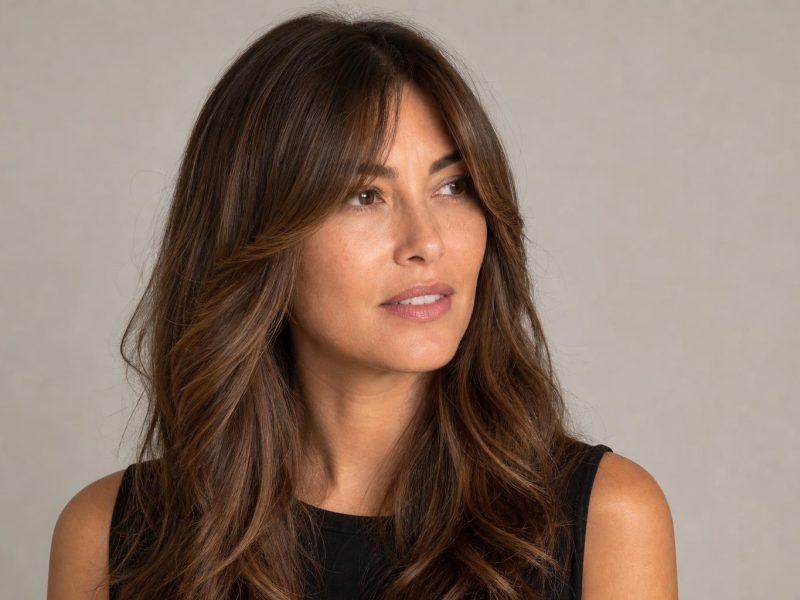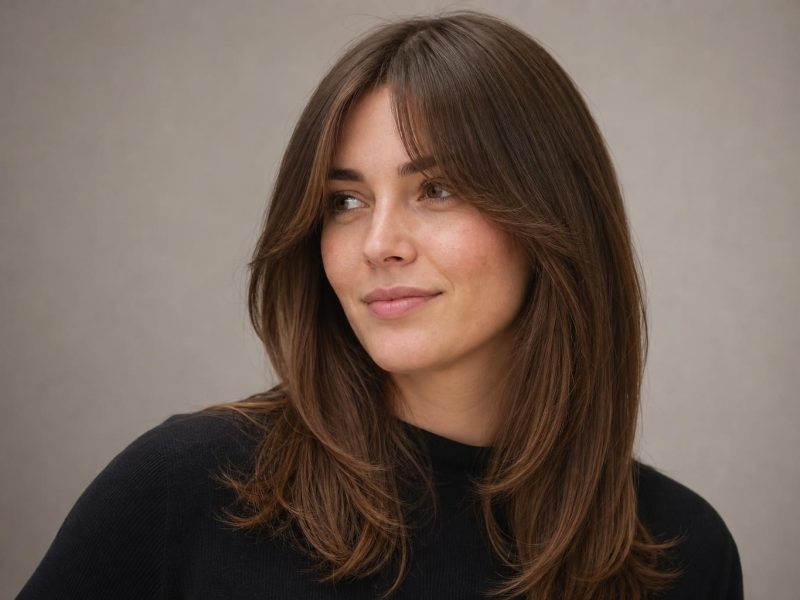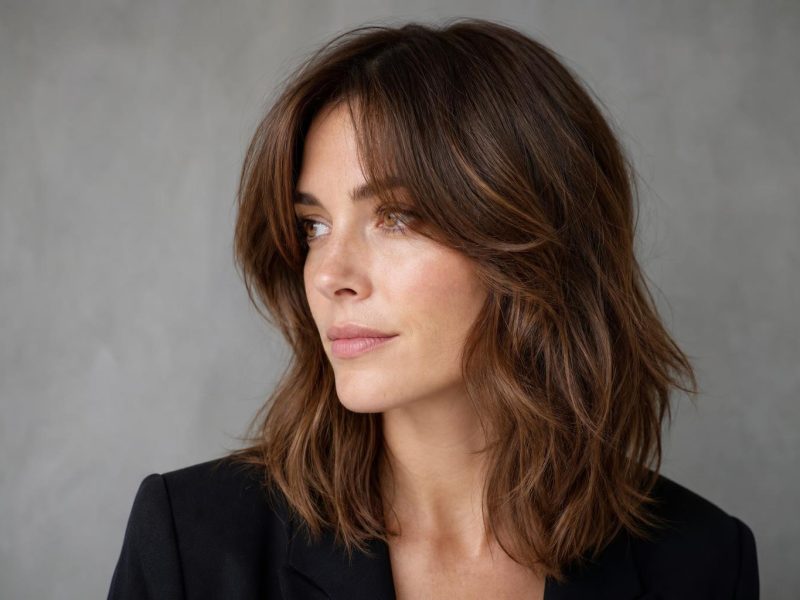

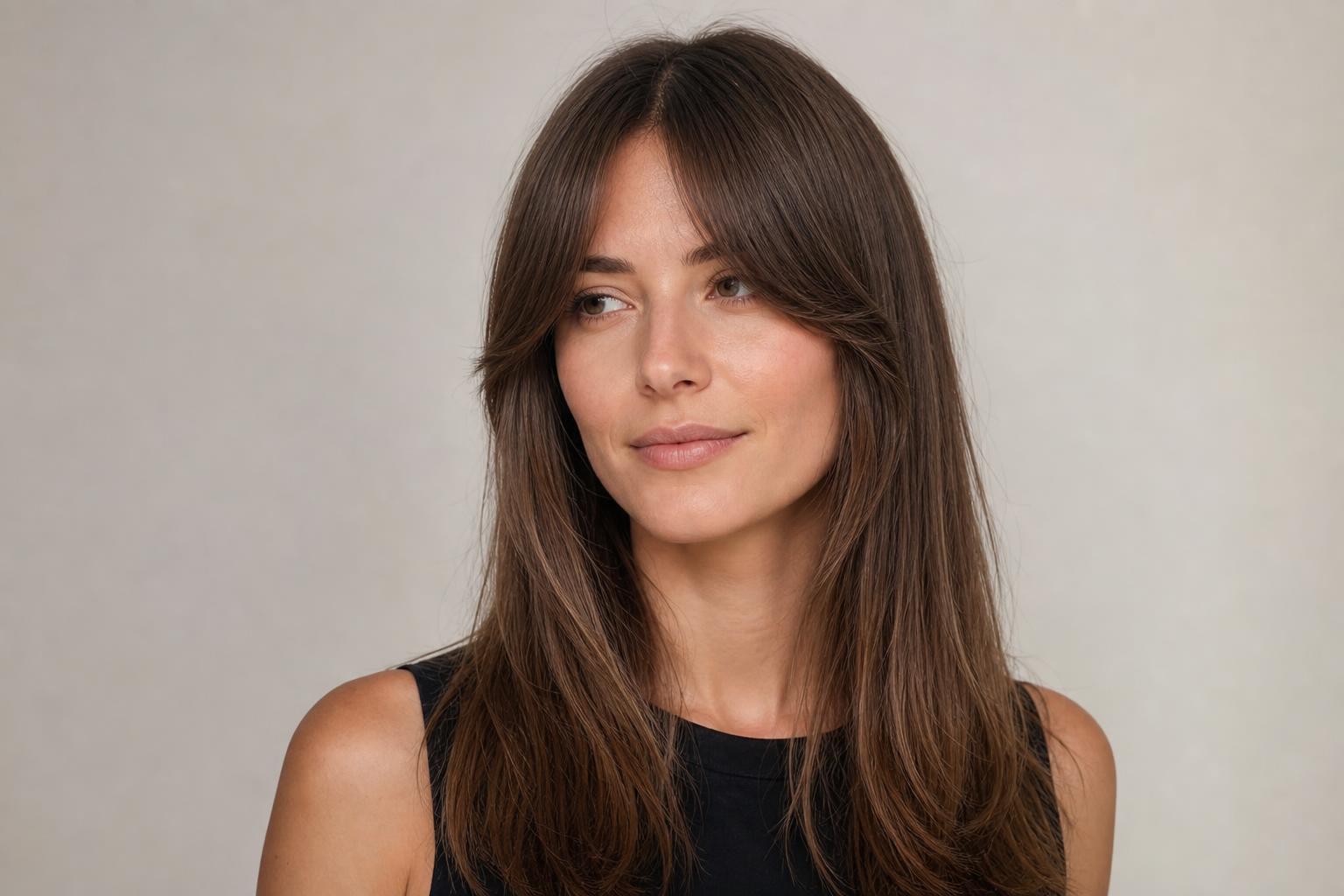
Curtain bangs on straight hair are a center-parted fringe that tapers from cheekbone level down toward the jaw, creating a symmetrical face-framing shape that grows out more gracefully than almost any other bang style.
Curtain bangs suit straight hair particularly well because the smooth texture lets the parted-curtain shape hold its form without frizz disrupting the line. Unlike blunt bangs, which show every millimeter of grow-out and need trims every 3-4 weeks, curtain bangs on straight hair stay wearable for 5-7 weeks, since the graduated outer edge blends into the side hair as it grows. These 25 styles cover every hair length from chin-length bobs to hip-length hair, with the same basic fringe adapting in length, curvature, and outer-edge tapering across each.
The gallery is organized by classic styles first, then by hair length, then by styling variations, and finally by face shape. Following the gallery are a full face shape compatibility table, a step-by-step at-home styling guide, exact salon language for your next appointment, and a maintenance schedule with realistic trim intervals.
| Factor | Details |
|---|---|
| Best for | Straight to slightly wavy hair; oval, round, square, and heart faces; chin-length to hip-length hair |
| Maintenance | Trim every 5-7 weeks; 5-10 minutes of daily styling with a round brush or flat iron |
| Works with | Fine, medium, and thick straight hair; bob through long hair lengths |
| Avoid if | Very fine hair with low density at the hairline; strong cowlicks in the bang section; very short hair above the jaw |
| Salon time | 15-20 minutes added to a standard cut; 45-90 minutes for a full cut plus curtain bangs together |
Classic Curtain Bangs on Straight Hair
Classic curtain bangs on straight hair rely on a point-cut center part and graduated length that deepens toward the temples. The key distinction from other bang styles is the feathered outer edge: rather than stopping in a defined line, the ends are point-cut to blend into the side hair rather than creating a visible stopping point. On straight hair, this produces a clean fringe that appears effortless rather than high-maintenance, provided the bang section gets a small amount of inward curve each morning during styling.
1. Classic Long Curtain Bangs
Long curtain bangs on straight hair are cut at cheekbone level at the shortest center point and graduate down to jaw level at the outer edge, forming the parted-curtain silhouette. The entire section is point-cut rather than blunt-scissored, which prevents the rigid line that blunt ends create on pin-straight hair and lets the fringe fall into the side sections naturally. To get this at the salon, ask for “face-framing layers starting at cheekbone level, point-cut at the ends, and graduated to jaw level at the outer edge.”
2. Short Curtain Bangs on Straight Hair
Short curtain bangs sit at or just below the brow, drawing the eye across the forehead rather than downward, which makes them a useful choice for square faces or anyone wanting to reduce visual width at the forehead. On straight hair, they need a slight inward bend at the root: blow-dry them with a small round brush while still damp, rolling inward toward the nose on each side. The short curtain bangs gallery covers additional length-specific variations and face shape guidance for this shorter fringe range.
3. Center-Parted Curtain Bangs on Fine Straight Hair
Fine, pin-straight hair produces the cleanest version of center-parted curtain bangs because there is no frizz or texture to disrupt the line, but the lack of natural movement means the bang section needs careful point cutting throughout, including the outer edges, to prevent the heavy, flat appearance that blunt-cut ends create on low-density straight hair. A lightweight texturizing spray applied to dry bangs adds a barely-there separation that mimics the movement wavy hair provides naturally, without buildup or stiffness. Keep the center part crisp with a fine-tooth comb after styling for the sharpest result.
4. Wispy Curtain Bangs
Wispy curtain bangs are created by combining standard point cutting with shallow thinning-shear passes through the upper half of the bang section, removing interior bulk without touching the visible ends. The result on straight hair is a soft, semi-transparent fringe that moves with the head rather than holding a fixed position, giving a more casual effect than the fuller curtain bang shape that defines most styles in this gallery. Style by misting with a flexible-hold spray and finger-combing outward from the center, with no brush or heat required.
5. Curtain Bangs with Face-Framing Highlights
Foiled highlights placed within the front 2-3 inches of curtain bangs create a brightness around the forehead that adds visual dimension, particularly on dark straight hair where the base color is uniform and the fringe alone carries little separation. Ask your colorist to lift the bang section two to three levels above your base, restricting the lightening to the visible fringe area and blending the outer edge into the first inch of side hair. On straight hair, the highlights also produce an illusion of texture and movement that the cut alone cannot achieve.
6. Curtain Bangs vs Blunt Bangs on Straight Hair
Curtain bangs and blunt bangs cover the same area of the face but behave completely differently on straight hair. Blunt bangs create a defined horizontal line across the forehead and need precise trims every 3-4 weeks to keep that line sharp, while curtain bangs divide at the center and sweep outward, growing out more gracefully and staying wearable for 5-7 weeks between cuts. On straight hair, blunt bangs appear more structured and classic, while curtain bangs look more relaxed and face-framing: the choice depends on how much daily styling effort you want and how frequently you visit the salon.
Curtain Bangs by Hair Length
Hair length changes how curtain bangs hang, how they blend into the side sections, and how prominent the fringe appears in the overall silhouette. A bob creates a compact frame where the bangs are a central feature of the look. Shoulder-length or longer hair gives the bangs more side hair to graduate into, producing a softer transition and a less defined fringe boundary. The seven styles below cover the range from a chin-length bob through hip-length hair.
7. Curtain Bangs on a Bob
A bob with curtain bangs requires the fringe to be cut slightly longer than on mid-length or long hair, because the shorter perimeter reduces the visual space below the bang section. The ideal length for a bob is a curtain bang that grazes the cheekbone at its shortest center point and reaches the lower cheek at the outer edge, maintaining face-framing proportion without overwhelming the cut. On short bobs, the stylist may also use undercutting below the bang section to prevent the perimeter from looking too thick relative to the fringe.
8. Curtain Bangs on Fine Straight Hair
Fine straight hair presents the biggest challenge for curtain bangs: low density makes the fringe appear thin and limp without added volume at the root. A volumizing mousse at the roots of the bang section before blow-drying, followed by a small round brush no wider than 1.25 inches rolled inward, gives fine curtain bangs the lift they need to curve rather than fall flat by midday. If fine hair also lacks density throughout the crown, combining curtain bangs with layered haircuts for thin hair creates a fuller frame without adding weight to the overall cut.
9. Curtain Bangs on Shoulder-Length Straight Hair
Shoulder-length straight hair with curtain bangs is one of the most balanced combinations: the bangs have enough side hair to blend into gradually, and the silhouette is versatile enough for both polished and casual styling. At shoulder length, the bangs can be worn open in their classic center-parted curtain shape or pushed entirely to one side, where they function as a deep side part fringe without needing a separate cut to accommodate that styling option. Trim every 5-6 weeks to keep the graduation from collapsing: once the outer edge catches up to the center point, the curtain shape becomes a flat side part fringe.
10. Curtain Bangs on a Lob
A lob (hair between chin and collarbone) is the most popular length for curtain bangs in salon consultations because it provides enough side hair for a gradual blend while being short enough that the bangs remain a visible, central feature of the style. When requesting this combination, tell your stylist you want curtain bangs that start at cheekbone level, graduate down 1.5 inches longer at the outer edge, and use only point cutting throughout — no razor, no blunt scissor line at the ends. Specifying “I want the outer edge to blend into the side sections rather than stop at a defined point” prevents a hard bang line that would look more like a short fringe than a true curtain shape.
11. Curtain Bangs on Long Straight Hair
Long straight hair past the collarbone works best with curtain bangs when the stylist adds a small amount of face-framing layering in the section immediately below the bangs, so the fringe ties into the length rather than floating above it as a separate element. Two or three long layers framing the face that begin at cheekbone level and continue down to shoulder level create a cohesive transition between the bang section and the rest of the length. Blow-dry the bang section and the upper layers together with a medium round brush, directing airflow inward for the first few inches and then releasing downward to blend both sections.
12. Curtain Bangs on Thick Straight Hair
Thick straight hair has enough density to support curtain bangs without them appearing sparse, but the weight can cause the bang section to push forward rather than curving flat against the forehead. Ask your stylist for thinning shears or slide cutting within the first inch of the bang section at the root, which reduces bulk and allows the bangs to fall in their natural curtain shape instead of puffing outward. A flexible-hold spray applied to damp bangs during blow-drying gives the most control over the final shape on high-density straight hair.
13. Curtain Bangs on Very Long Straight Hair
Very long straight hair past the collarbone creates a downward pull on the bang section from the weight of the surrounding length, which can flatten curtain bangs that do not have enough curve built in during styling. Concentrate the inward roll of the round brush in the upper half of the bang section during blow-drying: the root to mid-shaft is where the curl needs to set, so release the brush before reaching the ends rather than rolling all the way through. A small amount of lightweight hold cream through the outer edges after drying locks the shape without stiffening the bang against the longer hair.
Styling Variations for Straight Hair
Straight hair gives curtain bangs a clean, graphic quality that wavier textures soften naturally. On curtain bangs on curly hair, diffusing activates the natural curl in the fringe; on straight hair, every bit of curve must be created with heat or hand-shaping. Most of the variation in this section comes from three factors: how much heat is applied, what tool size is used, and whether product is added before or after drying.
14. Blown-Out Curtain Bangs
A blow-out for curtain bangs uses a small round brush with a 1-inch to 1.25-inch barrel, positioned below the bang section and rolled inward toward the nose while warm air is directed along the outer edge of each side. Take each side in a single continuous motion from root to end without pausing at mid-length, since stopping creates a kink in the middle of the bang rather than a smooth inward curve. The result on straight hair is a precisely curved fringe that holds its shape for most of the day without additional product.
15. Air-Dried Curtain Bangs on Straight Hair
Air-drying curtain bangs on medium-density straight hair typically produces a flat center-parted fringe rather than the curved shape, because straight hair lacks the natural spring that helps wavier textures fall into a shaped position. A practical solution is to mist the bang section with water after the rest of the hair has dried, press the bangs gently into a curved position with both hands for 10-15 seconds, and then leave them alone. A fingertip of styling cream through the outer edges while still damp holds the hand-shaped curve without heat.
16. Curtain Bangs with a Flat-Iron Bend
A 1.5-inch flat iron held diagonally and glided through the bang section in a single pass, with the wrist turning inward at the exit, creates a gentler and more even curve than a curling iron barrel does on straight hair. The flat iron makes the bend depth easier to control: the more the wrist turns, the more pronounced the curve, which suits straight hair beginners who find curling iron heat-shaping harder to predict. One pass only on each side — going over the same section twice with high heat on straight hair produces a harsh crease rather than a smooth bend.
17. Curtain Bangs Pinned Back
A practical aspect of curtain bangs on straight hair is that they grow long enough to pin back within 6-8 weeks, giving the style a natural second option as the bangs transition out of their shorter phase. Two small pins placed just behind the outer edge of each side keep the face clear while the crown hair continues to frame from above, producing a more polished, open look than simply tucking the bangs behind the ears. This pinned variation also functions as a built-in fallback on days when the blow-drying does not go as planned.
18. Curtain Bangs with a Tapered Outer Edge
A tapered outer edge is the technical detail that determines whether curtain bangs look like a deliberate face-framing element or a grown-out fringe that was left to its own devices. When booking a maintenance trim, specify that you want the outer edge graduated rather than blunt-cut, with the taper continuing into the first half-inch of the side section. Stylists unfamiliar with curtain bangs often blunt-cut the outer edge for speed, so confirming the taper explicitly at the start of the appointment takes 30 seconds and prevents the need for a corrective cut.
19. Curtain Bangs vs Wispy Side Bangs
Curtain bangs and wispy side bangs look similar in reference photos but are constructed differently: side bangs sweep across the forehead in one direction from a fixed side part, while curtain bangs divide from the center and fall to both sides equally. On straight hair, curtain bangs depend on a precise center part to hold their shape, while side bangs work with any part direction. If a center part feels too symmetrical for your face shape, wispy side bangs give a similar face-framing effect with more day-to-day styling flexibility.
20. Curtain Bangs with a Precise Center Part
On faces with a particularly wide forehead, placing the curtain bang part slightly lower on the forehead at skin level rather than at the hairline reduces the visible forehead width by narrowing the central opening of the curtain. Keep the parting very precise: even a 2-millimeter shift to one side makes the style appear asymmetric on straight hair, where every line is visible and unforgiving. A light-hold finishing spray along the parting line, followed by a fine-tooth comb to set the center part, keeps it from migrating through the day.
Curtain Bangs for Your Face Shape
Face shape changes not just whether curtain bangs suit you, but how long they should be, where the center part sits, and how the outer edge is tapered. The five entries below address specific face shapes with adjustments to length, positioning, and styling direction for straight hair.
21. Curtain Bangs for Round Faces
Round faces benefit from curtain bangs where the center point falls between the brows rather than at the hairline, and the outer edge graduates down below the cheekbone. This lower positioning creates a longer vertical line from forehead to cheek, which works against the face’s natural horizontal width. A bang line that ends at cheekbone level does the opposite by creating a wide horizontal frame at the widest part of a round face, so point-cutting the outer edge to blend well into the side sections is especially important here.
22. Curtain Bangs for Square Faces
Square faces have strong angular jawlines and a forehead that is roughly as wide as the jaw, and curtain bangs soften both by introducing a rounded framing element at the forehead that contrasts with the jaw’s straight geometry. On thick straight hair, which can appear flat and heavy against angular features, feathered curtain bangs with significant thinning at the outer edge reduce bulk around the forehead and add movement that a square face shape needs. Keep the outer edge of the bang graduating down to chin level for maximum softening effect.
23. Curtain Bangs for Heart Faces
Heart faces have a wider forehead and a narrower chin, so curtain bangs on this face shape need to be longer rather than shorter, falling at or below the cheekbone to draw the eye downward rather than framing the forehead and adding emphasis to its widest area. Style the outer edges to fall slightly outward rather than fully inward, which softens the framing effect and reduces the visual width added at the top. Those with a very wide forehead will find a broader set of face-balancing options in the hairstyles for big foreheads guide alongside curtain bangs.
24. Curtain Bangs for Oblong Faces
Oblong faces are longer than wide, and curtain bangs cut at brow level add the horizontal framing needed to visually shorten the face. Longer curtain bangs falling past the cheekbone do not provide the same effect because they extend the vertical line rather than interrupting it. A subtle toning service or glossing treatment applied specifically to the bang section reinforces the horizontal framing by drawing the eye to the forehead rather than down the face. At brow level, expect a trim every 4-5 weeks to keep the bang from growing past the horizontal framing point.
25. Curtain Bangs for Oval Faces
Oval faces have balanced proportions that suit the full range of curtain bang lengths and variations, from brow-grazing through collarbone-blending, making this the most forgiving combination for those who want to experiment with length over time. A useful maintenance advantage for oval faces is that the grow-out phase appears purposeful rather than neglected: as the bangs lengthen, they transition naturally into a centered curtain shape that continues to frame the face at cheek or collarbone level. Trimming every 6-7 weeks rather than 4-5 makes the most of this natural grow-out by keeping the style wearable throughout the full growth cycle.
Face Shape Guide for Curtain Bangs on Straight Hair
The table below summarizes the key adjustments for each face shape in one place. For straight hair specifically, the “avoid” column matters more than it does for wavy or curly textures: straight hair shows every length and angle precisely, making the wrong bang length more visible on straight hair than on textures that naturally soften edges.
| Face Shape | Best Curtain Bang Length | Key Adjustment | Avoid |
|---|---|---|---|
| Oval | Any length from brow to below cheekbone | No adjustment needed; most lengths and variations work | Nothing specific; most curtain bang lengths suit oval faces |
| Round | Center point between brows; outer edge at or below cheekbone | Lower outer edge to create a longer vertical line down the cheek | Bang line ending at cheekbone level (widens the face visually) |
| Square | Outer edge graduating to chin level | Significant feathering and thinning at the outer edge to soften the forehead | Heavy, blunt-ended curtain bangs that add visual weight at the brow |
| Heart | At or below cheekbone | Outer edges styled slightly outward to reduce framing width at the forehead | Short curtain bangs that tightly frame the widest area of the forehead |
| Oblong | At brow level | Shorter length adds a horizontal framing line that reduces visual face length | Long curtain bangs past the cheekbone (extends the vertical length of the face) |
| Diamond | Cheekbone level; outer edge slightly longer | Gentle feathering at the outer edge softens around the widest point at the cheekbones | Very short curtain bangs that expose the narrow forehead without framing |
How to Style Curtain Bangs on Straight Hair at Home
Straight hair needs more active shaping than textured hair during the styling process because there is no natural movement to help the bangs fall into a curved position on their own. The method below takes 5-8 minutes and works for fine, medium, and thick straight hair with minor product adjustments for each density.
Stylist tip: The most common mistake when styling curtain bangs on straight hair is starting with completely dry hair. Mist the bang section lightly with water first, even if the rest of your hair is already dry, so the heat from the brush can reshape the bang from a pliable base rather than moving stiff, set hair around without creating any new curl.
Step 1: Separate the bang section. Use a fine-tooth comb to section out only the bang area, from the hairline above each brow widening to just past the outer corner of each eye. Clip the rest of the hair back so it does not interfere with the blow-dry.
Step 2: Add product to damp bangs. For fine straight hair, work a pea-sized amount of volumizing mousse from root to mid-shaft. For medium or thick hair, a fingertip of lightweight hold cream through the outer edges is sufficient. Skip product on medium-density hair if you prefer a natural finish: too much product on any straight hair type makes the bangs stiff and difficult to reshape.
Step 3: Blow-dry with a small round brush. Use a 1-inch to 1.25-inch round brush. Start with one side of the bang, position the brush beneath that section, roll it inward toward the center, and direct airflow along the outer edge. Complete each side in one continuous motion from root to end without pausing mid-shaft, since pausing creates a kink rather than a smooth curve. Work both sides rolling toward the center part.
Step 4: Set the center part. After both sides are dry, define the center part with the fine-tooth comb, placing the parting at skin level rather than at the hairline for the cleanest curtain separation. A light-hold finishing spray along the outer edges only sets the shape without weighing down the root.
Step 5: Optional flat iron for extra control. If the blow-dry did not produce enough inward curve, run a 1.5-inch flat iron through each side in a single pass, turning the wrist inward at the end of the stroke. One pass only. This step also removes any flyaway from the outer edge that the round brush left behind.
What to Tell Your Stylist
Most salon miscommunications about curtain bangs on straight hair happen because the client shows a reference photo of a wavy-hair version and the stylist copies the look without adjusting the technique for a straight texture. Giving the stylist the exact technical details before the cut removes this guesswork entirely.
For a first-time curtain bang cut: “I’d like curtain bangs that start at cheekbone level at the center, graduate down about 1.5 inches longer at the outer edge, with the entire section point-cut throughout and no blunt scissor line at the ends or the outer edge. I want the outer edge feathered into the side section rather than cut to a defined stopping point.”
For a maintenance trim: “Please keep the same graduated shape, shorter at the center and longer at the outer edge, and use point cutting on the outer edge to keep it feathered. I do not want the outer edge blunt-cut.”
For thick straight hair: “My hair is quite thick, so please use thinning shears or slide cutting within the first inch of the bang section at the root to reduce bulk, so the bangs fall flat and curve rather than push forward.”
Stylist tip: Ask your stylist to show you the finished result after blow-drying before you leave the chair. Curtain bangs can look flat and shapeless straight off a wet cut, and the final shape only becomes clear once the hair is dried and the curve is set. Confirming the curtain shape at the root before you leave prevents a flat-fringe surprise the next morning when you style at home.
When Curtain Bangs Are Not the Right Choice
Curtain bangs suit the widest range of straight hair textures and face shapes of any bang style, but there are specific conditions where they are more likely to disappoint than flatter on straight hair.
- Very fine hair with a sparse front hairline: If the hairline is thin, curtain bangs will look patchy and limp rather than soft and face-framing. A deep side part that uses the side sections to cover the hairline area creates a similar face-framing effect without relying on the sparse front section for volume.
- A strong cowlick in the bang section: A cowlick at the front hairline pushes hair in a fixed direction rather than allowing it to fall in a curtain shape. On straight hair, this is harder to manage than on wavy hair because there is no texture to blend the cowlick into. Discuss with your stylist whether the cowlick can be grown out strategically before committing to the cut.
- Very short straight hair above the jaw: On pixie-length or above-the-jaw straight hair, curtain bangs cannot graduate properly because there is not enough side hair for the outer edge to blend into. Curtain bangs need at least chin-length side hair to create the feathered transition: below that length, a different bang style will suit the cut better.
- Oblong faces wanting more face length: Curtain bangs at any length add some horizontal framing to the forehead, which visually shortens an oblong face. If you have a very long face and specifically want to preserve its length, a style with no bangs and a deep side part will add less horizontal emphasis than curtain bangs do.
Curtain Bangs Maintenance Schedule
Trim frequency for curtain bangs on straight hair depends on how long the center point is and how much grow-out the graduated shape can absorb before the curtain effect collapses. Most people grow about half an inch of hair per month, and straight hair shows grow-out more visibly than wavy or curly textures because there is no natural volume or movement to disguise the length change.
| Bang Length | Trim Frequency | Daily Styling Time | Grow-Out Behavior |
|---|---|---|---|
| Short (at brow) | Every 4-5 weeks | 5-8 minutes with a small round brush | Grows into a cheekbone-length shape within 6-8 weeks; fairly graceful transition |
| Medium (at cheekbone) | Every 5-7 weeks | 5-10 minutes with a round brush or flat iron | Blends into side hair by week 6-7; very forgiving grow-out phase |
| Long (below cheekbone) | Every 7-8 weeks | 8-12 minutes; round brush needed for the longer section | Transitions into a face-framing layer rather than a bang; almost always wearable |
Between trims, maintaining the feathered outer edge matters more than maintaining the overall length. Once the outer edge grows blunt, the curtain character changes more noticeably than when the center point simply grows longer. A self-trim using small point-cutting scissors on the outer edge only (never blunt-cut) can extend a medium or long curtain bang by 1-2 additional weeks between appointments.
FAQ
Do curtain bangs work on straight hair?
Yes, curtain bangs work well on straight hair and many stylists consider straight hair the most predictable texture for cutting them, because the bang section falls exactly where it is cut with no curl shrinkage or frizz to account for. The main adjustment for straight hair is more active daily styling: a small round brush blow-dry creates the inward curve that wavy hair produces naturally. Once styled, curtain bangs on straight hair hold their shape well for most of the day without needing product reapplication.
How are curtain bangs different from regular bangs on straight hair?
Curtain bangs are parted at the center and sweep outward to both sides, while regular blunt or rounded bangs cover the forehead in a single layer without a central division. On straight hair, the curtain shape reveals the center of the forehead, creating an open, face-framing effect rather than the covered-forehead look of standard bangs. Curtain bangs also grow out more gracefully than blunt bangs on straight hair, staying wearable 5-7 weeks between cuts compared to 3-4 weeks for blunt bangs. The types of bangs guide covers each variation with face shape notes if you want to compare your options before committing.
Can I get curtain bangs if I have a cowlick?
A cowlick at the front hairline is the most common reason curtain bangs do not behave as expected on straight hair, because it pushes the hair in a fixed direction rather than letting it fall in a curtain shape. A cowlick at the crown affects the back of the head but not the bang section, while a cowlick directly in the front hairline impacts the curtain shape and is much harder to manage on straight hair. Discuss this with your stylist before the cut, and consider growing the cowlick area out for 3-4 months first to give it enough length to work with.
How do you keep curtain bangs from going flat on straight hair?
Curtain bangs on straight hair flatten when the hair is too long between trims, when scalp oil travels down the bang section, or when styling begins on completely dry rather than slightly damp hair. Misting the bang section with water before blow-drying gives the heat something to reshape. A volumizing mousse at the root of the bang section on fine hair, or a light hold cream at the outer edges on medium to thick hair, maintains the curve through the day. A trim when the center point starts appearing flat, typically at 5-7 weeks depending on length, resets the graduated shape.
How long does it take to style curtain bangs on straight hair?
Styling curtain bangs on straight hair takes 5-10 minutes depending on bang length and density. Short brow-level curtain bangs need 5-6 minutes with a small round brush. Medium or long curtain bangs reaching below the cheekbone need 8-10 minutes because the longer section requires more heat and brush work to set the curve consistently. On days when there is no time for heat styling, the mist-and-hand-shape method (wetting the bangs, pressing them into the curtain position with your hands, then air-drying) takes about 2 minutes and produces a softer, more casual version of the shape.
Can curtain bangs be done on a bob?
Yes, curtain bangs work on bobs with minor adjustments to keep the proportions balanced. On a short bob, the outer edge of the fringe needs to fall at or below the cheekbone so the bang has visual weight against the shorter perimeter; curtain bangs that are too short on a bob look more like a separated fringe than a face-framing element. Undercutting below the bang section on a short bob keeps the perimeter from looking too thick relative to the fringe.
Are curtain bangs on straight hair easy to grow out?
Curtain bangs are one of the easiest bang styles to grow out on straight hair because the graduated shape transitions naturally into face-framing layers as the length increases. Unlike blunt bangs, which go through a visible awkward phase around the 2-3 inch mark, curtain bangs simply appear longer and more blended as they grow. The main transition point is when the bangs reach 3-4 inches, roughly 6-8 months of growth, at which point they are long enough to pin back, tuck behind the ear, or blend fully into the side sections as a face-framing layer.
Curtain bangs on straight hair combine the practicality of low-maintenance grow-out with a face-framing effect that suits nearly every hair length from a chin-length bob through hip-length styles. The key to making them work on straight hair is in the cut details: point cutting throughout, a feathered outer edge, and a graduated length that deepens toward the temples. Bring one or two reference photos from this gallery to your next appointment and confirm with your stylist that the outer edge will be feathered rather than blunt-cut. A well-executed set of curtain bangs on straight hair requires only 5-10 minutes of styling each morning to maintain its shape consistently.
Hair results vary based on your natural hair type, texture, density, and condition. Always consult with a licensed hairstylist before making significant changes, especially with chemical treatments or dramatic length changes. Photos may show styled results that require professional tools and products to replicate.