

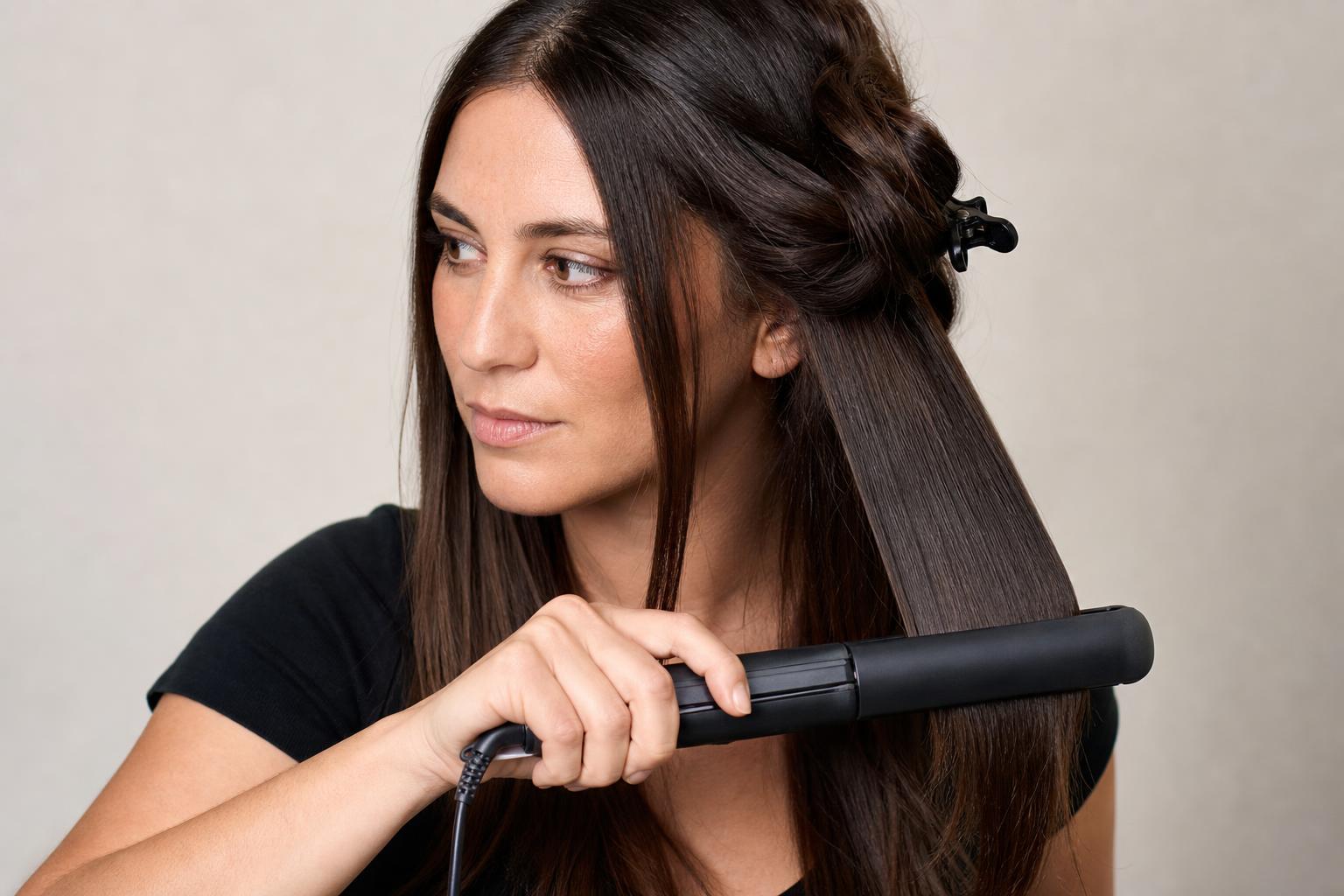
There is no flat iron temperature that straightens hair without changing it, and any guide promising one is selling something.
Most hair straightens between 250 and 400 degrees Fahrenheit, and where you land inside that range depends far more on whether your hair is colored or damaged than on how thick it is. Fine or bleached hair belongs at 250 to 300; medium virgin hair at 300 to 350; coarse, healthy, unprocessed hair at 350 to 400. Above roughly 400 you are past the point where higher heat buys a better result, and into the range where hair starts to break down.
This guide gives one temperature table rather than the six contradictory ones circulating online, explains why the published numbers disagree so wildly, covers what the research actually found about heat thresholds, and shows why technique changes your result more than the dial does.
The Temperature Table
Find the row that matches your hair’s condition first, then its thickness. Condition is the stronger variable of the two, so a coarse head of bleached hair belongs in the lower band despite the thickness. Start at the bottom of your range and only move up if a single slow pass is not straightening the section.
| Hair Type and Condition | Fahrenheit | Celsius | Notes |
|---|---|---|---|
| Fine, virgin | 250 to 300 | 120 to 150 | Straightens fast; most people run this far hotter than needed |
| Fine, colored or damaged | 250 to 280 | 120 to 138 | The most fragile combination on this table |
| Medium, virgin | 300 to 350 | 150 to 177 | The default starting point for most people |
| Medium, colored | 280 to 320 | 138 to 160 | Drop a full band after any lightening service |
| Thick or coarse, virgin | 350 to 400 | 177 to 205 | The only group with a real case for 400 |
| Thick or coarse, colored | 300 to 350 | 150 to 177 | Condition outranks thickness here |
| Bleached to blonde | 250 to 280 | 120 to 138 | Already structurally compromised before any heat |
| Gray or white | 300 to 330 | 150 to 165 | Often coarse but fragile, and scorches to yellow easily |
Stylist tip: Gray and white hair is the one group that shows heat damage as a color change rather than a texture change. If your grays have picked up a dull yellow cast that purple shampoo does not shift, your iron is too hot, and the discoloration is scorching rather than brassiness.
Why Every Guide Gives You Different Numbers
Search this question and you will find fine hair listed as 250 to 300 on one page and 350 to 375 on the next, both written with total confidence. The disagreement is not random, and understanding where it comes from tells you which numbers to trust.
The first problem is that most of these pages are published by companies that sell flat irons, and a tool that tops out at 450 degrees is easier to sell if 400 sounds routine. The second is a genuine conceptual mix-up: many guides sort by thickness alone, treating strand diameter as the only variable. Diameter tells you how much heat a strand can absorb before its core reaches temperature, but chemical history tells you how much heat it can survive, and the second matters more. A bleached coarse strand and a virgin coarse strand behave nothing alike.
The third is that a dial reading is not a measurement. Plate temperature varies across the surface of cheap irons, drifts as you work, and recovers slowly after each pass, so two irons set to 350 can deliver noticeably different heat to your hair.
What the Research Says About Heat Thresholds
The commonly repeated line is that damage begins somewhere around 392 degrees Fahrenheit, or 200 Celsius. Research on heat and hair structure puts the meaningful threshold much lower. A study on the effects of heat treatment on hair structure identified a critical temperature of 140 Celsius, which is 284 Fahrenheit. Below it, the changes were limited to loss of free water and were reversible. Above it, the structural changes were described as profound and irreversible.
That number deserves to be better known, because it means almost every temperature people consider normal is already in the irreversible range. This is not an argument for never using a flat iron. It is an argument for framing the decision honestly: you are not choosing between damage and no damage, you are choosing how much permanent change buys how much result. That framing is why the advice throughout this guide is to start low, because the lowest heat that straightens your hair is genuinely the correct one rather than a cautious compromise.
Total structural degradation appears around 200 Celsius, close to 400 Fahrenheit, which is why the top of the table stops there. Past that point you are not straightening more effectively, you are cooking protein.
Technique Changes the Result More Than the Dial
Two people can straighten the same hair at the same temperature and end up with very different outcomes, because heat exposure is temperature multiplied by time. Lowering the dial and then making four slow passes over a section delivers more total heat than one confident pass at a higher setting.
One Slow Pass Beats Three Fast Ones
Take a section no wider than the plate and no thicker than an inch, and move the iron down it in a single continuous glide over about five seconds. If the section is not straight afterward, the section was too thick or the temperature too low, and repeating the pass is treating the symptom. Repeated passes over the same section are the most common cause of heat damage at supposedly safe temperatures.
Hair Must Be Completely Dry First
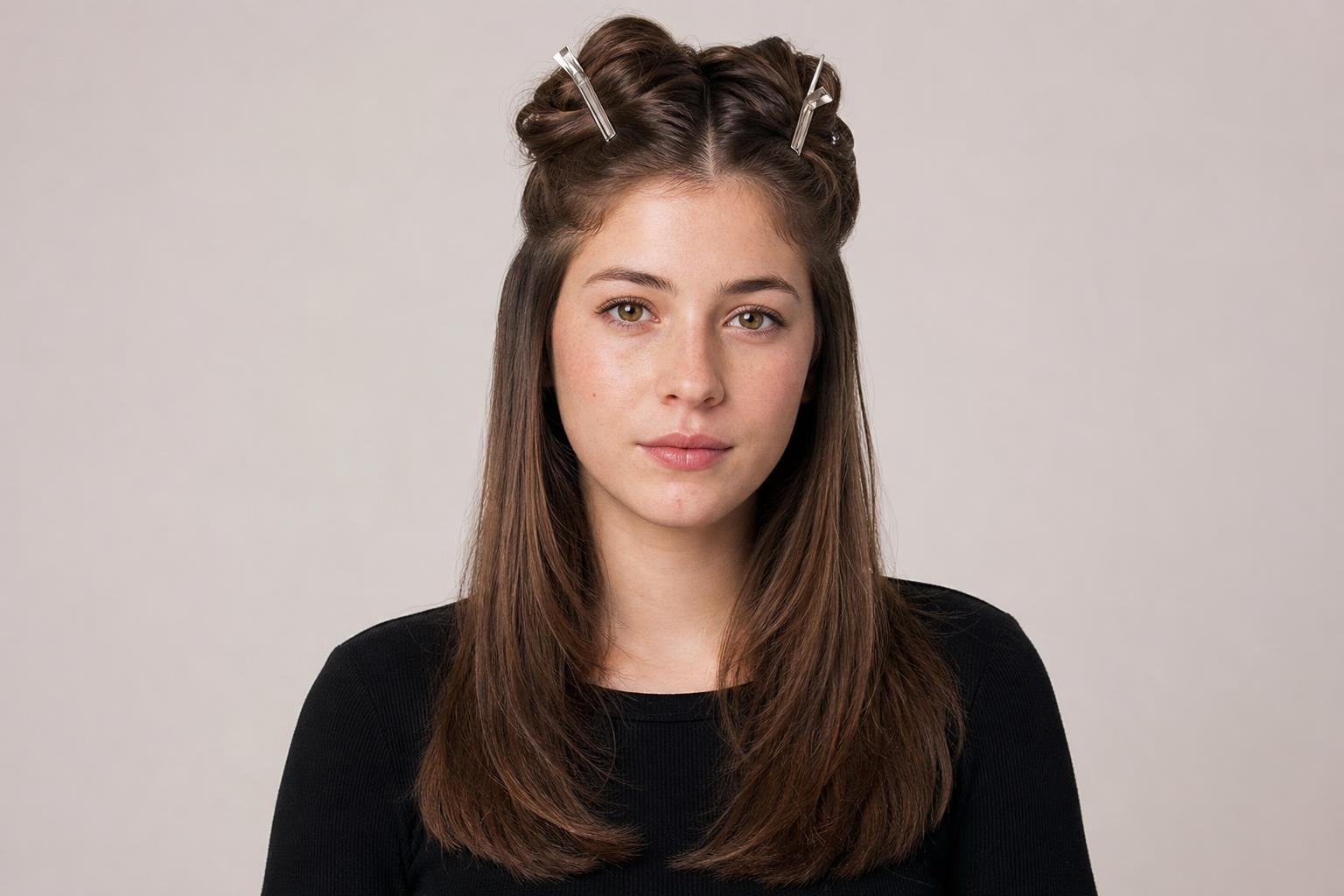
Ironing damp hair flashes the trapped water to steam inside the shaft, and that does far more damage than a high dial setting on dry hair. The audible sizzle is not a sign the tool is working, it is water boiling inside your strands. If you have just blow-dried, give the hair a few minutes to finish cooling and drying before the iron goes near it.
Heat Protectant Earns Its Place
This is one of the few product categories with direct evidence behind it. Research on cosmetic pretreatments protecting hair from flat iron damage found that specific polymer pretreatments significantly reduced breakage during hot ironing. Apply to damp hair, let it dry fully, and use noticeably less than feels right, since excess product on the plates burns and leaves residue. It belongs at the same stage of a regular hair care routine as any other leave-in, applied before drying rather than as an afterthought at the iron.
Stylist tip: Turn the iron on and let it heat for a full two minutes before the first section. Most people start after thirty seconds, find the plates are not fully up to temperature, get a poor result on the underneath sections, and respond by raising the dial for the rest of the head.
Adjusting for Your Hair’s History
The table gives a starting band, and a few situations justify moving down within it. None justify moving up.
- Recent lightening. Drop a full band for at least six weeks after any bleach or highlight service, regardless of how healthy the hair looks. Structural damage from lightening is not visible until heat is added.
- Keratin or chemical straightening. Follow the treatment provider’s instruction over any general guide, since some formulas specify a temperature and others rule out ironing entirely for a set period.
- Ends that feel rough or snap. Lower the temperature for the bottom third of the length and keep the higher setting for the roots, which are always the healthiest part of the strand.
- Hair that resists everything. Before raising the heat, check whether the real issue is porosity. Hair that repels water and product also takes heat unevenly, and our guide to reading your hair’s porosity properly is a better diagnostic than the dial.
When Not to Reach for the Iron at All
Some situations call for skipping the tool rather than adjusting it. Recognizing them saves more hair than any temperature choice.
Hair that is actively breaking mid-shaft, hair that has been bleached to platinum and feels gummy when wet, and hair within a few days of a chemical service all belong in the not-today category. So does daily use on any hair type, since the cumulative exposure matters more than any single session. If straightening has become a daily requirement rather than an occasional one, the honest fix is a cut that behaves better air-dried, or a no-heat routine. Setting a shape overnight with heatless methods that use damp hair rather than heat is not a like-for-like replacement for straightening, but it removes several heat sessions a week from the schedule, and air-dry techniques for layered cuts work on the same principle.
FAQ
What Is the Safest Flat Iron Temperature?
The lowest one that straightens your hair in a single pass, which for most people is between 280 and 350 degrees Fahrenheit. There is no temperature that is genuinely damage-free, since research places irreversible structural change from around 284 Fahrenheit upward. Start 50 degrees below where you normally work and move up only if one slow pass is not enough.
Is 450 Degrees Ever Necessary?
Almost never on your own hair. That setting exists on consumer irons largely as a selling point, and it is above the range where hair structure begins breaking down entirely. Professional smoothing services occasionally use very high heat under controlled conditions with specific chemistry involved, which is not comparable to a home session.
What Temperature Should I Use on Bleached Hair?
Between 250 and 280 Fahrenheit, and less often than you would with virgin hair. Lightening removes structure before any heat is applied, so bleached hair reaches its damage threshold sooner and shows it faster as rough, stretchy, or gummy texture when wet. Wait at least six weeks after a lightening service before using regular heat at all.
Does a More Expensive Flat Iron Cause Less Damage?
Partly, and not for the reason most people assume. Better irons hold their set temperature more consistently and recover faster between passes, which means fewer repeat passes over the same section. The plate material matters less than that consistency, and no tool at any price makes high heat harmless.
Can You Flat Iron Hair Every Day?
You can, but the cumulative effect is what causes the damage people blame on temperature. Daily ironing at 300 degrees does more harm over a month than an occasional session at 380. If daily straightening feels unavoidable, that is usually a signal the cut is fighting your natural texture rather than working with it.
Why Does My Hair Smell Burnt Even at a Low Setting?
Usually product residue rather than the hair itself. Heat protectant, dry shampoo, and styling product build up on the plates and burn on contact, which produces the smell and transfers residue back onto clean hair. Wipe the cooled plates with a damp cloth regularly, and make sure hair is fully dry before any pass.
Choosing a flat iron temperature is mostly an exercise in restraint, since the setting that works is almost always lower than the one people default to. Match the band to your hair’s chemical history rather than its thickness, let the tool preheat fully, protect before you start, and commit to one slow pass instead of several quick ones. Hair straightened at 300 degrees with good technique looks better a month later than hair straightened at 400 with poor technique, and that gap widens every week.
Hair results vary based on your natural hair type, texture, density, and condition. Always consult with a licensed hairstylist before making significant changes, especially with chemical treatments or dramatic length changes. Photos may show styled results that require professional tools and products to replicate.

2 responses