

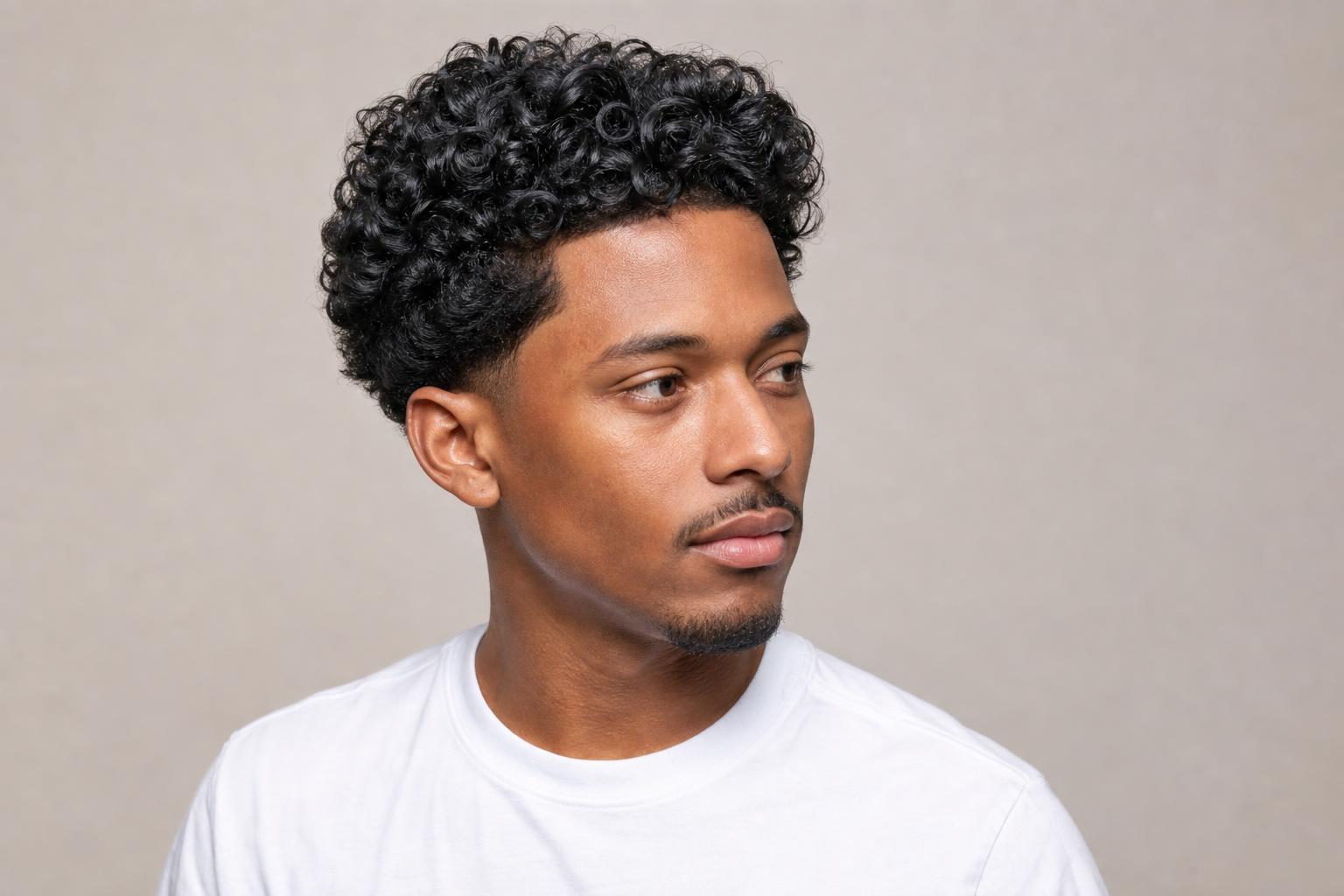
A Jheri curl is a perm for tightly coiled hair that loosens the natural curl and then rebuilds it bigger, and the wet look it became famous for was never the chemical itself but the daily activator that kept it from drying out.
A Jheri curl, often searched as “jerry curl” or “jeri curl,” is a two-step chemical process that softens tightly curled hair with a thioglycolate cream, then sets it on perm rods and locks in a looser, glossier curl. The result is soft, defined, shoulder-swinging curls that need a moisturizing activator every day to stay shiny and supple. The name comes from Jheri Redding, a hair-products chemist, and the style peaked in the 1980s once cheap home kits put it within reach of almost everyone.
This guide explains what the process does to the hair, compares it with a relaxer, a standard curly perm and a wash-and-go, lays out the two ways people get the look today, covers daily upkeep and the grow-out, and gives you the exact words to use at the salon. If you are not sure where your natural texture falls, our guide to curl types from 1A to 4C is a useful starting point.
| Factor | Details |
|---|---|
| What it is | A thioglycolate perm that loosens tight coils, then re-sets them on rods into bigger curls |
| Best candidates | Healthy, virgin 4A to 4C or tight 3C hair with no relaxer, bleach or recent color |
| Salon time | Roughly 2 to 4 hours, depending on length and density |
| Daily upkeep | Curl activator or moisturizer every day, covered hair at night |
| Touch-ups | New growth only, typically every 2 to 3 months |
| Avoid if | Your hair is relaxed, bleached, breaking, or your scalp is sore or irritated |
What a Jheri Curl Actually Is and Why It Has Three Spellings
The correct spelling is Jheri curl, after Jheri Redding, whose name the process carries. Because “Jheri” is pronounced “Jerry,” most people search for it as “jerry curl,” and “jeri curl” turns up often too. All three mean the same thing: a permanent curl for tightly coiled hair that trades the natural pattern for a looser, larger, shinier one.
What turned it from a salon service into a defining look of the 1980s was price. Comer Cottrell of Pro-Line created a home version called the Curly Kit, and at about $8 a box it brought the Jheri curl to the masses, as NPR’s obituary of Cottrell put it. The same report lists the famous wearers most people picture: Michael Jackson in his Off the Wall and Thriller years, Eazy-E, Ice Cube and Rick James. Films like Coming to America turned the dripping activator into a running joke, and that stain stereotype outlived the trend.
A Jheri curl is not a relaxer. A relaxer straightens hair permanently and stays straight. A Jheri curl also breaks and rebuilds the hair’s internal bonds, but it re-forms them around a rod, so the hair ends up curly again, just in a different shape.
How the Jheri Curl Process Works in the Chair
The process has two chemical stages, which is why stylists call it a two-step perm. Everything that goes wrong with a Jheri curl, from dryness to breakage, traces back to how well those two stages are controlled.
The Rearranger Softens the Natural Curl
The first product, called a rearranger or softener, is a cream based on ammonium thioglycolate. It is combed through the hair to break the bonds that hold the tight natural coil, loosening it into a much straighter, softer state. The stylist watches the hair closely and rinses as soon as it has relaxed enough, because overprocessing at this stage is what causes breakage later. These formulas are strongly alkaline, and a study of thioglycolate straightening creams on Afro-textured hair noted that products with a pH of 9 to 12 cause considerable damage, leaving hair dry and fragile. The same study found that adding conditioning agents to the cream reduced protein loss and breakage, which is one reason modern formulas feel gentler than the 1980s versions.
The Booster and Neutralizer Lock In a New Curl
Once the hair is rinsed, the stylist winds it onto perm rods and applies a curl booster, which works the loosened hair into the rod shape. A neutralizer, usually a mild oxidizer such as hydrogen peroxide, then re-forms the bonds around the rod so the new curl is permanent. Rod size decides the finished curl. Larger rods give the loose, rounded curls most people associate with the style, while smaller rods give a tighter, springier result.
Stylist tip: The rearranger should go on the new growth only at a touch-up, never over the previously permed lengths. Pulling it through to the ends at every visit is the most common reason Jheri curls break off at the same line year after year.
Jheri Curl Compared With a Relaxer, a Curly Perm and a Wash-and-Go
These four are often mixed up in searches because they all change how curly hair looks. The difference comes down to whether chemicals are involved and what the hair ends up doing. If you have fine, straight or wavy hair, a standard perm is the service you want, and our guide to wavy perms and wrap techniques covers it.
| Feature | Jheri Curl | Relaxer | Standard Curly Perm | Wash-and-Go |
|---|---|---|---|---|
| Starting hair | Tightly coiled | Curly or coily | Straight or wavy | Any natural curl |
| Result | Looser, larger, glossy curls | Straight | Curls or waves added | Natural curls defined |
| Chemical | Thioglycolate, two steps | Usually hydroxide based | Thioglycolate, one wrap | None |
| Permanent | Yes, grows out | Yes, grows out | Yes, relaxes over months | Washes out |
| Daily effort | High: daily activator | Medium | Low to medium | Restyle every 2 to 5 days |
The Modern Jheri Curl Takes Two Routes
The look is back in barbershops and on social media, but most people wearing it today have not had a traditional Jheri curl. They get there one of two ways, and choosing between them is mostly a question of how much chemical commitment you want.
Curl Reformation Is a Gentler Chemical Version
Salons now offer curl reformation services, sometimes sold under brand names, that use the same basic chemistry with conditioning built in and a stronger focus on treating only new growth. Touch-ups are usually spaced further apart than the old two-month cycle, and the finish is meant to look soft and moisturized rather than wet. It is still a permanent chemical service, so everything in the “who should not” section below applies.
A Wash-and-Go Gets the Look Without Chemicals
On 3C to 4A hair, and with more work on 4B and 4C, you can get close to a Jheri curl finish with styling alone. Apply a water-based leave-in conditioner made for curly hair to soaking wet hair, then a curl cream and a strong-hold gel, and use a defining brush to clump the curls. Let it dry fully, then finish with a few drops of a light oil for gloss. It lasts until your next wash and costs nothing if you already own the core curly hair products.
Stylist tip: Try the wash-and-go version for a month before booking the chemical one. If you do not enjoy the daily moisture routine at the no-chemical stage, a permanent Jheri curl will only ask more of you.
Men and Women Wear the Jheri Curl Differently
On men, the modern version is usually short on the sides and back with two to four inches of curl on top. It pairs naturally with a taper, and an afro taper fade keeps the sides clean while the curl on top does the talking. A sharp line-up makes the curls look deliberate rather than grown out. The longer, collar-length 1980s shape is rare today and needs far more activator to keep it from frizzing.
On women, the style is more often worn at chin to shoulder length, where the curls have room to swing, and it is frequently shaped into a rounded, layered bob so the curls stack instead of spreading into a triangle. Longer versions need a cut with layers built into the curl pattern, done dry so the stylist sees where each curl lands.
Daily Upkeep, the Activator and the Stain Problem
Permed coils lose moisture quickly, so a Jheri curl needs moisture every day. The traditional routine was a glycerin-based curl activator sprayed or worked through daily, a moisturizer on top, and a plastic cap at night so the hair did not dry out. That heavy layer is what stained collars, pillowcases and car headrests.
You can keep the moisture without the grease. Apply activator to the hair from mid-length down rather than drenching the roots, squeeze out the excess with a microfiber towel, and let it absorb for ten minutes before you get dressed. Swap the plastic cap for a satin bonnet or pillowcase, which holds moisture without trapping so much product. If your hair still feels dry after a week of this, look at whether it needs protein or moisture, since chemically treated hair can need both.
| How Often | What to Do | Why |
|---|---|---|
| Daily | Activator or moisturizer on mid-lengths and ends | Permed coils dry out and frizz within a day |
| Nightly | Satin bonnet or satin pillowcase | Cuts friction and keeps moisture in |
| Weekly | Gentle cleanse and a deep conditioner | Clears activator buildup without stripping |
| Every 6 to 8 weeks | Trim the ends; tidy the taper on men | Removes the driest, most processed ends |
| Every 2 to 3 months | Chemical touch-up on new growth only | Keeps roots and lengths the same curl |
Who Should Not Get a Jheri Curl
A Jheri curl is a permanent chemical service on hair that is already prone to dryness, so the wrong starting point turns it into a breakage problem. Skip it or choose the wash-and-go route in these cases.
- Relaxed hair. Relaxers and thioglycolate perms do not mix on the same hair, and layering one over the other is a common cause of severe breakage. Wait until the relaxed ends are fully cut off.
- Bleached or heavily colored hair. Lightened hair is already weakened, and a two-step perm on top of it can leave it gummy or snapping. A no-chemical curl style is the safer option.
- Hair that is already breaking or thinning. Another chemical process will not fix either, and thinning edges or patches need a dermatologist first.
- A sore, scratched or irritated scalp. The rearranger is strongly alkaline, so any broken skin will burn. Reschedule until the scalp has healed.
- Anyone who does not want a daily routine. Without daily moisture, permed coils turn dry and brittle within weeks, and a short natural cut will be far less work.
Growing Out or Removing a Jheri Curl
A Jheri curl cannot be washed out, because the change is inside the hair. The only ways out are to cut it off or grow it out. Where the permed hair meets your new natural growth, the two textures behave differently, and that line is where breakage concentrates. Keep that junction well moisturized, detangle gently from the ends up, and trim an inch or so every six to eight weeks until the permed hair is gone.
Many people shorten the process with one bigger cut once they have two or three inches of natural hair, then wear a short natural shape while the rest grows. Do not relax over a grown-out Jheri curl to even it out. Letting it go straight to natural, or cutting close, is gentler on the hair.
What to Tell Your Stylist
Book a consultation before the service and bring two or three photos of the curl size you want, taken in natural light rather than under studio lighting. A stylist who does chemical curl services regularly will want to see your hair clean and dry and will ask about every chemical you have used in the past two years.
Try something like: “I want a Jheri curl or curl reformation with loose curls about the size in this photo. My hair has had no relaxer or bleach. Can you do a strand test first, apply the rearranger to the new growth only at touch-ups, and tell me which rod size gets me this curl?” If a stylist is willing to start the process without a strand test or without asking about your chemical history, find a different stylist.
FAQ
Is a Jheri Curl the Same as a Perm?
A Jheri curl is a type of perm, designed for tightly coiled hair. A standard perm adds curl to straight or wavy hair in one wrap. A Jheri curl first loosens a tight natural coil with a rearranger, then re-curls it on rods, which is why it has two chemical steps.
How Long Does a Jheri Curl Last?
The permed hair stays curled until it is cut off. What changes is the new growth, which comes in with your natural texture, so most people need a touch-up on the roots every two to three months. Gentler reformation services are often spaced a little further apart.
Does a Jheri Curl Damage Your Hair?
It can, because the process uses a strongly alkaline chemical to break the bonds inside the hair. Damage is much lower when the rearranger is timed carefully, applied to new growth only at touch-ups, and followed by daily moisture. Hair that is relaxed, bleached or already breaking should not be permed.
Can You Get a Jheri Curl on 4C Hair?
Yes, the process was designed for tightly coiled hair, including 4C. The hair must be healthy and chemically virgin, and 4C hair usually needs the most careful timing at the rearranger stage. Without chemicals, a wash-and-go can define 4C curls, but it will not loosen them to the classic Jheri curl size.
Why Did Jheri Curls Leave Stains?
The stains came from the curl activator, not the perm. Wearers applied a heavy, glycerin-rich activator daily to keep the curls soft, and the excess transferred to collars, pillows and furniture. Applying less to the roots, blotting the excess and switching to a satin bonnet solves most of it.
Is the Jheri Curl Coming Back?
The look is having a revival, mostly in a softer, less wet form. Most people get there with a gentler curl reformation or with a no-chemical wash-and-go, rather than the traditional two-step process. On men, it is usually worn short and paired with a taper or fade.
A Jheri curl gives you looser, glossier curls in exchange for a daily moisture routine and regular touch-ups, and it works best on healthy hair that has never been relaxed or bleached. Try the look with a wash-and-go first, then take your reference photos and chemical history to a stylist who does curl services regularly and ask for a strand test before committing to a Jheri curl.
Hair results vary based on your natural hair type, texture, density, and condition. Always consult with a licensed hairstylist before making significant changes, especially with chemical treatments or dramatic length changes. Photos may show styled results that require professional tools and products to replicate.