

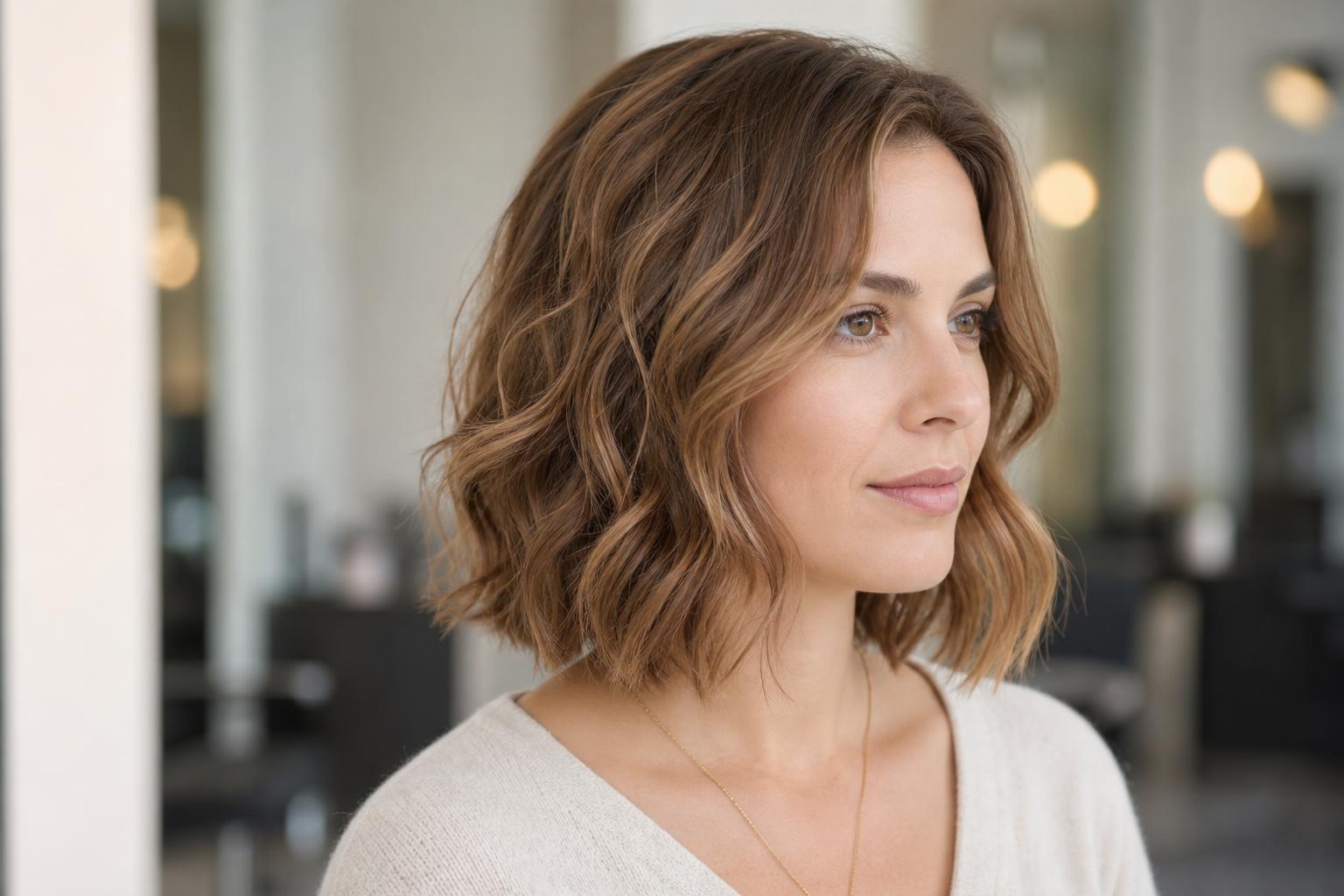
A light perm is built to relax, so the waves you walk out with on day one are the tightest they will ever be, and a good stylist plans for how they will look in week six.
A light perm uses large rods, usually from about 3/4 inch (19 mm) up to 1 1/4 inch (32 mm), and a gentler perm solution to give straight hair loose, open waves or soft body instead of defined curls. It typically lasts two to four months, loosening a little with every wash, and it grows out without a hard line because the wave is soft to begin with. It works best on healthy, uncolored or lightly colored hair of medium thickness, and it is a poor bet on bleached hair.
This guide explains what happens to your hair during a light perm, how it compares with a body wave and a digital perm, and how rod size and hair length change the result. It also covers the men’s version, who should skip it, the first 72 hours of aftercare, and the exact words to use at the salon.
| Factor | Details |
|---|---|
| Result | Loose S-waves or lift and bend, not ringlets |
| Rod size | Roughly 3/4 to 1 1/4 inch (19 to 32 mm) |
| How long it lasts | About 2 to 4 months, softening gradually |
| Salon time | Typically 1.5 to 3 hours depending on length |
| Best for | Straight or barely wavy hair, fine to medium, uncolored or single-process colored |
| Avoid if | Hair is bleached, recently relaxed or keratin-smoothed, or already breaking |
What a Light Perm Actually Does to Your Hair
Every perm, light or tight, works the same way. A reducing solution, usually a thioglycolate, breaks some of the disulfide bonds that hold your hair’s shape. The hair is wrapped around rods, so it takes on their curve while those bonds are open. A neutralizer then rebuilds the bonds in the new position. A study in PeerJ on how permanent waving changes the molecular structure of hair found that even a single perm penetrates deep into the strand and changes its internal keratin structure, which is why a perm is always a chemical commitment, however soft the result.
What makes a perm “light” is three choices made together: bigger rods, fewer or looser wraps, and often a milder or acid-balanced solution that processes more gently. The hair is not bent as sharply, so fewer bonds end up reset in a tight shape. That is also why the wave relaxes: a large, open curve has less holding it in place than a small, tight one.
Salons generally choose between two families of solution. Alkaline perms, often called cold waves, process faster and give a firmer result on resistant hair. Acid-balanced perms process more slowly and are gentler, which suits fine or color-treated hair. For a light perm, many stylists reach for the acid-balanced option, because the goal is softness rather than hold.
Stylist tip: Ask for a test curl on one section before the full service if your hair has any color on it. It takes about 20 extra minutes, and it shows how your hair takes the solution before every strand is committed.
Light Perm, Body Wave and Digital Perm Compared
“Light perm” is a salon description rather than a fixed technique, so it overlaps with a few named services. The quickest way to get what you want is to know which one your stylist is picturing.
| Service | What You Get | Wet or Dry Shape | Typical Lifespan |
|---|---|---|---|
| Light perm | Loose waves and movement through the lengths | Strongest when wet or scrunched | 2 to 4 months |
| Body wave | Volume and bend more than visible wave | Mostly shows as lift when dry | 6 to 12 weeks |
| Root perm | Lift at the scalp only, ends untouched | Lift shows when dry | 4 to 8 weeks, then grows away from the scalp |
| Digital perm | Soft, bouncy curls set with heated rods | Strongest when dry | Often 4 to 6 months or more |
| Spiral perm | Defined curls wound vertically | Defined wet and dry | 3 to 6 months |
The wet-or-dry column matters more than most people expect. A standard light perm looks its best when you scrunch product into damp hair and let it dry. If you mostly blow-dry straight and want the wave to show anyway, a digital perm fits that routine better. Our gallery of perms for short hair shows how each type looks on cropped and chin-length cuts.
Rod Size and Hair Length Decide How Loose the Wave Looks
The rod sets the diameter of the wave, but your hair length decides how that diameter looks once it dries. Long hair is heavy, and the weight pulls the wave open from the top down. Short hair has little weight, so the same rod gives a bouncier result. A stylist will often use a slightly smaller rod on long hair than a picture suggests, which surprises clients but is the right call.
| Rod Diameter | On Chin-Length Hair | On Shoulder-Length Hair | On Hair Past the Shoulder Blades |
|---|---|---|---|
| About 1/2 inch (13 mm) | Defined waves, close to curls | Clear S-waves | Medium waves after the weight drops them |
| About 3/4 inch (19 mm) | Soft, open waves | Classic light perm | Loose waves, mostly in the lower half |
| About 1 inch (25 mm) | Bend and volume | Loose, beachy movement | Very soft bend at the ends |
| About 1 1/4 inch (32 mm) | Lift more than wave | Body wave effect | Little visible change once dry |
Layers change the picture too. On one-length hair, the wave collects at the bottom and the top stays flat. Long or face-framing layers let the wave start higher and spread through the whole shape, so if your hair is all one length, book a cut with layers before or on the same day as the perm.
A Light Perm for Men Usually Means the Top Only
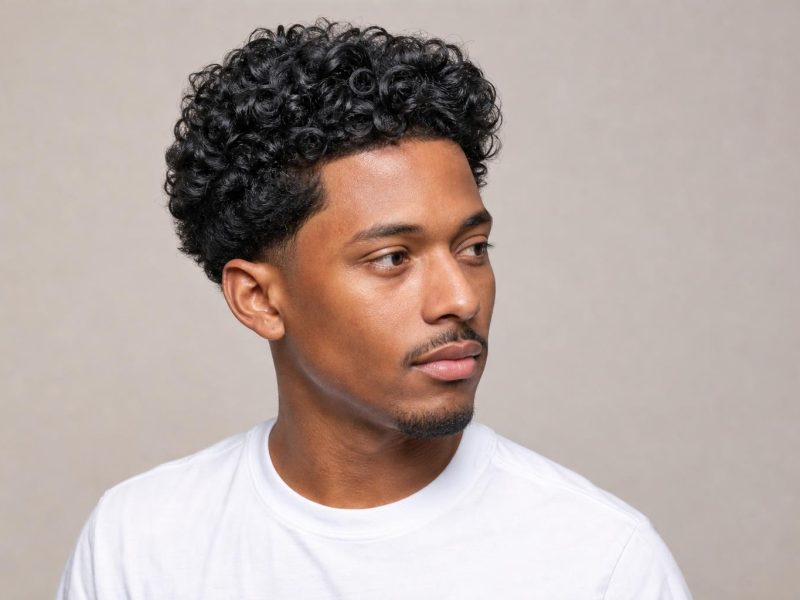
In barbershops, a light perm almost always targets the top section, usually hair that is 3 to 5 inches long, while the sides stay clipper-short. The result is the loose, textured top seen in Korean-style cuts, and it pairs naturally with a two-block haircut, where the long top falls over a disconnected short side. Rods for men’s light perms tend to be on the smaller end, around 1/2 to 3/4 inch, because short hair needs a tighter wrap to show any wave at all.
The men’s version has one practical advantage: it gets cut out. Every trim removes permed ends, so after two or three haircuts the top is back to straight, with no grow-out stage to manage. A textured crop is the no-chemical alternative if you want messy texture without committing to a perm, though it relies on product every morning.
Which Hair Types a Light Perm Suits
The best candidate is hair that is straight, holds no curl on its own, and has not been lightened. The table below covers the common situations stylists see at consultation.
| Your Hair | Light Perm Outlook | What to Ask For |
|---|---|---|
| Fine and straight | Good; takes the wave easily and gains volume | Acid-balanced solution, larger rods, shorter processing |
| Medium, straight or slightly wavy | The best match | Either solution; rod size by length |
| Thick and coarse | Possible, but may resist a soft wave | Alkaline solution and layers to remove bulk |
| Single-process colored | Usually fine with a test curl | Gentle solution; color after the perm, not before |
| Highlighted or bleached | High risk of breakage and frizz | Skip it, or perm only the unlightened roots area |
| Relaxed or keratin-treated | Not suitable until treated hair grows out | Heat styling or rollers instead |
If you are not sure how your hair handles moisture and chemicals, a quick hair porosity test at home gives a useful clue. High-porosity hair absorbs perm solution fast and can over-process, which is worth telling your stylist before they start.
The First 72 Hours and the Months After
The neutralizer keeps working quietly for a day or two after you leave the salon. For the first 48 hours, keep your hair dry and loose: no washing, no tight ponytail, no clips that dent the hair, and no flat iron. Sleeping on a silk or satin pillowcase keeps the fresh wave from being crushed on one side.
After that, the routine is closer to caring for natural waves than for straight hair. Wash with a gentle, sulfate-free shampoo, condition every time, and apply a light curl cream made for wavy hair or mousse while the hair is soaking wet. Scrunch, then air-dry or use a diffuser attachment on low heat. Brushing dry hair pulls the wave straight and adds frizz, so detangle only in the shower with conditioner in.
Expect the wave to be at its firmest for the first two to three weeks and noticeably softer by month two. Most people either let it fade out by month four or book a new perm on the regrowth. Repeating a perm over hair that is already permed is where damage builds up, so ask for the new solution on the new growth only.
Stylist tip: Don’t judge the result until your first wash. The wave straight out of the salon is set and a bit stiff; it settles into its real shape after the first shampoo and air-dry, usually looser and softer than it first looked.
What to Tell Your Stylist
Bring two photos: one of the wave you want when it is air-dried, and one of a result you do not want, such as tight curls. Then use plain, specific language:
- “I want a light perm with loose, open waves, not defined curls.”
- “I’d like it to look like this when I scrunch and air-dry, because I don’t blow-dry most days.”
- “My hair has had color in the last year, so please do a test curl and use the gentlest solution that will hold.”
- “Can we add long layers first, so the wave starts around my cheekbones instead of only at the ends?”
Ask how long the wave should last on your hair and when you should come back. A stylist who answers with a specific number of weeks, based on your hair, is usually a stylist who perms often.
When a Light Perm Is Not the Right Choice
A light perm is gentle compared with a spiral perm, but it is still a chemical service. It is the wrong choice in these situations:
- Bleached or heavily highlighted hair. Lightened hair has already lost strength, and perm solution on top can cause breakage. Overnight heatless curls or a curling wand give a similar wave with no chemical risk.
- Hair that is shedding or breaking. Fix the cause first. A perm adds stress to strands that are already weak.
- You want waves only on special occasions. Hot rollers or a large-barrel curling iron give you the look when you want it, without months of commitment.
- Hair that already waves on its own. A 2a or 2b texture often just needs the right cut and a diffuser to show the wave it already has.
Light Perm Myths
Two beliefs cause most of the disappointment with light perms.
Myth: A Light Perm Doesn’t Damage Hair
Reality: It is gentler than a tight perm, but it still breaks and rebuilds bonds inside the hair. On healthy hair the change is usually minor, and good aftercare keeps it that way. On already-weak hair, it can be the thing that tips it into breakage.
Myth: A Light Perm Will Wash Out Completely
Reality: The wave softens, but the permed hair never returns fully to its original straightness. What disappears is the visible wave, as the hair relaxes and new straight growth comes in. The permed ends keep a slight bend until they are cut off.
FAQ
How Long Does a Light Perm Last?
Most light perms last two to four months. The wave is strongest in the first few weeks and softens gradually, so by month three many people have only a gentle bend at the ends. Shorter hair and frequent trims shorten that window.
Is a Light Perm the Same as a Body Wave?
Not quite, though the two overlap. A body wave uses the largest rods and gives lift and bend more than a visible wave, while a light perm usually uses slightly smaller rods and gives recognizable loose waves. Ask your stylist which one matches your photo.
Can You Get a Light Perm on Colored Hair?
Yes, if the color is single-process and the hair is in good condition. Bleached or highlighted hair is a different story and often too fragile. Book the perm first and add color about two weeks later, since perming after coloring can shift the shade.
How Soon Can I Wash My Hair After a Light Perm?
Wait about 48 hours. The bonds are still settling after the neutralizer, and water or shampoo too early can loosen the wave. Your stylist may give a slightly different number depending on the product used.
Does a Light Perm Work on Fine Hair?
Fine hair usually takes a light perm well and gains noticeable volume from it. The main risk is over-processing, because fine strands absorb solution quickly, so a gentle acid-balanced solution and careful timing matter more than on thicker hair.
Will a Light Perm Look Frizzy?
It can if you brush it dry or skip conditioner, since the wave pattern separates and puffs. Styling product applied to soaking-wet hair, then scrunching and air-drying or diffusing, keeps the waves smooth.
A light perm gives straight hair soft movement for a few months, as long as you plan for the wave to relax and choose rods for your length, not just for the photo. Book a layered cut alongside it, ask for a test curl if your hair has any color, and leave it alone for 48 hours afterward. The first wash will show you the wave you actually bought.
Hair results vary based on your natural hair type, texture, density, and condition. Always consult with a licensed hairstylist before making significant changes, especially with chemical treatments or dramatic length changes. Photos may show styled results that require professional tools and products to replicate.



1 response