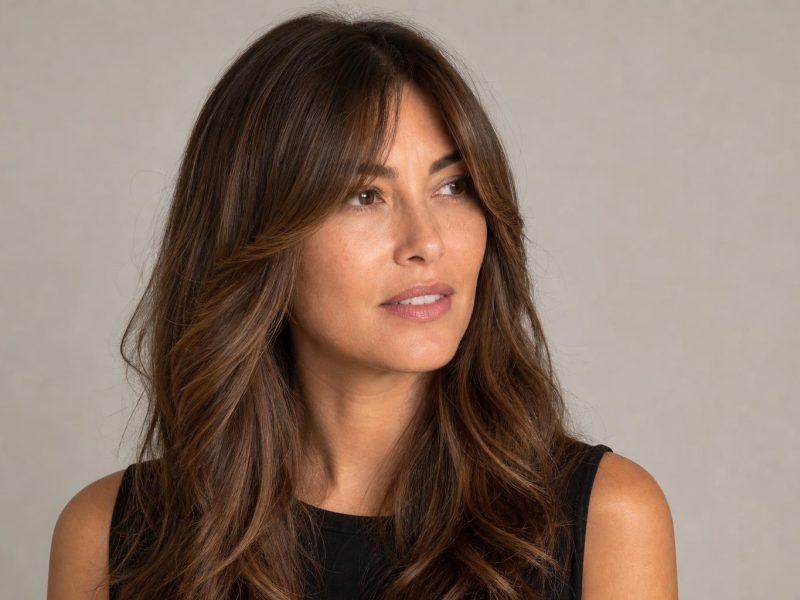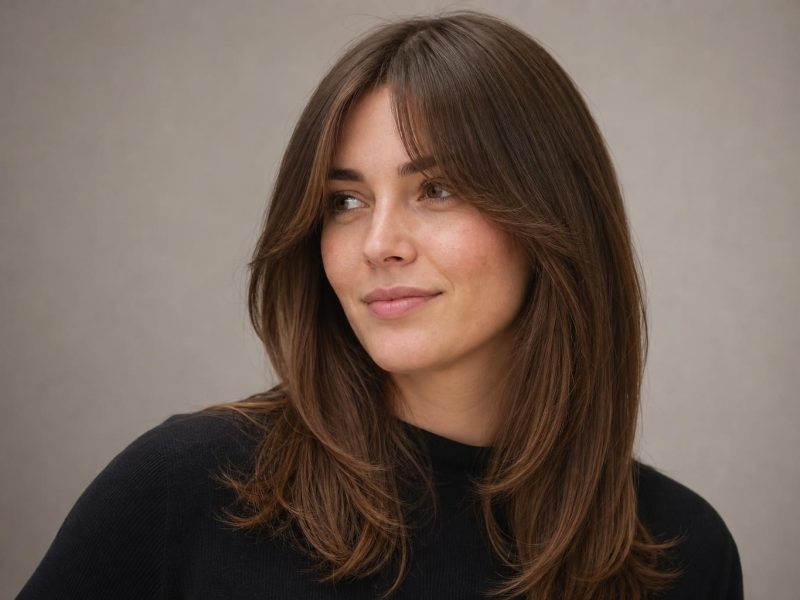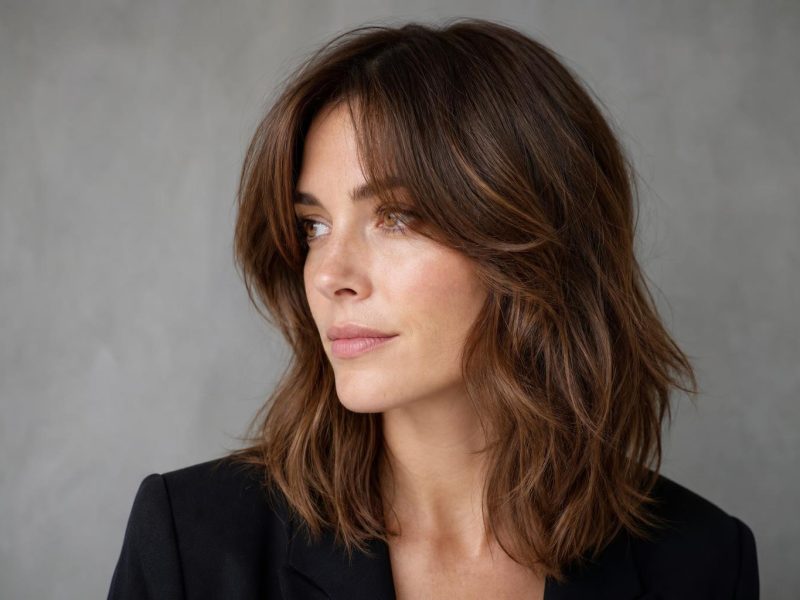


Wolf cut with bangs works because the cut’s built-in volume at the crown and longer length at the ends gives bangs something to frame, and the choppy layering through the mid-lengths connects the bang to the rest of the silhouette rather than leaving it as a separate element stuck to the forehead.
The 25 variations here are organized by bang type: entries 1 through 8 cover curtain bangs (the most popular combination), entries 9 through 14 cover wispy and airy bangs, entries 15 through 19 cover blunt and statement bangs, entries 20 through 22 cover bottleneck bangs, and entries 23 through 25 cover micro bangs and bold fringe options. Each entry specifies the bang type, the hair texture it suits best, and the face shapes it flatters. Guidance sections on face shape compatibility, hair texture, salon language, maintenance, and when the combination needs modification follow the gallery.
| Factor | Details |
|---|---|
| Most popular combination | Curtain bangs with a medium-length wolf cut on wavy or straight hair |
| Best face shapes | Oval and heart face shapes suit all bang types; curtain bangs balance round and square faces; blunt bangs narrow oblong faces |
| Best hair textures | Wavy and straight hair: all bang types. Curly hair: wispy or curtain bangs only. Fine hair: wispy bangs. Thick hair: blunt or bottleneck bangs |
| Maintenance | Bang trim every 3 to 5 weeks; full wolf cut refresh every 10 to 14 weeks |
| Styling time | 10 to 15 minutes with texturizing spray and diffuser or blow-dry |
Wolf Cut with Curtain Bangs
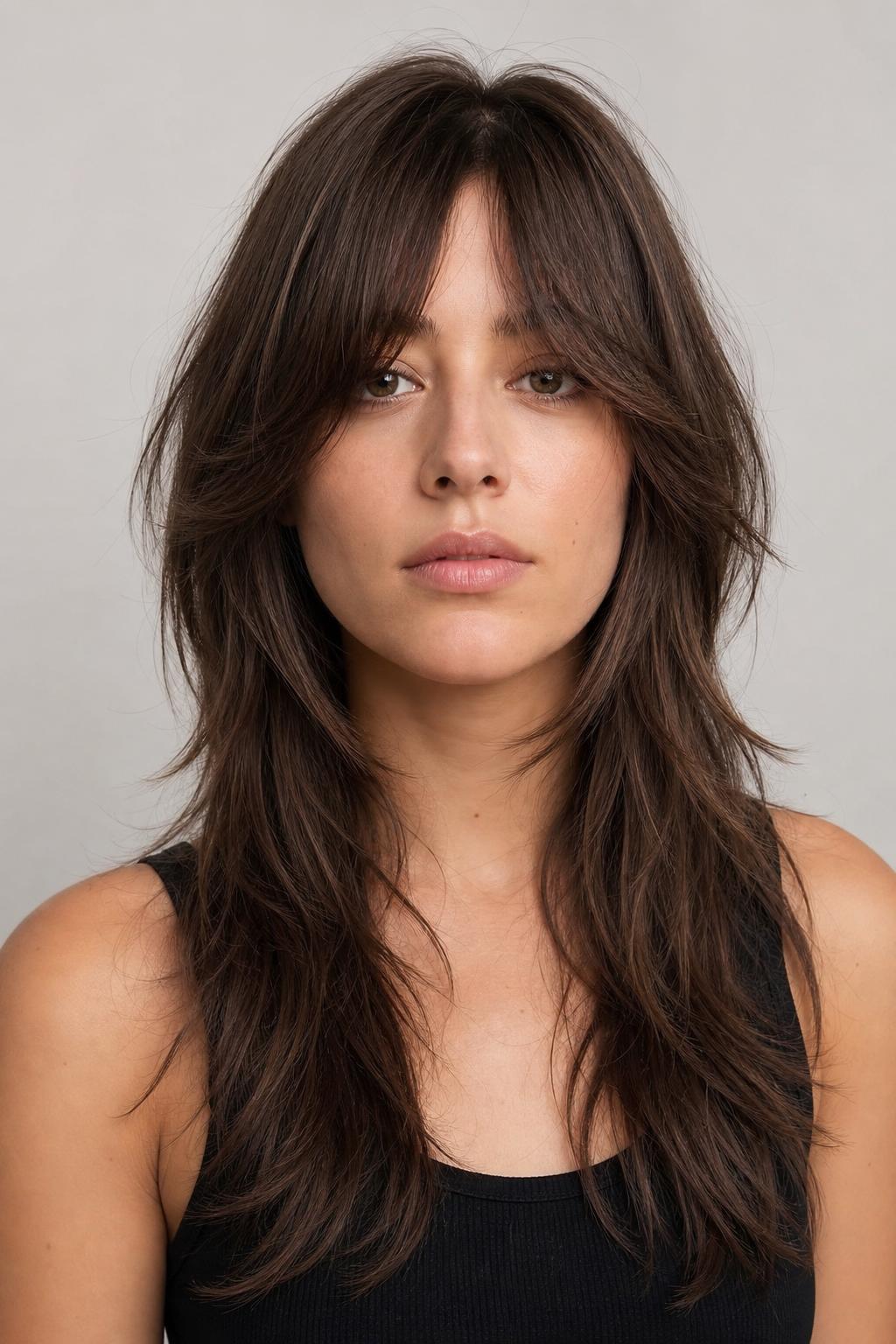
Curtain bangs part at the center and sweep outward toward the temples, giving them the same outward-flowing direction as the wolf cut’s face-framing layers. This alignment between bang and cut is why the curtain bang and wolf cut combination is more cohesive than pairing a wolf cut with bangs that fall straight down — the movement matches. The eight variations below cover different curtain bang lengths, densities, and base lengths from short to long wolf cuts.
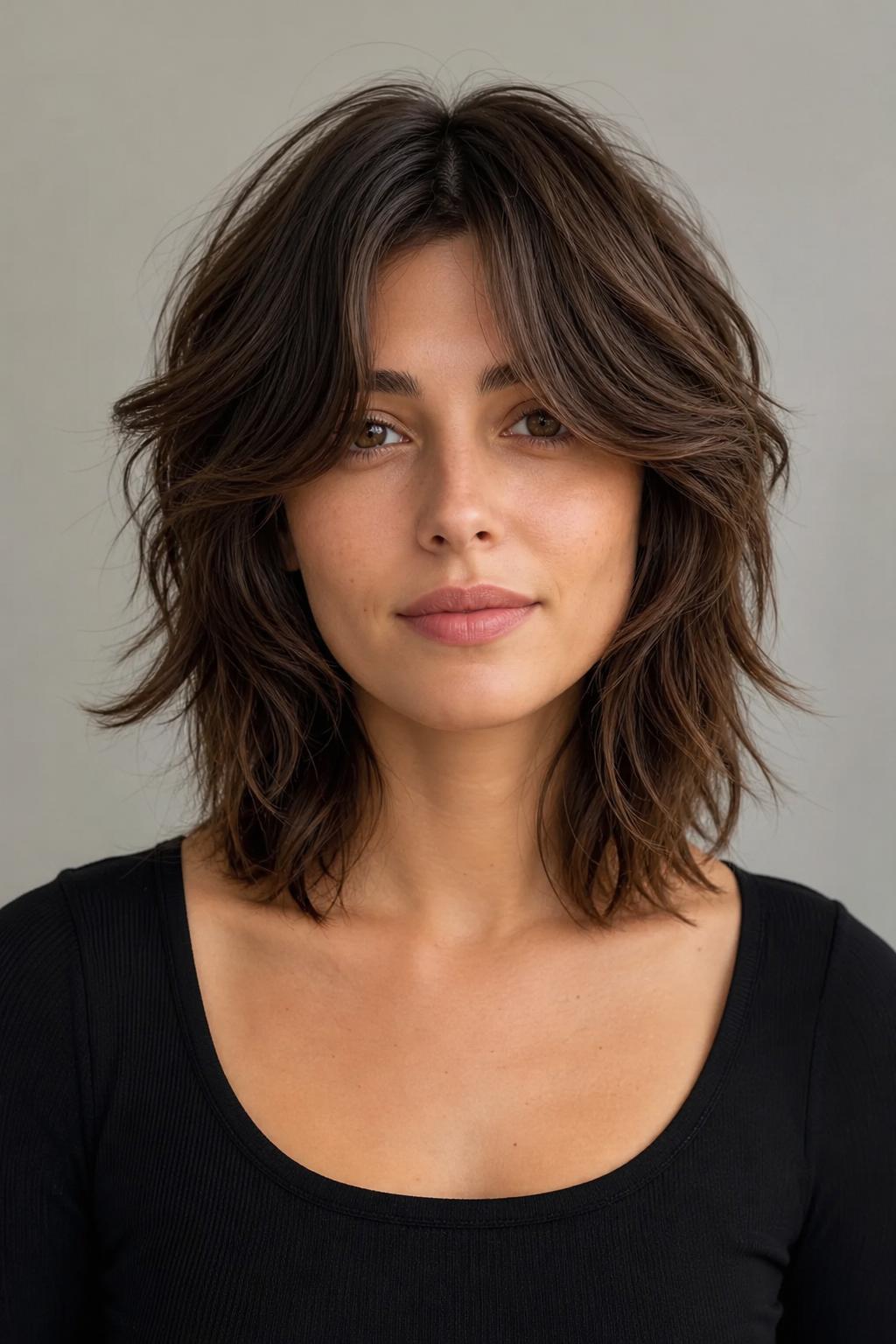
1. Medium Wolf Cut with Classic Curtain Bangs
Classic curtain bangs on a medium wolf cut land at eyebrow level at the center and sweep to the outer eye corner, with the bang blending seamlessly into the face-framing layers on each side. Wavy hair carries this combination particularly well because the natural bend in the bang sweeps outward without needing heat styling. For oval and heart face shapes, this is the lowest-risk entry point into the wolf-cut-with-bangs combination because the curtain sweep softens the forehead without narrowing or widening the face disproportionately.
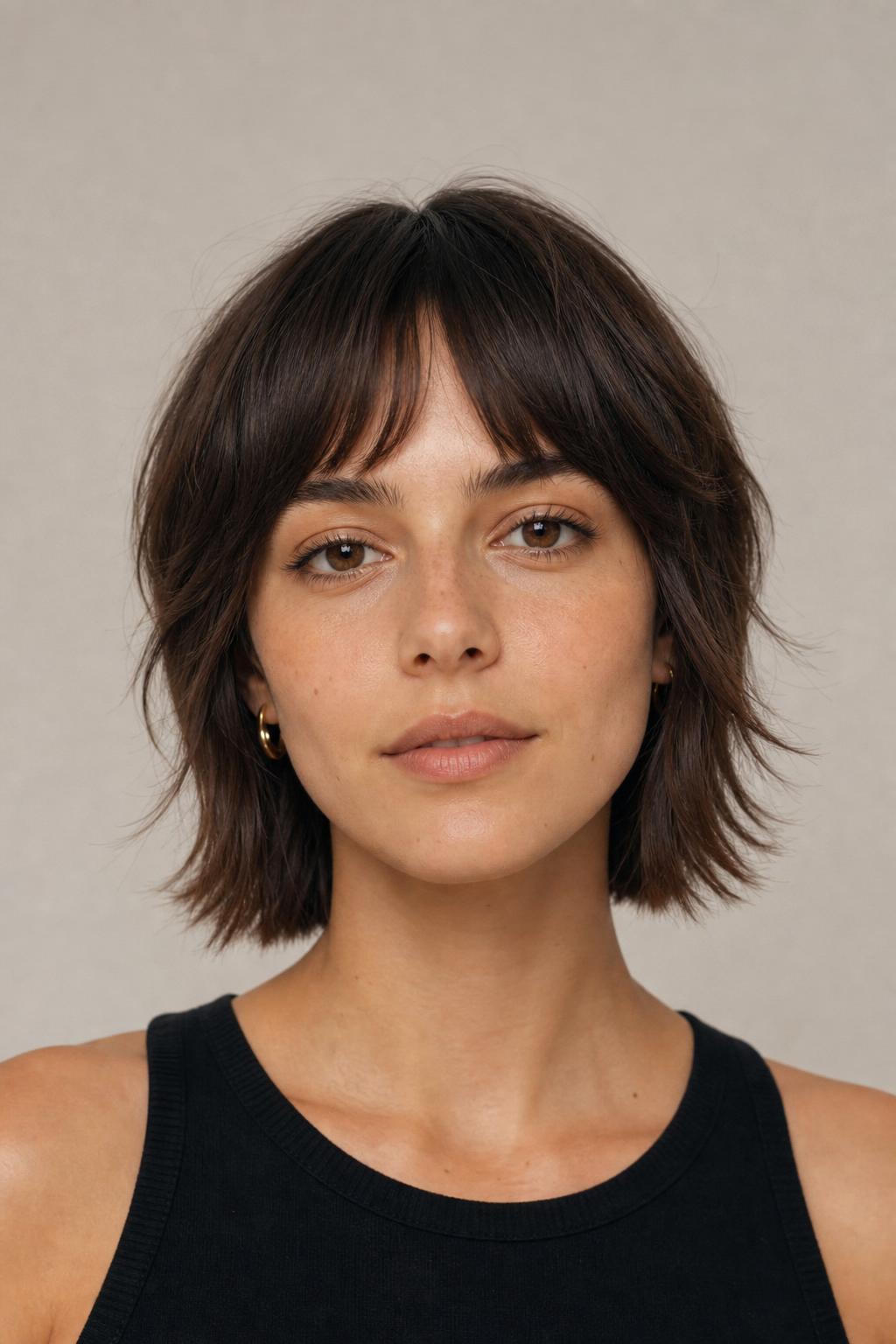
2. Short Wolf Cut with Cropped Curtain Bangs
A short wolf cut at the jaw or neck, paired with curtain bangs that land above the brow rather than at it, creates a bold geometric proportion — the bang frames the upper face tightly while the rest of the cut emphasizes the jaw and cheekbones. Straight hair holds this combination best since the short length requires clean, structured movement that wavy hair can sometimes disrupt. Square face shapes benefit particularly from the curtain sweep at a short length, as the outward movement at the brow softens the angular jawline without adding vertical bulk.
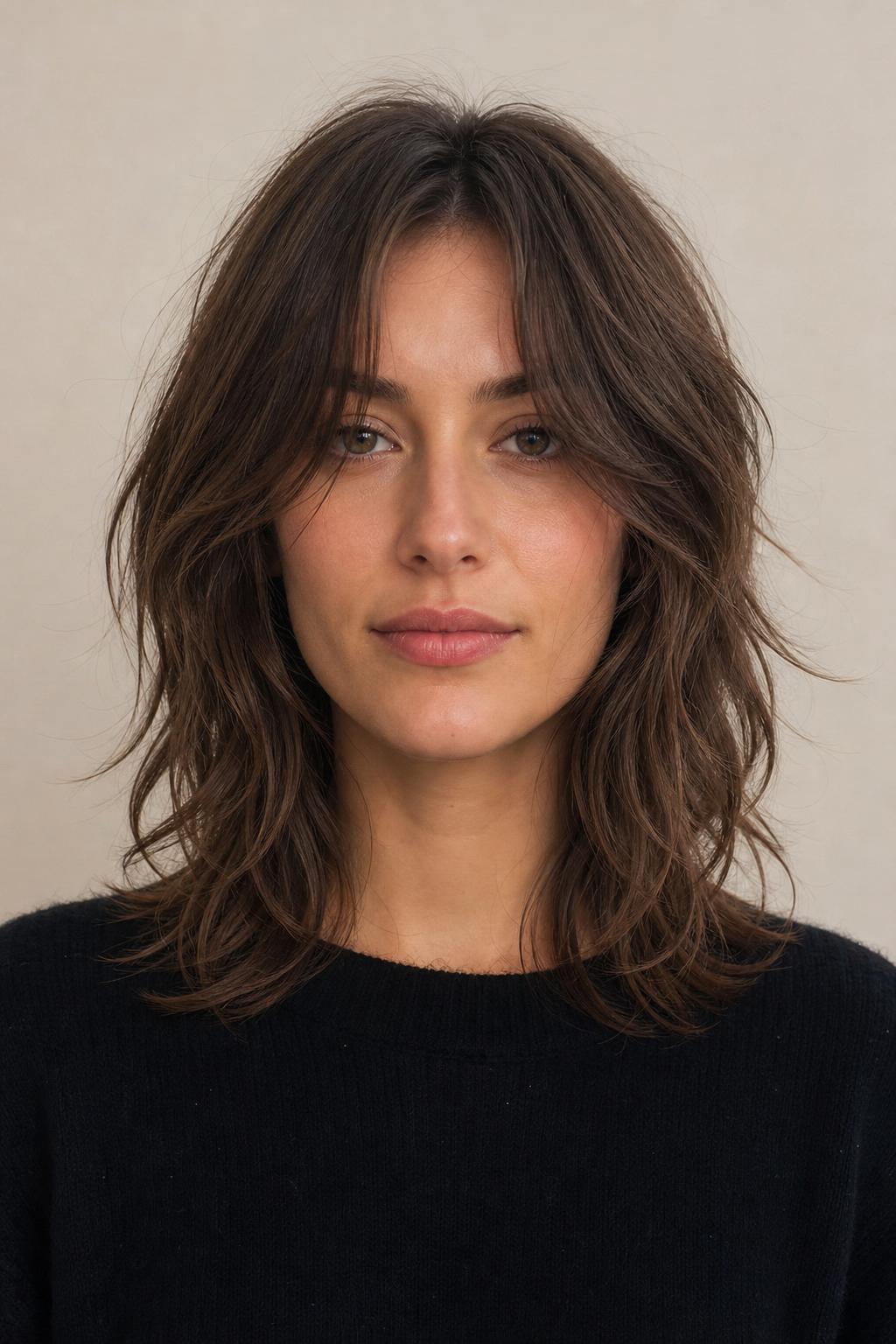
3. Long Wolf Cut with Extended Curtain Bangs
Extended curtain bangs land below the outer eye and merge into the face-framing layered sections of a long wolf cut, creating a continuous sweeping movement from forehead to collarbone. The longer the bang, the more it reads as a layer rather than a fringe, which suits clients who want the curtain bang aesthetic without committing to a visually distinct fringe line. On wavy and curly long hair, extended curtain bangs require a round brush or diffuser to direct the wave outward rather than forward toward the face.
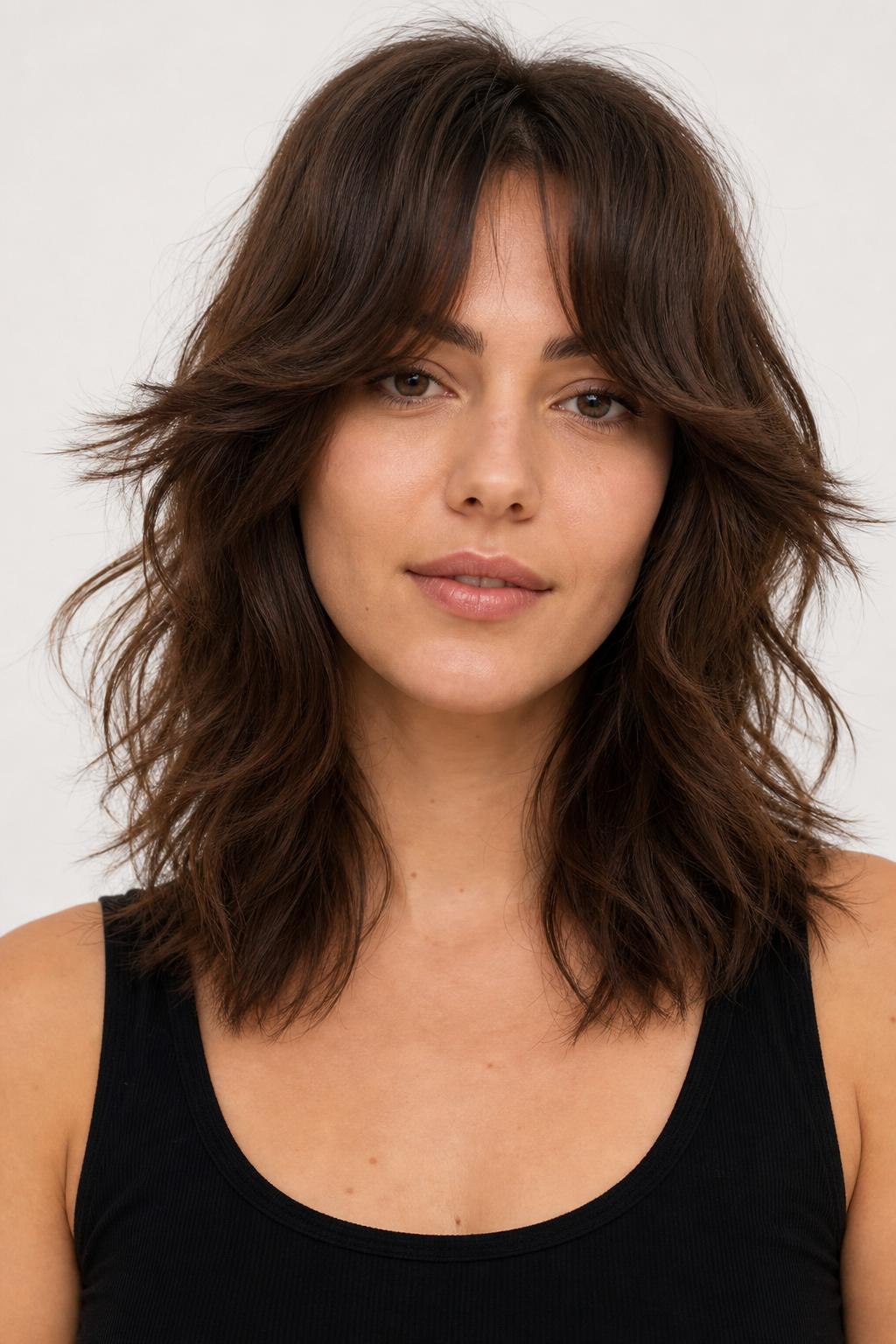
4. Wolf Cut Curtain Bangs on Wavy Hair
Wavy hair with a wolf cut and curtain bangs is the combination that defined the style’s viral spread, largely because the wave in the bang naturally sweeps outward and the layers through the mid-lengths create movement that photographs with strong visual appeal. The key difference between wavy and straight curtain bangs is that wavy bangs should be cut slightly longer than a straight bang because the wave shortens the effective length, what falls to the brow on straight hair falls to the upper lid on a wavy section of equal physical length. Ask the stylist to cut the bang dry after blow-drying to account for the wave pattern before trimming.
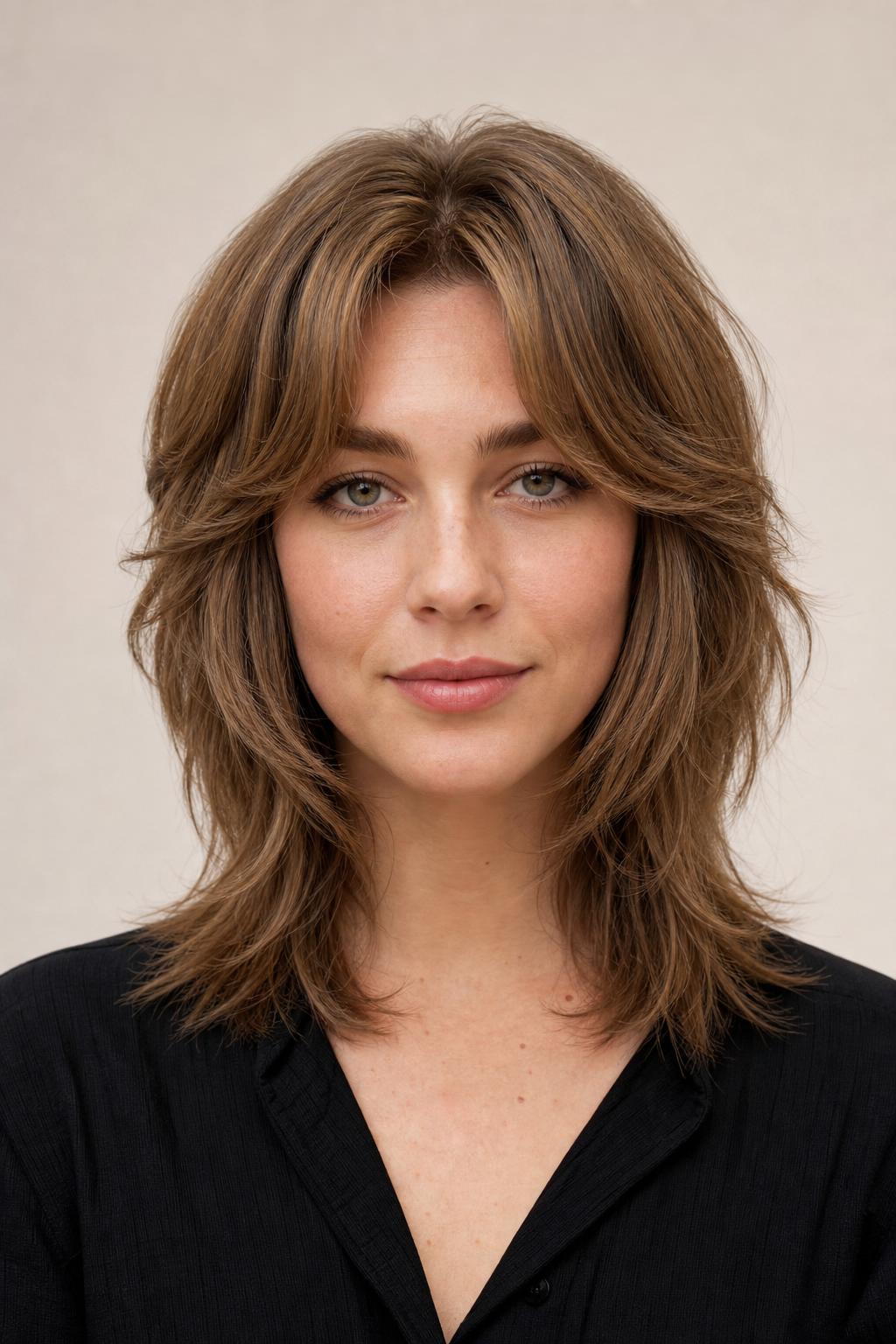
5. Wolf Cut Curtain Bangs on Fine Hair
Fine hair benefits from curtain bangs on a wolf cut because the bang creates density at the forehead that the rest of the fine-hair wolf cut may lack at the root. The styling trick for fine-hair curtain bangs is to use a round brush to add lift at the root of the bang while directing the ends outward, which gives the optical impression of more hair at the crown. Keep the bang density moderate rather than thick, a very dense curtain bang on fine hair requires more hair from the front sections, which can thin the sides and create a visually uneven volume distribution.
6. Wolf Cut with See-Through Curtain Bangs
See-through curtain bangs are a very thin version of the classic curtain bang, with enough transparency that the skin of the forehead shows through the fringe. On a wolf cut, they add a delicate, soft-focus element to the front of the cut while keeping the overall silhouette as dramatic as a full bang would. This style suits oval and oblong faces especially well, as the thin fringe adds a visual horizontal at the forehead without shortening the face the way a dense curtain bang does. Thin hair naturally produces a see-through bang without effort; thick hair requires significant thinning at the bang to achieve the effect.
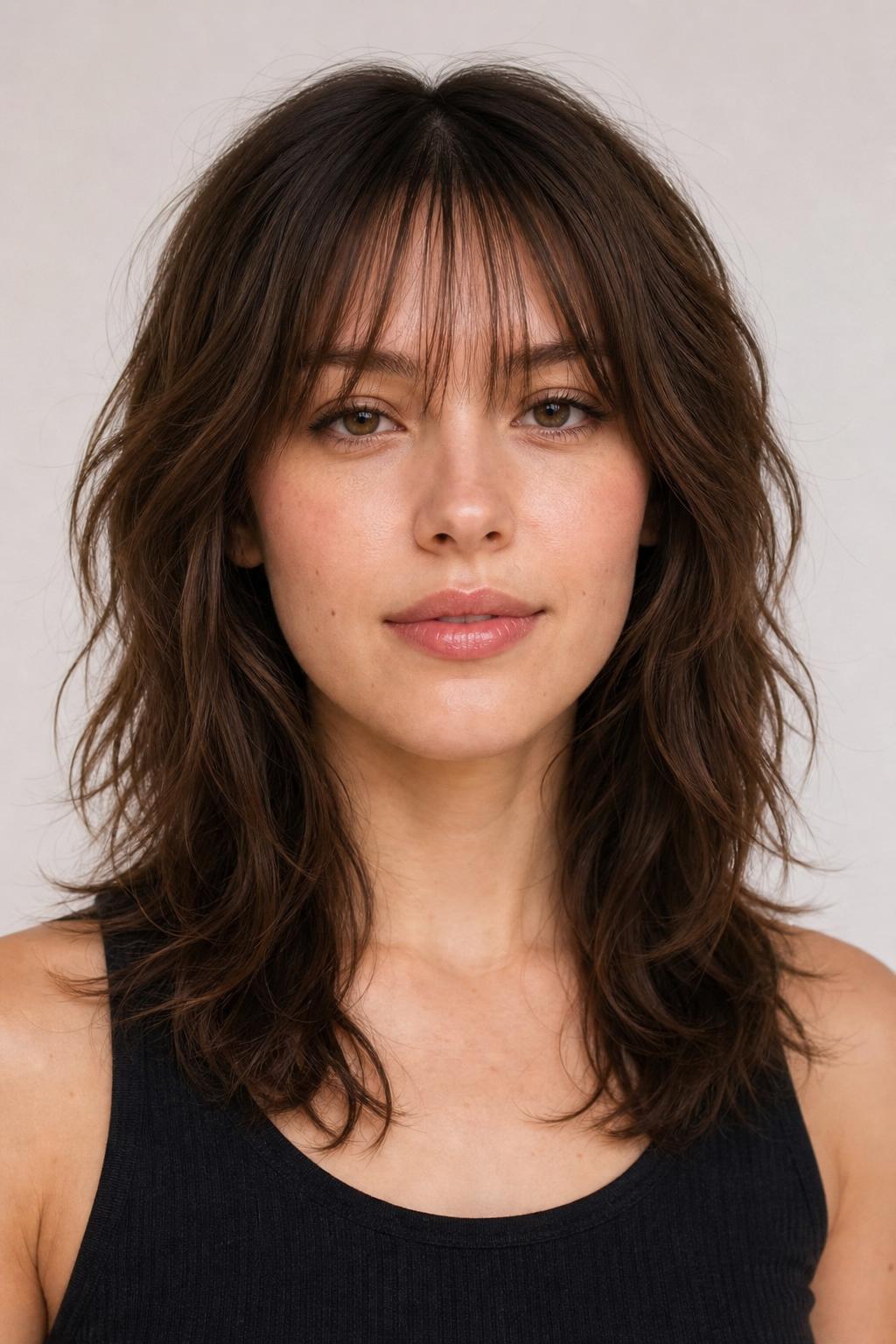
7. Wolf Cut with Long Curtain Bangs Swept to One Side
Curtain bangs on a wolf cut can be styled with more weight to one side than the other, creating a slightly asymmetric face frame where one eye is more exposed than the other. This one-sided sweep works particularly well for oval and diamond face shapes where a centered part would leave both sides of the forehead symmetrically open, the off-center placement adds visual interest and creates a more editorial framing than the standard center-parted curtain look. Heat-styling the bang to fall toward the more open eye works best, since the curtain bang’s natural direction tends to part at the center without encouragement.
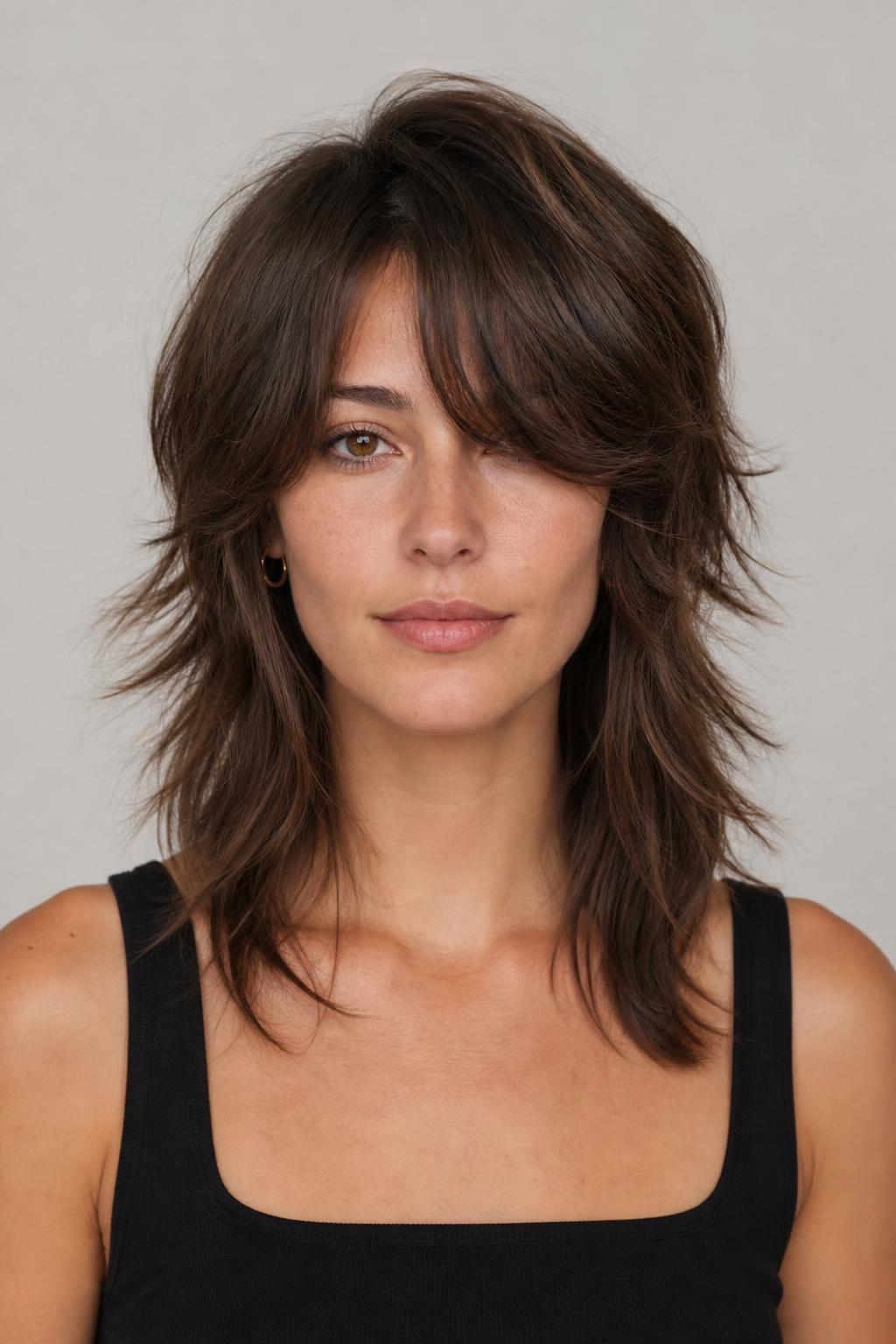
8. Wolf Cut Curtain Bangs on Natural Curly Hair
Curly curtain bangs on a wolf cut require a specialized cutting technique: the bang should be cut while dry (not wet) to account for shrinkage, and the ends should be point-cut rather than blunt-trimmed to let the curl spiral naturally rather than puffing into a triangle. On type 3 and 4 curls, a curtain bang typically needs additional diffusing to direct the curl outward rather than forward, since the natural curl spring can push the bang toward the face rather than away from it. Keep the bang density low on curly hair, thick curly bangs at the forehead stack and create disproportionate volume at the top of the face.
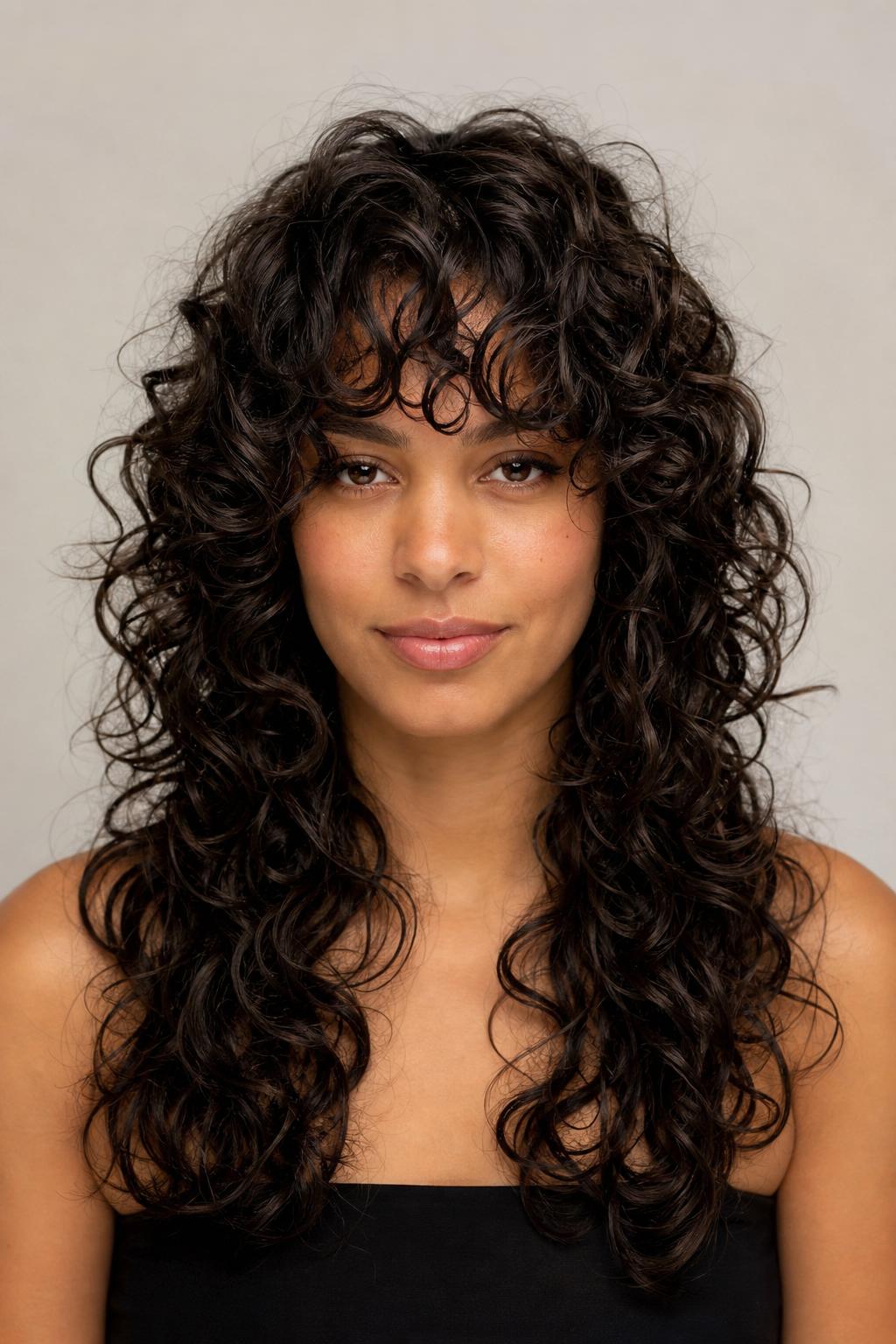
Wolf Cut with Wispy and Airy Bangs
Wispy bangs are thin, texturized fringes with feathered or point-cut ends that create a soft, delicate line across the forehead rather than a dense block of hair. On a wolf cut, wispy bangs emphasize the cut’s natural diffuse, lived-in quality — the thin fringe mirrors the sparse, textured ends in the rest of the cut. The six variations below move from ultra-thin wispy bangs to slightly denser airy styles.
9. Classic Wispy Bangs on a Medium Wolf Cut
Classic wispy bangs on a medium wolf cut land at the brow with soft, feathered ends that catch the light without creating a hard visual line. The bang looks as if it grew into its current state rather than being cut to a precise length, which aligns with the wolf cut’s own emphasis on grown-in texture. Fine hair naturally produces this effect; thick hair requires point-cutting and texturizing shears throughout the bang to reduce the density before the ends reach the wispy quality.
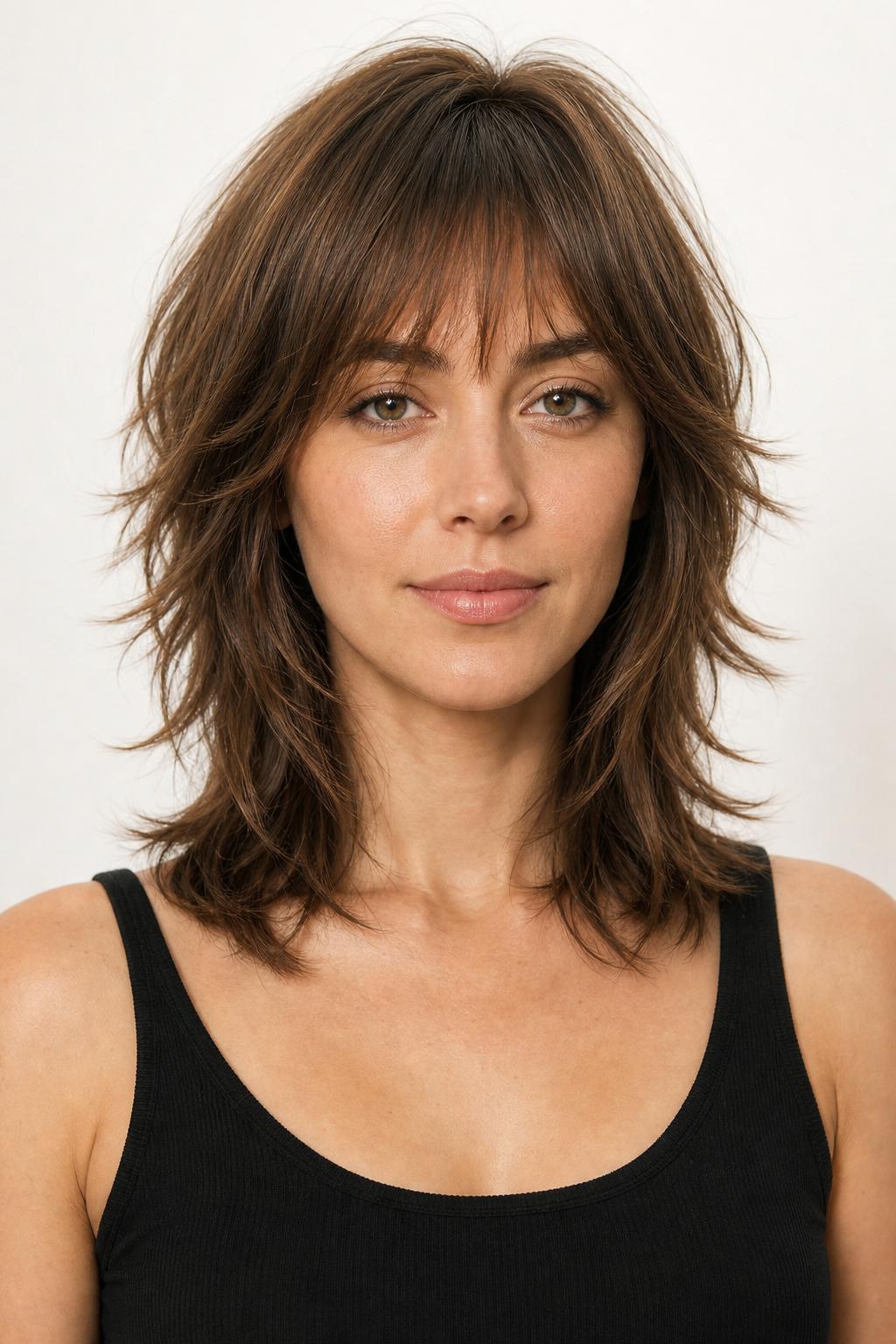
10. French Fringe Wispy Variation
A French fringe is a short, center-parted wispy bang that ends above the brow rather than at it, exposing more of the forehead than a standard curtain bang while still framing the upper face. On a wolf cut, the French fringe adds a vintage editorial quality because the short, delicate bang contrasts with the long, voluminous back sections of the cut. Round and square face shapes benefit from the French fringe’s length, ending above the brow opens the forehead and lengthens the face visually, counterbalancing the width in the lower face.
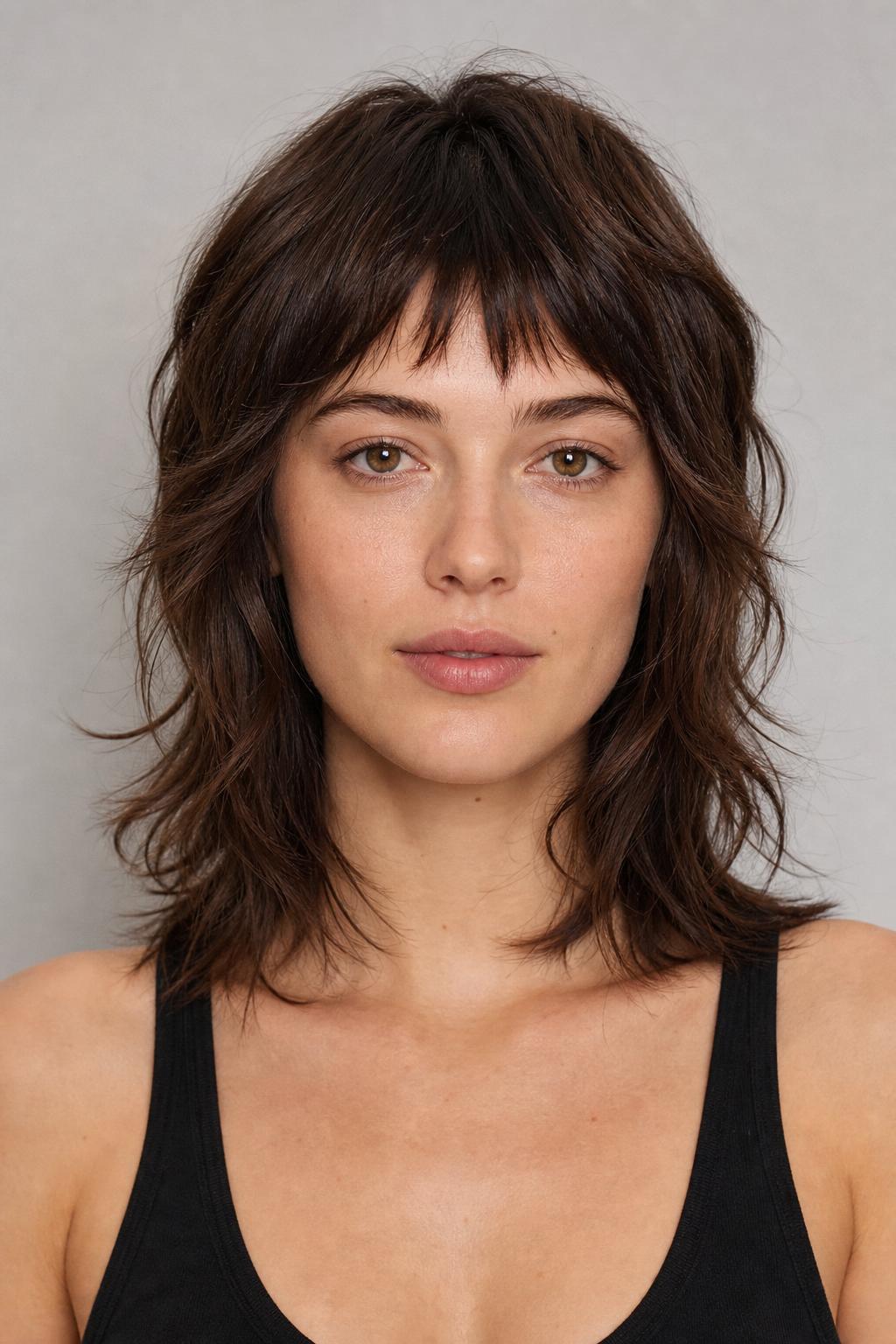
11. Airy Wolf Cut with Side-Swept Wispy Bangs
Side-swept wispy bangs sweep across the forehead from a side part, covering one eye partially and leaving the other side of the forehead open. On a wolf cut, this creates an asymmetric face frame where the side with the swept bang has softness and cover while the open side shows the face-framing layers of the cut. Heart and oval face shapes suit side-swept bangs on the wolf cut best; diamond faces should be cautious, as covering one high cheekbone with the sweep can create an uneven emphasis at the widest part of the face.
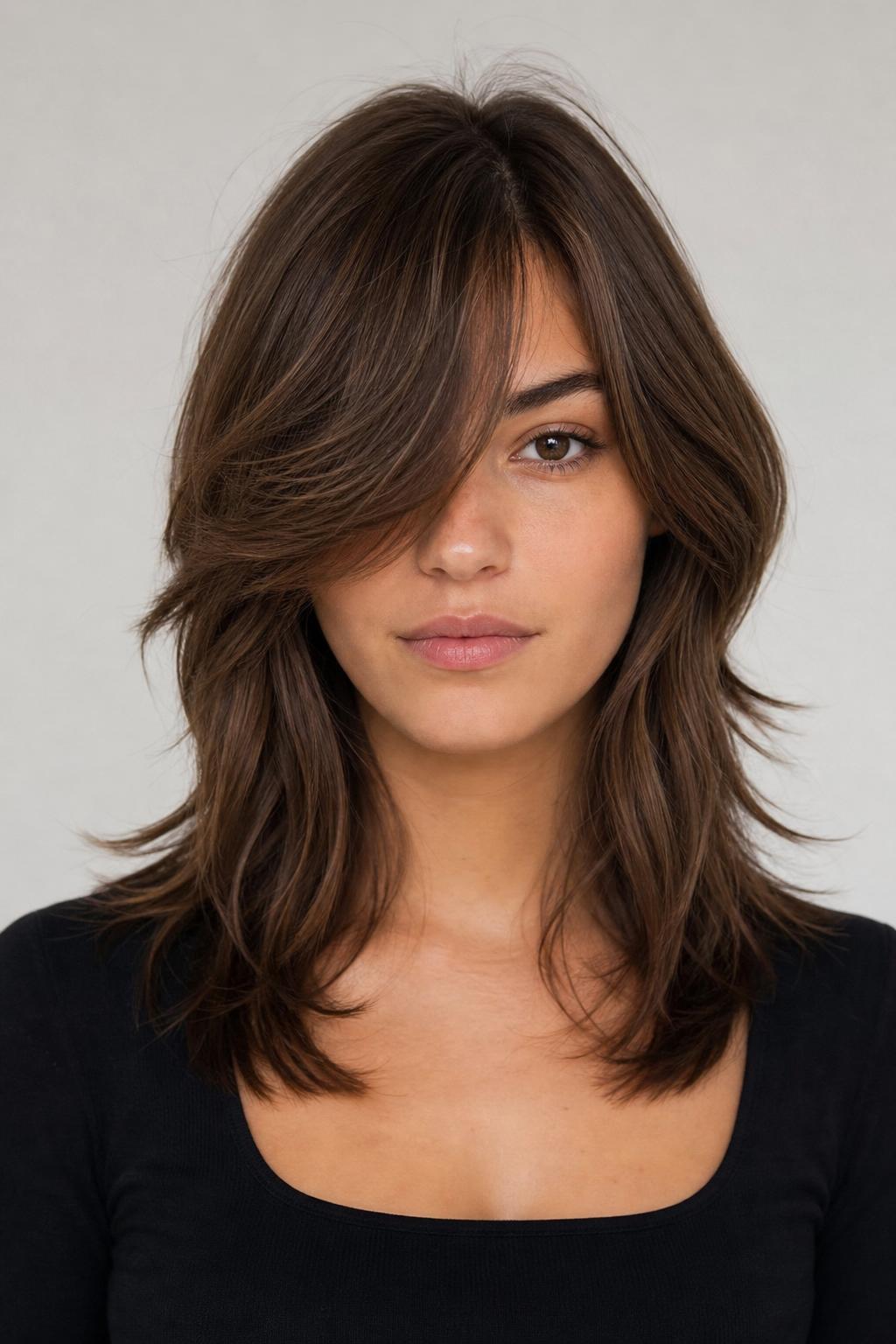
12. Wolf Cut with Piece-y Textured Bangs
Piece-y bangs separate into individual strands rather than laying as a unified curtain or fringe, giving the forehead a textured, dimensional look rather than a single horizontal element. Achieving piece-y texture in the bang requires either naturally fine hair or the application of a light pomade or clay worked through the bang with fingers to separate the sections. On a wolf cut, piece-y bangs enhance the cut’s emphasis on individual strand texture and work best on straight and slightly wavy hair where the separated sections maintain their individual shape without clumping.
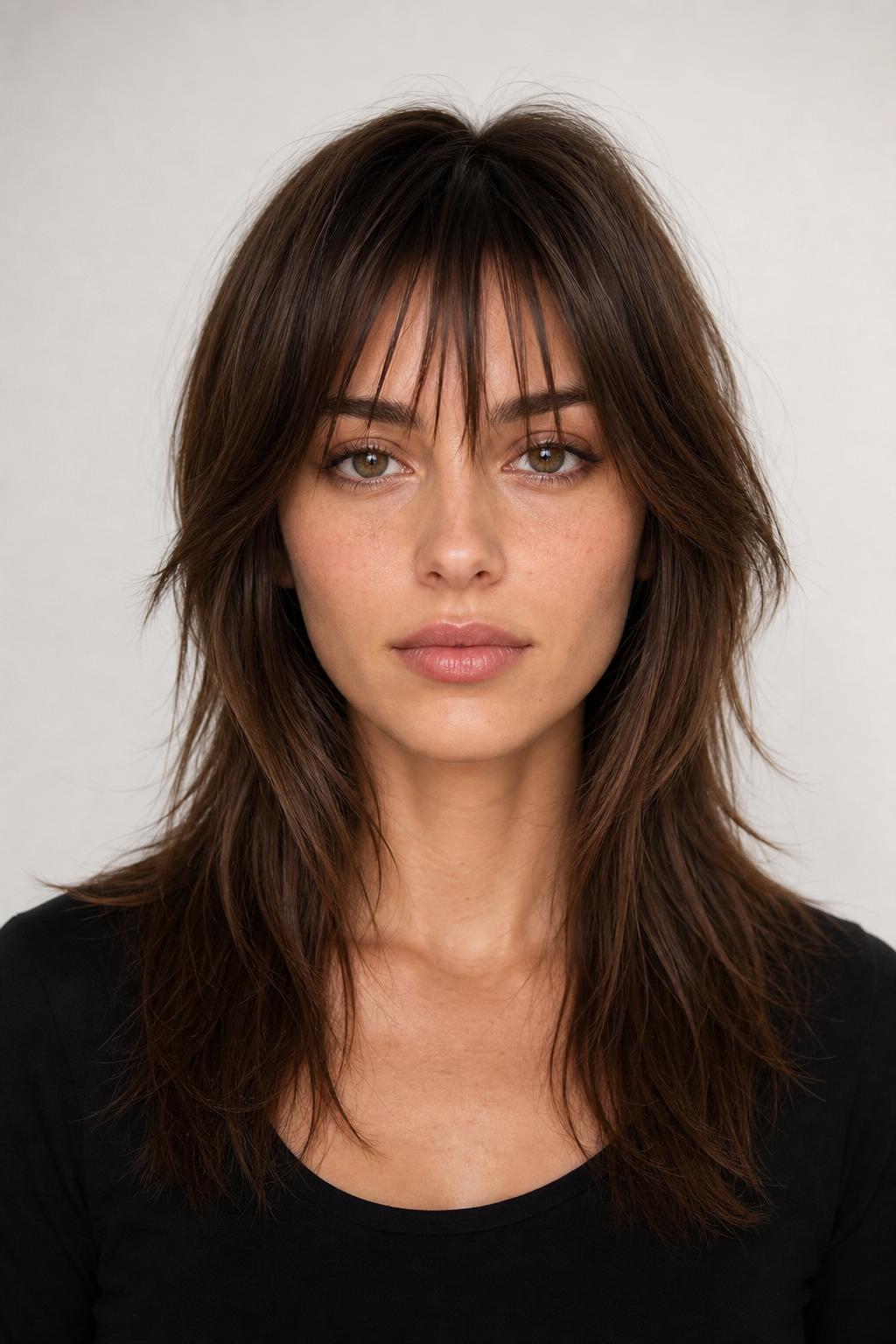
13. Wolf Cut with Feathered Bangs
Feathered bangs use a razor or texturizing shears to thin the ends of the fringe into a soft, graduated point, giving the bang a 1970s-adjacent quality that aligns with the wolf cut’s own retro-influenced silhouette. The feathering technique removes bulk from the bang’s ends specifically rather than from the whole bang section, which means the bang retains its density at the roots while becoming progressively lighter toward the tip. Thick and medium hair responds best to feathering; fine hair is often already naturally feathered and does not benefit from additional thinning at the ends.
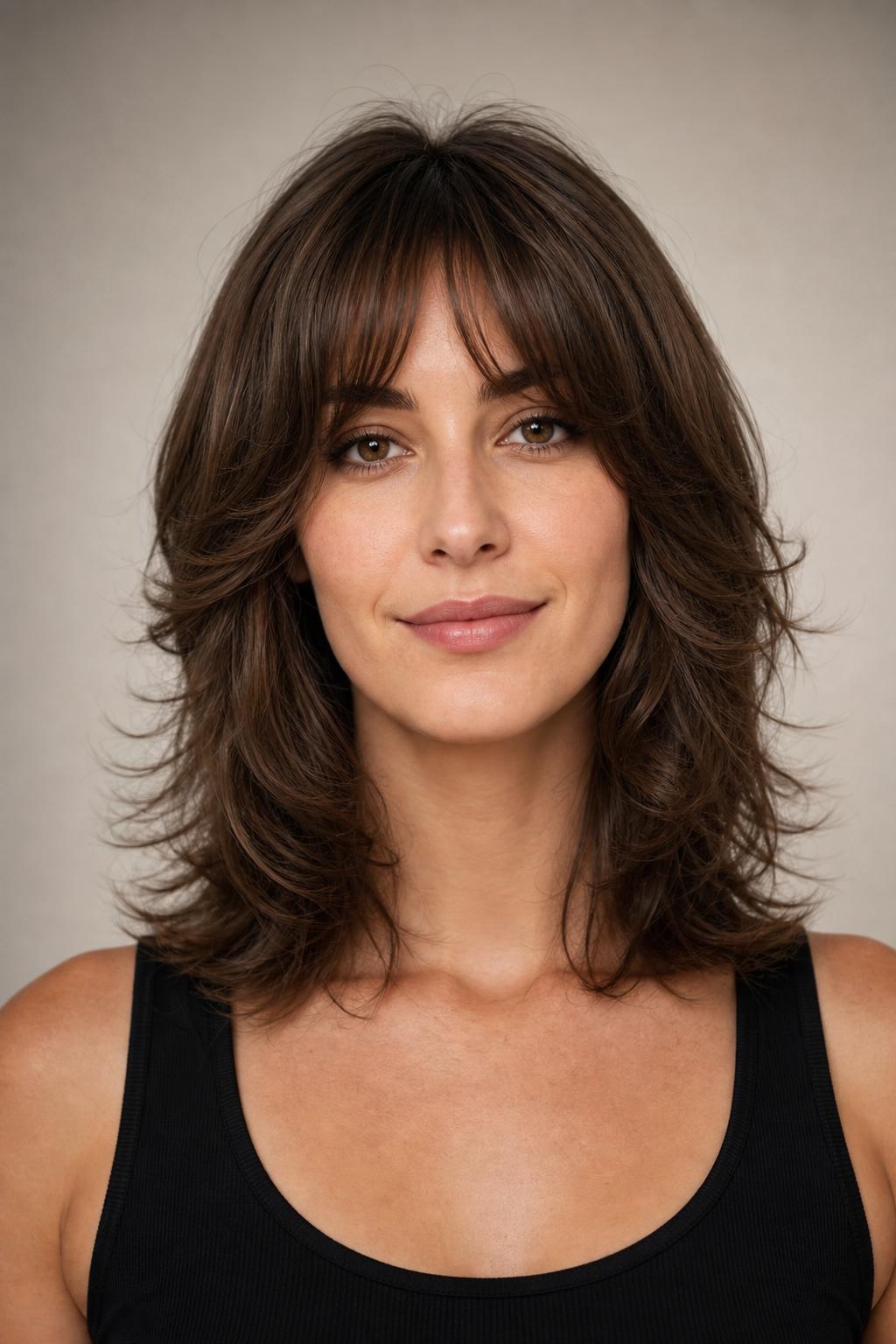
14. Long Wispy Bangs Blending into Wolf Cut Layers
Very long wispy bangs that reach the cheekbone or below effectively eliminate the distinction between “bang” and “face-framing layer,” creating a continuous soft curtain of hair from forehead to mid-face. On a wolf cut, this long wispy section blends into the existing face-framing layers and functions as an extension of the cut’s layering rather than as a traditional fringe. This is the highest-commitment version of the wispy bang for someone who wants the soft forehead coverage without a clearly defined fringe line, and it requires the least maintenance since the grow-out is nearly invisible within the existing layering structure.
Wolf Cut with Blunt and Statement Bangs
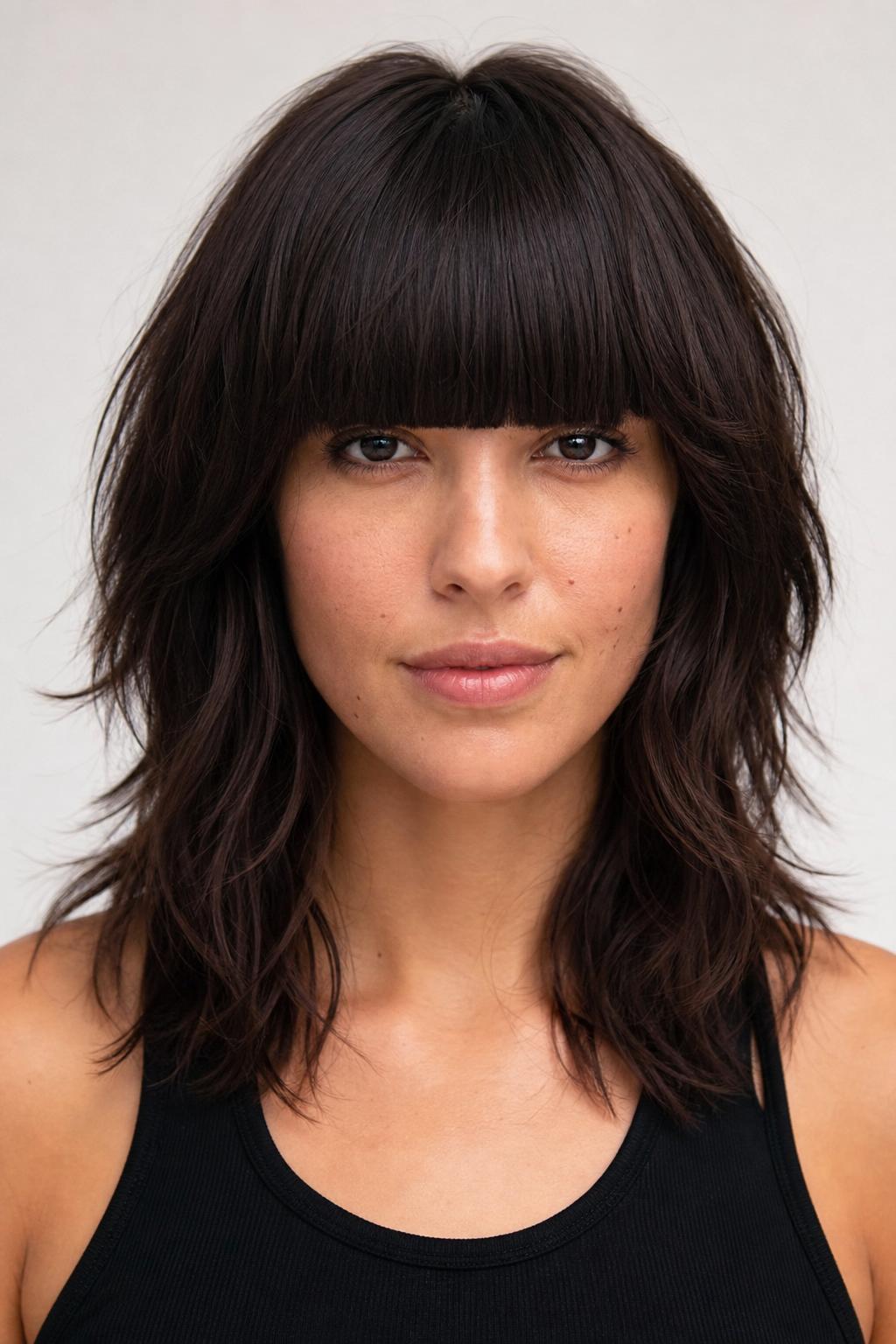
Blunt bangs cut the fringe to a uniform length with a clean, defined edge, creating a sharp horizontal line across the forehead that contrasts with the choppy, textured layers of the wolf cut. The contrast between the blunt bang and the organic layering through the rest of the cut is the entire aesthetic logic of this combination: structure at the front, volume and movement through the body. The five variations below cover straight-across blunt bangs and their variations.
15. Wolf Cut with Full Blunt Bangs
Full blunt bangs across the entire forehead on a wolf cut create the strongest visual contrast available in this gallery: the dense, flat horizontal of the blunt bang against the voluminous, multi-directional layers of the wolf cut’s body. Thick hair carries this combination most naturally because the blunt bang requires enough density to hold its flat, uniform edge without gaps. Oblong face shapes particularly benefit from a full blunt bang on a wolf cut, as the horizontal line shortens the apparent length of the face and the volume in the wolf cut’s body adds width at the sides.
16. Short Wolf Cut with Micro Blunt Bangs
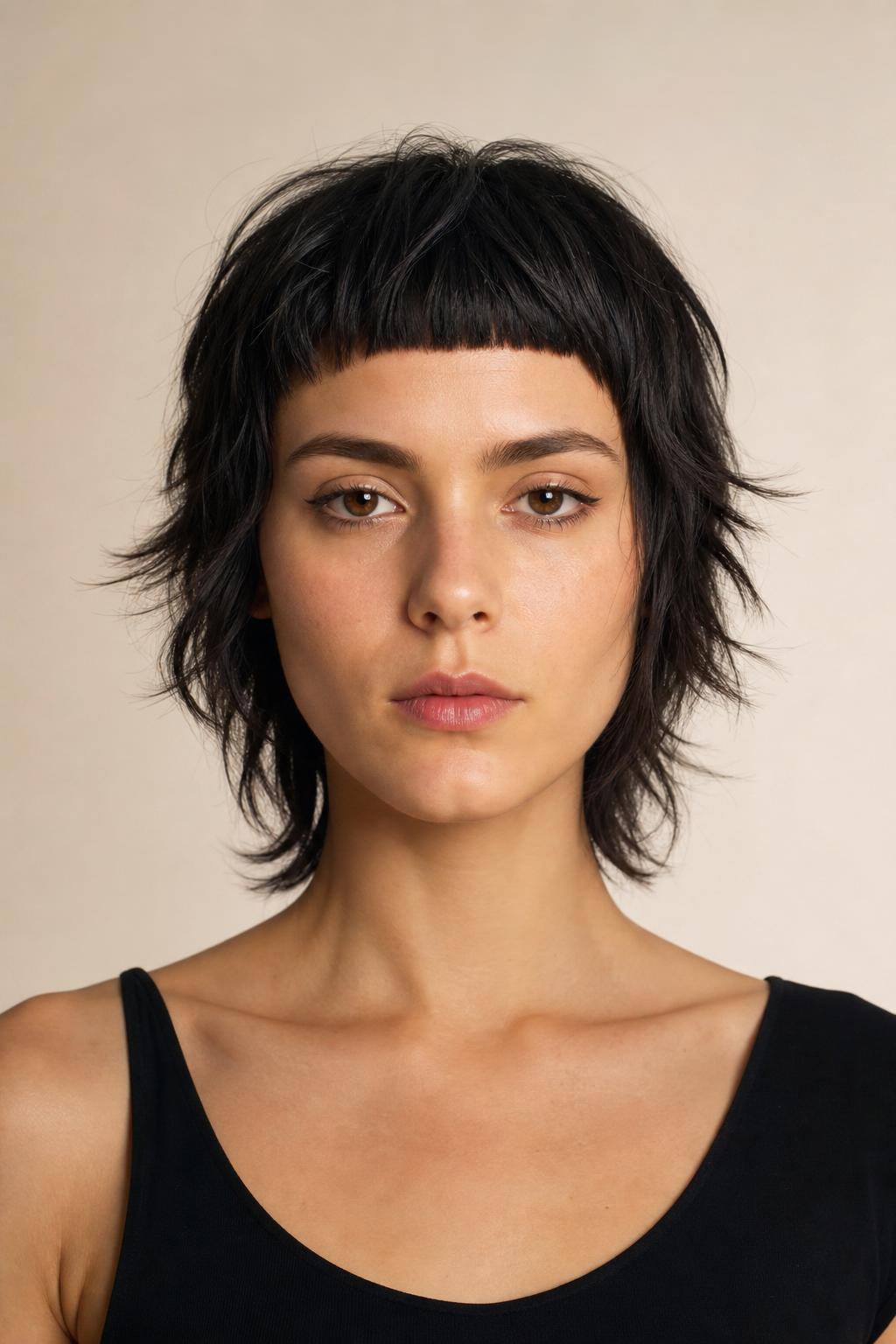
Micro blunt bangs end at mid-forehead rather than at the brow, which on a short wolf cut creates a highly structured, graphic look where the bang occupies a small, precise zone above the midface. This combination is the most editorial of any pairing in this gallery and requires the most confident styling approach, as the short cut and the high bang together leave the face almost completely exposed. Oval faces carry micro blunt bangs on a short wolf cut without adjustment; other face shapes should test the proportions first with a clip-pinned simulation before committing to a full cut.
17. Wolf Cut with Baby Bangs
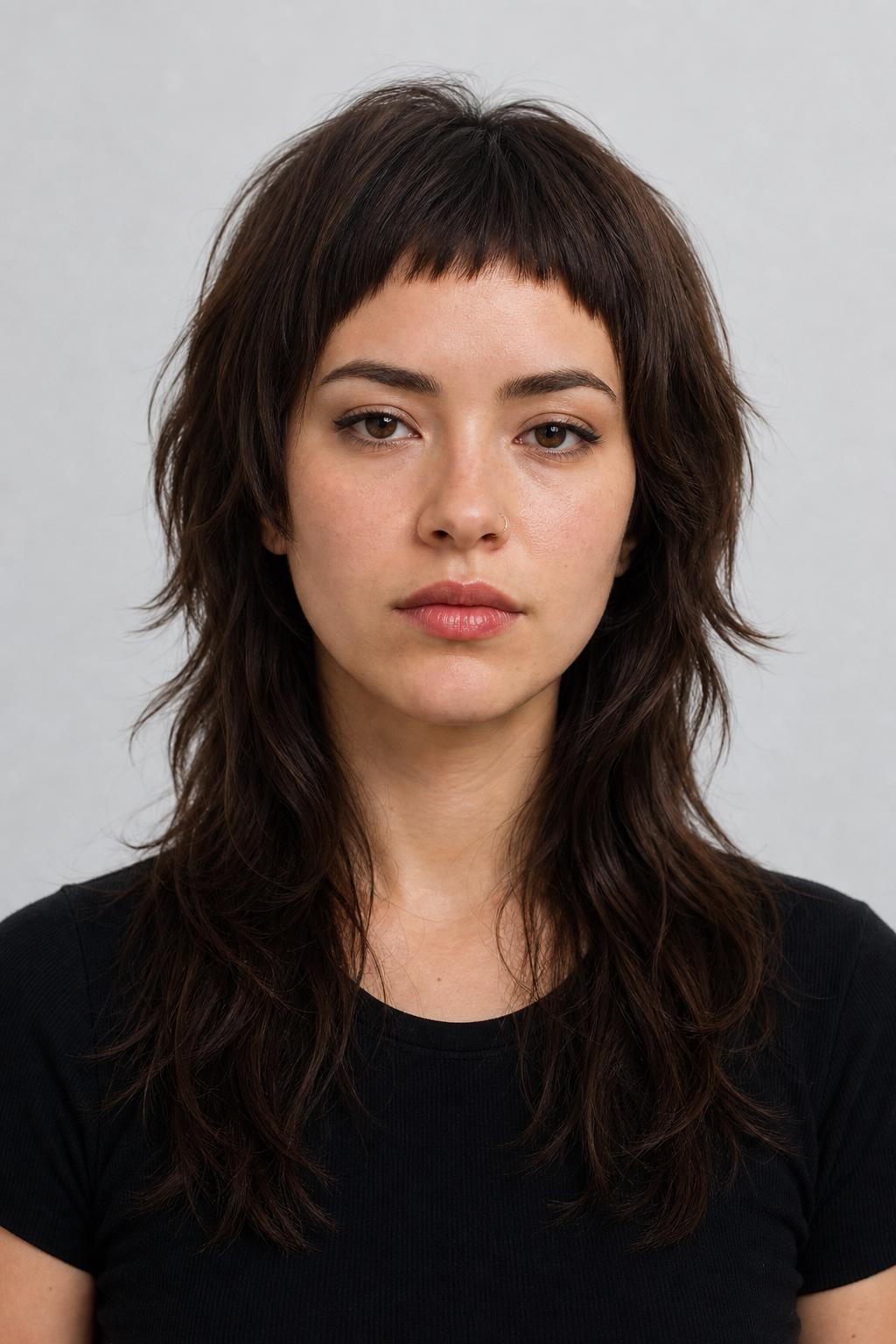
Baby bangs end at the upper forehead, above the brow and sometimes at the hairline, leaving most of the forehead exposed while still providing a defined fringe at the top of the face. On a wolf cut, baby bangs create the most dramatic length contrast in the whole silhouette: a very short, crisply cut bang against the long layered back. Baby bangs suit oval and oblong face shapes best; for round and square faces, the exposed forehead created by baby bangs can emphasize width at the widest parts of the face rather than directing attention upward.
18. Wolf Cut with Brow-Grazing Blunt Bangs
Brow-grazing bangs end exactly at the brow, the most classic of all blunt bang positions, which on a wolf cut adds a clean, structured reference point at the forehead while the rest of the cut remains loose and layered. This is the most forgiving length for blunt bangs on a wolf cut because it sits long enough to tuck behind the ear for variety while short enough to remain clearly defined as a fringe rather than a long side section. Most face shapes carry brow-grazing bangs well, making this the most accessible blunt bang option for clients who want the statement look without the commitment of very short or very thick alternatives.
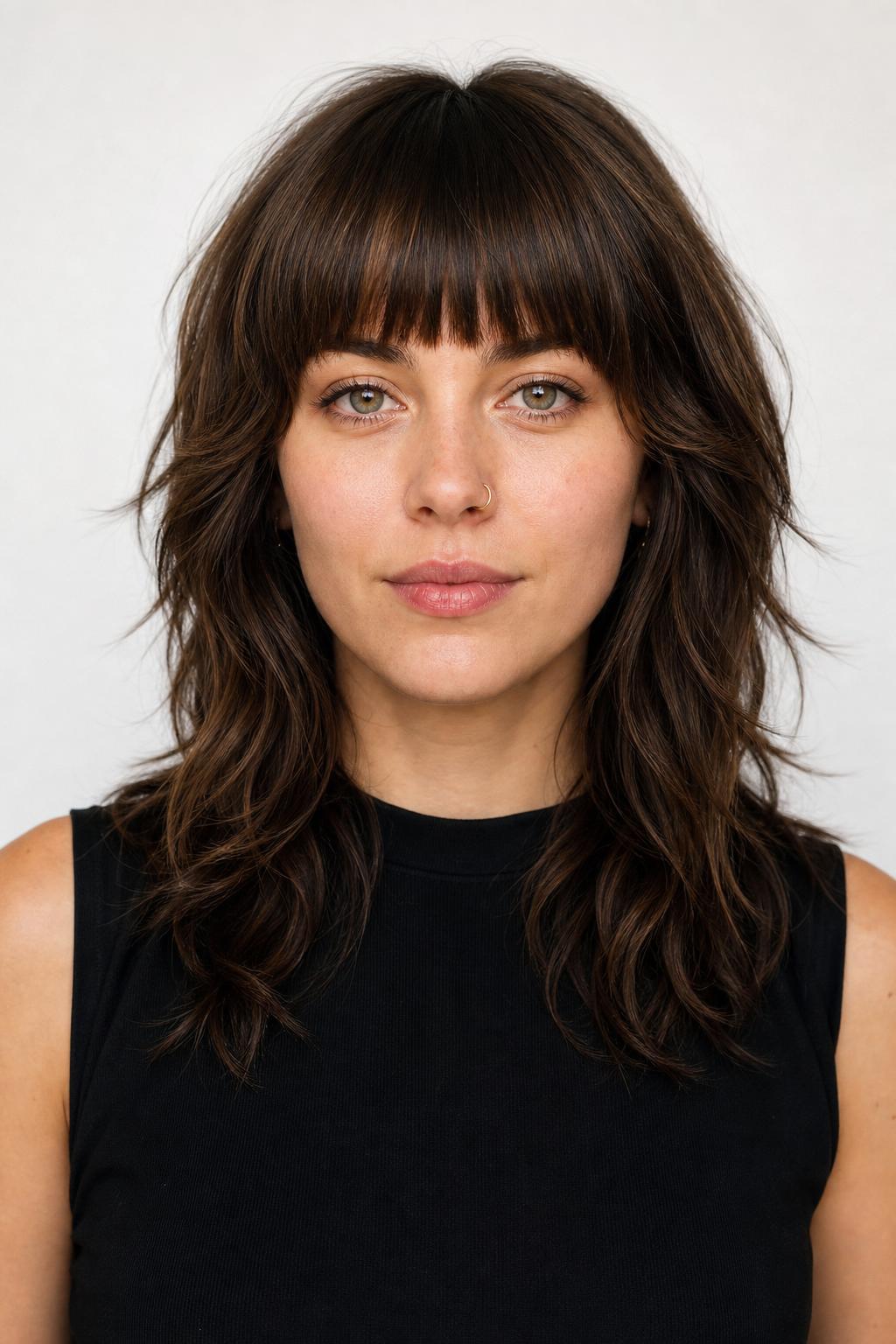
19. Wolf Cut with Textured Blunt Bangs
Textured blunt bangs apply point-cutting to the blunt bang’s ends to soften the hard edge while retaining the overall straight-across silhouette. The result is a bang that has the weight and density of a blunt cut but the softer finish of a wispy one, bridging the two styles for clients who want structure without severity. On a wolf cut, textured blunt bangs reduce the stark contrast between the precise bang and the organic layering in the rest of the cut, creating a more blended overall look that ages well between appointments as the bang grows.
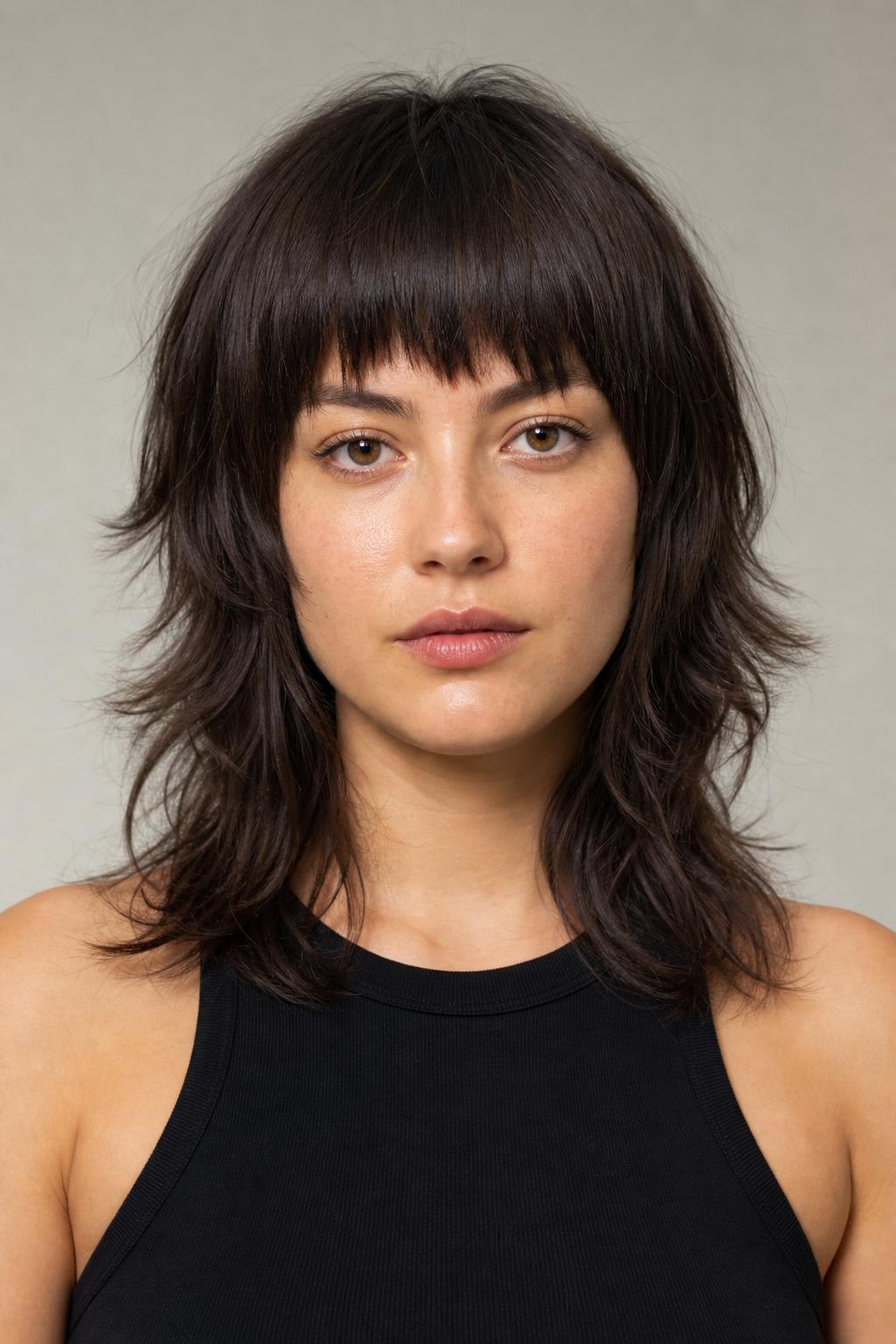
Wolf Cut with Bottleneck and Modern Bangs
Bottleneck bangs are narrower at the crown and wider at the outer eye corners, mimicking the shape of a bottle neck when viewed from the front. The narrow-to-wide shape creates a graduated curtain that frames the face broadly at the temples while leaving the forehead relatively open at the center. This proportion is different from standard curtain bangs, which typically have consistent width from center to temple.
20. Medium Wolf Cut with Bottleneck Bangs
Bottleneck bangs on a medium wolf cut create a wide, sweeping face frame that extends from the brow outward to the temple on each side, effectively widening the visual width of the top half of the face. Heart face shapes benefit most from bottleneck bangs because the wide temple-level framing visually balances a narrow chin. Wavy hair carries bottleneck bangs naturally because the wave sweeps the wider outer sections of the bang outward and downward, which follows the bottleneck shape without any additional styling direction.
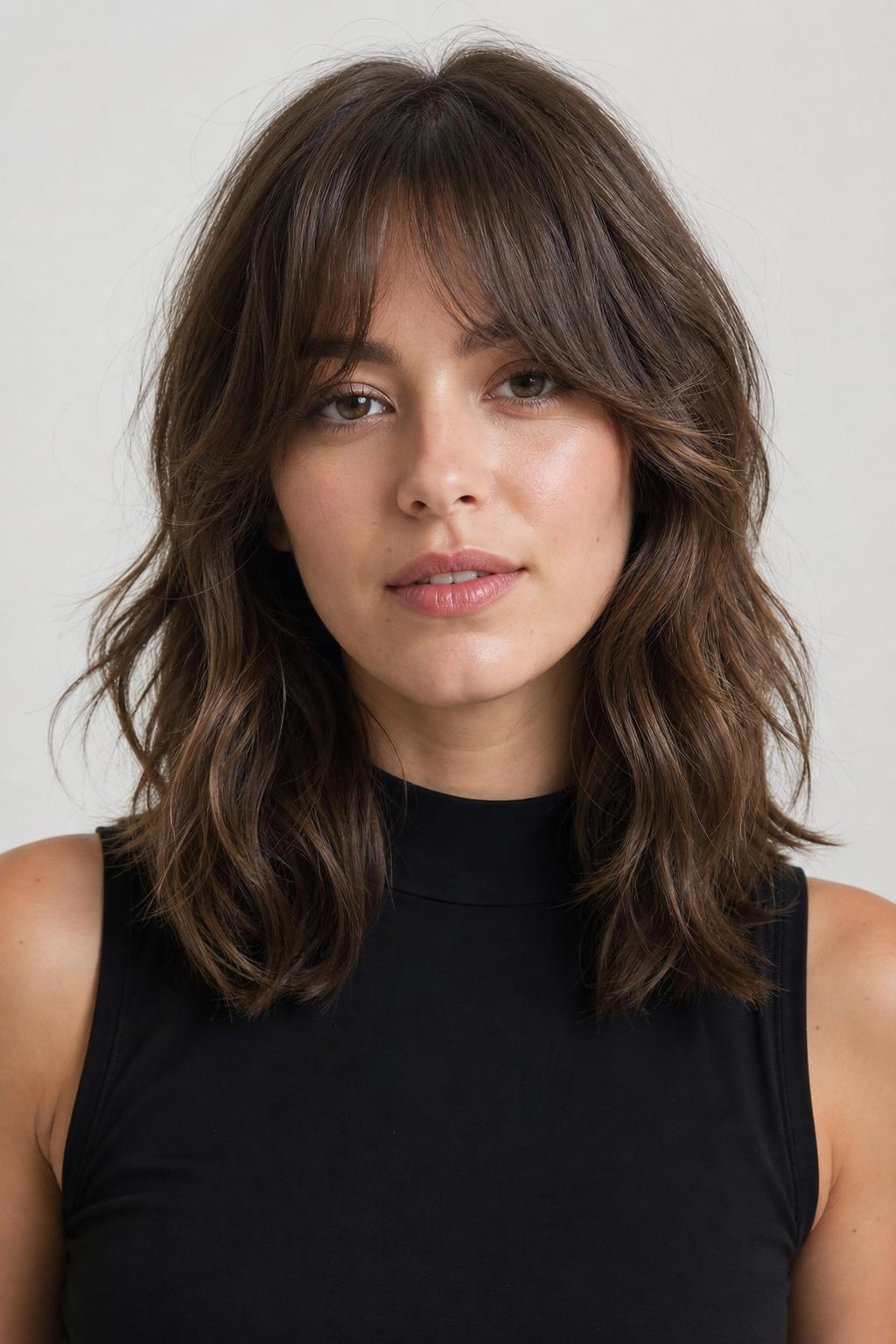
21. Wolf Cut with Bottleneck Bangs on Straight Hair
Straight hair produces the cleanest bottleneck bang silhouette because the even texture allows the graduated width from center to temple to show precisely. The styling approach for straight bottleneck bangs on a wolf cut involves directing a round brush outward at each temple section while keeping the center bang flat, a technique that takes practice but sets in quickly with heat. Square face shapes should ask the stylist to make the bottleneck bang’s widest point at or above the outer corner of the eye rather than extending all the way to the temple, which would emphasize the horizontal width of a square jaw.
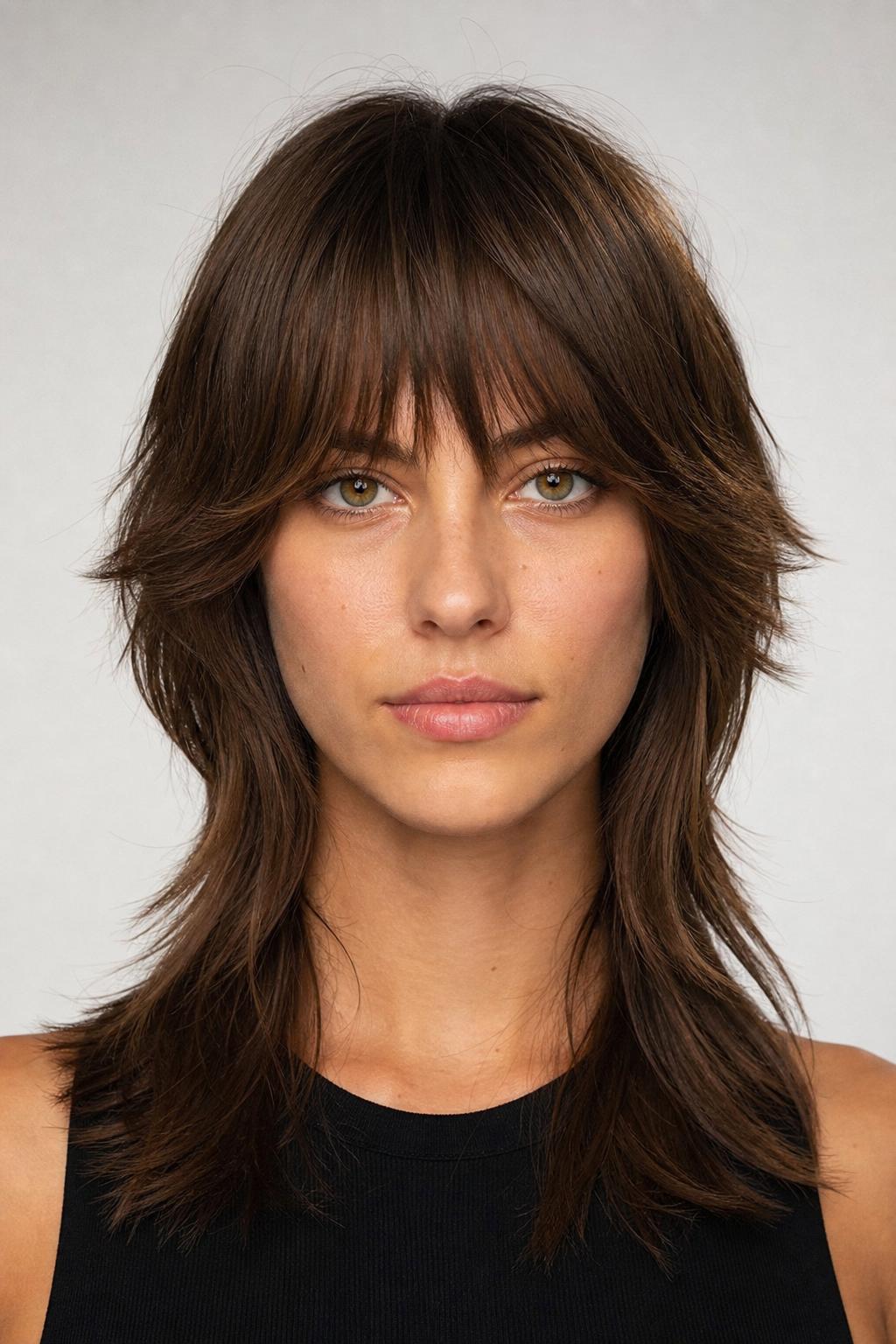
22. Wolf Cut with Bottleneck Bangs on Curly Hair
Curly hair produces the most dramatic version of the bottleneck bang because the curl spring at the outer sections of the bang coils outward naturally, exaggerating the widening bottleneck shape without any styling effort. On a type 3 curl, the bottleneck proportions can become very wide at the temple, creating a halo effect at the top of the face. This is the version most suited to oval and oblong face shapes, where the wide temple framing adds visual width without unbalancing a naturally narrow or long face shape; round faces should approach curly bottleneck bangs with caution.
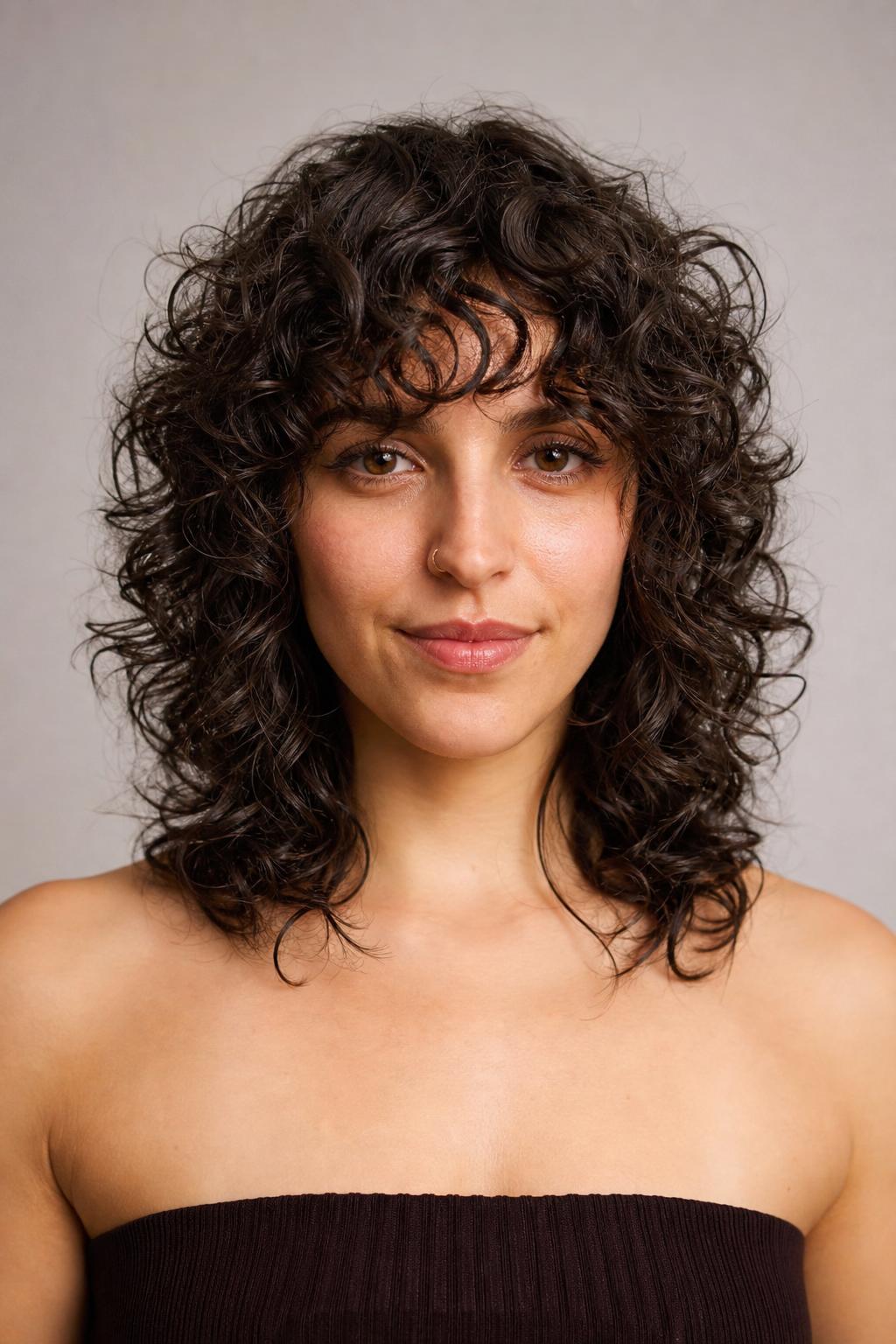
Wolf Cut with Micro Bangs and Bold Fringe
Micro bangs, baby bangs, and bold heavy fringes represent the maximum commitment end of the wolf cut with bangs combination. Each of these styles makes a clear visual statement that the bang is the primary design element of the face frame, with the wolf cut’s layered body serving as the supporting structure. These three entries cover the most distinctive and highest-maintenance bang options.
23. Wolf Cut with True Micro Bangs
True micro bangs end at or above the hairline, leaving the entire forehead exposed and functioning as a decorative fringe at the very top of the face rather than a practical curtain. On a wolf cut, micro bangs create the most extreme version of the short-top, long-bottom proportion that defines the wolf cut’s silhouette overall: the bang is as short as possible while the cut’s back sections remain at their full length. Maintenance requires a trim every 2 to 3 weeks to keep the micro bang at its extreme length; growing them out requires accepting an awkward mid-length phase that many clients find difficult to style during the transition.
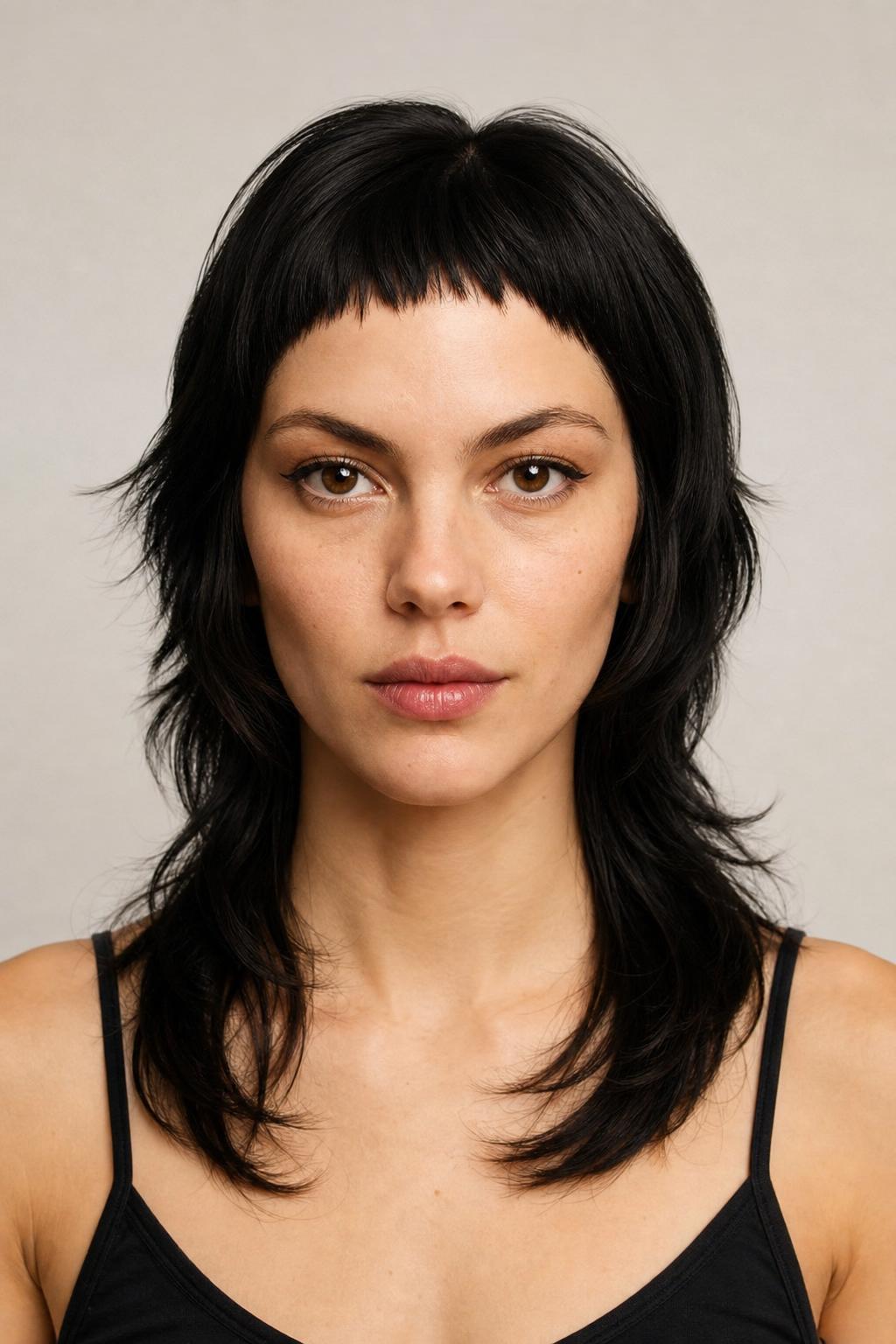
24. Wolf Cut with Heavy Full Fringe
A heavy full fringe is a dense, thick bang cut at brow level with a blunt or very lightly textured edge, covering the entire forehead from temple to temple with a substantial weight of hair. On a wolf cut, the heavy fringe creates the most dramatic possible contrast with the voluminous, tousled body of the cut: very controlled and dense at the front, very loose and layered through the back. Thick hair is required to carry a truly heavy fringe because the bang needs enough density to sit flat and uniform without thinning or gapping at the edges; fine hair attempting a heavy fringe often ends up with a fringe that looks thinner than planned.
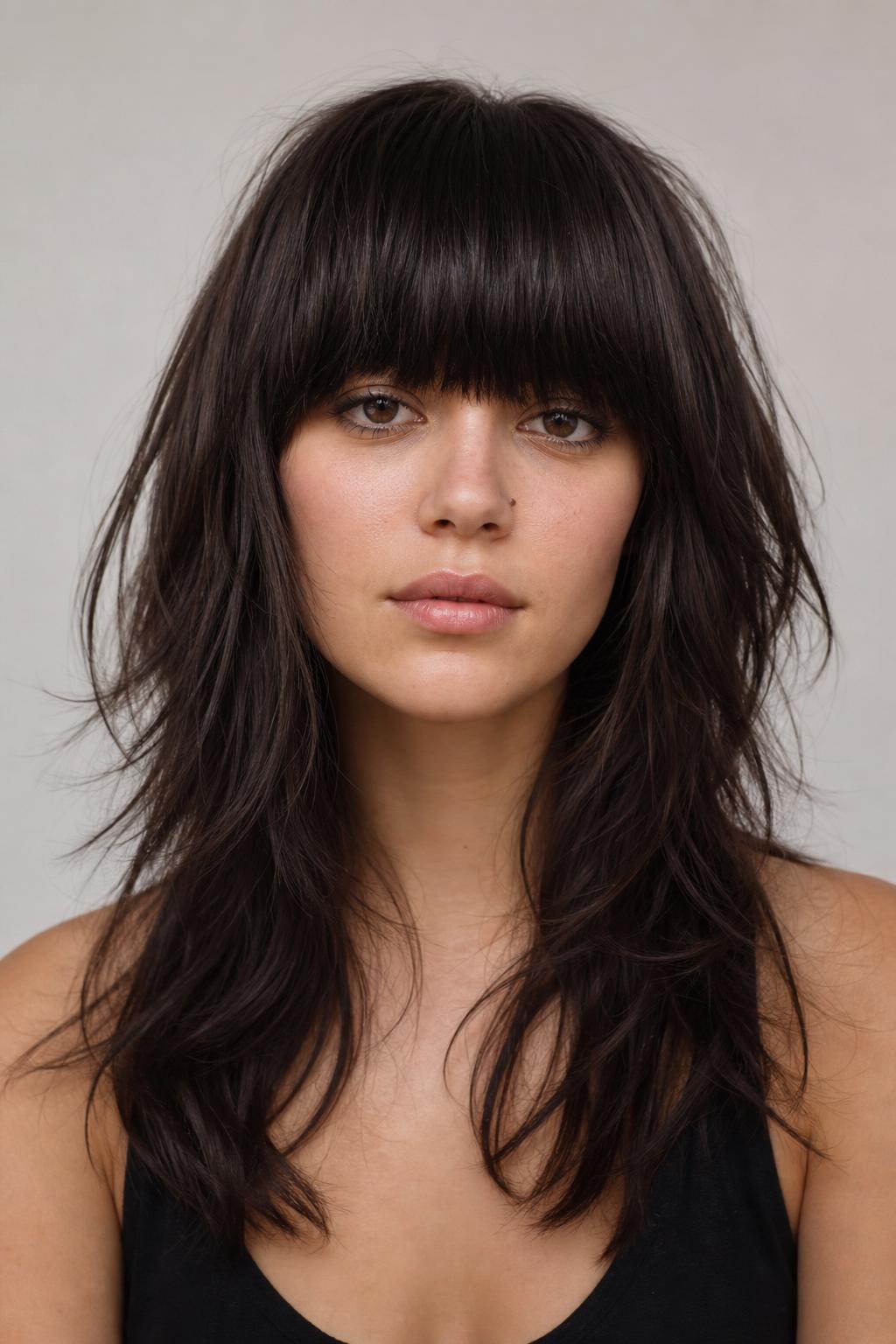
25. Wolf Cut with Split-Bang
A split bang parts exactly in the center and falls in two equal sections toward each temple, creating a parted curtain effect that exposes the center of the forehead while keeping hair on either side. On a wolf cut, the split bang functions as a very short curtain bang but with a more deliberate part that shows a clear line of scalp at the center. This is the lowest-maintenance bang option in this section because the split bang has intentional spacing that allows the grow-out to follow the same part line, meaning the bang can extend in length without losing its identity as a split design. Any face shape can wear a split bang, though heart faces get the most benefit from the wide temple framing it creates.
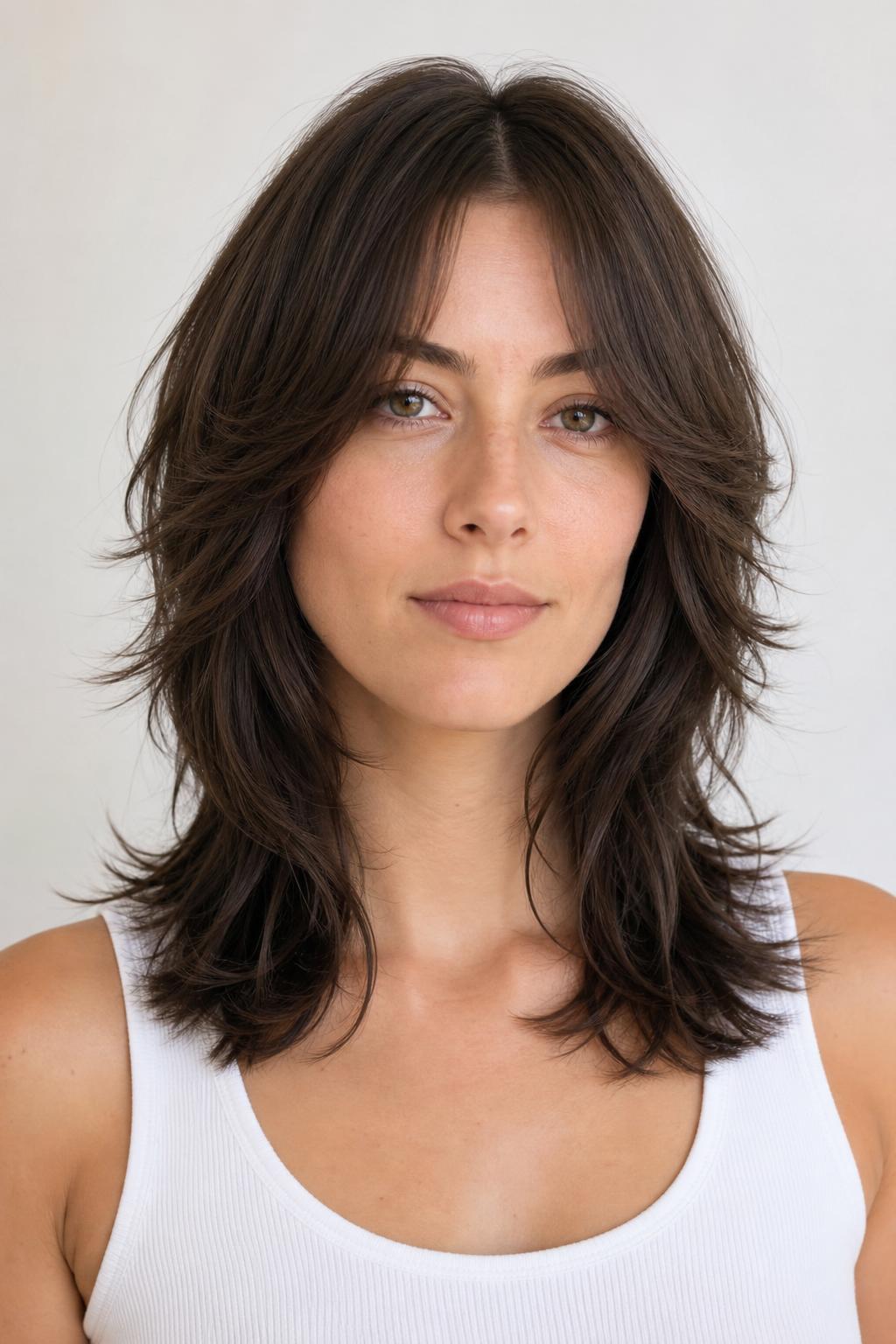
Wolf Cut and Bangs: Face Shape Compatibility
The bang type on a wolf cut determines how the face appears to widen, lengthen, or balance. The wolf cut body is relatively consistent across face shapes, so the bang is the primary tool for adjusting the overall proportion of the hairstyle to suit each face shape.
| Face Shape | Best Bang Type | Why It Works | Avoid |
|---|---|---|---|
| Oval | All bang types work | Balanced proportions suit any fringe | No restrictions |
| Round | Curtain bangs, side-swept wispy bangs | Outward sweep adds length; center part creates vertical visual line | Full blunt bangs (emphasize width); bottleneck bangs that extend to the cheekbone |
| Square | Curtain bangs, feathered bangs, wispy bangs | Soft edges at brow reduce angularity of jawline | Heavy blunt bangs that create a second hard horizontal line across the forehead |
| Oblong / Long | Full blunt bangs, brow-grazing blunt bangs, heavy fringe | Horizontal line across forehead reduces apparent length of face | See-through or micro bangs (forehead remains visible, face appears longer) |
| Heart | Curtain bangs, bottleneck bangs | Wide framing at temple balances narrow chin; curtain sweep reduces forehead dominance | Side-swept bangs that cover only one side of the forehead unevenly |
| Diamond | Wispy bangs, piece-y bangs, see-through curtain bangs | Light bang coverage at a narrow forehead without adding bulk at the cheekbones | Bottleneck bangs (widen the already-prominent cheekbone area) |
Wolf Cut Bangs by Hair Texture
Hair texture determines not only which bang type is easiest to maintain but also which bang types are achievable at all. Some bang styles that work well on straight hair require significant effort or additional products to replicate on wavy or curly hair, and some styles simply do not translate between textures without changing their fundamental appearance.
Stylist tip: “The most common mistake when a client wants a wolf cut with bangs is cutting the bang wet on wavy or curly hair. A wet cut always appears longer than it will once dry — a curtain bang cut to the brow while wet can end up sitting above the brow once the wave or curl springs back. I always cut the bang dry, or at least do the final length adjustment dry, so the client sees exactly what they’re getting.” (THP contributor, textured hair specialist)
| Hair Texture | Best Bang Options | Why | Avoid |
|---|---|---|---|
| Straight | All types, most versatile | Predictable behavior, holds any cut direction | No restrictions, though heavy blunt bangs on very fine straight hair may thin visibly |
| Wavy | Curtain bangs, wispy bangs, bottleneck bangs | Wave naturally sweeps outward, enhancing curtain and bottleneck bang shapes | Full blunt bangs (wave disrupts the clean edge); must be heat-styled to maintain blunt line |
| Curly (Type 2c-3b) | Curtain bangs (cut dry), wispy bangs (cut dry), piece-y bangs | Light, open bang structures let the curl spiral without creating excess bulk at the forehead | Blunt bangs, heavy fringe (puff and triangle-shape on curls) |
| Coily (Type 3c-4) | Wispy bangs, very loose curtain structure | High shrinkage requires cutting bang longer than target length to account for coil spring-back | Micro bangs, blunt bangs (coil shrinkage makes length control difficult) |
| Fine | Wispy bangs, see-through curtain bangs, piece-y bangs | Light, sparse bang styles work with fine hair’s natural transparency rather than against it | Heavy full fringe (fine hair cannot produce the density required) |
| Thick | Blunt bangs, full fringe, bottleneck bangs | Thick hair provides the density needed for statement bangs to hold their shape | See-through or wispy bangs (thick hair resists the fine, sparse appearance these require) |
What to Tell Your Stylist
A wolf cut with bangs involves two separate decisions: the wolf cut structure and the bang type. Stylists need clear direction on both before they start, since changing the bang type mid-service is possible but changes the timing and approach of the cut.
Stylist tip: “When clients say they want a wolf cut with bangs but don’t bring a photo, I always ask what they don’t want first. ‘I don’t want bangs that stick to my forehead’ usually means curtain bangs. ‘I don’t want a fringe that needs daily styling’ usually means wispy or see-through. The don’ts narrow it down faster than the dos, especially for clients who haven’t had bangs before.” (THP contributor, editorial stylist)
- Wolf cut length: “I want the shortest layers [at the crown / at the nape / both] and the longest sections [at the shoulders / mid-back / just below the collarbone]”, this tells the stylist how extreme you want the length contrast that defines the wolf cut’s silhouette.
- Bang type: “I want [curtain bangs that sweep outward / wispy fringe that barely covers my forehead / blunt bangs across the full forehead / a split bang parted in the middle]”, use the specific terms rather than just “bangs” to ensure the stylist does not default to their own preferred style.
- Bang weight: “I want the bang to be [very thin and see-through / medium density / full and dense]”, density is independent of style; you can have dense curtain bangs or thin blunt bangs.
- Texture preference: “I want the layers to feel [choppy and textured / smooth and blended / very piece-y with defined separation]”, this determines whether the stylist uses point-cutting, slide-cutting, or blunt scissor work through the body of the cut.
- Maintenance willingness: “I can come in for a bang trim every [3 / 5 / 8] weeks”, this determines whether the stylist cuts the bang at a length that will need frequent trimming or at a length that has a longer grace period.
Maintenance for Wolf Cut with Bangs
The wolf cut body and the bangs have different maintenance cycles. The wolf cut’s layered structure has one of the longest grace periods of any popular cut because the grown-in, tousled appearance is part of the style’s design. Bangs, however, grow faster visibly and require more frequent attention to stay at their intended length and shape.
| Bang Type | Trim Frequency | Full Cut Refresh | Styling Daily |
|---|---|---|---|
| Blunt bangs | Every 3 to 4 weeks | Every 10 to 12 weeks | Round brush blow-dry or flat iron to maintain clean edge |
| Curtain bangs | Every 4 to 6 weeks | Every 12 to 14 weeks | Round brush outward or air-dry with styling cream |
| Wispy and feathered bangs | Every 5 to 7 weeks | Every 12 to 16 weeks | Texturizing spray or finger-style; minimal heat needed |
| Micro and baby bangs | Every 2 to 3 weeks | Every 10 weeks | Minimal, bang is too short for significant styling |
| Bottleneck bangs | Every 4 to 5 weeks | Every 12 to 14 weeks | Round brush directed outward at each temple section |
When Wolf Cut with Bangs Needs Modification
The wolf cut with bangs combination does not work uniformly across every situation. These are the circumstances where the approach should be adjusted before committing to the cut.
- Very low-maintenance lifestyle: Bangs on a wolf cut require at minimum a trim every 4 to 6 weeks for curtain and wispy styles and every 2 to 3 weeks for blunt or micro bangs. If regular salon visits are not feasible, the bang will grow past its intended length and either cover the eyes or become an awkward in-between section that is too long to be a bang and too short to tuck away easily. Clients with very low maintenance availability should consider a wolf cut without bangs, using the face-framing layers already present in the cut as a natural frame.
- Cowlicks or strong growth direction at the forehead: A cowlick in the front hairline pushes hair in a direction that fights the intended bang style, particularly for center-parted curtain bangs or blunt bangs that require even distribution across the forehead. A cowlick does not make bangs impossible, but it does require either significant daily styling to override the growth direction or choosing a bang type that incorporates the cowlick’s natural direction rather than opposing it.
- Transitioning from chemical treatments: Permed, relaxed, or chemically straightened hair behaves differently from its natural state, and adding a bang to a wolf cut during a chemical transition period can produce unpredictable results as the natural texture starts to return at the roots. Anyone with a recent chemical treatment should wait for the treated section to grow out of the bang length before committing to a precise bang style.
- Very high humidity environments: Blunt bangs and precise curtain bangs require humidity resistance to maintain their shape through a full day. In high-humidity climates, these styles tend to frizz or curl upward at the ends, undoing the clean shape that makes them distinctive. Wispy and piece-y bangs are more humidity-tolerant since their natural texture incorporates some variation rather than requiring a uniform edge.
FAQ
What is the difference between wolf bangs and curtain bangs?
Wolf bangs is an informal term for curtain bangs styled specifically on a wolf cut, where the bangs have been cut to blend into the face-framing layers of the wolf cut’s structure. Standard curtain bangs can be cut into many hairstyles; wolf bangs specifically refer to the curtain fringe cut to harmonize with the choppy, layered silhouette of a wolf cut. In practice, the cut technique is the same, but the layering through the rest of the hair differs significantly from a standard curtain bang service on a non-wolf cut base.
Will bangs make a wolf cut harder to style?
Yes, bangs add a separate styling requirement to the wolf cut. A wolf cut without bangs can often be styled by simply scrunching in texturizing spray and diffusing or air-drying, while bangs require at least a quick pass with a round brush or a few minutes of directing them with a blow-dryer. The extra time ranges from 3 to 5 minutes for wispy or curtain bangs to 10 to 15 minutes for blunt bangs that require a smooth, flat finish.
Can you get a wolf cut with bangs on short hair?
Yes, a wolf cut on short hair can accommodate bangs, though the options narrow compared to a medium or long wolf cut. At a short length, the contrast between the short top layers and the longer back sections of the wolf cut is more pronounced, and bangs on a short wolf cut tend to create bold, graphic results rather than soft face-framing effects. Curtain bangs and wispy bangs translate well to shorter wolf cuts; blunt bangs on a very short wolf cut produce the most statement-forward result.
How often do you need to trim bangs on a wolf cut?
Blunt bangs need a trim every 3 to 4 weeks to stay at their intended length, as the clean edge becomes undefined quickly once the bang grows past the target position. Curtain and wispy bangs can go 4 to 7 weeks between trims because their natural softness means the grow-out is less visually obvious. Micro and baby bangs need the most frequent attention, every 2 to 3 weeks, as even a small amount of growth changes their proportions significantly when the starting length is so short.
What products work best for styling wolf cut bangs?
Curtain and wispy bangs benefit from a light styling cream or mousse applied to damp hair before drying, which provides hold without stiffness and allows the bang to air-dry into its swept direction. Blunt bangs need either a light pomade or a setting spray to keep the edge flat and the bang free of flyaways throughout the day. Piece-y bangs use a small amount of clay or wax worked through dry hair with the fingertips to create separation between strands. Avoid heavy creams or oils on any bang type, as they weigh the bang down and cause it to separate into clumps rather than holding its shape.
Is a wolf cut with bangs good for growing out a short haircut?
A wolf cut with bangs can be a useful transition style during a grow-out because the cut’s layered structure allows different sections to be at different lengths simultaneously, which is already the situation during a grow-out. Adding a bang during a grow-out frames the face while the sides and back develop length, reducing the awkward in-between appearance that comes from growing a short haircut without a defined style goal. Wispy or curtain bangs are the best choices during a grow-out because they blend naturally into shorter front sections without requiring a precise length match with the rest of the hair.
Wolf cut with bangs covers as wide a range as the wolf cut and the bang category each cover independently. The combination that works for any individual comes down to bang type, hair texture, face shape, and how much daily styling time is realistic. A wolf cut with curtain bangs on wavy hair is the most low-maintenance starting point; blunt bangs on a short wolf cut are the highest-commitment version. Both are the same cut concept in different registers, and both work best when the bang and the layering through the wolf cut’s body are cut in the same session rather than added separately at different appointments.
Haircut results depend on your hair texture, density, and growth patterns. Bring reference photos to your stylist consultation and request a detailed explanation of how your specific hair type will affect the result before any cutting begins. Bangs are a significant commitment, use clips to simulate a fringe during your consultation before agreeing to cut.