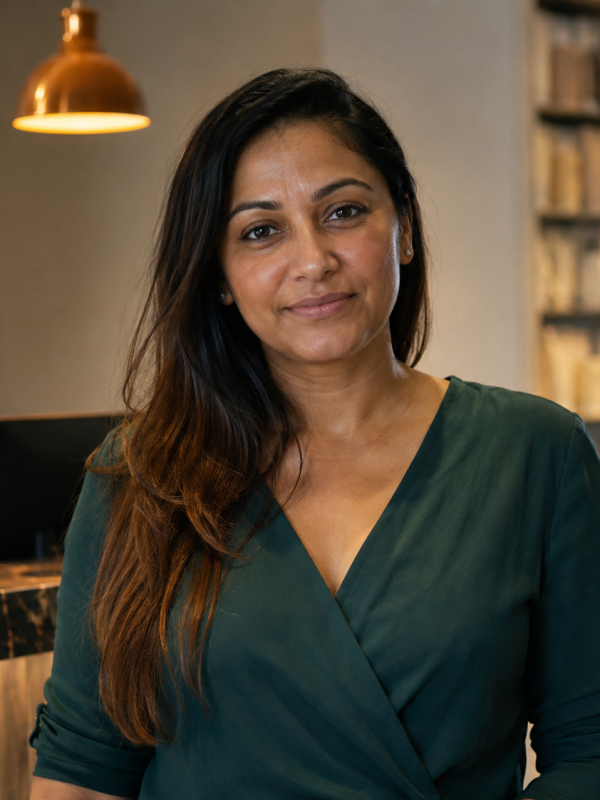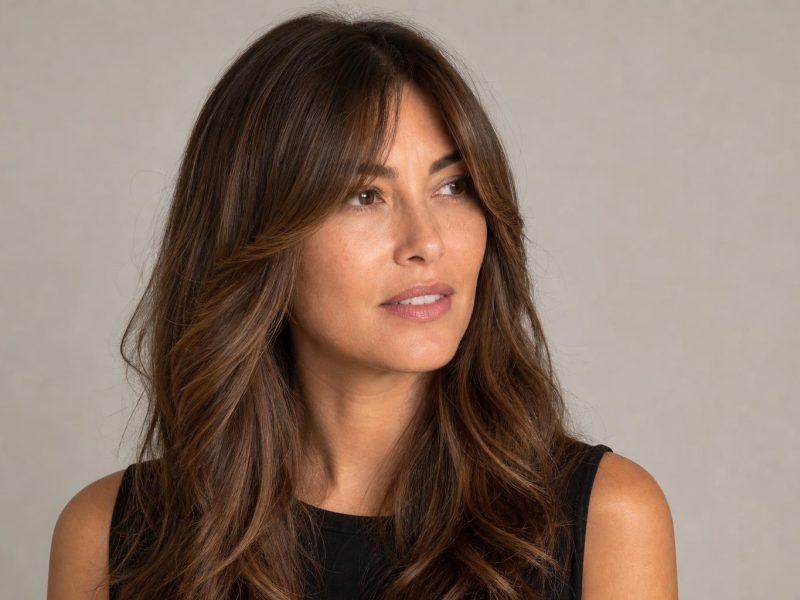

An off-center fringe does what a straight one cannot: it puts an angle exactly where your face needs one.
Asymmetrical bangs are cut on a diagonal, starting shorter on one side and lengthening toward the other, so the fringe crosses your forehead at a slant instead of a horizontal line. That single change flatters round and heart-shaped faces, disguises cowlicks, and gives fine hair visible structure at the hairline. Below are 30 asymmetrical bangs ideas, from brow-skimming micro versions to jaw-grazing diagonals, each with the detail your stylist needs to recreate it.
The gallery is grouped by fringe length and texture: micro and baby versions first, then soft wispy takes, long diagonal sweeps, pairings with bobs and pixies, and finally curly and statement versions. After the photos you will find a face shape table, the exact wording to use at the salon, a realistic trim schedule, and an honest section on who should skip this fringe entirely. If you are still weighing your options, our overview of every major type of bangs is a useful companion to this collection.
| Factor | Details |
|---|---|
| Best for | Round, heart, and square faces; straight to wavy hair; anyone with an off-center cowlick |
| Maintenance | Trim every 3 to 5 weeks; 3 to 8 minutes of daily styling depending on texture |
| Works with | Pixies, bobs, lobs, shags, and long layers; fine through thick density |
| Avoid if | You flip your part daily, wear tight coils you prefer not to heat-style, or want a fringe you can ignore for 8 weeks |
| Salon time | 15 to 30 minutes as an add-on; 45 to 60 minutes with a full cut |
Micro and Baby Asymmetrical Bangs
Short fringes make the slant impossible to miss, because every millimeter of angle shows against the forehead. These versions demand confident bone structure and frequent trims, but they deliver more edge per inch than any other fringe on this list. If you already love the look of micro bangs, the angled versions below are the logical next step.
1. Micro Fringe with a Hard Diagonal Line
A blunt scissor line cut well above the brows, angled so one temple carries almost no fringe while the other holds a full inch. The precision comes from cutting the line clean rather than point cutting it, which keeps the diagonal crisp against the skin. Pair it with hair worn at collarbone length or longer so the short fringe stays the focal point.
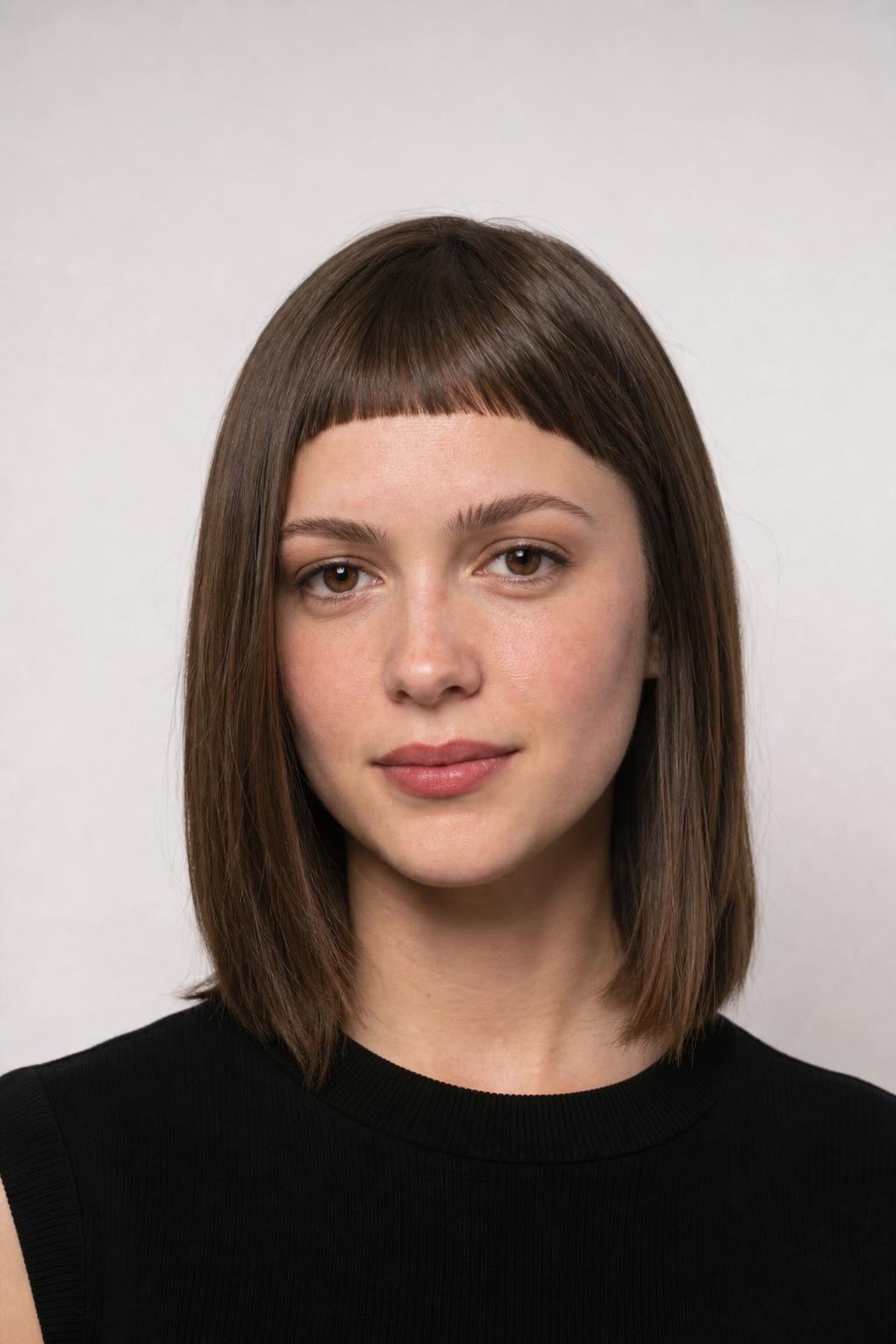
2. Baby Bangs on a Soft Slant for Round Faces
Round faces usually get warned away from short fringes, but a slanted baby bang works because the diagonal cuts across the forehead’s width instead of underlining it. Keep the longest point near the outer brow so the angle draws the eye up and out. The rest of the hair stays long and flat-ironed smooth to add vertical length.
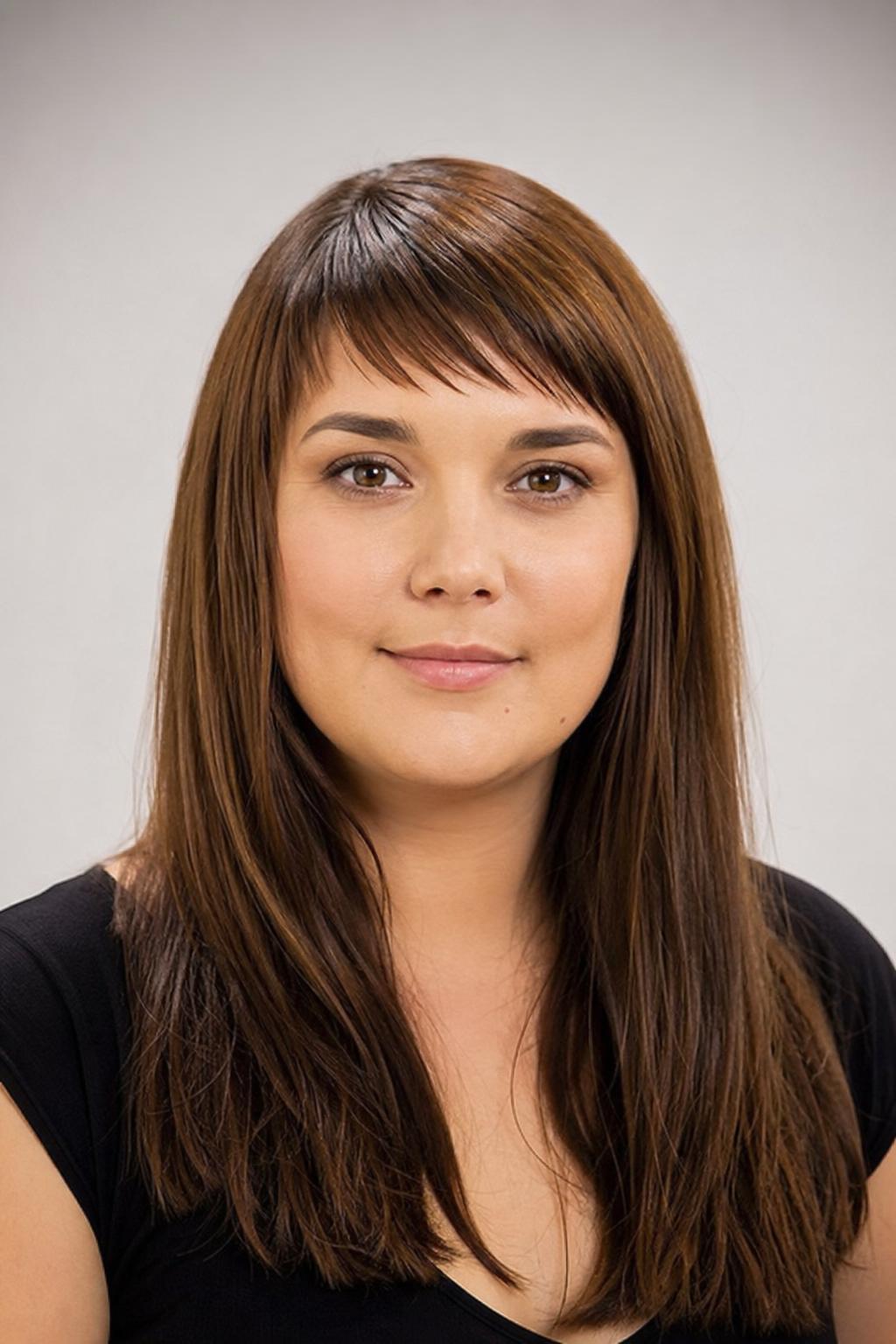
3. Choppy Micro Fringe on Thick Hair
Thick, coarse hair pushes a micro fringe outward, so this version uses deep point cutting to remove bulk and let the short pieces lie flat. The chopped texture also blurs the diagonal into something softer than a razor line. Expect your stylist to thin the fringe from underneath, not the surface, to avoid frizz at the hairline.
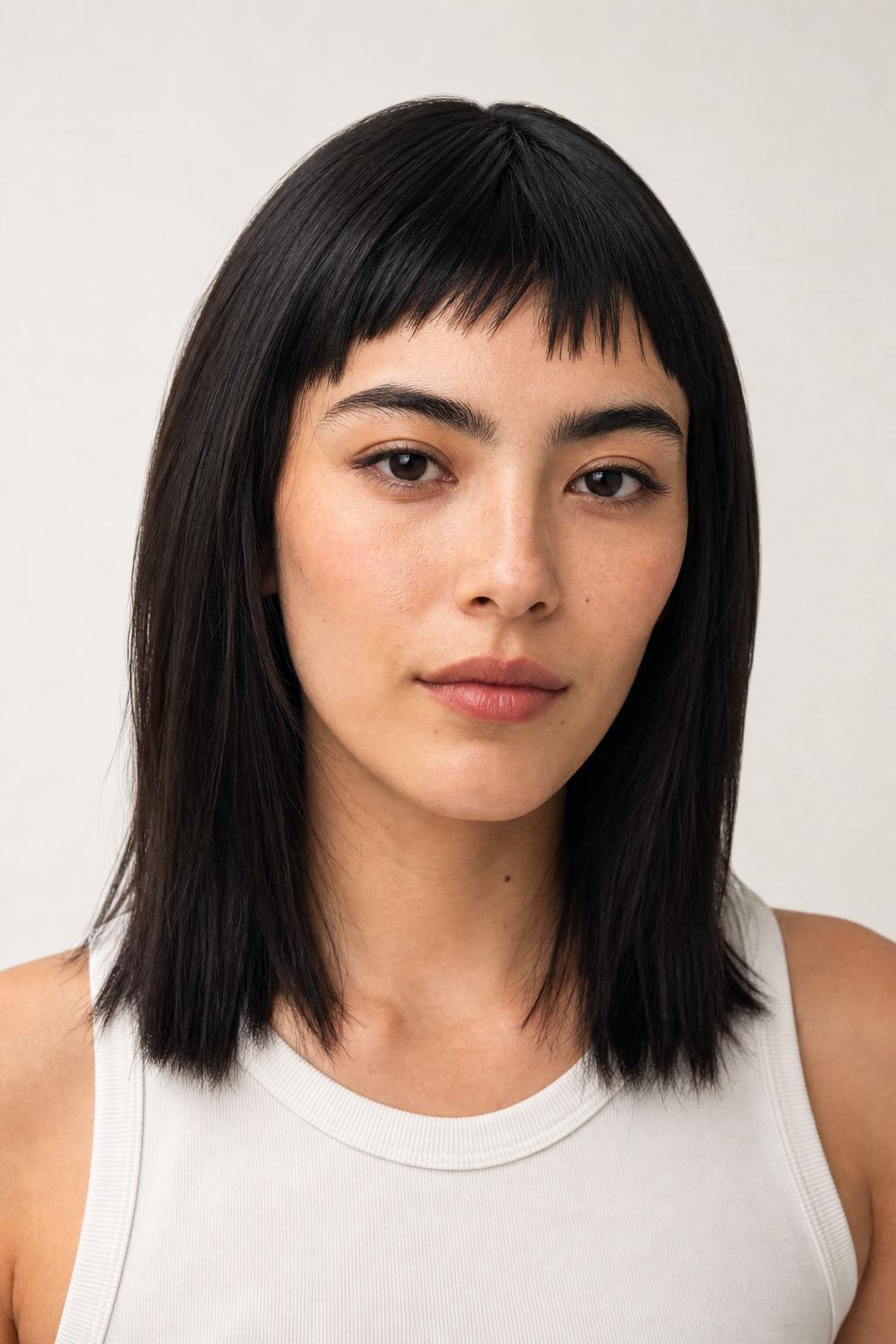
4. Sliced Baby Fringe with a Cropped Pixie
Style this one with a fingertip of matte paste, pushing the fringe diagonally across the forehead rather than down. The slicing technique leaves narrow gaps between pieces, so the slant stays visible even when the hair moves. On a pixie this short, the fringe angle is the whole haircut, so keep the product light and the direction consistent.
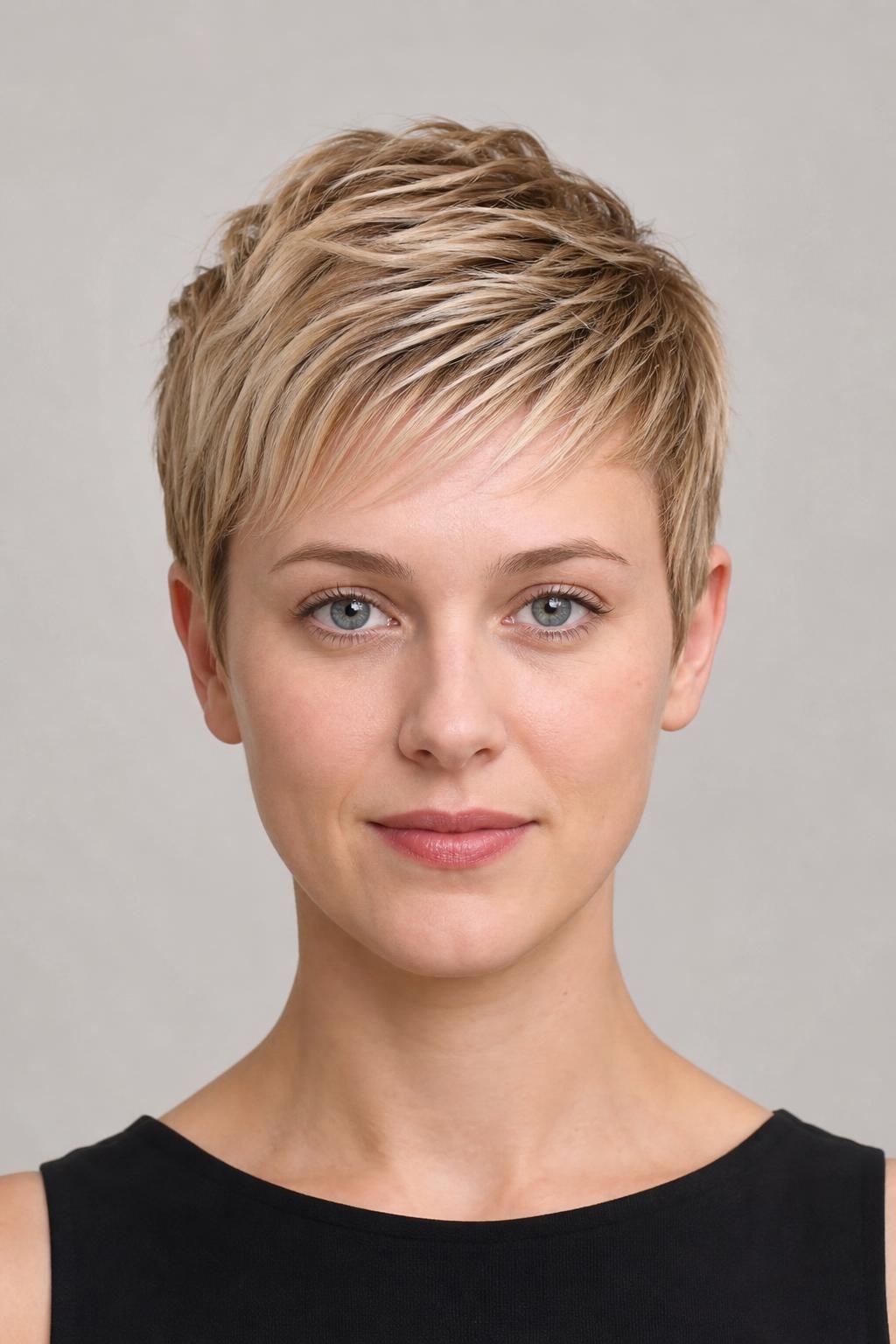
5. Angled Micro Bangs on a Blunt Bob
Because both the bob line and the fringe are blunt, this pairing shows regrowth fast: the diagonal loses its tilt within about 3 weeks. Book standing fringe trims, most salons offer them free or under $15 between full cuts. The payoff for the upkeep is a graphic, gallery-ready shape that needs almost no daily styling.

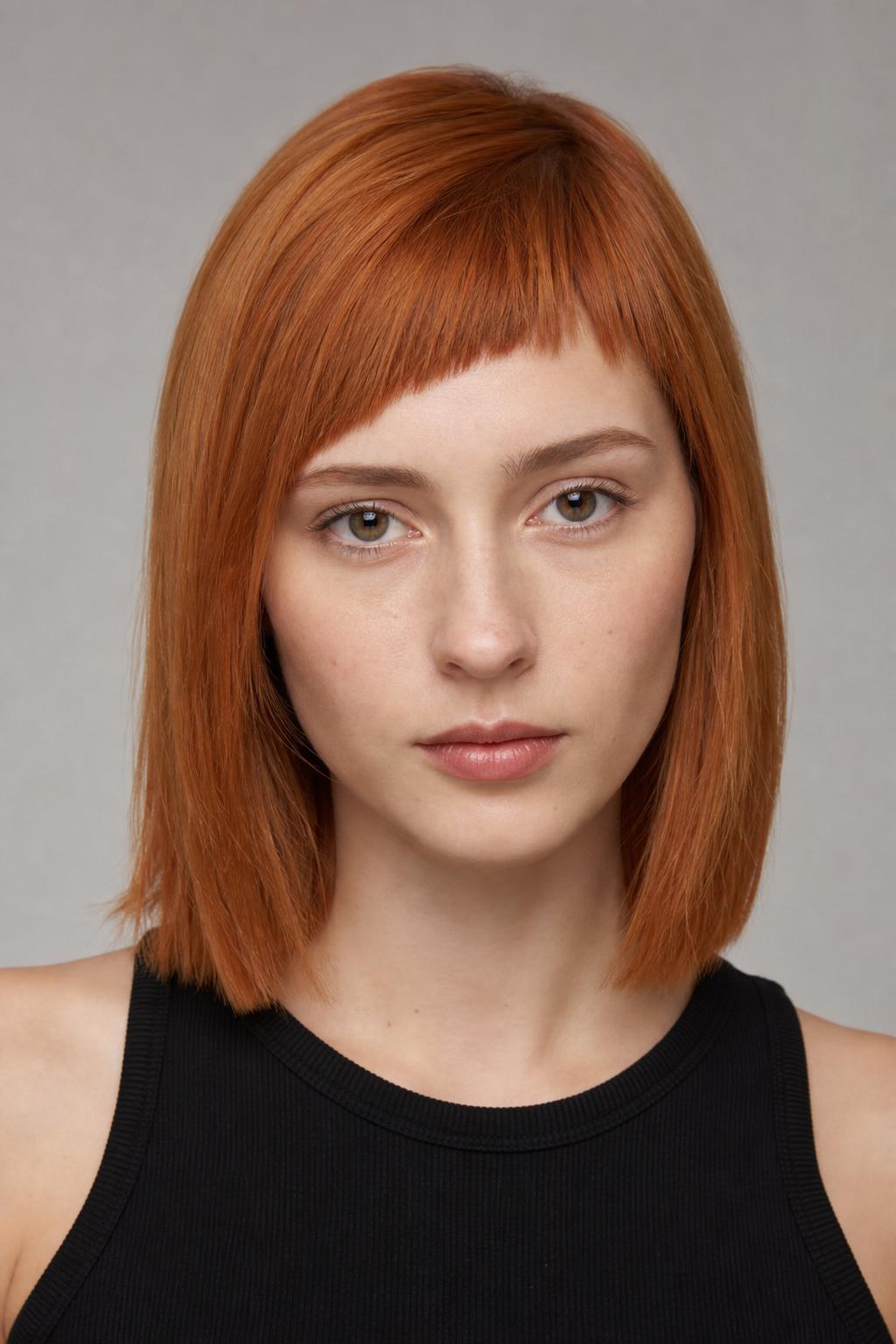
6. Copper Micro Fringe with an Off-Center Slant
Vivid color turns the fringe into a frame within a frame, and copper does it best because the short hairs catch light against the forehead. A slant that starts off-center, rather than at the temple, gives the color an unexpected starting point. Ask for the fringe to be colored in the same session as the cut so the line and the tone land together.
Soft and Wispy Asymmetrical Bangs
Wispy versions trade the graphic line for an airy slant that moves like curtain bangs but commits to one side. They suit first-timers, fine hair, and anyone who wants the angle without the maintenance contract of a blunt edge. Most of these grow out gracefully into face-framing pieces.
7. Wispy Diagonal Fringe with Curtain Softness
Bring a photo and ask for a curtain bang cut with the split pushed off-center, longer on one side by about an inch. That wording matters, because “asymmetrical bangs” alone can get you a hard slant when what you want here is soft and blended. The result parts like a curtain but falls with a clear lean.
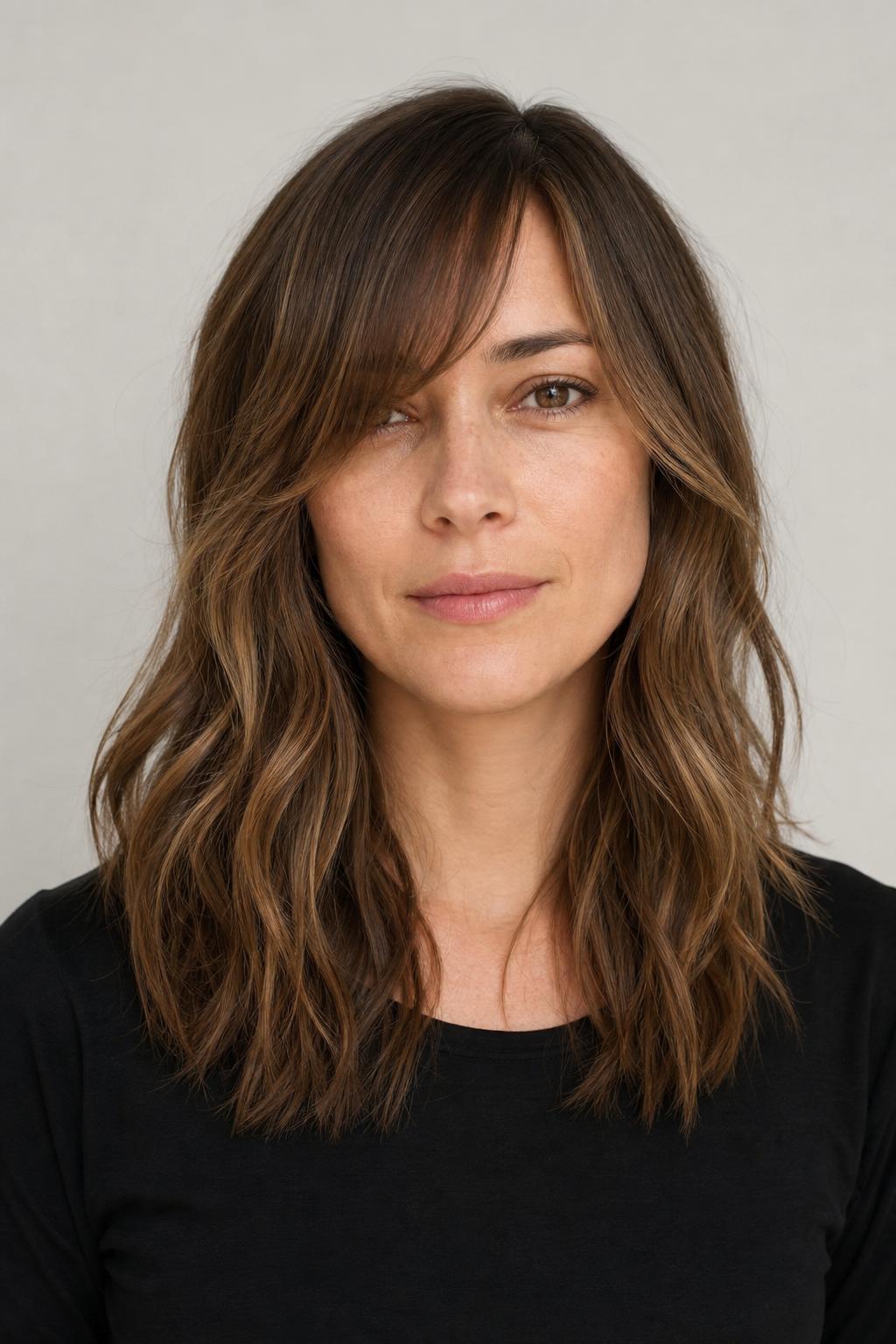
8. See-Through Slanted Bangs
Unlike the classic straight version popularized by Korean styling, a see-through fringe cut on a slant keeps its transparency while adding direction. The sparse density means the diagonal whispers rather than shouts, which suits workplaces where a hard line feels like too much. We cover the straight original in depth in our see-through bangs gallery if you want to compare before choosing.
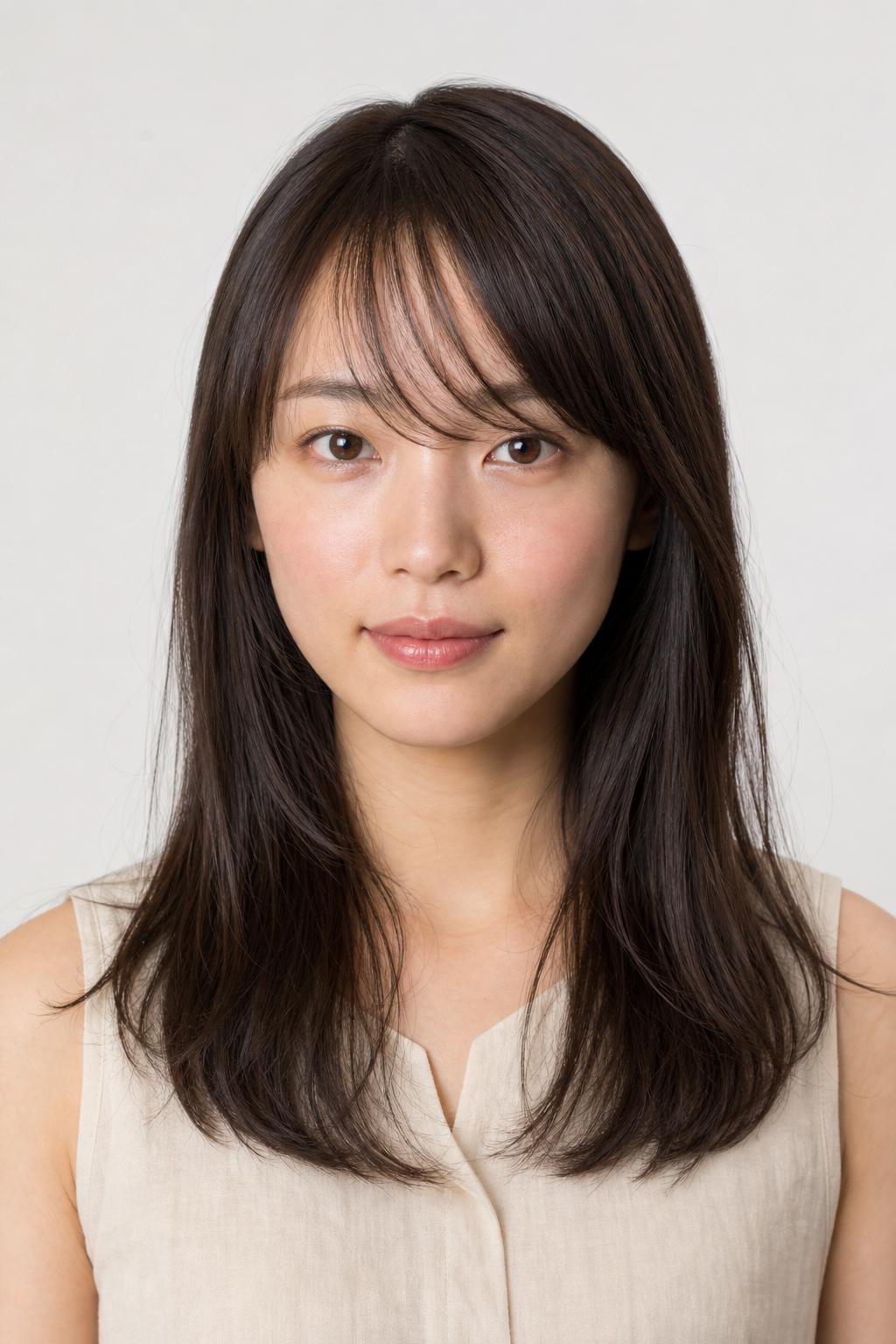
9. Feathered Slant on Fine Hair
Fine hair holds an angled fringe better than a blunt one, because feathered ends need less density to look finished. The stylist cuts the diagonal first, then softens it with the scissor tips angled downward, leaving a fringe that tapers instead of stopping. Blow-dry it with a small round brush for 2 minutes and it keeps the lean all day.
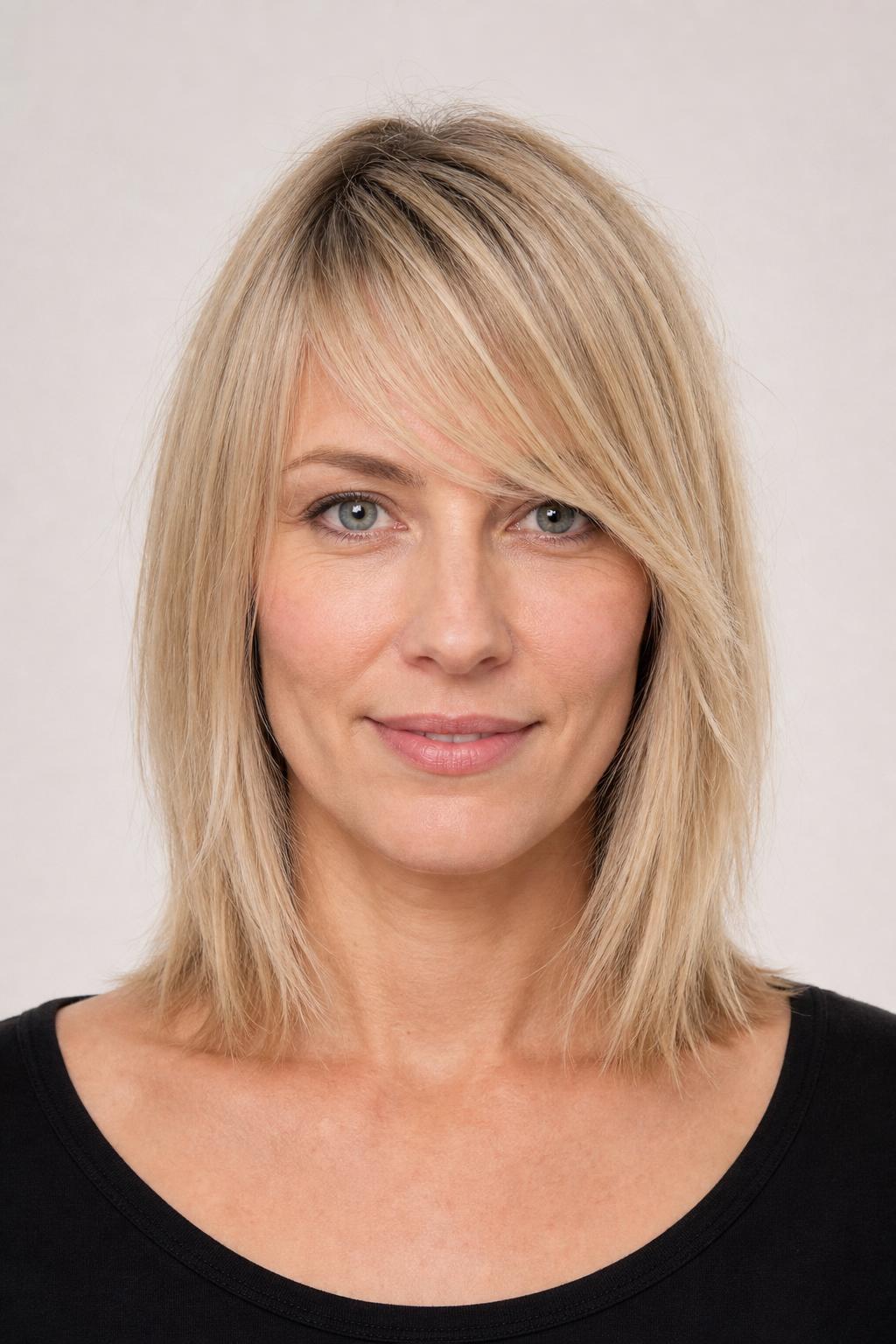
10. Airy Angled Bangs with Long Layers
Long faces do well here: the diagonal fringe adds a horizontal interruption while the layers keep length around the jaw, balancing the proportions from two directions at once. Keep the short end of the fringe no higher than mid-brow, or the horizontal effect weakens. The layers should start where the fringe ends so the two connect visually.
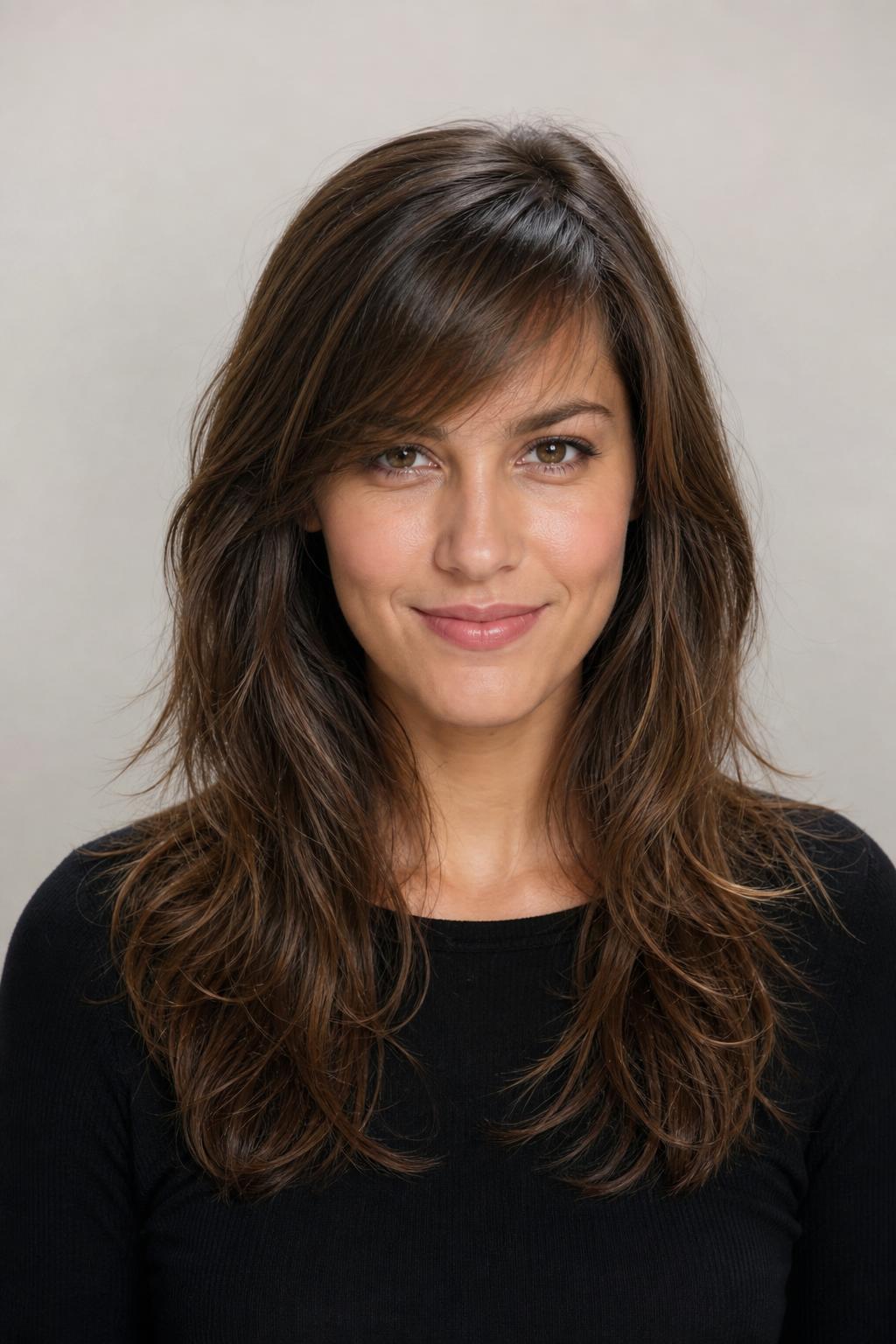
11. Soft Asymmetrical Fringe on Wavy Hair
Waves complicate any fringe, so this one is styled by smoothing only the bangs with a flat brush and cool air while the rest of the hair air-dries naturally. The contrast between the smooth slanted fringe and the loose waves behind it looks deliberate, not accidental. A pea-sized dab of light cream keeps the fringe from rejoining the waves by noon.
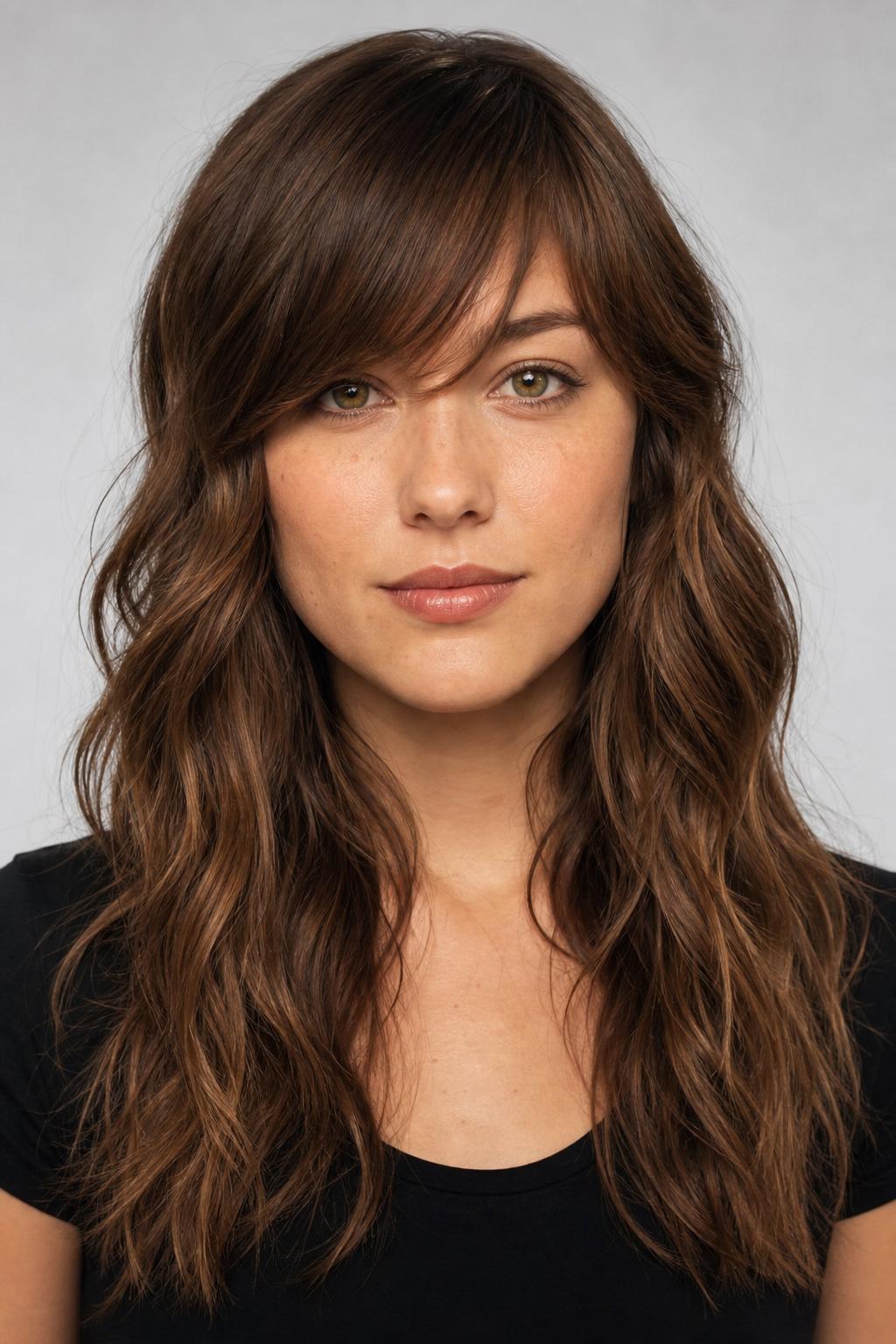
12. Brunette Wispy Fringe with a Subtle Lean
Grow-out is this version’s quiet strength: because the angle is only half an inch from short side to long, it disappears into curtain pieces within 6 weeks if you stop trimming. That makes it the lowest-commitment entry in this gallery. Choose it if you want to test-drive the off-center look before ordering a harder slant.

Long Diagonal and Side-Sweeping Styles
Longer fringes stretch the slant from brow to jaw, which softens the effect and blends the bangs into the rest of the cut. These are the most forgiving asymmetrical versions and the easiest to grow out, since the long end is already halfway to a layer.
13. Jaw-Grazing Diagonal Fringe
Cut from the outer corner of one brow down to the jawline on the opposite side, this fringe is one continuous diagonal with no steps. The stylist cuts it with the hair dry and combed into its natural fall, because a wet cut springs up shorter and breaks the line. It doubles as face-framing when tucked behind the ear.
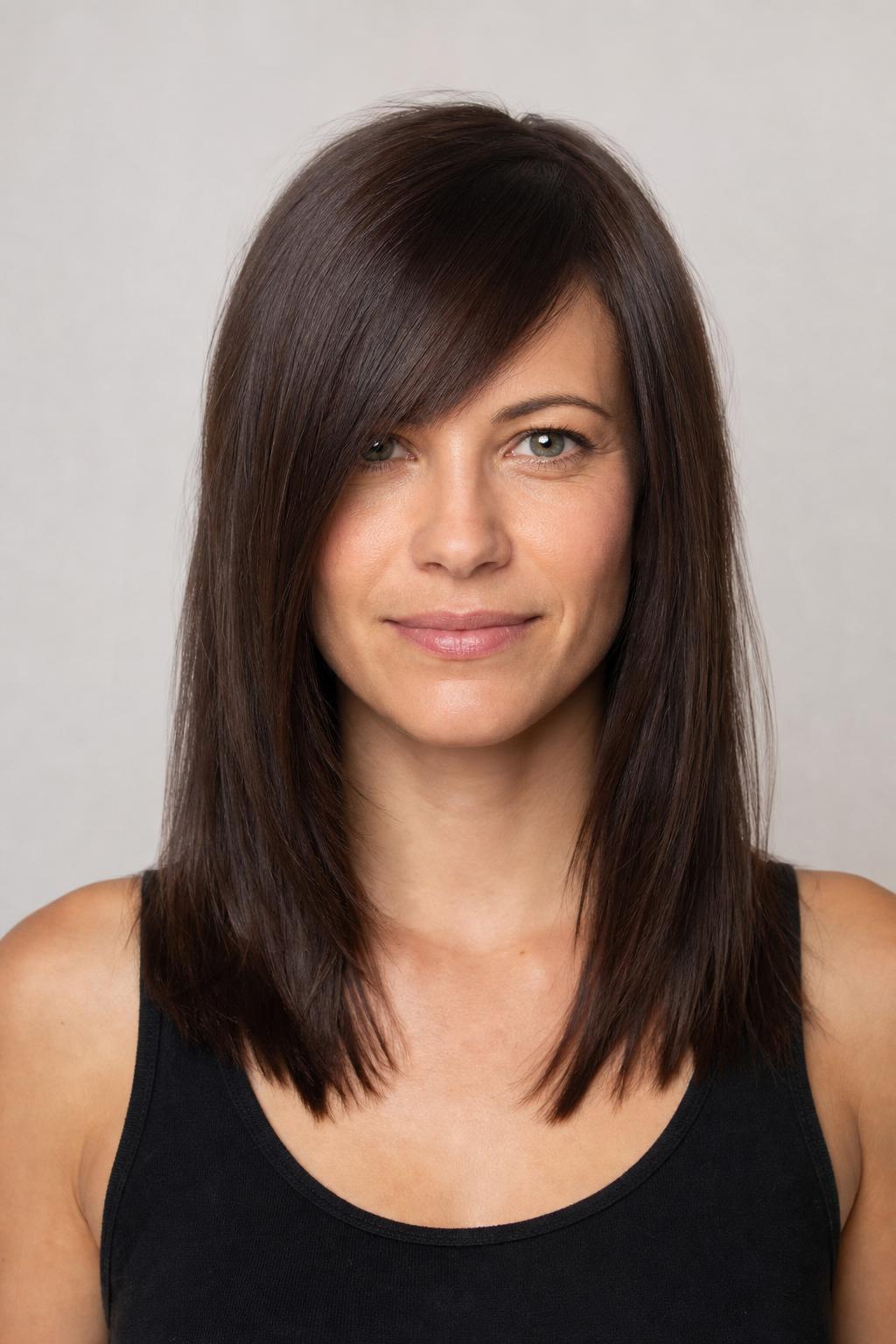
14. Long Angled Bangs Blended into Face-Framing Layers
Heart-shaped faces benefit most from this pairing, since the long end of the fringe adds width beside the chin where the face narrows. The bangs melt into face-framing pieces with no visible seam, so the whole front of the haircut works as one shape. Ask for the shortest point at cheekbone level, never above, to keep the blend seamless.
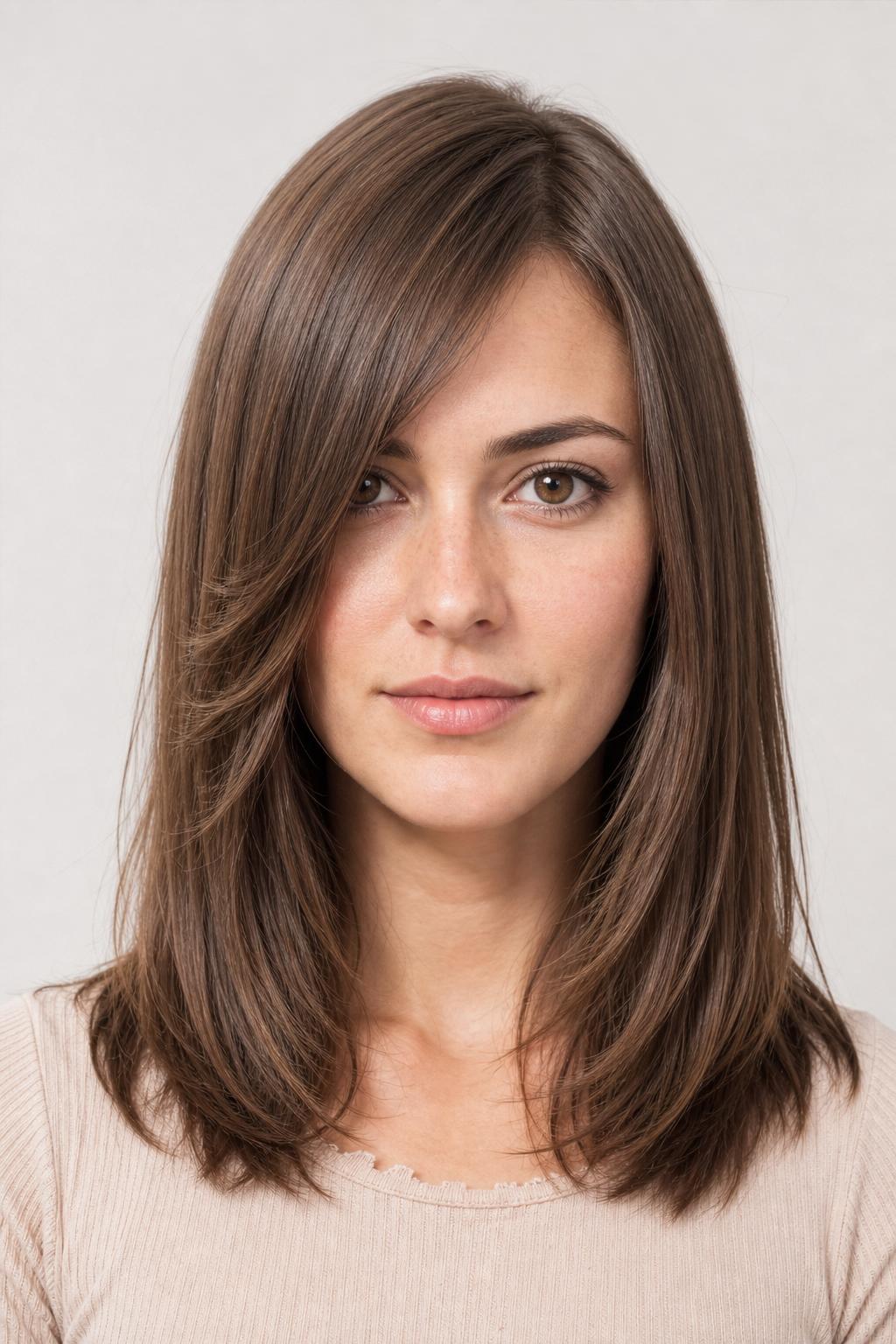
15. Deep Side-Slant Fringe on Straight Hair
People confuse this with classic side-swept bangs, but the difference is in the cut, not the styling: a side-swept fringe is cut straight and combed sideways, while this one is cut on the diagonal and falls into place on its own. No round brush, no direction training, no fighting your part. Straight, medium-density hair shows the distinction most clearly.
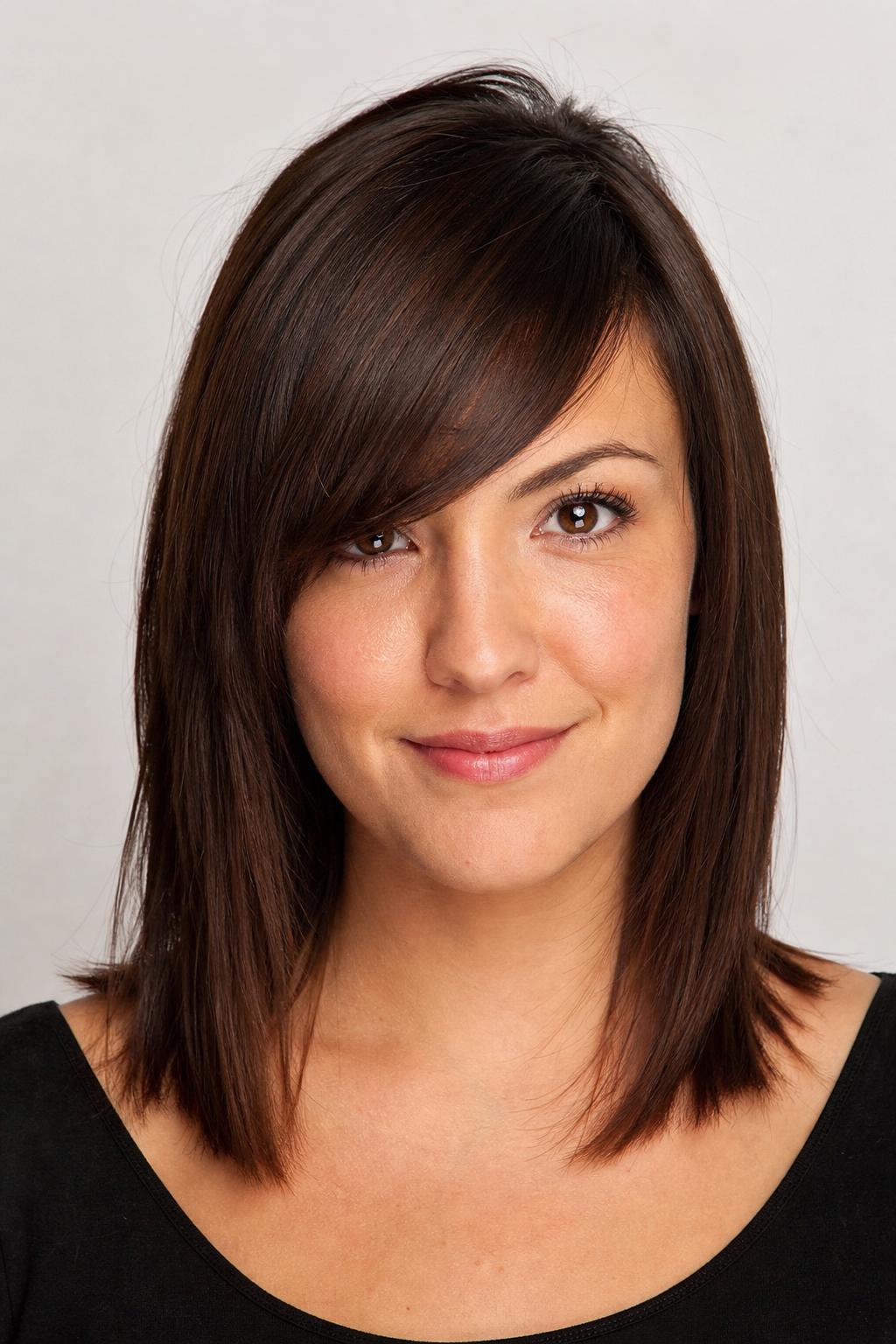
16. Cheekbone-to-Jaw Angled Bangs
Request this as “a diagonal fringe from cheekbone to jaw, cut dry, with the weight kept at the ends.” Keeping the ends weighted stops the long side from wisping away into nothing after the first wash. It flatters square jaws by laying a soft line over the face’s strongest angle.
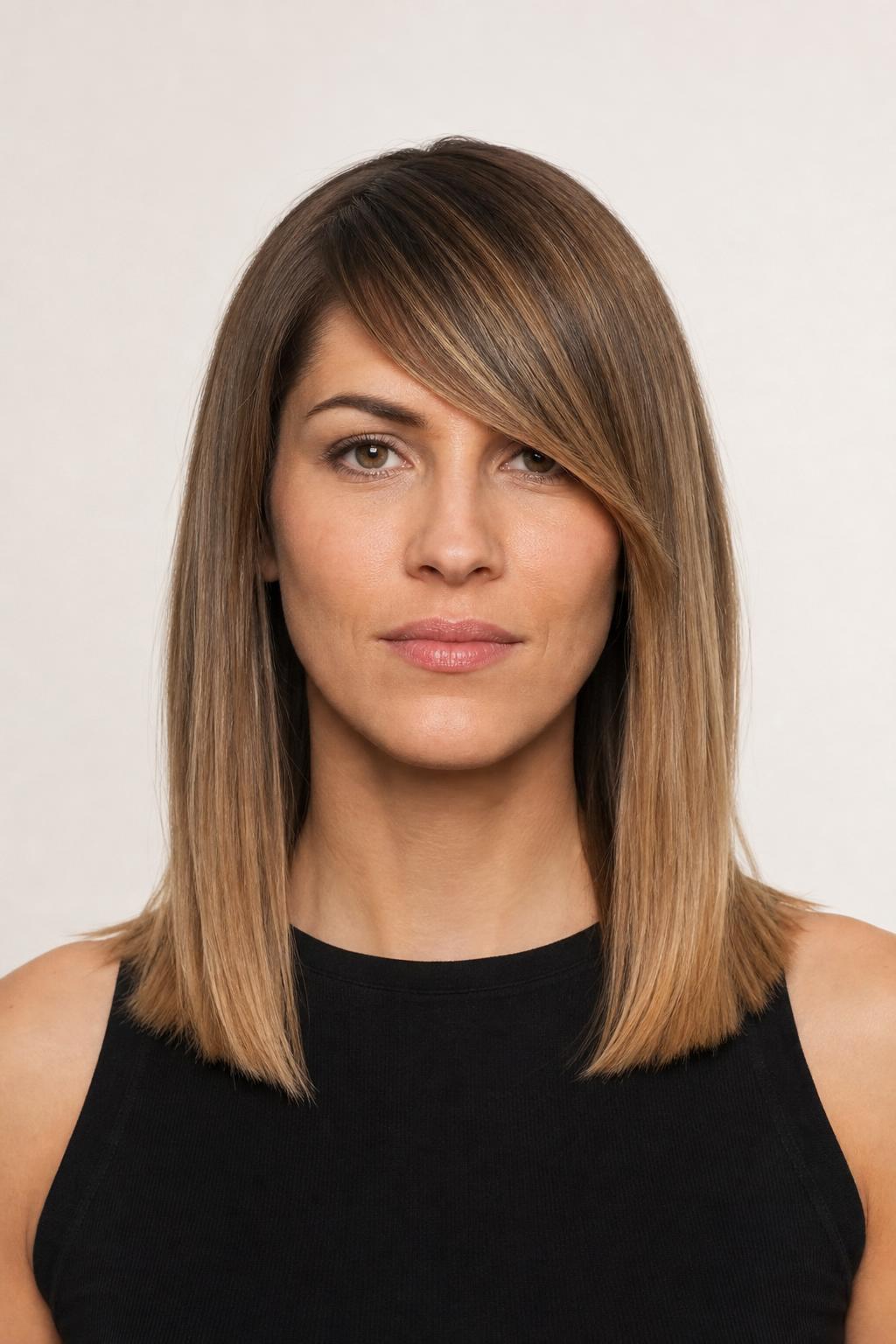
17. Long Slanted Fringe with Balayage
Dimensional color makes a long diagonal look lit from within, because the fringe crosses several balayage ribbons on its way down. The lightest pieces should land at the fringe’s long end, near the jaw, where painted balayage naturally brightens. If your color appointment comes first, cut the fringe afterward so the stylist can place the angle through the brightest section.
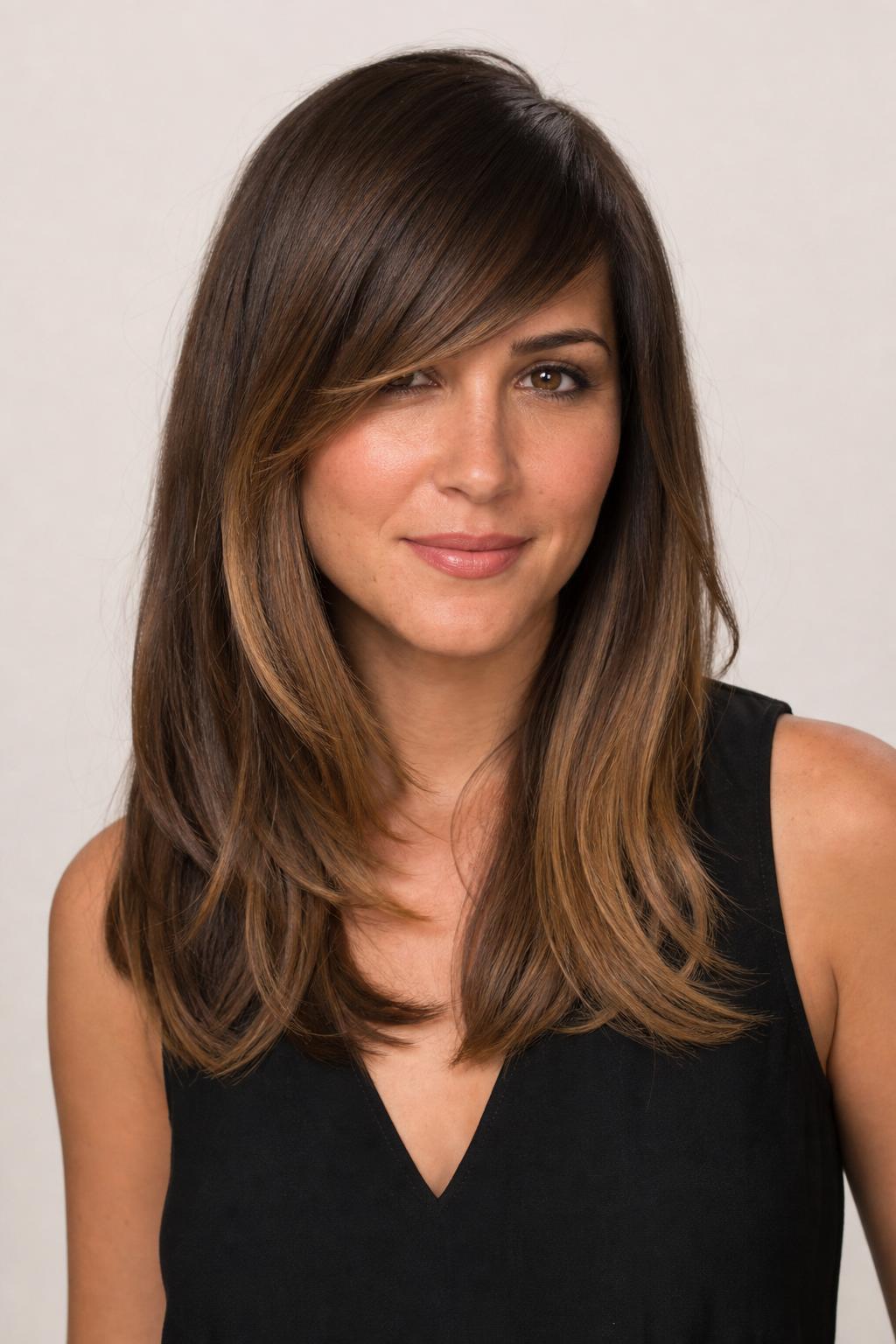
18. Eye-Skimming Diagonal on Thick Hair
Thick hair gives this length its best version, since the fringe needs enough density to hold a defined edge as it crosses the eyeline. The stylist removes interior weight with slide cutting so the fringe skims the lashes without pushing forward like an awning. Sweep it fully to one side on day two for a different look from the same cut.
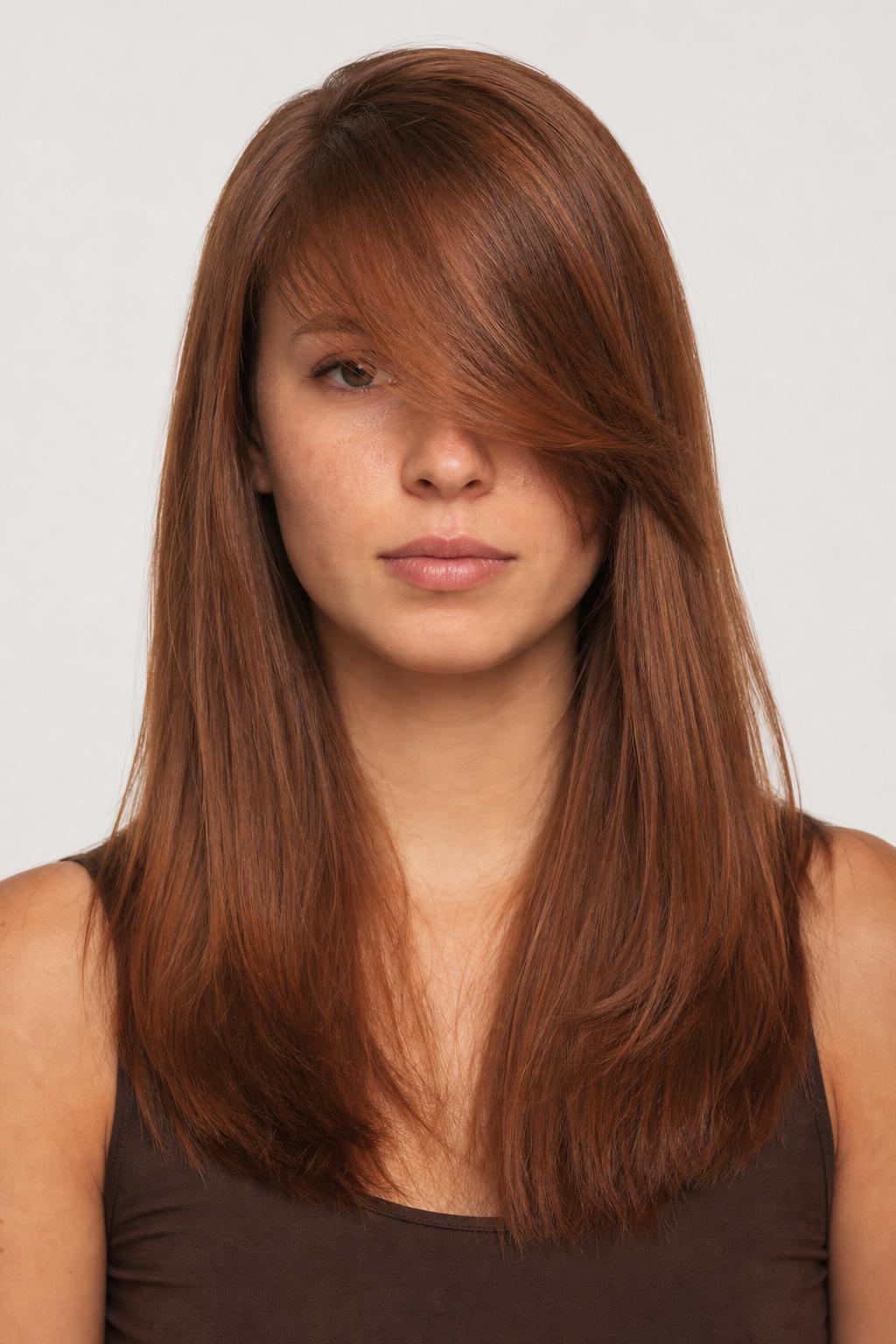
Asymmetrical Bangs with Bobs and Pixies
Short haircuts amplify an angled fringe, because there is less hair to compete with it. The pairings below match the fringe’s slant to the cut’s own geometry, which is the detail that separates a considered look from a busy one.
19. French Bob with an Angled Micro Fringe
The classic French bob wears its fringe straight, so tilting it is a quiet subversion of a familiar shape. Keep the bob itself blunt and chin-length while the fringe carries all the asymmetry. Parisian styling rules still apply: air-dry, a drop of smoothing cream, and no visible effort.

20. Asymmetrical Bob with Matching Slanted Bangs
Here the fringe repeats the bob’s own diagonal, with both angling down toward the same side. Committing to one direction makes the whole cut feel architectural, and it is the version stylists photograph most for their portfolios. The geometry pairs naturally with the longer-one-side shapes in our asymmetrical bob collection.
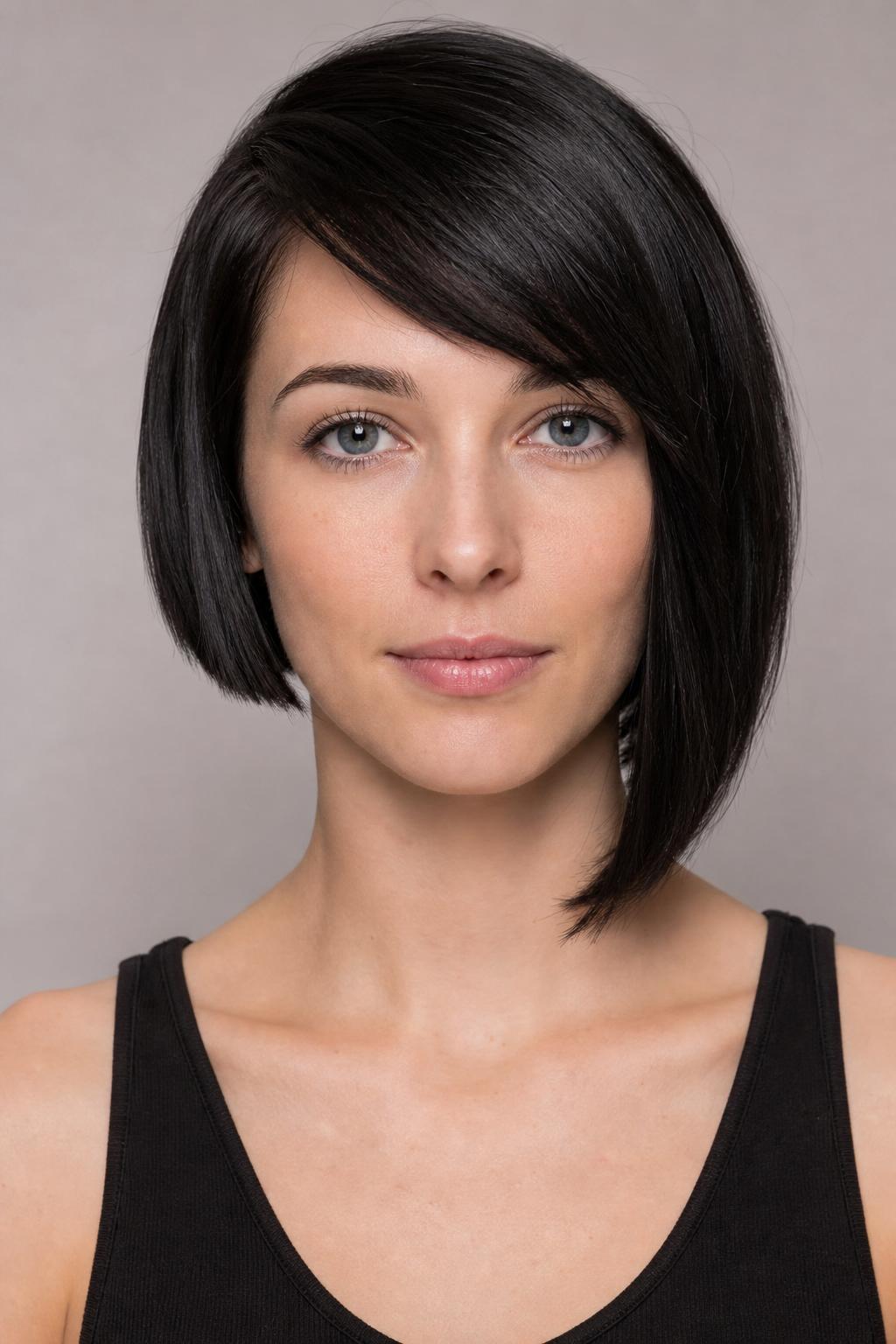
21. Pixie with a Long Diagonal Fringe
A cropped back and a cheekbone-length fringe give this pixie two personalities: sharp from behind, soft from the front. Fine and medium hair both carry it well since the fringe supplies the volume the crop removes. It belongs to the same family as the styles in our gallery of pixie cuts with bangs, but the diagonal makes it the most forward-looking of them.
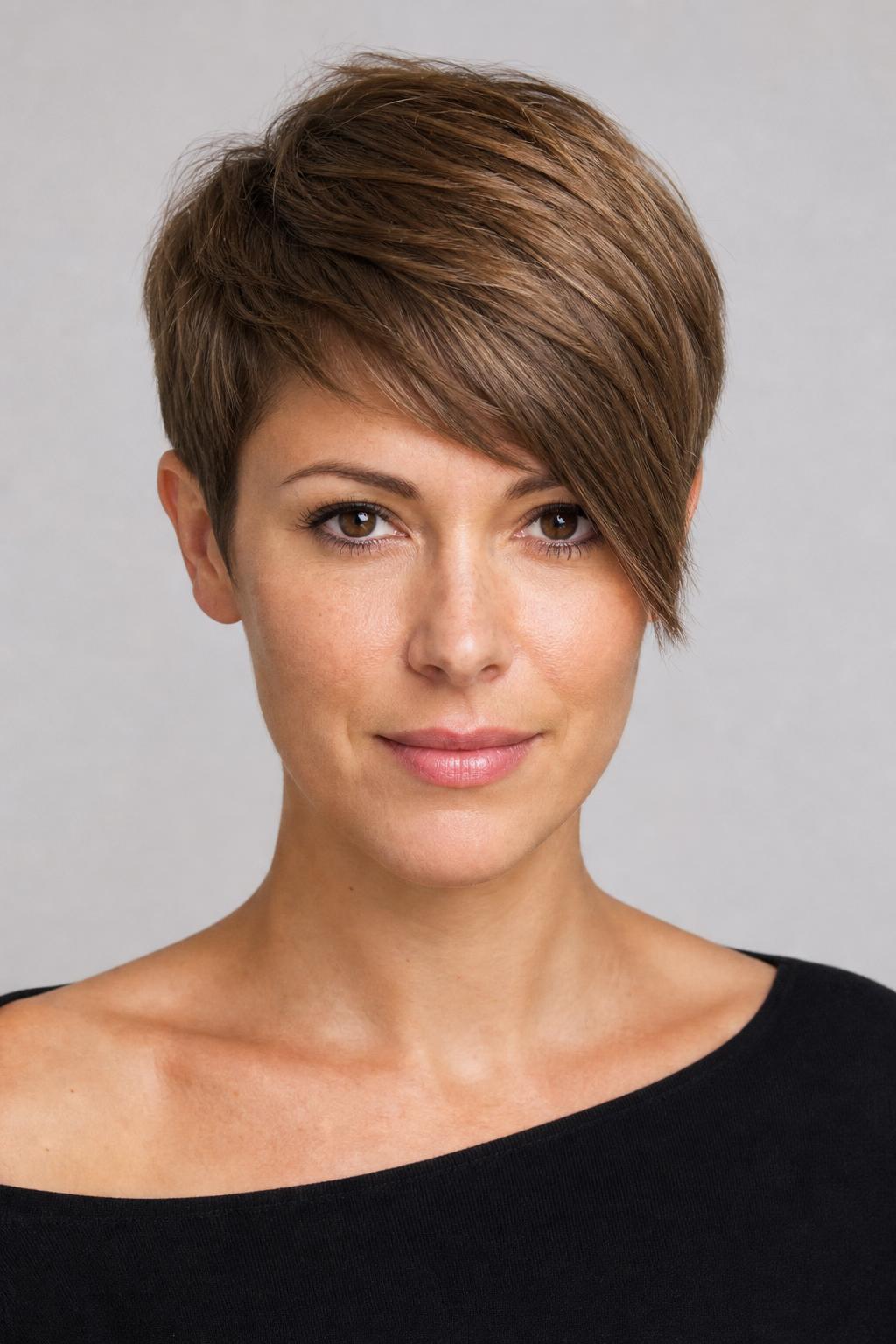
22. Chin-Length Bob with a Soft Off-Center Fringe
Softness is the point here: the fringe splits slightly off-center and both pieces are razored at the ends, so nothing about the cut has a hard line. Wavy-leaning hair takes to it especially well because the razored edges move with the bend instead of fighting it. Expect an easy 7 to 8 weeks between trims, unusual for a bob with bangs.

23. Bixie with Choppy Angled Bangs
The bixie’s hybrid length gives the choppy fringe somewhere to blend, so the angle registers as texture rather than a line. Work a texturizing paste through both fringe and crown in one pass; separating them defeats the cut’s whole point. Round and oval faces wear this best since the choppiness adds width at the temples.
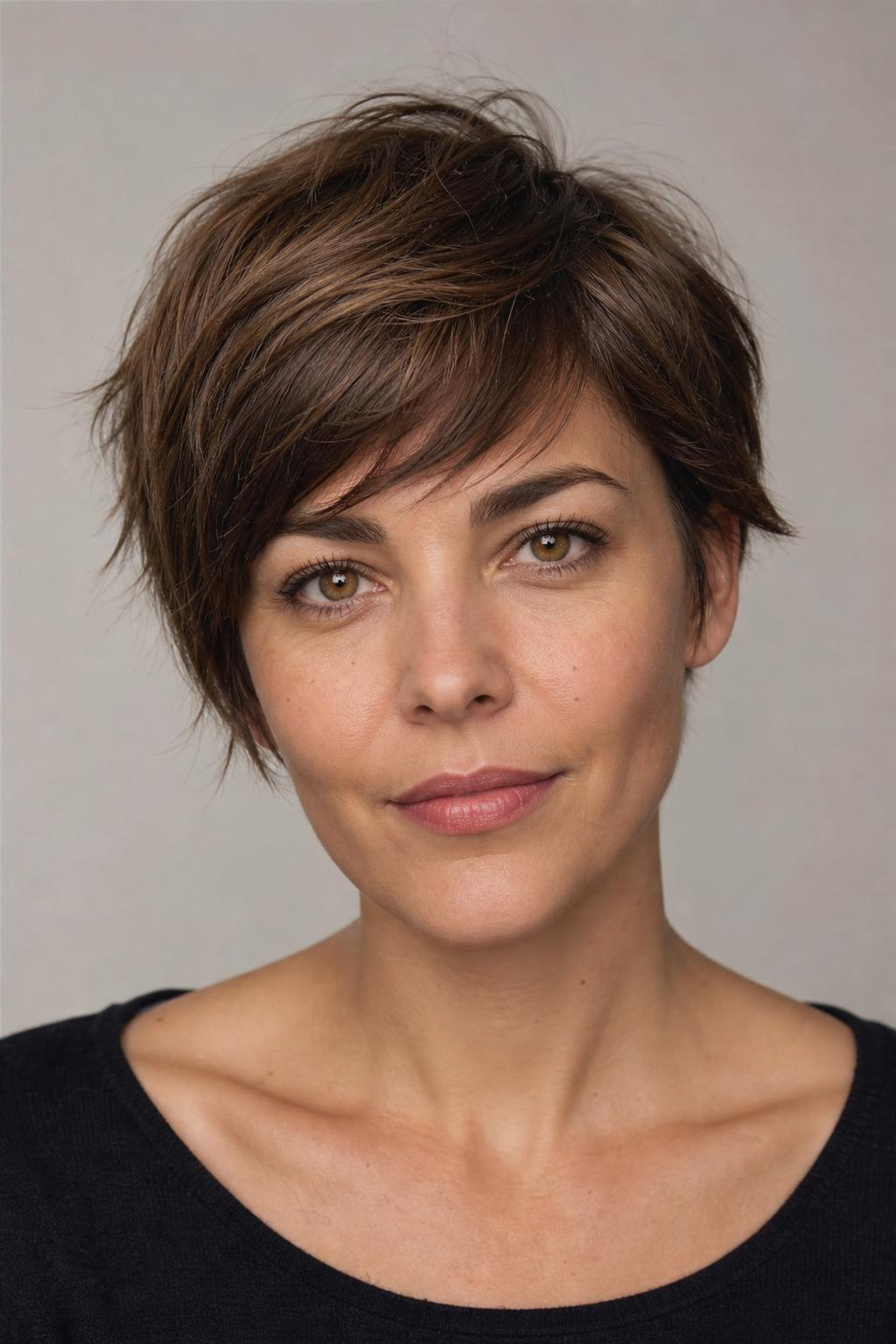
24. Sleek Lob with a Precision Diagonal Fringe
Glass-smooth styling turns the diagonal into the sharpest line in the room. Flat-iron the fringe in one downward pass with a narrow-plate iron, then finish with a rice-grain amount of shine serum pressed between your palms. The lob stays one length to keep every eye on the angle.
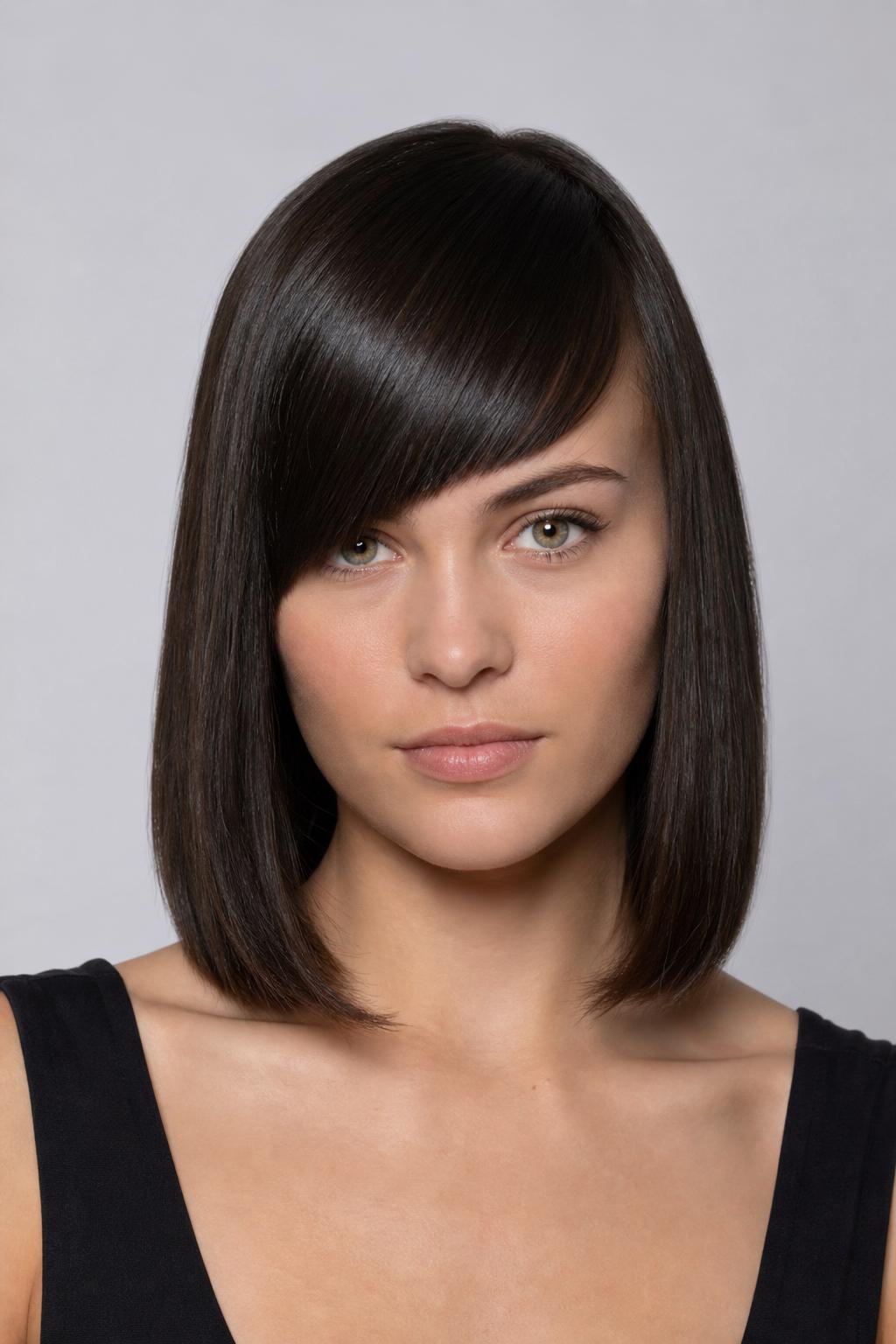
Curly, Textured, and Statement Versions
Texture changes the math of an angled fringe: curls shrink, waves bend, and razored pieces scatter the line. The final six looks lean into that unpredictability, plus two bold versions for anyone treating the fringe as the outfit. Curl-specific inspiration continues in our curly bangs gallery if these spark something.
25. Curly Asymmetrical Fringe Cut Dry
On 3a to 3c curls the slant must be cut dry, curl by curl, because shrinkage will turn a wet-cut diagonal into a surprise. The finished fringe stacks shorter spirals on one side and longer ones on the other, an angle you see through volume rather than a line. Refresh it between washes with a mist of water and a dime of curl cream scrunched upward.
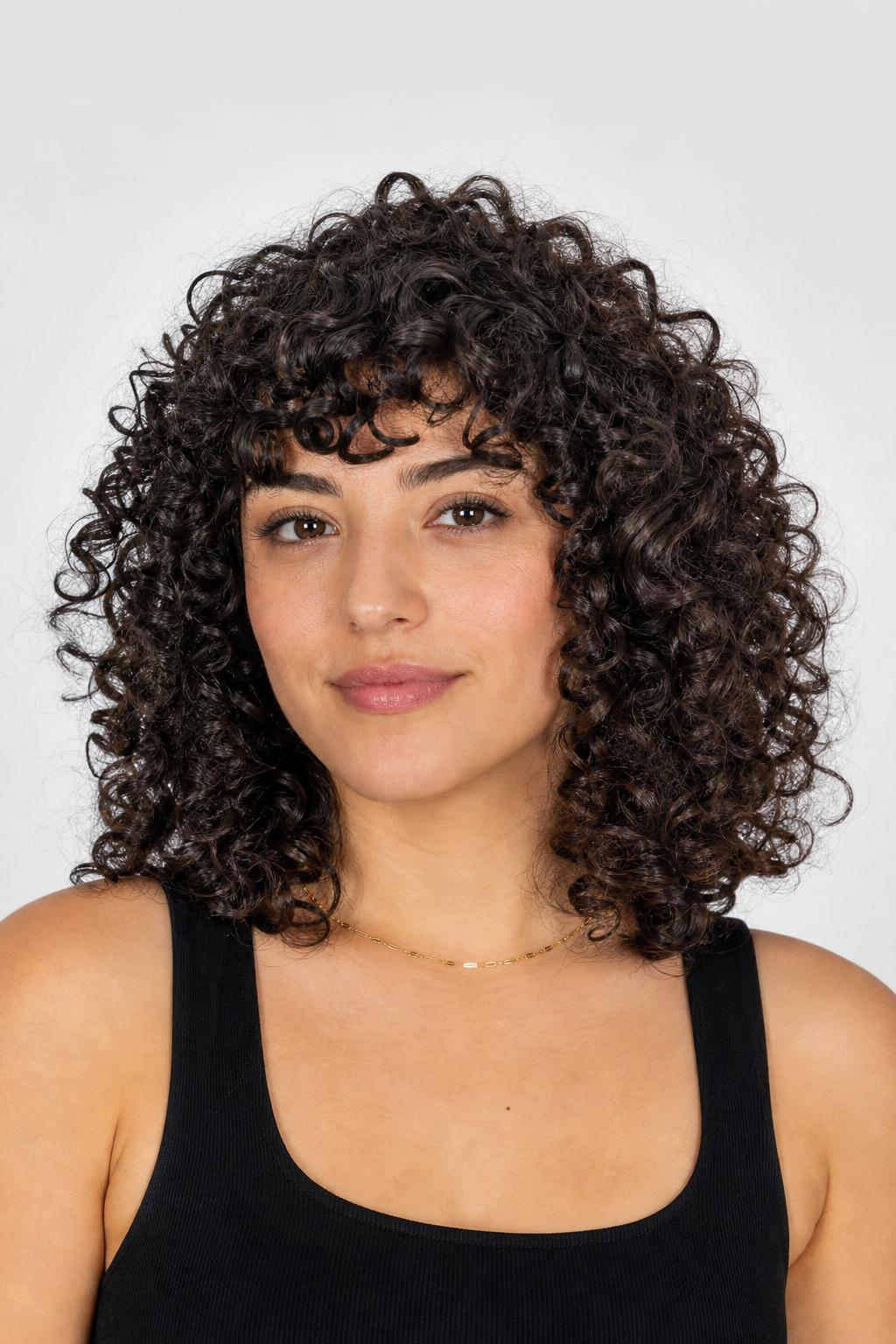
26. Shag with a Slanted Fringe
A shag already carries layers at every length, so the slanted fringe simply becomes the shortest layer in the sequence. The look holds up on wavy hair with nothing but a diffuser and a texturizing spray. Grow-out is nearly invisible, which makes this the best angled fringe for people who stretch salon visits past 10 weeks.
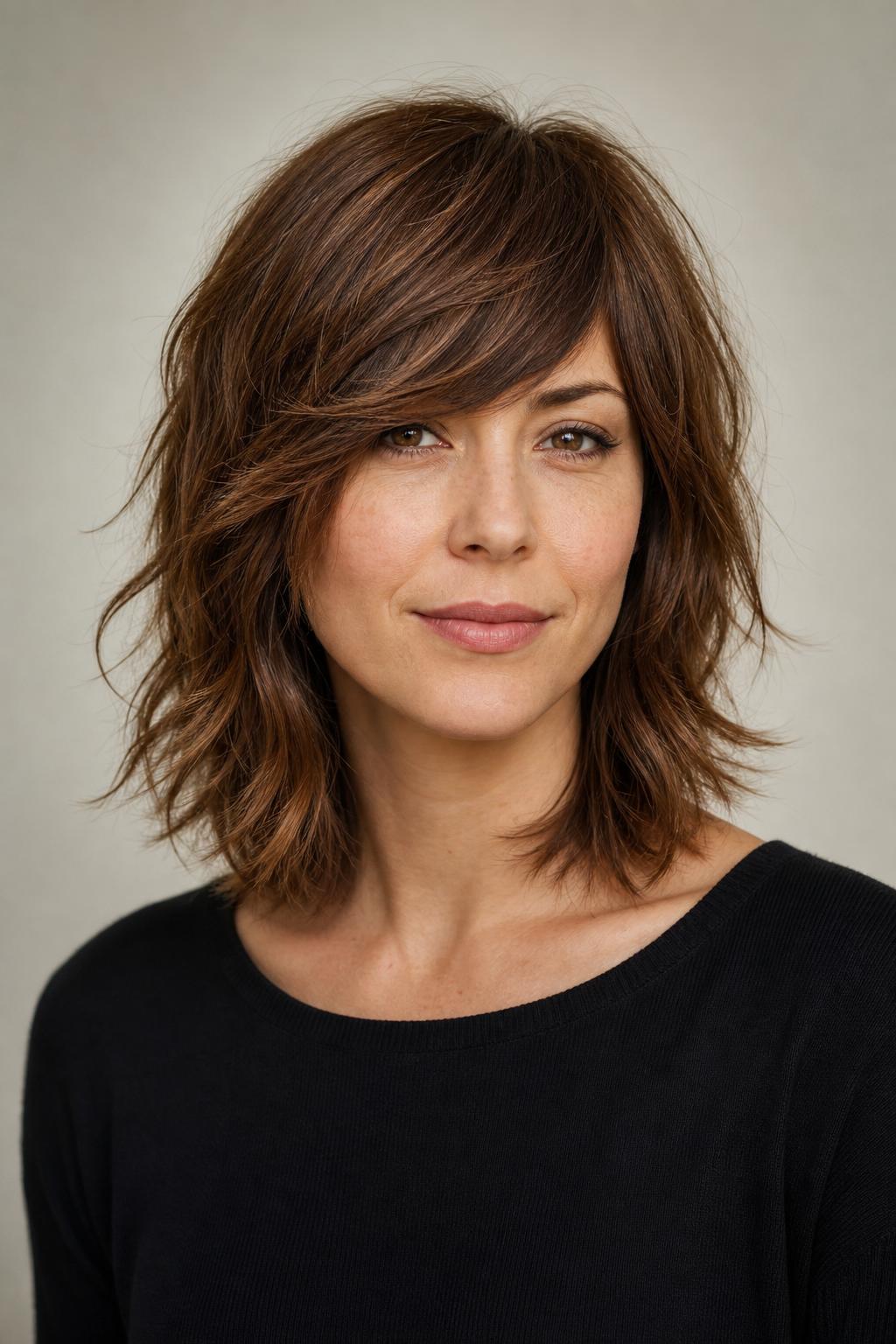
27. Razor-Cut Fringe on a Wolf Cut
Razoring gives the fringe torn, uneven ends that match the wolf cut’s shaggy crown, and the slant keeps the front from looking like a helmet of layers. The fringe should hit mid-brow at its shortest and eye level at its longest, staying inside the wolf cut’s frame. Straight-to-wavy medium hair holds the razored texture without frizzing.
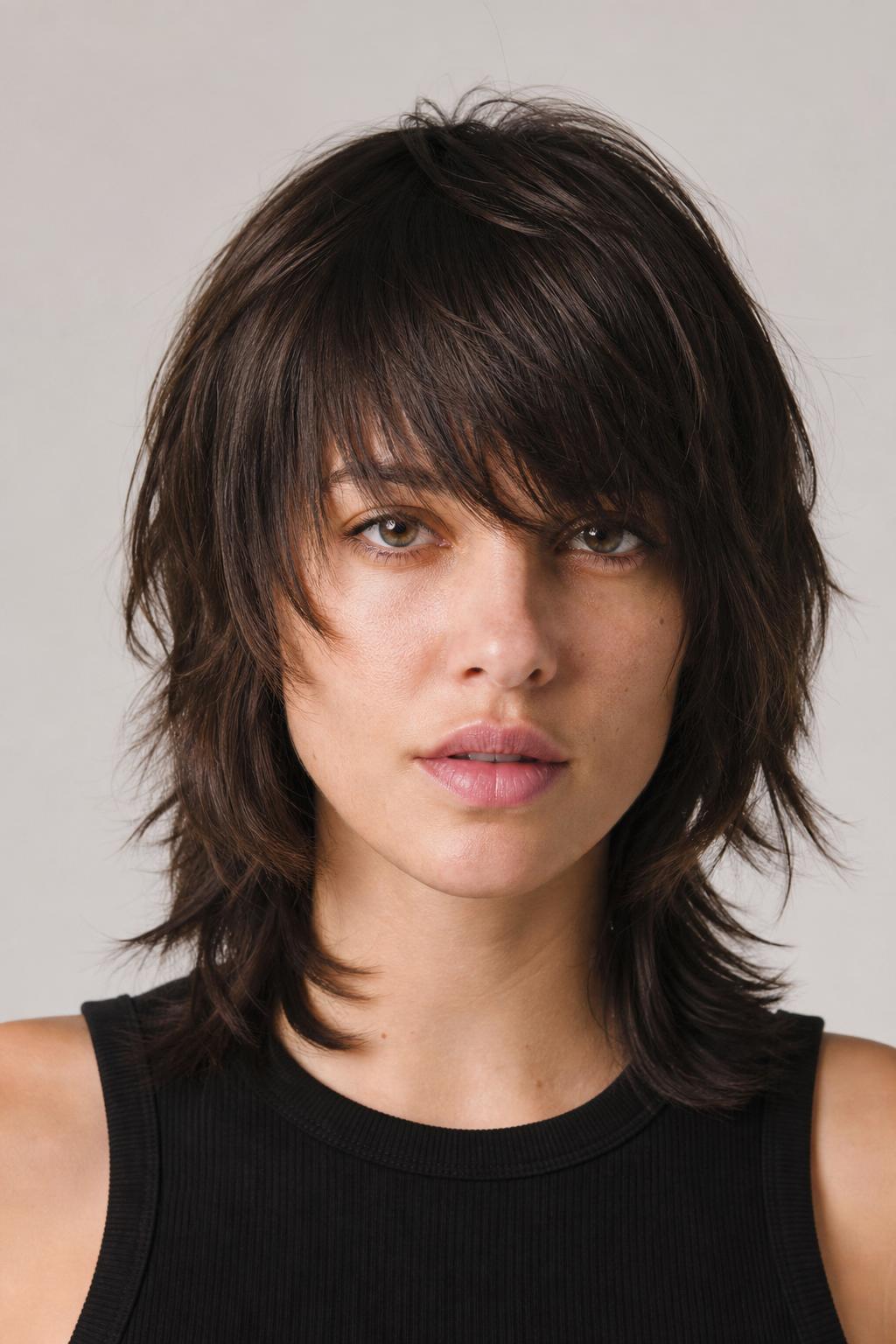
28. Platinum Angled Fringe as the Focal Point
Bleaching only the fringe is a striking, lower-damage alternative to a full platinum head, and the diagonal cut turns the color block into a graphic shape. The contrast works hardest on naturally dark hair, where the angle is legible from across a room. Budget for a toner refresh every 4 weeks, since yellowing shows faster on a small bright section than on full-head color.
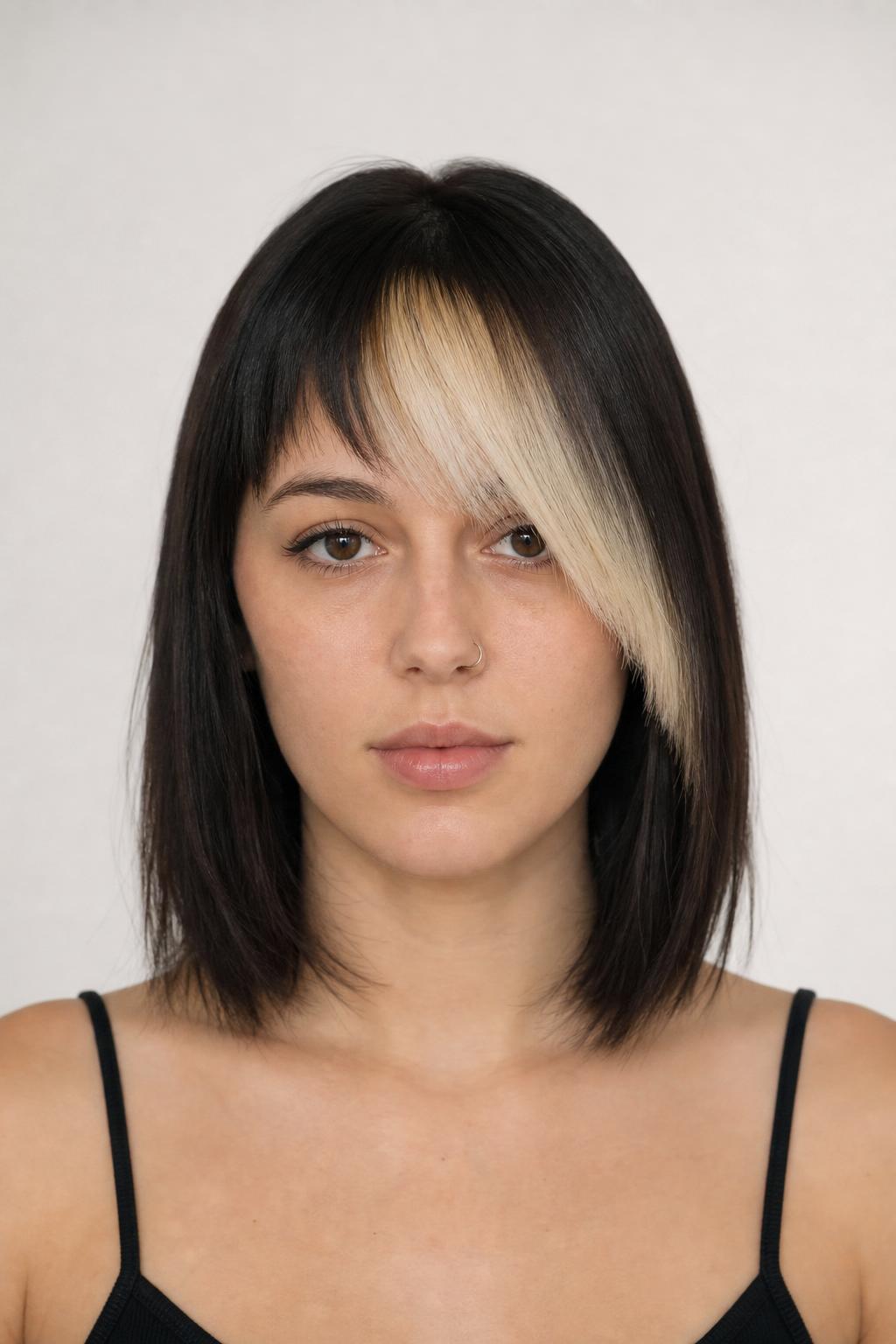
29. Thick Blunt Fringe with a Stepped Angle
Instead of one smooth diagonal, this fringe drops in two visible steps, like a staircase across the forehead. It needs dense, straight hair to keep each step crisp, and a stylist comfortable cutting geometric lines freehand. Show the photo rather than describing it; “stepped fringe” means different things in different chairs.
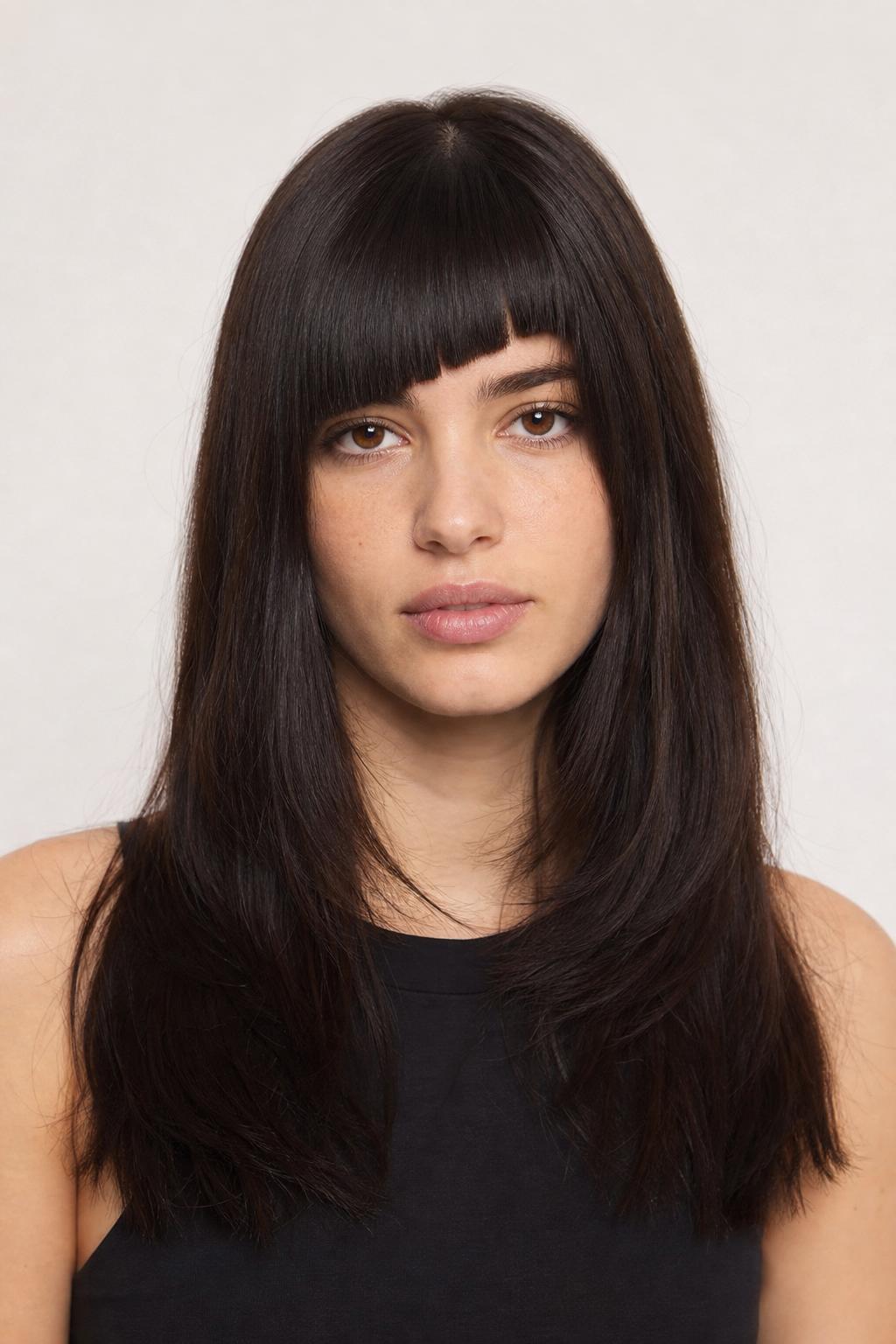
30. Disconnected Fringe with an Undercut Pixie
The longest fringe in this gallery hangs from the shortest haircut: a jaw-length diagonal panel over a clippered undercut. Disconnection means the two lengths never blend, and the fringe can flip back to reveal the crop underneath. It asks for confidence and a monthly clipper appointment, and it gives back a look nobody else in the room is wearing.
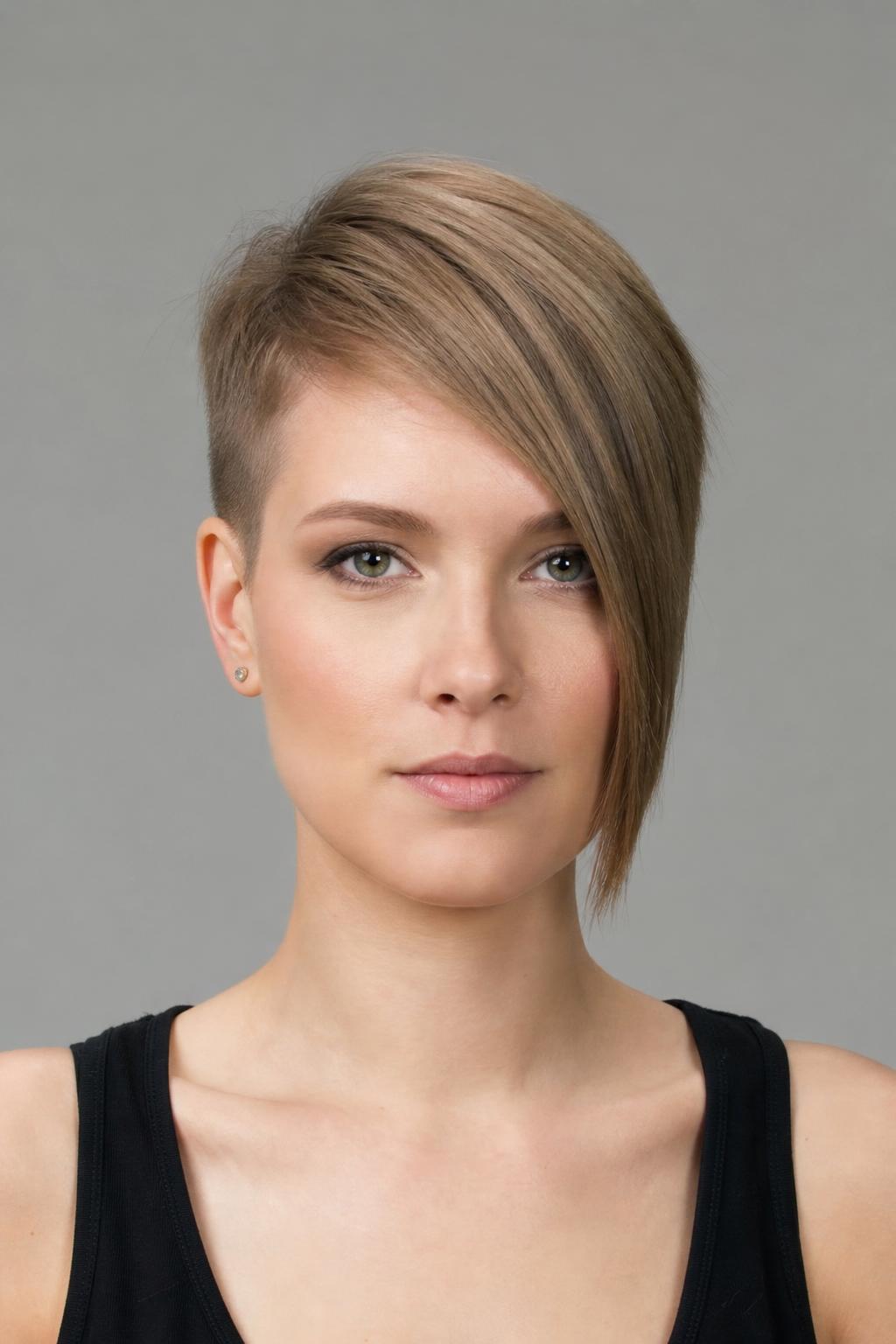
How to Choose Asymmetrical Bangs for Your Face Shape
A slanted fringe is a diagonal line laid over your face, so the question is what that line should counteract. Wide faces want the angle to travel up and out; long faces want it low and closer to horizontal; angular faces want the line softened with texture. The table below turns that logic into specific requests.
| Face Shape | Best Version | Ideal Slant | Avoid |
|---|---|---|---|
| Oval | Almost any; micro versions show off balanced proportions | Any angle, brow to cheekbone | Nothing structural; choose by hair type instead |
| Round | Long diagonal ending past the cheekbone | Steep, brow to jaw | Wide, shallow slants that repeat the face’s width |
| Square | Wispy or razored slant with soft ends | Moderate, brow to cheekbone | Hard blunt diagonals that add a second angle to the jaw |
| Heart | Long end blended into chin-level face-framing | Cheekbone to jaw | Micro versions that expose the forehead’s full width |
| Long / Oblong | Fuller fringe with a gentle lean at eyebrow level | Shallow, half an inch to an inch | Jaw-length diagonals that add more vertical line |
| Diamond | Soft slant with width kept at the temples | Gentle, brow to outer brow | Slants ending at the cheekbone, the face’s widest point |
What to Tell Your Stylist
“Asymmetrical bangs” is a category, not a request, so walk in with three specifics: the shortest point, the longest point, and the texture of the edge. A complete request sounds like this: “I want a diagonal fringe, mid-brow at its shortest over my left eye, reaching my right cheekbone at its longest, with the ends point cut so the line stays soft.” Name the side deliberately, because the slant should lean toward your usual part, not away from it.
Bring two photos: one of the fringe you want and one of your hair as it dries naturally, so the stylist can judge how your texture will treat the angle. If you have a cowlick at the hairline, say so before the first snip; a good stylist will start the slant on the cowlick’s side and let the growth pattern help rather than fight. Still deciding whether a fringe fits your routine at all? Our honest guide to whether you should get bangs walks through the questions to answer first.
Stylist tip: Ask for the fringe to be cut dry and finished after the rest of the haircut is styled. A diagonal cut wet stretches under the comb’s tension and can spring up a full half inch shorter on the short side, which exaggerates the angle far past what you asked for.
Maintenance and Styling
An angled fringe loses its geometry faster than a straight one, because growth blurs the slant from both ends. Blunt and micro versions need a trim every 3 to 4 weeks; wispy and long diagonal versions stretch to 5 or even 8 weeks since new growth blends into the taper. Daily styling stays quick: 2 to 3 minutes of blow-drying the fringe downward with a flat brush for straight hair, 5 to 8 minutes with a round brush or iron for wavy textures.
| Fringe Version | Trim Frequency | Daily Styling | Key Product |
|---|---|---|---|
| Micro / baby slant | 3 to 4 weeks | 1 to 3 minutes | Matte paste, a fingertip amount |
| Wispy / see-through | 4 to 6 weeks | 2 to 4 minutes | Lightweight smoothing cream |
| Long diagonal | 6 to 8 weeks | 3 to 5 minutes | Light hold spray |
| Curly / textured | 5 to 7 weeks, dry cut | 3 to 8 minutes | Curl cream, scrunched upward |
Stylist tip: Wash-day flatness is the angled fringe’s biggest enemy. Dry the fringe first, before the rest of your hair, while it still holds zero moisture memory; a fringe dried last has already air-dried into whatever direction it slept in, and no brush fully resets it.
When Asymmetrical Bangs Are Not the Right Choice
A slanted fringe rewards commitment and punishes ambivalence. Skip it, at least for now, if any of these describes you:
- You change your part frequently. The slant is built around one part direction, and flipping it leaves the fringe pointing the wrong way; a centered curtain fringe tolerates part changes far better.
- You want a fringe you can ignore. The diagonal disappears without regular trims, so a low-upkeep season calls for soft face-framing layers instead.
- You wear tight coils and prefer no heat or daily manipulation. Keeping a visible slant in 4a to 4c hair means constant reshaping; a curly fringe cut for volume rather than line respects the texture more.
- You have a strong double cowlick at the front hairline. Two opposing growth patterns can split any fringe down the middle, and an angled one shows the split most; ask your stylist whether your hairline can support a fringe before booking the cut.
FAQ
What is the difference between asymmetrical bangs and side-swept bangs?
Asymmetrical bangs are cut at two different lengths, while side-swept bangs are cut evenly and styled to one side. The angled cut holds its shape after washing with no direction training, but it cannot be styled straight across on days you want a different look. Side-swept versions are more flexible; angled versions are more consistent.
Do asymmetrical bangs work on curly hair?
Yes, if they are cut dry. Curl shrinkage varies strand to strand, so a slant cut on wet curls lands unpredictably once the hair dries. A stylist experienced with curls will cut the angle curl by curl at natural resting length, and the finished slant shows through volume rather than a hard line.
How often do asymmetrical bangs need to be trimmed?
Every 3 to 4 weeks for short blunt versions, and every 6 to 8 weeks for long or wispy ones. The diagonal blurs as hair grows because the short side catches up to the long side, softening the angle you paid for. Many salons offer free or low-cost fringe trims between full appointments, which makes the schedule easier to keep.
Can I cut asymmetrical bangs myself at home?
It is riskier than trimming straight bangs, and stylists advise against starting the shape yourself. A diagonal must account for your cowlicks, density, and natural fall, and home cuts tend to overshoot the angle on the short side. Maintaining an existing slant at home is more doable: trim sparingly, cutting vertically into the ends rather than straight across, and only on dry, styled hair.
Which face shape suits asymmetrical bangs best?
Round and heart-shaped faces get the most measurable benefit, because the diagonal interrupts facial width and rebalances proportions. Oval faces can wear any version, and square faces do well with softened, wispy slants. Long faces should choose the shallowest angle at brow level, since steep diagonals add vertical emphasis they do not need.
Will asymmetrical bangs grow out awkwardly?
Less awkwardly than straight blunt bangs, which is one of this fringe’s underrated advantages. The long side is already partway to a face-framing layer, so growth mostly extends an existing line rather than creating a new in-between stage. The short side takes 2 to 3 months to catch up; tucking it behind the ear or pinning it during weeks 6 through 10 covers the gap. You can browse more fringe styles at every grow-out stage in our bangs and fringes section.
The right asymmetrical bangs come down to three decisions: how short the short side goes, where the long side ends, and how soft the edge between them should be. Settle those with the face shape table above, bring a photo from this gallery, and give your stylist the exact endpoints rather than just the word “asymmetrical.” A slanted fringe chosen that precisely stops being a trend you tried and becomes the detail your haircut is known for.
Hair results vary based on your natural hair type, texture, density, and condition. Always consult with a licensed hairstylist before making significant changes, especially with chemical treatments or dramatic length changes. Photos may show styled results that require professional tools and products to replicate.