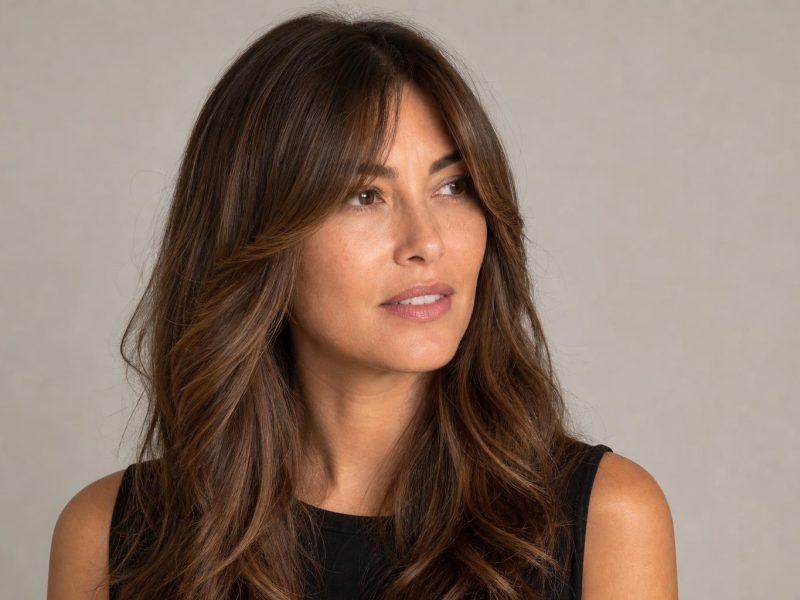

Your stylist cuts your bangs; your glasses decide how they look, so the two need to be chosen together.
Bangs for glasses work when the fringe and the frames divide your face instead of fighting over the same territory: the bangs should end at least a finger’s width above the top rim, or clearly sweep past it to the side. Get that clearance right and almost any fringe pairs with almost any frame. The 20 styles below are matched to specific frame types, from thin wire rounds to bold acetate rectangles, with the practical details eyewear blogs skip: lash clearance, lens smudging, and what regrowth does to the balance.
The gallery is organized by fringe family: curtain and face-framing versions first, then wispy see-through styles, full blunt fringes, and short textured cuts. After the photos come a frame-matching table, salon advice that includes exactly what to bring to the appointment, and an honest section on the combinations that genuinely do not work. If you are still comparing fringe families in general, our guide to the main types of bangs covers the full landscape.
| Factor | Details |
|---|---|
| Best for | Daily glasses wearers who want the fringe and frames to read as one deliberate look |
| Key rule | Fringe ends a finger’s width above the top rim, or sweeps clearly past it |
| Maintenance | Trims every 3 to 6 weeks; short styles need the most frequent upkeep |
| Avoid if | Your lashes brush your lenses, or your fringe would rest directly on the top rim at its styled length |
| Bring to the salon | The glasses you actually wear daily, worn during the consultation and the cut |
Curtain and Face-Framing Bangs with Glasses
Curtain styles are the safest opening move for glasses wearers, because the fringe parts around the frames instead of competing with the top rim. The sweep also softens the vertical line that strong frames draw across the face. These five versions run from barely-there to fully committed.
1. Classic Curtain Bangs with Oversized Frames
Oversized acetate frames occupy the middle of the face, so the curtain pieces are cut to open just wider than the frame’s outer edge. That small measurement is the whole trick: too narrow and the bangs pile onto the lenses, too wide and the look loses its frame-within-frame effect. Soft versions of this pairing dominate salon request books, and our gallery of soft curtain bangs shows the fringe on its own.

2. Long Curtain Pieces with Thin Wire Rounds
Delicate wire rounds disappear against the face, which lets a longer, heavier curtain fringe take the lead. The pieces fall from a center part to jaw length, framing the small lenses like parentheses. Fine to medium straight hair suits this best, since the long pieces need enough weight to hang close to the face.

3. Swooping Side Fringe over Cat-Eye Frames
A cat-eye frame lifts at the outer corners, and a side-swept fringe angled the same direction doubles that upward line. Ask your stylist to cut the sweep so its lowest point lands beside the frame’s lifted corner, not on top of it. The pairing flatters round faces by pulling every line on the face diagonally upward.

4. Face-Framing Pieces with Rimless Glasses
Rimless lenses add almost nothing visually, so the face-framing pieces do the structural work a frame normally would. Cheekbone-length front pieces blend into longer layers, drawing a soft border around the face that the glasses float inside. It is the lowest-commitment entry here, since face-framing bangs of this length are barely bangs at all.

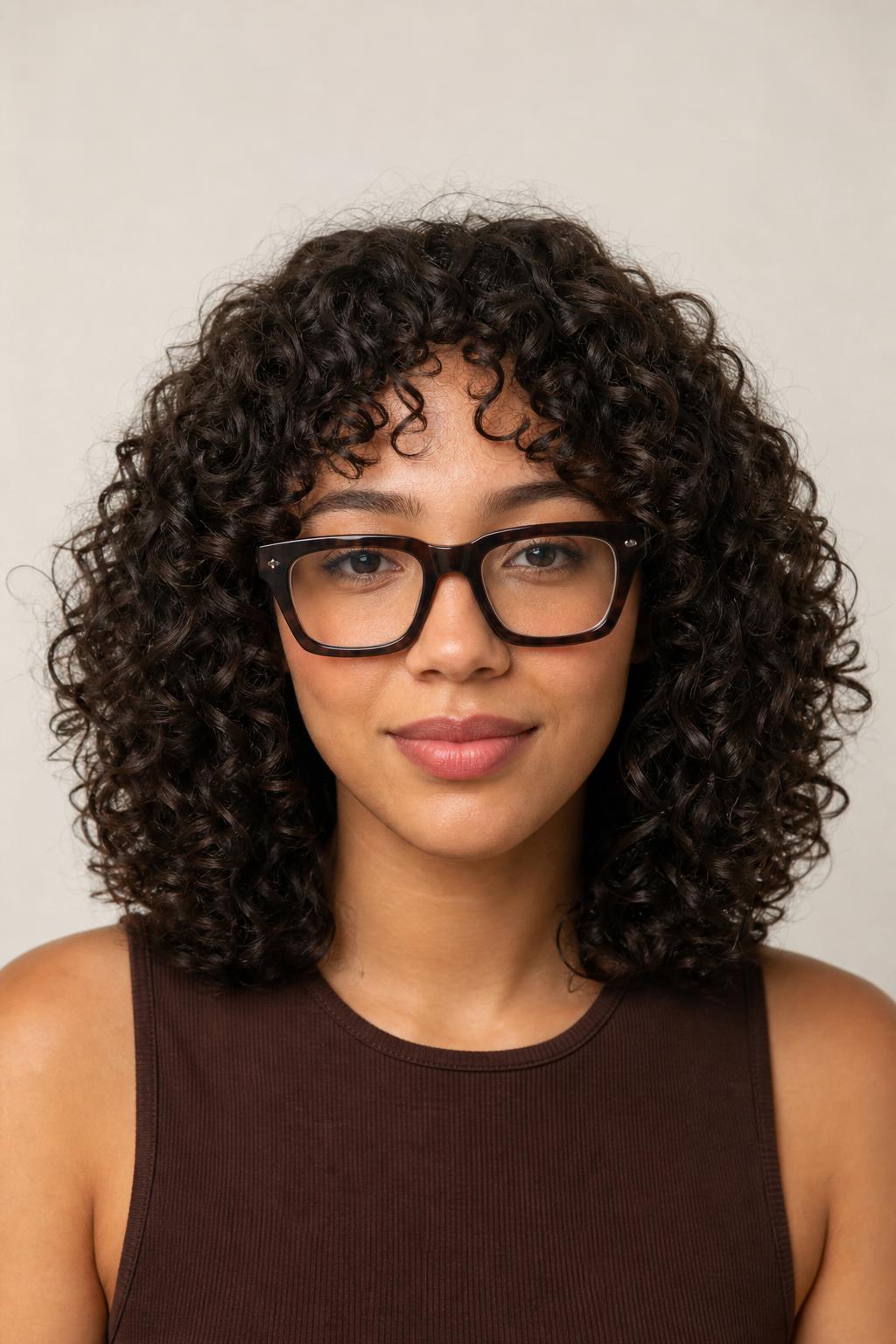
5. Curly Curtain Fringe with Bold Rectangles
Springy curls shrink upward and outward, so this curtain fringe is cut dry to sit above bold rectangular frames with room to spare. The geometric frame against organic curl is the point: one line straight, everything else in motion. More curl-specific fringe ideas live in our curly bangs gallery.
Wispy and See-Through Fringes for Frames
Sheer fringes solve the crowding problem by lowering the density instead of raising the hem. Light passes through them, the frames stay visible, and the forehead keeps some coverage. They are the stylist’s usual recommendation for first-time bangs on a longtime glasses wearer.
6. See-Through Bangs with Thin Metal Frames
Sparse, brow-grazing strands let both the forehead and the frame tops show, which keeps the eye area from feeling walled in. Thin metal frames match the fringe’s lightness; a heavy acetate rim would overpower it. The full straight-hair version of this fringe has its own gallery in our see-through bangs collection.

7. Wispy Bangs with Clear Acetate Frames
Clear frames are already a soft choice, and a feathered, wispy fringe keeps the whole upper face in the same gentle register. The tapered ends should just clear the top rim so the two soft elements never overlap. Fine hair wears this pairing particularly well because neither element demands density.

8. Airy Fringe with Blue-Light Readers
Desk-day glasses deserve their own plan, because screens plus a heavy fringe mean constant lens smudging as the hair swings forward. An airy fringe cut to eyebrow length stays out of the lens zone even when you look down at a keyboard for hours. Style it once in the morning with a two-minute blast of a blow-dryer on cool and it holds through the workday.

9. Soft Slanted Wisps with Round Tortoiseshell Frames
Tortoiseshell rounds bring warmth and pattern, so the fringe stays quiet: sheer wisps cut on a slight slant, longer toward one temple. The diagonal keeps the pairing from looking too symmetrical, a common trap when round frames meet a straight fringe on a round face. Warm brunette and copper tones echo the frame’s coloring naturally.

10. Grown-Out Wisps Tucked Behind the Temples
Every fringe spends weeks in the in-between stage, and glasses actually help: the temple arms hold grown-out wisps neatly against the head. Cut so the regrowth splits at the temples, the pieces tuck behind the arms and stay put without pins. It turns the awkward phase into a deliberate style, which no bare-faced fringe can claim.

Blunt and Bold Bangs with Frames
Full fringes and statement frames can share a face, but only with strict geometry: one straight line above, one strong horizontal below, and visible skin between them. Get the gap right and the effect is graphic and polished; get it wrong and the eyes disappear into a letterbox. These five show the gap done well.
11. Blunt Brow-Length Bangs with Slim Rectangles
A dense blunt fringe brings the strongest horizontal line in hairdressing, so the frames underneath stay slim and simple. The finger-width gap between hem and rim is non-negotiable here; when the fringe touches the frame, both lines blur. Straight, thick hair keeps the hem crisp with nothing but a flat brush and ten seconds of tension while blow-drying.

12. Micro Bangs with Statement Acetate Frames
Short fringes give bold frames the most room of any style on this list, which is why stylists steer clients with heavy statement glasses toward them. The fringe stops high on the forehead, the frames own the eye area, and the two never negotiate. Our dedicated micro bangs gallery covers the fringe across every hair type if this pairing tempts you.

13. Thick Textured Fringe with Aviator Frames
Metal aviators slope downward at the outer edges, so a fringe with choppy, point-cut texture keeps the pairing from looking droopy. The broken hem line adds upward energy that the frame shape lacks on its own. Medium to thick hair with a slight wave gives the texture its best grip.

14. Bardot-Style Parted Fringe with Oversized Rounds
A full fringe parted softly in the middle channels 1960s glamour, and oversized round frames complete the reference without a costume feel. The part must stay shallow, just enough to break the hem, or the style tips from Bardot into curtain territory. Blow-dry the fringe over a large round brush, then split it with fingers rather than a comb.

15. Blunt Bangs and Bob with Matching Square Frames
Repetition is the styling idea: square frames, square-ish blunt fringe, and a jaw-length blunt bob build three matched horizontal lines. On an oblong face this stack shortens visual length better than any single element could. Keep all three lines sharp with trims every 4 weeks, since this look has no texture to hide regrowth in.

Short Cuts and Textured Fringes with Glasses
Pixies and crops treat glasses as a feature, not an obstacle, because the exposed face gives frames nothing to hide behind. The fringe versions here are short, textured, and deliberately worn with the frames as the outfit’s anchor.
16. Pixie with a Forward Fringe and Bold Frames
A pixie’s forward-combed fringe stops short of the brow, so bold frames sit in open space and carry the face. The crop’s exposed jaw and neck balance the visual weight of heavy acetate better than any longer cut. Fine hair gains apparent thickness from the pixie’s compressed length, a bonus the frames then frame.

17. Choppy Bixie Fringe with Semi-Rimless Frames
Semi-rimless frames draw one line across the top and vanish below, mirroring how a choppy bixie fringe draws texture above the brow and leaves the eye area open. The pairing suits anyone moving from a bob to shorter hair who wants the glasses to stay prominent. A pea-sized dab of texture paste, twisted through the fringe with fingertips, finishes it.

18. Curly Crop Fringe with Round Wire Frames
Cropped curls form a soft, irregular hairline that round wire frames echo in miniature. The fringe curls stop above the brow when dry, cut with shrinkage in mind rather than measured wet. Refreshing takes a damp palm and a drop of curl cream, pressed upward into the fringe rather than dragged through it.

19. Long Grown Pixie Fringe Swept over One Temple Arm
The longest fringe a pixie can carry sweeps sideways and rides just above one temple arm of the glasses. That overlap is deliberate and it works because the fringe crosses the arm, not the lens. Fine to medium straight hair holds the sweep with a light-hold spray misted onto a comb, not the hair.

20. Silver Crop with a Wispy Fringe and Modern Frames
Natural silver hair against current-season frames is a striking pairing, and the wispy crop fringe keeps it modern rather than nostalgic. The fringe’s soft ends stop the look from turning severe, a real risk when gray hair meets dark geometric acetate. Women embracing their silver often find that updating the frames matters as much as updating the cut; the fringe simply connects the two.

How to Match Your Bangs to Your Frames
The working rule is inverse weight: heavy frames pair with lighter or shorter fringes, and light frames leave room for heavier fringes. Density is the second lever, since a sheer fringe can break the rule a solid one cannot. The table pairs the most common frame families with their most reliable fringe partners.
| Frame Type | Best Fringe | Why It Works | Avoid |
|---|---|---|---|
| Oversized acetate | Curtain, micro, or wispy | The frame carries the weight; the fringe stays out of its way | Heavy blunt fringes that crowd the top rim |
| Thin wire / rimless | Full blunt or long curtain | A quiet frame leaves room for a statement fringe | Sheer wisps that leave the whole face underdefined |
| Cat-eye | Side-swept or slanted | Diagonal fringe lines repeat the frame’s upward lift | Perfectly horizontal blunt hems that fight the lift |
| Round | Wispy, curly, or softly parted | Soft irregular hems echo the curve without boxing it in | Hard geometric fringes that clash with the curve |
| Rectangle / square | Blunt with a clear gap, or textured | Matched straight lines look deliberate when separated by skin | Fringes resting directly on the top rim |
| Aviator / downswept | Choppy or point-cut texture | Broken hem lines add lift above a downward-sloping frame | Long straight curtains that drag the face downward |
What to Tell Your Stylist
Wear your everyday glasses into the consultation and keep them on during the dry sections of the cut; a fringe measured against a bare face lands differently once frames go on. The request that covers the essentials: “I wear these glasses daily. I want [fringe style] that clears the top rim by at least a finger’s width when styled, and please check the length with my glasses on before the final trim.” If you rotate between two pairs, bring both and ask the stylist to cut for the larger frame.
Mention your lens type too. High-prescription lenses can magnify or shrink the eye area behind the lens, and an experienced stylist will adjust fringe density so the eyes stay the focal point. If you are weighing whether a fringe suits your routine at all, our decision guide on whether you should get bangs is the honest place to start.
Stylist tip: Ask for the fringe’s final length check to happen while you sit upright and look straight ahead in your glasses. Fringe hems get cut with the client’s chin dipped toward the chest, and that posture raises the hem a quarter inch; on a glasses wearer that quarter inch is the difference between clearing the rim and touching it.
Maintenance and Everyday Reality
Glasses shorten the fringe maintenance cycle, because the tolerance is tighter: a fringe that could drift for 6 weeks on a bare face starts brushing a top rim at week 4. Budget trims every 3 to 5 weeks for brow-length styles and every 5 to 6 for curtain and swept versions. Daily styling stays under 5 minutes for most of these looks, but build in the habit of styling with glasses on, since the hair settles differently around temple arms.
Lens contact is the other running cost. A fringe that touches the lenses transfers styling product and natural oil, so a smudge-prone fringe means cleaning glasses two or three times a day. The fix is length or density, not product: either lift the hem above the rim or thin the fringe so stray strands carry less weight. Anti-static microfiber cloths help in the growing-out weeks when some contact is unavoidable.
Stylist tip: If your lashes brush your lenses, skip lash-level fringes entirely and choose a style that ends above the brow. Lash contact means the lenses already sit close to the face, and any fringe at eye level will rest on the glass within days of a trim, no matter how well it was cut.
When Bangs and Glasses Do Not Mix
Some combinations fail no matter how good the cut is. Rethink the fringe, or the frames, if any of these applies:
- Your lenses sit very close to your face. Close-fitting frames leave no clearance lane, so eye-level fringes rest on the glass; choose a brow-length or shorter style instead.
- You want a lash-grazing fringe and wear glasses all day. The fringe will sweep the lenses with every blink and head turn; save that length for contact-lens days.
- Your frames change constantly. A fringe cut for oversized rounds looks stranded above slim rectangles; either settle on a frame family or pick an adaptable curtain style.
- You touch your fringe all day at a screen. Combined with glasses adjustments, the constant hand traffic flattens the fringe and smudges the lenses by noon; a swept or tucked style survives the habit better.
FAQ
Should bangs go over or under glasses?
Neither: bangs should clear the frames entirely, ending above the top rim or sweeping past the side. Hair resting on the frame front looks accidental, smudges the lenses, and bends into odd shapes around the rim. The only working overlap is a long side sweep that crosses above a temple arm, where no lens is involved.
What bangs look best with big glasses?
Curtain bangs, micro bangs, and wispy see-through styles pair best with oversized frames. Each leaves the frame as the face’s main event: curtains open around it, micro fringes stop far above it, and sheer styles let it show through. A heavy blunt fringe is the one to avoid, since two dominant horizontals crowd the eyes.
Do curtain bangs work with glasses?
Yes, and they are the most glasses-friendly fringe there is. The center part swings the hair away from the lenses, and the sweep can be cut to open exactly as wide as your frames. Ask for the shortest pieces to land at the outer corner of the frames so nothing hangs in front of the glass.
How do I keep my bangs from touching my glasses?
Cut length is the main control: keep the styled hem at least a finger’s width above the top rim. Between trims, a cool-shot blow-dry with the fringe brushed flat trains the hair to lie against the forehead rather than tent outward onto the frames. If strands still stray, a single pass of light-hold spray on a fine-tooth comb pins them without stiffness.
Should I bring my glasses to a haircut appointment?
Always, and wear them during the consultation rather than leaving them in a case. The stylist needs to see where the frames cross your face to place the fringe hem, the part, and any face-framing pieces. Bring every pair you wear regularly, since the largest frame decides how much clearance the fringe needs.
Do bangs with glasses suit every face shape?
Yes, because the frames and fringe can be chosen to correct in opposite directions. A round face pairs upswept cat-eyes with a diagonal fringe; a long face stacks a fuller brow-level fringe over wider frames to shorten it. The face shape matters less than making sure fringe and frames are not both doing the same job; the full range of pairings in our bangs and fringes section shows how differently the same frame can land.
Choosing bangs for glasses is really one decision made twice: pick where the fringe ends, then pick frames that use the space left over, or work the other way around and cut the fringe for the frames you already love. Bring your glasses to the appointment, ask for the finger-width clearance check, and treat trims as slightly more urgent than a bare-faced fringe needs. The pairing that looks effortless is always the one that was measured.
Hair results vary based on your natural hair type, texture, density, and condition. Always consult with a licensed hairstylist before making significant changes, especially with chemical treatments or dramatic length changes. Photos may show styled results that require professional tools and products to replicate.