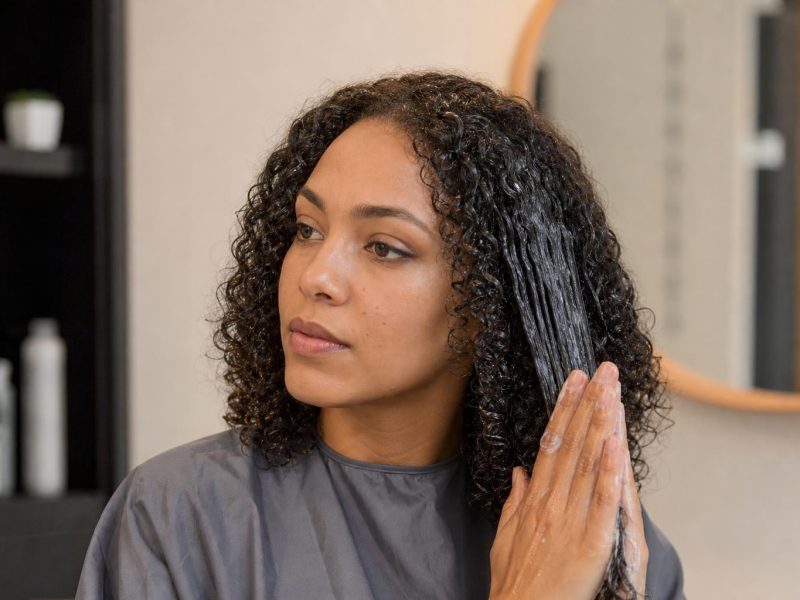


The Rezo cut builds one continuous rounded shape around your whole head, which is why it gives so much volume while barely touching your length.
A Rezo cut is a dry curly haircut worked in triangular sections around a circular perimeter, designed to keep almost all of your length while producing a full, evenly rounded silhouette. It was developed by Dominican master stylist Nubia Suarez, who trademarked it as the Rëzo cut, and it trains stylists in a standardized sequence rather than leaving the shape to freehand judgment. The result is noticeably rounder and bigger than what most curly clients are used to.
Below you will find how the technique is executed, which densities and curl patterns it flatters, how it differs from a curl-by-curl approach, what the appointment costs and how long it holds, plus the specific language that gets you the shape you actually want.
| Factor | Details |
|---|---|
| Best for | Medium to high density 3a through 4a hair, mid-length or longer |
| Cut on | Dry hair, in triangular sections, following a round perimeter |
| Length removed | Minimal by design, often under an inch on a first appointment |
| Chair time | 90 minutes to 3 hours depending on density and length |
| Avoid if | You want face-framing shorter pieces or a flatter, closer shape |
What a Rezo Cut Actually Is
Instead of isolating individual spirals, a Rezo stylist divides the head into triangular partings and cuts each one to a common rounded perimeter, moving around the head in a fixed order. Every section is measured against that round outline rather than against a straight guide line, so the finished shape has no corners and no visible steps. The whole cut happens on dry hair, unstretched, so the stylist is watching the actual silhouette form in real time.
Two features separate it from most curly cutting. The first is that layering, in the conventional sense, barely happens: rather than removing interior length to create movement, the technique builds movement through the geometry of the round shape itself. The second is that it is standardized. Stylists complete a specific training and follow the same sequence, which is why Rezo results look recognizably similar from salon to salon in a way that a general dry curly cut never does.
Stylist tip: Ask to see the shape from the back in a hand mirror before the wash, while the cut is still dry. The roundness is easiest to judge at that moment, and any adjustment costs nothing at that stage.
Why the Method Keeps So Much More Length Than People Expect
Length preservation is baked into the geometry. Because every section is trimmed to reach a shared round perimeter rather than to a shorter internal guide, the scissors only touch the pieces hanging outside that outline. On hair that already has a reasonably even outline, that can mean half an inch or less comes off in total. People arriving from years of wet cuts often assume the appointment cannot possibly be doing much, then discover the shape has changed dramatically without the length changing at all.
The trade-off is volume. Keeping interior length means keeping interior weight, and the round shape pushes that weight outward. If you have wanted bigger hair and never got it from a cut, this is the method that delivers it. If you have spent years trying to reduce bulk, it is working against your goal, and a technique with real internal weight removal will serve you better. Comparing the two dry-cutting philosophies side by side is the fastest way to pick, and our guide to the DevaCut and its curl-by-curl logic covers the alternative in detail.
Who the Rezo Cut Flatters Most
Density does more to predict the outcome here than curl pattern alone. The round shape needs enough hair to fill it out, and it needs curls tight enough to hold that roundness once gravity gets involved. Check where you land on the curl type chart and be honest about your density before booking.
Dense Type 3 Curls Get the Fullest Version of the Shape
Springy 3b and 3c curls with medium to high density are what the technique was designed around. There is enough hair to build a genuinely round outline, and the curl pattern is strong enough to keep that outline from collapsing by mid-afternoon. Expect noticeably more width at the sides than you are used to, particularly in the first week before the shape settles. Our collection of shapes cut for 3b curls gives a sense of how much silhouette that pattern can carry.
Type 4 Coils Take the Shape Well When Length Allows It
Coily hair holds a round silhouette beautifully, and the length-preserving logic is especially welcome on textures where growth feels slow and every inch counts. The practical requirement is enough hanging length for the perimeter to be visible, which usually means at least chin length unstretched. On shorter coils the round outline gets shaped more by the head than by the cut, so a shape-focused cut with a specialist is a better use of the appointment. Readers working with tighter patterns will find more context in our guide to 4a coil-friendly cuts.
Fine or Low-Density Hair Needs the Shape Scaled Down
A round perimeter on sparse hair can look thin at the edges, because the outline becomes visible before there is enough hair to fill it. Stylists who work regularly with fine curls adapt by keeping the round smaller and tighter to the head, or by combining the perimeter logic with some genuine interior shaping. Say the word “fine” during your consultation and ask directly how the stylist plans to adapt. A blank answer is a signal to book elsewhere.
What Happens During a Rezo Appointment
The sequence is longer than a standard cut, and the wash comes at the end rather than the beginning. Blocking out a full afternoon for a first appointment is realistic, particularly on long or very dense hair.
Step 1: Come with Clean, Fully Dried, Loose Hair
What you need: Hair washed within the last day or two, completely dry to the roots, worn loose with no gel cast and no crown dent from a clip.
How: Style as you normally would, then break up any cast fully before the appointment so individual curls move freely.
Why: The perimeter is measured against where curls hang naturally. Clumped or compressed hair reports the wrong outline and the stylist cuts to it.
Common mistake: Arriving after a workout or a humid commute with roots slightly damp. Damp roots pull curls down and shift the whole outline lower than it will actually hang.
Step 2: The Stylist Maps the Sections and the Round
Before any cutting starts, the head gets divided into triangular partings and the stylist establishes where the round perimeter will fall. This is the part of the appointment worth watching, because the height and width of that round determine everything else. If you want the shape closer to the head or fuller at the sides, this is the moment to say so.
Step 3: Cutting Happens Section by Section Around the Head
Each triangular section is lifted, checked against the perimeter, and trimmed only where it hangs past the line. The stylist works around the head in sequence rather than jumping between areas, and you will see very little hair come off compared with a conventional cut. On dense hair this stage alone runs 45 to 90 minutes, which is where most of the appointment time goes.
Step 4: The Wash and Style Reveals the Real Silhouette
Hair gets washed, conditioned, product applied to soaking hair, then dried under a hood or diffused. Nearly everyone is surprised by the volume at this point, so give yourself a few days before deciding you dislike it. Curls settle and drop for roughly a week, and the shape at day seven is the one you are actually going to live with.
Rezo Cut Compared with the Other Dry Curly Methods
The three techniques below get offered to the same client, and they solve different problems. Choosing between them is really a choice about silhouette.
| Feature | Rezo Cut | DevaCut | General Dry Curly Cut |
|---|---|---|---|
| Cutting unit | Triangular sections against a round perimeter | One curl at a time in its resting position | Freehand, varies by stylist |
| Length kept | Maximum, often under an inch removed | Whatever you agree to in dry inches | Depends on the plan you set |
| Volume | High, weight stays in and pushes outward | Moderate, defined rather than expanded | Adjustable in either direction |
| Face framing | Minimal, the round runs continuously | A core feature of the method | Available on request |
| Straightened result | Even and blended, holds up well | Can look uneven when smoothed | Depends on how it was cut |
The straightened-result row is the one most people overlook and later care about. Because the Rezo perimeter is a continuous geometric line rather than a set of individually placed curls, blowing the hair out smooth reveals an even outline instead of scattered lengths. Anyone who alternates between natural texture and stretched styles should weigh that heavily. If face-framing pieces matter more to you than an even outline, our breakdown of how to ask for face-framing layers is a better starting point.
When a Rezo Cut Is the Wrong Choice
This technique has a strong point of view, and that point of view does not suit everyone.
- You want less bulk, not more. The method keeps interior weight by design, so hair that already expands at the sides will expand further rather than settle.
- You want shorter pieces around your face. The continuous round runs uninterrupted, and cutting into it for framing undoes the geometry it depends on.
- Your hair is shorter than chin length unstretched. There is not enough hanging length for a round perimeter to be visible, so the shape gets defined by your head rather than by the cut.
- Your curl pattern is loose or mostly wavy. Waves do not hold a rounded outline through the day, and the shape tends to flatten into a triangle by afternoon.
- You need a big length change. A method built to preserve length is a poor way to lose six inches, and paying Rezo pricing for a shorter shape is not a good use of the appointment.
Finding a Stylist, Pricing, and How Long It Holds
Rezo-trained stylists are far less common than curl specialists generally, and in smaller markets you may be driving to a bigger city for the appointment. Certification lists maintained by the technique itself are the reliable starting point, but portfolios still matter more than credentials. Look specifically for finished results on hair with your density, and for photos taken a week after the cut rather than only on the day.
On price, expect a specialist rate closer to a color appointment than to a cut, driven mainly by the chair time involved. Two to three hours of a senior stylist’s day is what you are paying for. Ask up front whether the quote covers the wash and style-out, and whether follow-up appointments are billed at a lower maintenance rate, which many salons do.
| Hair Profile | Rebook Window | How It Loses Shape | Between-Visit Fix |
|---|---|---|---|
| Dense 3b to 3c, mid-length | 12 to 16 weeks | Perimeter drops and the round softens | Root clips at the crown while drying |
| Dense 3b to 3c, long | 14 to 20 weeks | Weight pulls the sides flatter | Diffuse upside down to lift the roots |
| 4a coils, mid-length | 16 to 20 weeks | Outline blurs as ends tangle | Regular ends-only dusting at home |
| Fine 3a, any length | 10 to 12 weeks | Edges thin out and the round breaks up | Lightweight foam instead of heavy gel |
What to Tell Your Stylist
The single most useful thing you can specify is how big you want the round to be, because that is the one variable under discussion. Try: “I want the round kept close to my head at the sides and fuller at the crown, and I want to keep all my current length.” If you want the opposite, say that instead. Naming the width and the height separately gives the stylist two dials to work with rather than one vague instruction about volume.
It is also worth stating how often you wear your hair stretched. Someone who blows their curls out monthly wants a slightly different perimeter height from someone who never does, and that is a conversation to have before the sections get mapped rather than at the mirror afterward. Some of the terminology involved is genuinely technical, and our plain-English glossary of salon terms is worth a skim beforehand.
Stylist tip: Photograph the back of your head on day one and again on day seven. Curls drop over that week, and having both images makes your next consultation far more productive than trying to describe the change from memory.
FAQ
How Much Hair Comes Off During a Rezo Cut?
Often under an inch, and sometimes just the pieces hanging outside the round perimeter. Length preservation is the point of the technique, so a stylist removing significant length has either agreed that with you or misunderstood the brief. If you want a real length change, negotiate it explicitly at the consultation rather than assuming it will happen.
Does a Rezo Cut Work on Wavy Hair?
Not well in its standard form. The round outline relies on curls holding their shape against gravity, and loose waves flatten at the top while widening at the bottom, which produces a triangle rather than a circle. A wave-experienced stylist can borrow ideas from the method, but paying the full specialist rate for a technique your pattern cannot hold is rarely worth it.
Can I Straighten My Hair After a Rezo Cut?
Yes, and this is one of the method’s genuine advantages over curl-by-curl cutting. Because the perimeter is a continuous geometric line, smoothed hair shows an even outline rather than a scatter of individual lengths. Mention that you straighten sometimes so the stylist can account for it when setting the perimeter height.
How Long Does the Appointment Take?
Plan for 90 minutes on shorter or less dense hair and up to three hours on long, dense curls. The sectioning and the section-by-section trim account for most of that, with the wash and style-out adding another 30 to 45 minutes. First appointments run longer than rebooked ones because the consultation and the initial shaping take extra time.
Is the Rezo Cut Better Than a DevaCut?
Neither one wins in general, because they aim at different silhouettes. Choose Rezo if you want maximum length, maximum volume, and an even round outline. Choose curl-by-curl shaping if you want defined face-framing pieces and a result tailored to each individual spiral rather than to a geometric shape.
Will a Rezo Cut Make My Hair Look Too Big?
It might, at first, and that reaction is common enough that stylists warn about it. The volume peaks in the first few days and then settles as curls drop and the perimeter relaxes. If the fullness still bothers you at the two-week mark, ask at your next visit for a smaller round with the perimeter set closer to your head.
Can I Get a Short Rezo Cut?
The technique needs hanging length to make a round perimeter meaningful, so very short shapes fall outside what it does well. Chin length unstretched is a reasonable floor, and below that a specialist shaping a curly bob will give you a better result. The shorter the hair, the more the shape comes from your head and the less it comes from the cut.
A Rezo cut earns its price when you want to keep every inch of your length and finally get the volume that conventional cutting kept taking away. Go in knowing how wide and how tall you want the round to be, ask to approve the dry shape before the wash, and give the curls a full week to drop before you judge the result. It is a specific silhouette rather than a universal upgrade, and the people who love it are the ones who wanted that silhouette in the first place.
Hair results vary based on your natural hair type, texture, density, and condition. Always consult with a licensed hairstylist before making significant changes, especially with chemical treatments or dramatic length changes. Photos may show styled results that require professional tools and products to replicate.