

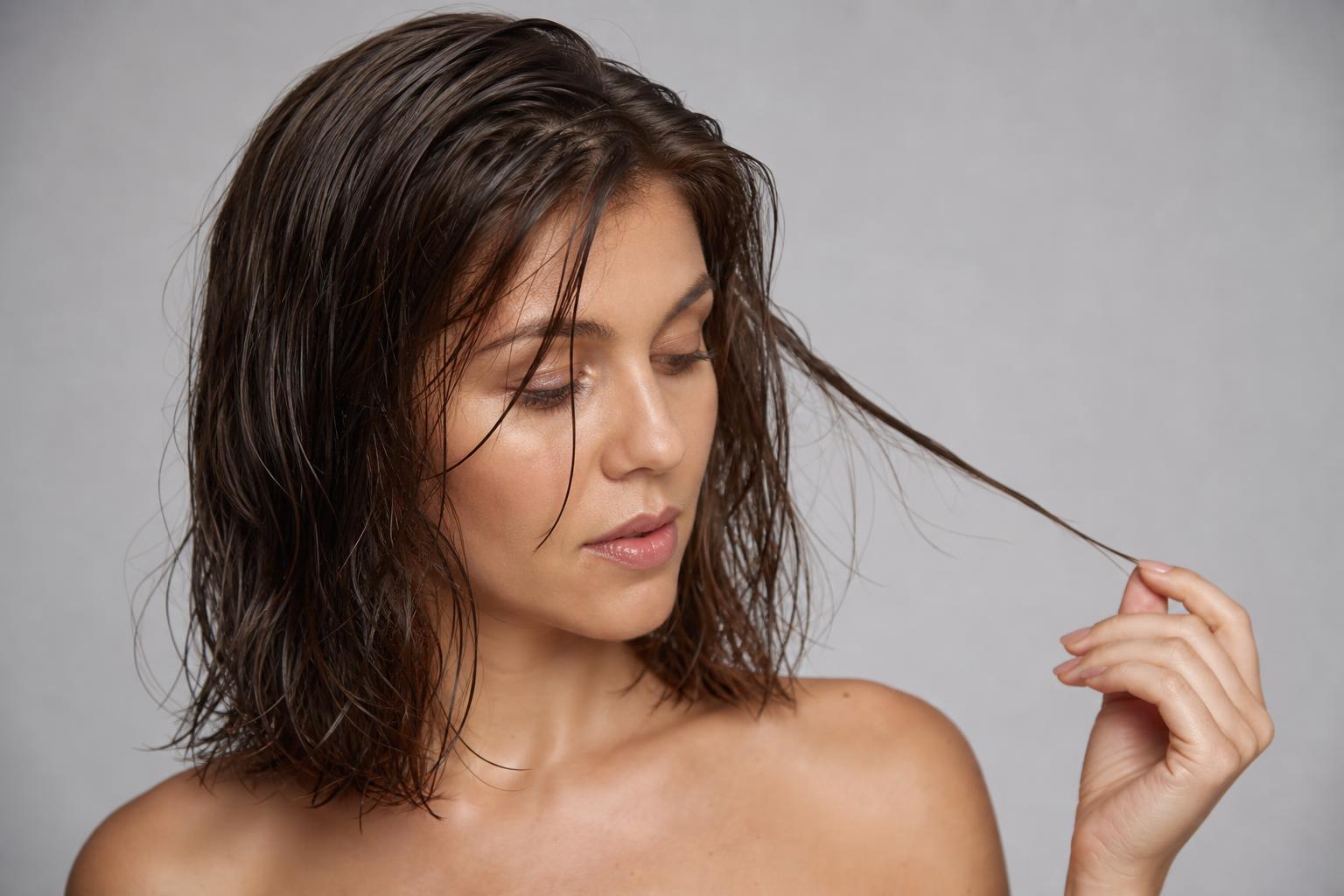
Dry, rough hair is the one symptom that both problems share, which is why so many people reach for protein when their hair was starving for water.
Take a damp strand between your fingers and pull it gently. If it snaps almost immediately with no give, your hair needs moisture. If it stretches like chewing gum and stays stretched instead of springing back, it needs protein. That ten-second check is more reliable than any symptom list you will find online, because protein overload and plain dryness produce nearly identical surface symptoms and get treated in opposite directions.
This guide covers how to run the stretch test so it gives an honest reading, a symptom table that separates the two conditions, which protein types actually get inside the hair and which only coat the outside, a four-week rebalancing plan, and the three situations where neither protein nor moisture is the real problem.
What Protein and Moisture Actually Do Inside a Strand
Hair is built from keratin proteins bundled into long chains inside the cortex, the thick core of the strand. Those chains are what give hair its tensile strength, the ability to be pulled without breaking. Water is what gives it flexibility. A strand with plenty of keratin structure but no water content behaves like uncooked spaghetti, and a strand full of water with degraded protein behaves like cooked spaghetti. Healthy hair needs both at once, and the balance shifts every time you color, heat style, or swim.
The reason this trips people up is that the two ingredients do not compete for the same space. Protein rebuilds gaps in the cortex and reinforces a damaged cuticle. Moisture, delivered through humectants and emollients, fills the strand and keeps the outer layer pliable. Adding more of one does nothing for a deficit in the other, and past a certain point it actively blocks the fix you actually need.
Stylist tip: If a deep conditioner made your hair feel worse rather than better, check the ingredient list before you blame the product. Anything listing hydrolyzed keratin, hydrolyzed wheat protein, amino acids, or collagen in the first six ingredients is a protein treatment marketed as a moisturizer, and on already stiff hair it compounds the problem.
The Stretch Test Gives You a Direct Reading
Every symptom you can see happens on the surface of the hair. Elasticity happens inside it, which is why a physical pull test beats a visual assessment. The test takes under a minute and needs nothing except a shed strand and clean hands, and it works on every texture from 1A through 4C as long as you account for shrinkage on tight curl patterns.
Damp Hair Gives an Honest Reading, Dry Hair Does Not
Run the test on freshly washed hair that has been towel dried, not on bone-dry hair and not on soaking wet hair. Dry hair under-reports elasticity because there is no water in the strand to stretch, so even balanced hair snaps. Soaking wet hair over-reports it because water temporarily swells the fiber and everyone looks like they need protein. Towel-dried is the middle state where the reading matches how your hair behaves during styling, which is when breakage actually happens.
A Strand That Snaps With No Give Needs Moisture
Hold a damp strand at both ends and pull slowly. If it breaks within the first fraction of its length, with a clean sharp snap and no visible stretching, the strand has lost water and flexibility. This is the reading you get on hair that has been over-shampooed, exposed to hard water, sun-bleached over a summer, or given too many protein treatments in a row. The fix is a moisture-forward routine, and protein treatments should stop entirely until the reading changes.
A Strand That Stretches and Stays Stretched Needs Protein
If the strand extends noticeably, feels slack or gummy under your fingers, and then hangs limp instead of recoiling, the internal keratin structure has been compromised. Bleach, relaxers, and repeated high-heat styling all break the bonds that let hair spring back. Hair in this state often feels deceptively soft when dry, which is exactly why people keep conditioning it. A balanced strand does something in between: it stretches a small amount and returns to close to its original length.
Test Three Strands From Three Places on Your Head
Your ends are older than your roots by years, and on anyone with highlights the mid-lengths have taken more chemical exposure than either. Pull one strand from the nape, one from the crown, and one from the front hairline. Mixed results are common and useful. If the ends read protein-deficient while the roots read balanced, you treat only the lower two thirds of your hair and leave the new growth alone.
Reading Your Symptoms When You Cannot Run the Test
Symptoms are less reliable than elasticity, but they narrow the field quickly when you are standing in a store aisle. The distinguishing detail is almost always texture underhand rather than appearance: protein-heavy hair feels rough and rigid, while moisture-heavy hair feels soft and structureless.
| What You Notice | Most Likely Cause | First Move |
|---|---|---|
| Straw-like and stiff even right after conditioning | Too much protein | Clarify once, then protein-free conditioning for three weeks |
| Soft and touchable but will not hold any style | Too much moisture, not enough structure | One protein treatment, then reassess after two washes |
| Frizzy halo, rough ends, tangles constantly | Moisture deficit with a raised cuticle | Weekly deep conditioner plus a leave-in on damp ends |
| Curls dropped and went stringy | Protein deficit after color or heat | Mid-weight protein treatment, then a moisturizing rinse-out |
| Short broken pieces around the part and crown | Breakage from brittleness, usually protein overload | Stop all protein, switch to a creamy rinse-out conditioner |
| Feels wet and heavy long after everyone else is dry | Moisture overload on low porosity hair | Lighter products, less leave-in, add a light protein |
Both Extremes Feel Like Straw, Which Is Why People Get It Wrong
Protein overload and a moisture deficit produce the same complaint at the bathroom mirror: dry, rough, dull, snapping when you comb it. The reason is that both states leave the strand with too little internal water, one by depleting it and the other by locking it out behind a rigid protein film. Every product marketed at that complaint contains protein, so the person with overload buys the exact thing making it worse and the cycle tightens.
Two details separate them. Protein overload arrives suddenly, usually within two or three washes of starting a bond-building or keratin product, and the hair feels rough and rigid rather than merely dry. A genuine moisture deficit builds slowly over weeks or a season, and hair in that state improves noticeably from a single deep conditioning treatment. If one good deep conditioner does nothing at all, you are almost certainly looking at overload. How readily your cuticle lets anything in matters here too, and testing your hair porosity at home explains why low porosity hair reaches overload faster than anyone else.
Stylist tip: Before starting any rebalancing routine, wash once with a clarifying shampoo. Protein and silicone films build up in layers, and treating hair through that buildup gives you a false read on whether the new routine is working.
Protein Size Decides Whether It Repairs or Just Coats
The word protein on a label tells you almost nothing, because the molecular weight determines where the ingredient ends up. Research published in the International Journal of Cosmetic Science tracked hydrolyzed keratins of three different sizes into the hair fiber and found that low and mid-weight peptides, at roughly 221 and 2,577 daltons, penetrated deep into the cortex, while a high-weight keratin at around 75,440 daltons mostly adsorbed onto the surface. Mid and high weights both reduced breakage, but they were doing two different jobs.
| Protein Type on the Label | Where It Ends Up | Best Used For |
|---|---|---|
| Amino acids, small peptides | Deep in the cortex | Bleached or relaxed hair with real internal damage |
| Hydrolyzed keratin, hydrolyzed silk | Cortex and inner cuticle | Elasticity loss, limp curls after color |
| Hydrolyzed wheat or rice protein | Mostly the cuticle surface | Slip, shine, mild reinforcement on fine hair |
| Collagen, whole silk protein | Surface film only | Temporary body and smoothing, not repair |
This is why one person swears a protein treatment saved their hair and another says protein ruined theirs, and both are telling the truth. Surface-film proteins on low porosity hair pile up fast and produce the stiff, coated feeling within a couple of washes. Small penetrating peptides on bleached hair go where the damage actually is and rarely cause the same problem at sensible frequency.
A Four-Week Plan to Rebalance
Rebalancing is a sequence, not a single treatment, and the order matters more than the products. Strip the buildup first so you can see what you are working with, correct the deficit for two to three weeks, then reintroduce the other side at a low dose. Most people see the change by wash three or four, and the plan below assumes two to three washes a week.
| Stage | If You Need Moisture | If You Need Protein |
|---|---|---|
| Week 1, reset | Clarify once, then a rich rinse-out conditioner every wash | Clarify once, then one mid-weight protein treatment for 10 minutes |
| Weeks 2 to 3, correct | Weekly deep conditioner with humectants, protein-free products only | One more protein treatment in week 3, moisturizing conditioner between |
| Week 4, reintroduce | Add one light protein treatment, then retest elasticity | Add a hydrating mask, drop protein to every third wash |
| Ongoing | Protein every 4 to 6 weeks for uncolored hair | Protein every 2 to 3 weeks for bleached or relaxed hair |
On the moisture side, an overnight oil treatment gives dry mid-lengths and ends a longer contact time than any ten-minute mask, and the method behind the overnight slugging routine works particularly well during the correction phase. Keep it on the lengths and off the scalp if you are prone to buildup.
When the Problem Is Neither Protein nor Moisture
A significant share of hair that gets diagnosed as unbalanced is neither. Running the stretch test and getting a normal reading, then still hating how your hair feels, is a strong signal that the cause is mechanical, environmental, or structural rather than chemical. These are the three that come up most often in the chair.
- Mineral buildup from hard water. Calcium and magnesium deposits leave hair coated, dull, and resistant to every product you own, and no amount of protein or moisture cuts through them. A chelating shampoo, not a regular clarifying one, is what removes them.
- Split ends that need cutting. Once the cuticle has worn through and the fiber has frayed, nothing rebuilds it. Products smooth the appearance for a wash, then it returns. A trim is the only thing that removes the split, and a quarter inch every 10 to 12 weeks keeps it from traveling upward.
- Heat damage past the point of repair. Hair that has been ironed above 400 degrees Fahrenheit repeatedly has denatured keratin, which does not reform. Treatments improve the feel temporarily, and the right iron temperature for your hair type prevents the next round of it.
- A scalp problem wearing a hair costume. Flaking, itch, and dull lengths often trace back to the scalp rather than the strand, and a consistent scalp care routine resolves more so-called dryness than another mask will.
What to Tell Your Stylist
Stylists can feel the difference in seconds, so hand them the observation rather than the diagnosis. Saying “my hair is damaged” gives them nothing to work with. Saying what it does gives them everything.
Useful phrasing at the shampoo bowl: “When I stretch a damp strand it snaps right away with no give” or “it stretches and stays stretched.” Follow it with your chemical history in dates, not adjectives, because “I lightened it a while ago” and “I lightened it six weeks ago” lead to completely different recommendations. If you want a treatment done in the salon, ask specifically whether they are recommending a protein treatment or a moisturizing one, and why they chose that side. Learning the vocabulary stylists use makes that conversation faster in both directions.
Stylist tip: Ask your stylist to run the elasticity test on a wet strand during your consultation and tell you what they felt. It takes them three seconds, it costs nothing, and it gives you a professional baseline to compare your home test against.
FAQ
How Often Should I Use a Protein Treatment?
Every four to six weeks for virgin or lightly colored hair, and every two to three weeks for bleached, relaxed, or heavily heat-styled hair. Fine hair and low porosity hair usually need less than the label suggests, so start at the longer interval and shorten it only if elasticity gets slack again. Weekly protein is the single most common cause of overload.
Can Hair Need Protein and Moisture at the Same Time?
Yes, and it happens constantly on bleached hair, where the same process that broke internal bonds also stripped the lipid layer that holds water in. The sequence to use is protein first, moisture second, because a protein treatment on a strand with no structure has nothing to reinforce. Apply the protein treatment, rinse, then follow with a moisturizing conditioner in the same shower.
Does Low Porosity Hair Need Protein at All?
It needs far less, and it needs the small penetrating kind rather than surface films. A tightly packed cuticle keeps large protein molecules on the outside where they build up and cause the stiff, coated feeling within a couple of washes. If your hair is low porosity and uncolored, protein once every two months is plenty, and many people do fine on none at all.
Will a Bond Builder Fix Protein Overload?
No, and it often makes it worse. Bond builders work on the disulfide and other internal links in the hair, which is a different mechanism from protein deposition, but most of them are formulated alongside proteins and add to the load. If your hair is stiff and snapping, the correct move is to stop everything reparative and use only moisture for three weeks.
How Long Does It Take to Fix Protein Overload?
Two to four weeks for most people, starting from a clarifying wash. The first improvement usually shows up by the second or third wash as the buildup comes off, and full elasticity returns more slowly because the strand has to rehydrate. Hair that has been protein-loaded for months takes closer to six weeks.
Is Coconut Oil a Protein Treatment?
No, but it behaves like one for people who react badly to protein. Coconut oil penetrates the cortex more readily than most oils and can leave hair feeling stiffer rather than softer, particularly on fine or low porosity textures. If oil treatments make your hair hard, switch to a non-penetrating oil such as jojoba or grapeseed before concluding that moisture is not your answer.
Can I Test Elasticity on a Strand Still Attached to My Head?
Use a shed strand from your brush or the shower instead, because pulling on attached hair risks damaging the follicle and you cannot feel the recoil properly while it is anchored. Collect the strand after washing, while it is still damp, and test it within a minute or two. A dried-out shed strand from yesterday gives the same false reading as testing dry hair.
Getting the protein versus moisture question right is less about buying better products and more about pausing long enough to read what your hair is actually doing. Run the stretch test on three strands this week, write down what you felt, then pick one side and stay on it for three weeks before judging the result. Most hair that people have written off as permanently damaged is simply stuck on the wrong side of that balance.
Hair results vary based on your natural hair type, texture, density, and condition. Always consult with a licensed hairstylist before making significant changes, especially with chemical treatments or dramatic length changes. Photos may show styled results that require professional tools and products to replicate.

5 responses