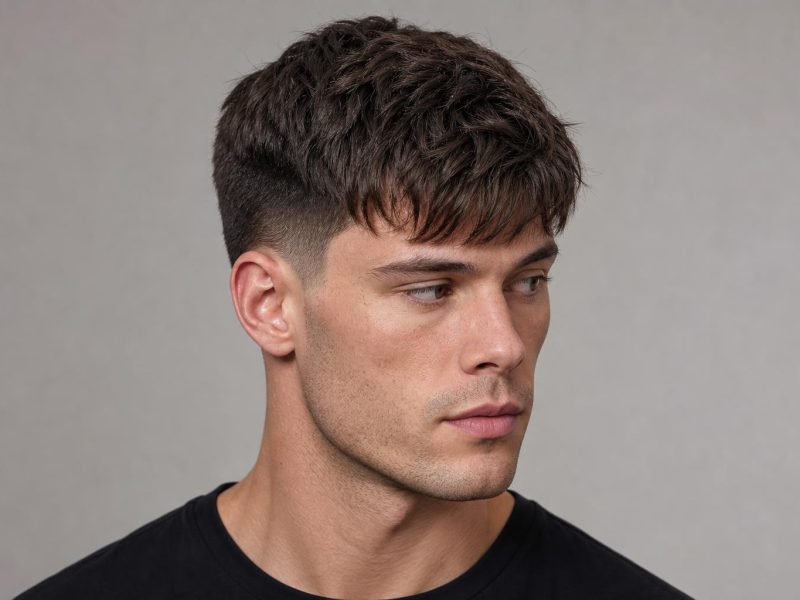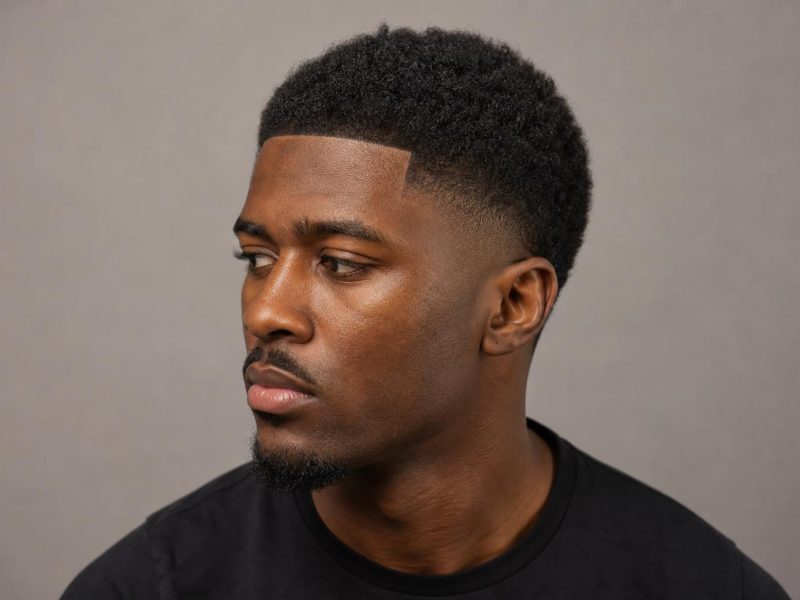

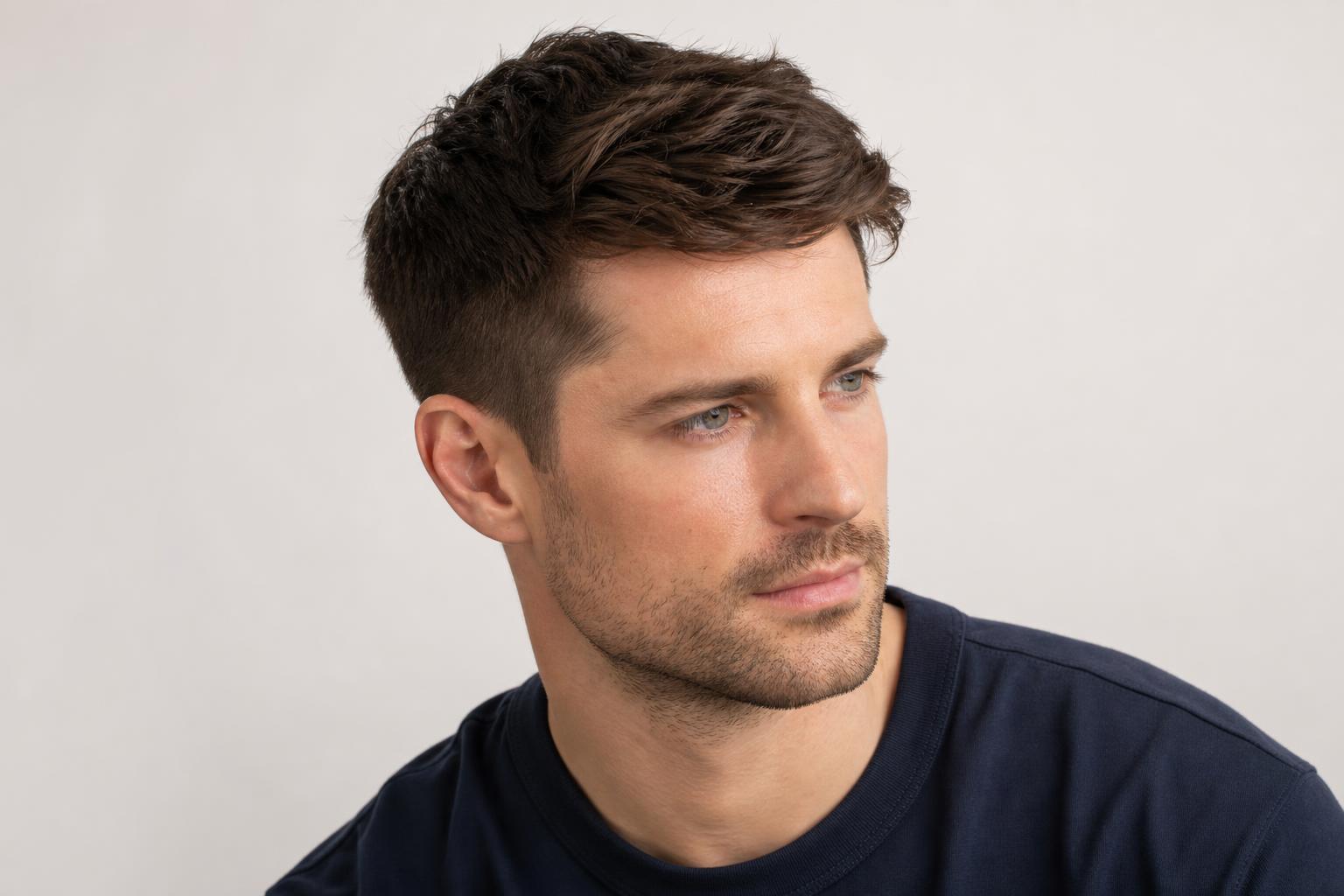
Almost every short men’s haircut is a combination of two decisions: how short the sides go, and how much length stays on top.
A short men’s haircut means anything under about 4 inches on top with sides cut close to the head, and the four shapes that cover the vast majority of requests are the buzz cut, the crew cut, the textured crop, and the classic short back and sides. Which one suits you comes down to three things in order: how much time you will spend styling, your hair type, and your face shape. Everything else, including fade height and neckline shape, is a detail layered on top of those choices.
This guide defines what each of the four base cuts actually is, matches them to face shapes and hair types, translates clipper guard numbers into real lengths, gives you the sentences to say in the barber chair, and sets out honest maintenance intervals for each. It also covers the situations where a short cut is the wrong call, which is a question most guides skip.
What Counts as a Short Men’s Haircut
Short, in barbering terms, means the hair on top is under roughly 4 inches and the sides are cut with clippers or scissors close enough that they lie flat against the head rather than falling over the ear. Below that ceiling there is enormous range: a number 1 buzz and a 3-inch textured crop are both short cuts, and they need completely different amounts of daily work. The clipper guard number is the single most useful piece of vocabulary here, because it converts a vague request into a measurement your barber can act on.
| Guard Number | Length Left | Typical Use | Scalp Visible? |
|---|---|---|---|
| 0 (no guard) | About 1/16 inch | Skin fade base, induction buzz | Yes, clearly |
| 1 | 1/8 inch | Short buzz, lowest section of a fade | Yes on most hair colors |
| 2 | 1/4 inch | The most requested buzz length | Slightly, on light hair |
| 3 | 3/8 inch | Sides of a crew cut, longer buzz | No |
| 4 | 1/2 inch | Conservative sides, grown-in look | No |
| 6 to 8 | 3/4 to 1 inch | Top of a buzz, longest clipper work | No |
The numbers move in eighths of an inch, so a 2 is exactly double a 1. That sounds trivial and is the reason so many men come out shorter than they expected: the jump from a 3 to a 2 removes a third of the visible length. If you are not sure, go one guard longer than you think, because a barber can always take more off in the same appointment. A fuller breakdown of what each clipper size actually leaves behind is worth reading before your first appointment at a new shop.
Four Base Cuts Cover Almost Every Short Haircut Request
Barbershop menus list dozens of names, but nearly all of them are variations on four underlying shapes. Learning the four means you can describe any cut you see in a photo, because every version is one of these with a specific fade height, neckline, or texture treatment applied. Work out which base shape you want first, then decide the details.
A Buzz Cut Is One Uniform Length All Over
The whole head gets a single guard, usually a 1 through 4, with either a tapered or a blunt edge at the neck. It takes ten minutes in the chair, needs no product, and shows the shape of your skull honestly, which is either an advantage or the reason to avoid it. Men with a well-defined jaw and even scalp tone get the most from it, and anyone with visible scars or an uneven hairline should try a 3 before a 1. Some barbers cut the top one guard longer than the sides, which softens the effect considerably without changing the ten-minute maintenance.
A Crew Cut Keeps Graduated Length on Top
The crew cut leaves about an inch at the front, graduating shorter toward the crown, with tapered or faded sides. That front length gives you something to style, so the cut can look sharp for the office or roughed up on the weekend without a second appointment. It is the most broadly flattering short cut because the height at the front adds a small amount of length to the face, which helps round and square shapes equally. Fine hair suits it particularly well, since the graduation stacks the remaining density where it shows.
A Textured Crop Puts the Weight at the Front
Here the top stays around 2 to 3 inches and falls forward rather than back, with the ends point cut so they separate. It is the modern default for men in their twenties and thirties, and it covers a high forehead better than any other short shape. Close relatives include the French crop with its blunter fringe line and the softer point-cut textured fringe, which differ mainly in how the front edge is finished. All three need a small amount of matte clay daily.
A Short Back and Sides Uses Scissors, Not Clippers
The classic barbershop cut leaves 1 to 2 inches on the sides, cut with scissors over a comb, and 2 to 3 inches on top with a side part. There is no clipper line anywhere, which means it grows out over six to eight weeks without ever looking unkempt. Older men and anyone in a conservative workplace tend to land here, and it is also the safest cut to get from a barber you have not used before, because there is no fade to get wrong.
Stylist tip: If you are between barbers or trying a new shop, book a short back and sides for the first visit rather than a skin fade. A fade exposes technical skill immediately and a bad one takes three weeks to fix; a scissor cut is far more forgiving and still tells you whether the barber listens to what you asked for.
Face Shape Decides the Shape on Top
The sides of a short haircut do very little to your face; the top does almost all of the work. Height on top lengthens a face, width at the sides broadens it, and a forward fringe shortens it. Once you know which of those three effects you want, the cut chooses itself. If you have never actually measured, working out your face shape with a tape measure takes about two minutes and makes the rest of this section concrete rather than theoretical.
| Face Shape | Goal | Best Short Cut | Avoid |
|---|---|---|---|
| Oval | Keep the existing balance | Any of the four base cuts | Very heavy fringes that hide the proportions |
| Round | Add height, remove width | Crew cut with a high or mid fade | Uniform buzz cuts, which echo the roundness |
| Square | Soften the angles slightly | Textured crop with a soft front edge | Hard disconnected tops, which sharpen the jaw further |
| Oblong | Shorten the face, add side width | Textured crop with a forward fringe, low fade | Height on top or a high skin fade |
| Heart | Reduce forehead width | Light forward crop, kept narrow at the temple | Wide, dense tops that broaden the upper face |
| Diamond | Add width at forehead and jaw | Crew cut with slight fullness at the sides | Tight temple fades, which narrow the forehead more |
Hair Type Changes the Cut, Not Just the Styling
Two men can ask for the same crew cut and walk out with visibly different results, because density and texture change how a cut behaves the moment the barber puts the scissors down. A good barber adjusts the technique rather than the name of the cut. Knowing what adjustment your hair needs lets you ask for it directly instead of hoping.
Fine Hair Needs Blunt Ends, Not Texturizing
Fine hair has fewer strands per square inch, so removing weight makes the ends look sparse rather than separated. Ask for a blunt perimeter and light point cutting only at the very tips. Keep the top under 3 inches, because beyond that length fine hair cannot support itself and lies flat regardless of product. A dry texture spray at the root gives more visible lift than any clay or paste.
Thick and Coarse Hair Needs Weight Removed From Underneath
Dense hair grows outward as much as downward, which is why thick-haired men often end up with a boxy silhouette by week four. The fix is internal thinning underneath the top section, leaving the surface length intact so the shape stays crisp while the bulk comes out. Say “take weight out from underneath, keep the length on the surface” and most barbers will know exactly what you mean.
Curly Hair Should Be Cut Dry
Wet curls stretch, and a curl cut at eyebrow level while wet can sit an inch and a half higher once it dries. A dry cut lets the barber see where every piece actually lands. Curly hair also needs the sides tapered rather than skin faded, because a hard skin line against curl looks uneven within about three weeks as the new growth comes in at different rates.
Thinning Hair Does Better Short Than Long
Longer hair over a thinning crown separates and shows scalp, while a short uniform length makes the density difference much harder to see. A number 2 or 3 buzz is genuinely the most effective option once thinning is well established, and a textured crop works while it is still limited to the temples. There are specific shapes designed around a receding hairline that buy several more years before a buzz becomes the better answer.
How to Ask a Barber for a Short Haircut
A useful request names four things in order: the length on top, the length on the sides, where the sides change length, and what happens at the neck. Saying “short back and sides” alone hands all four decisions to a stranger. A complete request sounds like this: “About an inch on top, graduating shorter toward the back. Number 2 on the sides blending up to a number 4 at the temple. Keep it below the temple line. Tapered neckline, not blocked.” That takes fifteen seconds and eliminates almost every way the cut can go wrong.
The neckline is the detail most men never specify and then dislike for a month. A blocked neckline is cut straight across and looks sharp for about ten days before the regrowth makes a visible line below it. A tapered neckline fades into the skin and stays clean for the whole cycle. A rounded neckline sits between the two. Unless you are getting cut every two weeks, tapered is the better default.
Stylist tip: Bring a photo of a cut on someone with hair like yours, not just a cut you like. A textured crop on thick straight hair and the same crop on fine wavy hair are two different results, and a barber shown the wrong reference will either produce something you did not want or spend the appointment managing your expectations instead of cutting.
Fade height is worth naming explicitly, because low, mid and high fades change the whole balance of the cut. A low fade starts just above the ear and keeps the look conservative, while a high fade begins near the temple and creates a much stronger contrast with the top. If you say only “fade,” most barbers will default to a mid fade, which is a reasonable middle ground but may not be what you had in mind.
Common Short Haircut Myths That Lead to Bad Appointments
Myth: Short Hair Is Lower Maintenance
Reality: short hair takes less time each morning and more time at the barbershop. A buzz cut needs a visit every two to three weeks to stay even, while hair at 4 inches or more can go two to three months. Total hours spent are roughly comparable; the difference is where you spend them.
Myth: Cutting Hair Short Makes It Grow Back Thicker
Reality: density is set at the follicle and cutting cannot change it. Short hair feels coarser because a blunt-cut end has a wider cross-section than a tapered grown-out end, which is a texture change, not a growth change. Nothing you do with scissors affects how many hairs your scalp produces.
Myth: A Skin Fade Suits Every Head
Reality: skin fades expose the shape of the skull and any scarring, birthmarks, or uneven scalp tone, and they emphasize protruding ears rather than hiding them. A number 1 or 2 taper achieves a similar clean effect with a thin layer of hair still covering the scalp. Ask for the shortest guard rather than skin if you are trying a tight fade for the first time.
Myth: The Same Cut Will Look the Same on You
Reality: the reference photo shows one head of hair with one growth pattern, one density, and one set of cowlicks. Two things are usually adjustable and one is not: length and texture treatment can be tailored, but a growth pattern that pushes your hair in a particular direction will keep doing that. Ask your barber which parts of the photo are realistic for your head before the cut, not after.
When a Short Haircut Is Not the Right Choice
Short cuts are the default recommendation for men, and there are real cases where they are the worse option.
- A very small or narrow head. Cutting the sides tight removes the width that balances your proportions, and the result can look severe. Leave a number 4 or scissor length at the sides instead of fading.
- Protruding ears. Any cut that clears the ear puts them on display; longer sides covering the top of the ear soften the outline considerably.
- Curls you actually like. Cutting 3b or tighter curls short removes the length that lets the curl pattern form, and what remains often looks like undifferentiated volume. Medium length is where curls read as curls.
- A schedule that cannot absorb a visit every three weeks. Short cuts show growth fastest, and the shorter the cut the tighter the cycle.
- Significant scalp scarring or uneven pigmentation. A number 3 or longer keeps a layer of coverage while still reading as a short cut.
Maintenance and Upkeep by Cut
The honest cost of a short haircut is the appointment cycle, not the morning routine. Buzz cuts and skin fades run on a two to three week clock, and scissor cuts stretch past two months. Daily styling runs from nothing at all to about five minutes, and product needs are modest across the board: one matte clay or paste covers every cut in the table below.
| Cut | Barber Cycle | Daily Styling | Product | Grow-Out Behavior |
|---|---|---|---|---|
| Buzz cut | 2 to 3 weeks | None | None | Stays even; gets shapeless past week 4 |
| Crew cut | 4 weeks | 2 minutes | Matte clay | Front loses graduation first |
| Textured crop | 3 to 5 weeks | 3 to 5 minutes | Matte clay or paste | Fringe reaches the eyes around week 5 |
| Short back and sides | 6 to 8 weeks | 2 to 3 minutes | Cream or light pomade | Most forgiving; no visible clipper line |
| Any cut with a skin fade | 2 to 3 weeks | Same as base cut | Same as base cut | Contrast disappears by week 3 |
One habit saves money over a year: book the fade or taper on the short cycle and the full cut on the long one. Most shops will tidy the sides and neckline for a reduced rate, which keeps the outline sharp without paying for a full cut you do not yet need. Men who prefer a genuinely minimal routine tend to end up in the shortest end of the range, where styling time drops to zero.
FAQ
What Is the Easiest Short Haircut for Men to Maintain Daily?
A buzz cut at a number 2 or 3 needs no product, no drying and no styling at all. The trade-off is the barbershop cycle, which runs every two to three weeks to keep the length even. If you want the lowest total effort including appointments, a short back and sides is the better answer, since it needs about two minutes each morning and a visit only every six to eight weeks.
How Short Is a Number 2 Haircut?
A number 2 guard leaves a quarter of an inch of hair. It is the most commonly requested buzz length because it reads as deliberately short without showing scalp on most hair colors. On very light blond or gray hair a 2 can still look close to shaved, so a 3 is usually a safer starting point.
Which Short Haircut Suits a Round Face?
A crew cut with a mid or high fade works best, because the height on top adds vertical length while the tight sides remove width. Avoid a uniform buzz cut, which follows the round outline of the head and reinforces it. Keeping the top at least an inch long is the part that matters most; the fade height is secondary.
Should I Ask for a Blocked or Tapered Neckline?
Tapered, unless you get cut every two weeks. A blocked neckline is a straight horizontal line that looks sharp immediately and then develops a visible fuzzy edge below it as the hair grows. A tapered neckline fades into the skin and looks intentional for the entire cycle between appointments.
Can Men with Thinning Hair Get a Short Haircut?
Short cuts are usually the best option for thinning hair, because they reduce the contrast between denser and sparser areas. A number 2 or 3 all over is the most effective once thinning is established, while a textured crop still works while it is limited to the temples. Longer hair combed over a thinning area separates during the day and draws more attention, not less.
How Often Should a Man Get a Short Haircut Trimmed?
Every two to three weeks for buzz cuts and skin fades, four weeks for a crew cut, three to five weeks for a textured crop, and six to eight weeks for a scissor-cut short back and sides. Hair grows roughly half an inch per month, so a cut with a hard clipper line shows growth long before a scissor cut does. Booking the next appointment as you leave is the simplest way to hold the cycle.
Is a Fade Necessary on a Short Haircut?
No, and a taper is often the better choice. A taper shortens the hair gradually around the ears and neckline without the dramatic contrast of a fade, which means it grows out with no visible line and lets you stretch appointments by two to three weeks. Fades read as more current, but they carry a maintenance cost that many men underestimate at the point of booking.
Choosing a short hair cut for a man comes down to naming four things at the chair: length on top, guard number on the sides, where the sides change, and how the neckline is finished. Pick the base shape that matches your face and hair type from the tables above, decide honestly how often you can get to a barbershop, and let that decide between a fade and a taper. A cut you can maintain on your real schedule always looks better than a sharper one you cannot.
Hair results vary based on your natural hair type, texture, density, and condition. Always consult with a licensed hairstylist before making significant changes, especially with chemical treatments or dramatic length changes. Photos may show styled results that require professional tools and products to replicate.