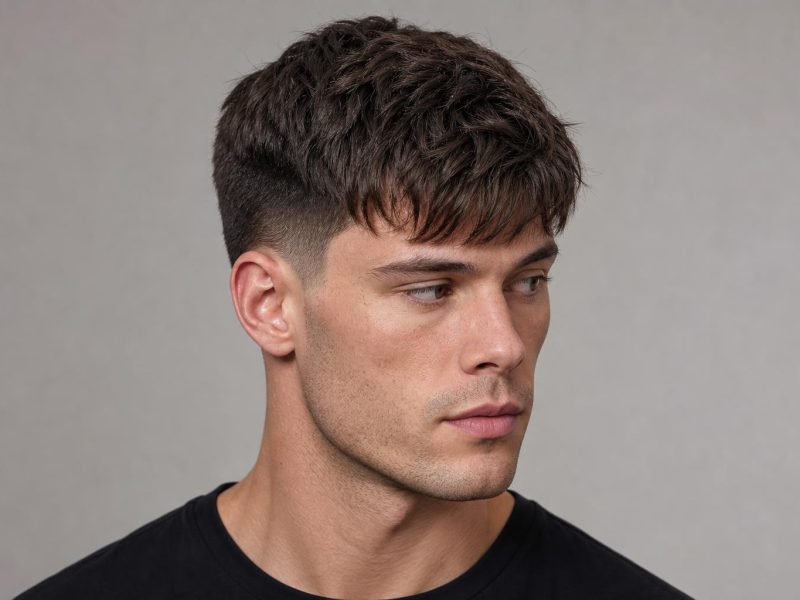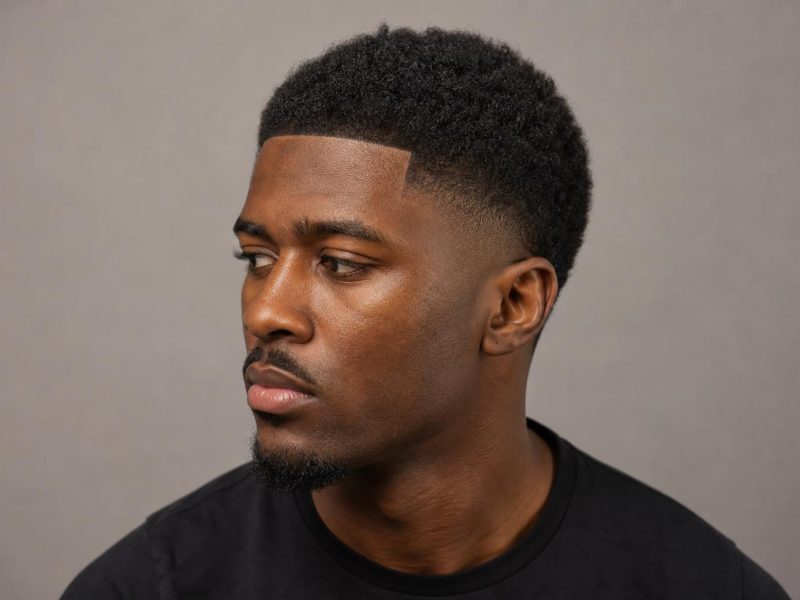

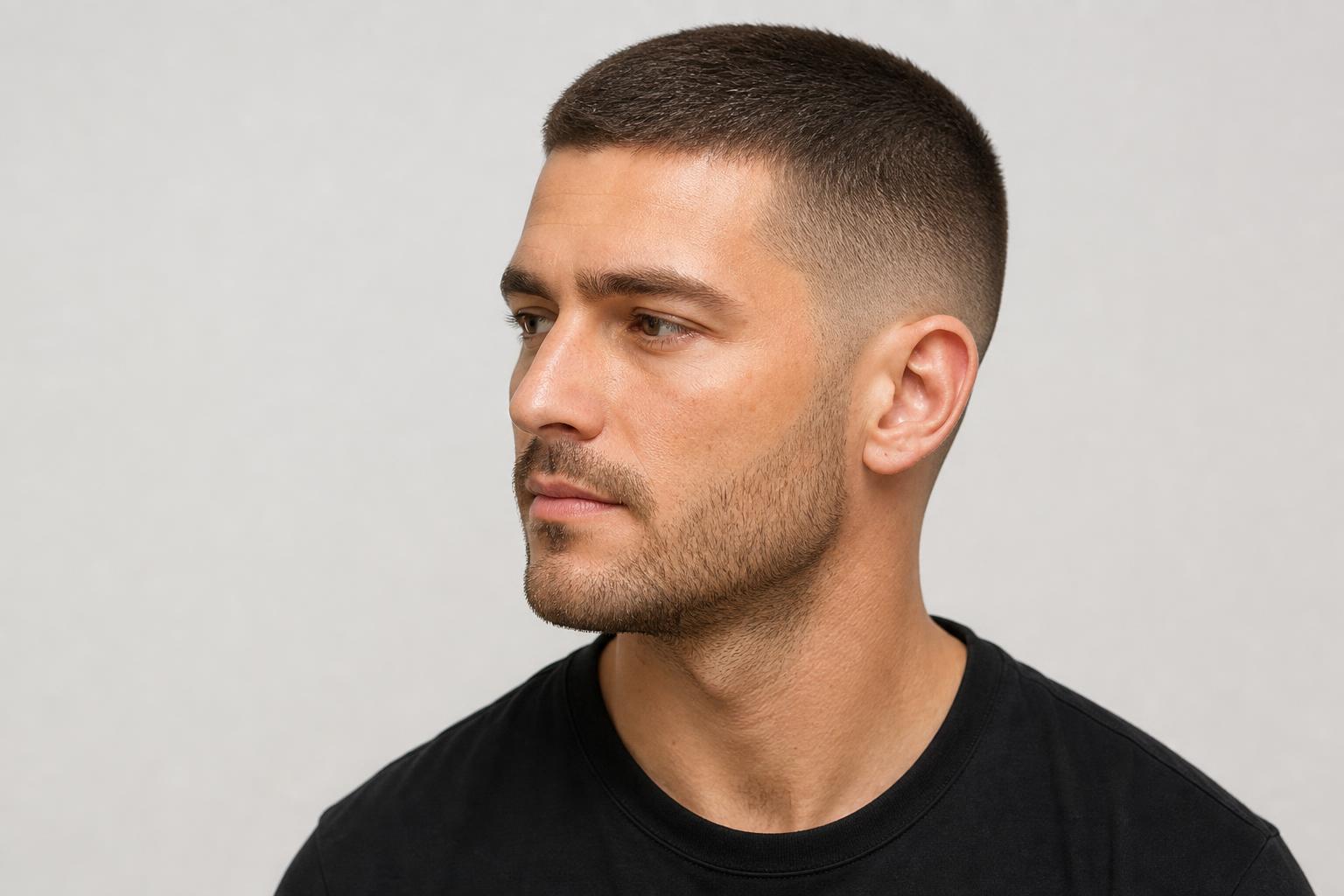
A buzz cut is one decision, not one haircut, and the decision is which number goes on the clipper before anyone touches your head.
A buzz cut hairstyle runs from a bare 1mm induction cut through a half-inch butch at guard 4, and the two look nothing alike on the same person. Guard 1 leaves an eighth of an inch and shows scalp through it. Guard 4 leaves half an inch, holds a visible shape, and still passes as a proper haircut in an office. The 30 variations below are organized by that number first, then by what happens at the sides, and they cover the shortest end of the short haircuts for men range.
Also covered: how much scalp shows at each guard depending on your hair color, the exact wording to give a barber, what the grow-out looks like week by week, and the scalp care nobody mentions until you have already been sunburned through your own hair.
| Factor | Details |
|---|---|
| Best for | Oval and square head shapes, thick or thinning hair, strong jawlines |
| Guard range | 000 to 4, from 1mm bare to half an inch |
| Maintenance | Every 2 to 4 weeks; 30 seconds of daily styling or none |
| Avoid if | Advanced horseshoe pattern loss, or raised scalp scars you would rather cover |
| Barber time | 10 to 20 minutes, or 25 with a fade and a line-up |
What Each Clipper Guard Number Leaves Behind
Guard numbers are the only vocabulary that matters in this haircut, and they are standardized across brands, so a 2 at one barbershop is a 2 at the next. Each step up adds an eighth of an inch. The jump that changes the look most is between 1 and 2, where the hair stops lying flat against the scalp and starts standing up enough to carry its own color.
| Guard | Length Left | Common Name | What It Looks Like |
|---|---|---|---|
| No guard / 000 | About 1mm | Induction cut | Scalp fully visible, shadow of color only |
| 1 | 1/8 inch, 3mm | Burr cut | Even shadow, scalp shows through on dark hair |
| 2 | 1/4 inch, 6mm | Standard buzz | Solid color, scalp mostly covered, no shape yet |
| 3 | 3/8 inch, 10mm | Butch cut | Hair stands up, texture becomes visible |
| 4 | 1/2 inch, 13mm | Long buzz | Holds a shape, can be styled with a matte paste |
If you have never buzzed before, start at 3 and go shorter next time. Going up a guard means waiting four to six weeks; going down takes ten seconds in the chair. Our fuller reference on what each clipper size leaves behind covers the half-guard sizes too.
One-Length Buzz Cut Hairstyles by Guard Number
These ten run a single guard over the whole head with no fade and no graduation. It is the fastest version of the haircut, the cheapest, and the one you can do yourself at home once you know your number. The trade-off is that a uniform length follows the shape of your skull exactly, so it flatters an even head shape and reports honestly on an uneven one.
1. Classic Guard 2 Buzz
One pass with a 2 over the entire head, against the direction of growth, then a second pass across it to catch the strays. Quarter-inch length is the sweet spot where hair reads as a solid color rather than a shadow, which is why this is the default request in most barbershops.
2. Guard 4 Buzz for a Narrow Head
A longer buzz adds a half-inch of width at the sides, which balances a head that is noticeably taller than it is wide. Anything shorter than a 3 will emphasize the narrowness rather than soften it. Keep the sides at the same 4 rather than tapering, since a taper narrows the silhouette again.
3. Guard 1 Burr on Thick Coarse Hair
Coarse hair at guard 1 stands straight up and holds a dense, even texture that finer hair cannot produce at the same length. Thick growth also means the scalp barely shows through, so a burr on this hair type looks fuller than the same cut on a fine-haired head.
4. Induction Cut with No Guard
Run bare clippers over the whole head and you are left with about a millimeter, enough to see hair color as a tint on the scalp but not enough to feel like hair. Apply a light moisturizer afterward rather than nothing, because bare clipper blades scrape the scalp surface and it will flake within two days otherwise. This is the shortest cut available before a razor.
5. Guard 3 Butch for Everyday Wear
Three-eighths of an inch is where a buzz starts behaving like a haircut you maintain rather than a length you tolerate. It grows out to a 4 in about three weeks and to something shaggy by six, which makes a monthly appointment the natural rhythm.
6. Salt and Pepper Guard 2
Gray growing in through dark hair looks patchy at longer lengths and even at short ones, because a buzz removes the length differences that make the mix look scattered. Silver reads as a deliberate gradient at guard 2 rather than as a few stray white hairs.
7. Guard 2 with a Rounded Neckline
The neckline is the one shaping decision in a one-length buzz, and there are three options: blocked square, tapered to nothing, or rounded. Ask for rounded if your neck is broad, since a square block adds visual width right at the base of the skull. Say the word rounded specifically, because most barbers default to blocked.
8. Home Buzz with a Two-Guard System
Cutting at home works if you use a 3 on top and a 2 on the sides, then blend the join with the clipper held at an angle and moving upward in a scooping motion. Trying to do the whole head at one length yourself produces visible tracks at the crown, where you cannot see what you are doing.
9. Guard 1 Buzz on Thinning Hair
Rather than hiding thinning, a short buzz removes the contrast that makes it obvious, since dense sides and a sparse top become the same length and nearly the same density. It works cleanly through the earlier stages of loss and stops working once the horseshoe pattern is fully formed. Our guide to cuts for a thinning crown covers where that line falls.
10. Guard 4 with a Light Matte Paste
Half an inch is just long enough to push in a direction, and a pea-sized amount of matte paste worked through dry hair gives it a slight forward lean. Skip anything with shine, which at this length looks like the hair is wet rather than styled.
Buzz Cut Hairstyles with a Fade or Taper
Adding a fade turns a buzz from a uniform length into a shaped haircut with a top, a transition and a bottom. It costs more, takes longer, and needs recutting every two to three weeks instead of four, because a fade loses its gradient the moment the shortest section grows. In exchange you get a silhouette that follows the shape you want rather than the shape of your skull.
11. Buzz with a Low Taper
Only the last inch above the ear and around the neckline gets shortened, leaving the rest at your chosen guard. It is the most conservative version and the one that grows out invisibly, which makes it a sensible first fade. Ask for the taper to start at the top of the ear, not above it.
12. Buzz with a Mid Fade
Starting the gradient at temple height creates a clear break between the top and the sides, so a guard 3 top over a faded side has visible structure. Round faces get the most from this, because the shorter sides pull width out of the widest part of the head.
13. Buzz with a High Fade
Taking the fade up above the temple leaves a defined patch of length on top and very little at the sides, which is a hard look that suits a long or oval head shape. On a round head it exaggerates the roundness at the crown. Bring a photo for this one, since high is a relative word and barbers place it differently.
14. Buzz with a Skin Fade
Taking the sides down to bare skin gives the sharpest contrast available, and it also shows every scalp mark at the bottom of the gradient. A skin fade needs recutting every ten to fourteen days to stay sharp, versus three weeks for a guard 1 fade. Consider whether you want that appointment schedule before committing, and see our bald fade gallery for how the different heights sit.
15. Buzz with a Burst Fade
A burst fade curves around the ear in a semicircle and leaves the back of the neck longer, rather than fading the whole perimeter evenly. It follows the natural hairline instead of cutting across it, so the grow-out stays tidy longer than a straight fade. Works particularly well with curly or coily texture on top.
16. Buzz with a Drop Fade
Unlike a straight fade that runs level around the head, a drop fade arcs downward behind the ear, following the curve of the skull. That downward arc is what keeps the back of the head from looking flat, which is the main complaint about a standard fade on a flat occipital bone.
17. Buzz with a Temple Fade
Also called a temp fade, this shortens only the corners at the temples and the outline around the ear, leaving everything else at one length. Men with a receding front corner use it to clean up the shape rather than to draw attention to it. Our breakdown of the temple fade covers where the line should land.
18. Buzz Cut with a Sharp Line-Up
A line-up squares off the front hairline and the temple corners with a trimmer, which turns a soft natural edge into a defined one. It is the single detail that makes a buzz look barbered rather than home-cut, and it costs about two minutes. Skip it if your hairline is receding, since a hard line makes the recession measurable.
19. Buzz with a Tapered Nape
Fading the back of the neck to nothing rather than blocking it square means there is no hard line to grow out unevenly. Three weeks later a blocked nape has a visible shelf while a tapered one has just gotten softer.
20. Buzz with a Faded Beard Connection
Rather than stopping the fade at the jaw, the barber carries the gradient down into the beard so the two meet at the same length. Getting this right means specifying that you want them connected, since the default is to finish the haircut and the beard as separate pieces.
Buzz Cut Hairstyles with Texture, Color and Detail
The last ten use the buzz as a base for something else: natural curl pattern, a color change, an etched design, or the interaction with facial hair. Length here is usually guard 2 to 4, because anything shorter leaves nothing for the detail to show against.
21. Buzzed Curls at Guard 4
Curly and coily hair kept at half an inch shows its pattern clearly while staying short enough that no styling is needed. Dampen it and let it dry naturally rather than towel-drying, which at this length just flattens the curl against the scalp. A leave-in spray keeps the pattern defined, and our gallery of curly haircuts for men covers the longer options.
22. Buzz Cut with a Full Beard
The visual logic of this combination is contrast: almost no hair above, substantial hair below, which shifts the weight of the face downward and strengthens the jaw. Keep the beard at least twice the length of the buzz or the two blur into one continuous shadow. Suits long and oval face shapes best.
23. Bleached Buzz at Guard 3
Lightening at this length takes twenty minutes rather than three hours, and there is very little hair to damage, which makes it the lowest-risk way to try blonde. Regrowth appears as a soft shadow at the roots rather than a hard line, so it stays wearable for six weeks. Dark hair still needs a toner afterward or it turns brassy.
24. Buzz with a Hard Part
A single trimmed line shaved along the natural part gives a one-length buzz an actual style line without any length to work with. It grows closed in about ten days, so it is a look you commit to per haircut rather than long-term. Works best at guard 3 or 4 where the line has something to cut through.
25. Buzz Cut for a Square Jaw
Short sides expose the jawline completely, which is why a square or angular face gets the most out of this haircut and a round face gets the least. Adding a slight bit of length on top at guard 4 keeps a strong jaw from being the only feature in play.
26. Buzz with Edge-Up and Etched Design
One or two shaved lines through the temple area read as deliberate detail; three or more begin to look busy at this length. Ask the barber to freehand it rather than working from a photo, since designs need to follow your actual hairline.
27. Grown-Out Buzz at Six Weeks
Left alone, a guard 2 reaches roughly an inch by week six, which is a short crop rather than a buzz and often a decent haircut in its own right. The failure point is the neckline, which goes shapeless first, so a five-minute neck cleanup at week four buys you two more weeks of wear. Many men cycle between buzz and crop this way rather than maintaining one length.
28. Buzz Cut on Gray Hair with a Skin Fade
Gray at guard 2 over faded sides produces a clean gradient from silver down to skin, and the color transition does the work a longer cut would need layering for. Gray hair is coarser and grows in more wiry, so it holds this shape better than pigmented hair of the same thickness.
29. Buzz with a Textured Top at Guard 5
Pushing to a 5 on top with faded sides gives you five-eighths of an inch, enough for a barber to point-cut some separation into the surface. Point cutting at this length is what separates a shaped crop from a plain buzz, and it is worth asking for by name. Sides stay at 1 or 2 for the contrast to register.
30. Buzz Cut with a Faded Neckline for Fine Hair
Fine hair at guard 2 shows scalp through the sides more than any other type, and a faded rather than blocked neckline stops that from turning into a visible border at the back. Keeping everything soft-edged is the general rule for fine hair in short cuts. Pair it with a matte product on top if you go to guard 4, and skip product entirely below that.
How Much Scalp Shows at Each Guard
The same guard number produces a visibly different result depending on the contrast between your hair color and your skin tone. Dark hair on pale skin shows every gap at guard 1 because each strand is a dark dot on a light background. Light hair on the same skin blends, so a blonde guard 1 looks fuller than a black guard 2. Density matters too, but contrast matters more, and no barber mentions it.
| Hair and Skin Contrast | Shortest Flattering Guard | Why |
|---|---|---|
| Dark hair, light skin | Guard 2 | High contrast makes any gap visible below quarter-inch |
| Dark hair, deep skin | Guard 1 or bare | Low contrast, so density reads as even at any length |
| Blonde or light brown | Guard 1 | Low contrast hides thinning better than length does |
| Gray or silver | Guard 1 | Reflects light, so it reads fuller than its density |
| Red or auburn | Guard 2 | Warm tone against skin shows scalp at very short lengths |
Barber tip: Ask to see the guard before it goes on the clipper. Guards get mixed between combs and a worn 2 sitting loose on the blade cuts closer than a fresh one, which is the usual explanation when a familiar number comes out shorter than you expected.
What to Tell Your Barber
This is the one haircut where a number does most of the communicating, and the whole request fits in a sentence. Give the guard for the top, the guard for the sides, whether you want them blended, and what should happen at the neckline. A complete version sounds like “guard 3 on top, guard 1 on the sides, blended, with a tapered neckline and a light line-up at the temples.”
Two details are worth adding out loud. Say whether you want the crown left slightly longer, because most heads have a flat spot or a whorl there that a uniform pass exposes. Say what you want at the front corners if your hairline is receding, since a barber will otherwise make a judgment call about whether to square them off. If you want a specific length combination without the numbers, our gallery of buzz cuts with a taper is worth showing on your phone.
Barber tip: Book the first appointment of the day for a skin fade. Clipper blades dull through a shift, and the difference between a freshly oiled blade at nine in the morning and the same blade at four is visible on bare skin, though not at guard 2 or above.
When a Buzz Cut Is Not the Right Choice
The buzz has a reputation as the haircut anyone can wear, and it mostly earns it. There are still four situations where it works against you rather than for you.
- Hair loss has reached a full horseshoe pattern. A buzz makes the bare crown and the dense band around it the same length but not the same density, so the pattern becomes more obvious rather than less. Shaving fully is usually the better answer at that stage.
- You have raised scars, cysts or a pronounced ridge on the skull. Short hair follows the surface exactly and a buzz will trace anything the scalp is doing, which is fine if you do not mind and worth avoiding if you do.
- Your face is round and your neck is short. Removing all the height on top and all the width at the sides leaves nothing to lengthen the silhouette, and a guard 4 with a mid fade is a better compromise than a uniform 1.
- You dislike a two to three week barber cycle. A buzz with any fade demands it, and a grown-out fade looks worse than a grown-out one-length cut. Choose the uniform version if your schedule is unpredictable.
Grow-Out and Scalp Care
The buzz is not zero maintenance, it is zero styling with a shorter appointment cycle. Hair grows roughly half an inch a month, which means a guard 2 becomes a guard 4 in about four weeks and loses its shape entirely by six. Scalp care is the part nobody warns you about: skin that has been under hair its whole life is suddenly exposed to sun, wind and cold within a single afternoon.
| Week | Uniform Buzz | Buzz with a Fade |
|---|---|---|
| Week 1 to 2 | Looks as cut, slightly softer to touch | Gradient still sharp; best two weeks |
| Week 3 | Up one guard, still clean | Gradient closing; skin fades need recutting now |
| Week 4 | Neckline goes shapeless first; book a cleanup | Fade has flattened into one length |
| Week 6 | About an inch; wearable as a short crop | Looks overdue rather than grown out |
| Week 8 | Needs a cut or a different haircut entirely | Needs a full recut |
On the scalp itself: use sunscreen on the top of your head from the first day, because the skin there has no tan and burns faster than your face. A light moisturizer after each cut prevents the flaking that follows clipper contact, and a gentle shampoo two or three times a week is plenty since there is no length for oil to travel down. Ingrown hairs at the nape respond to a soft exfoliating scrub twice a week rather than to anything stronger.
FAQ
What Guard Number Is a Standard Buzz Cut?
Guard 2 is the standard, leaving a quarter of an inch across the whole head. It is short enough to be unmistakably a buzz cut and long enough that the hair reads as a solid color rather than a shadow on the scalp. Guard 3 is the next most common request and the safer starting point if you have never buzzed before.
Does a Buzz Cut Make Hair Grow Back Thicker?
No. Cutting hair does not change the follicle, the growth rate or the diameter of what grows next. What changes is the feel: a cut hair has a blunt tip rather than a tapered one, so regrowth feels coarser to the hand even though nothing about it is thicker. Density is set at the follicle and clippers never reach it.
How Often Do I Need to Recut a Buzz Cut?
Every two to four weeks depending on the version. A uniform one-length buzz holds up for four weeks and stays wearable for six, while any fade needs recutting at two to three weeks and a skin fade at ten to fourteen days. The neckline usually goes before anything else, so a quick neck cleanup between full cuts extends the cycle.
Will a Buzz Cut Suit My Head Shape?
Oval and square head shapes suit it most easily, since a uniform length follows the skull and both of those shapes are already balanced. Narrow heads benefit from a longer guard at the sides, and round heads from a fade that removes width at the widest point. The one shape to be careful with is a head with a pronounced flat spot at the back, where a drop fade helps more than a uniform cut.
Can I Buzz My Own Hair at Home?
Yes, for a uniform cut, and no for anything faded. A single guard over the whole head is genuinely straightforward with a second mirror behind you, working against the direction of growth. Fades need two hands, a clear view and practice with clipper-over-comb, so paying for those and doing the plain buzzes yourself is a reasonable split.
Is a Buzz Cut a Good Idea for Thinning Hair?
In the earlier stages, yes, because it removes the density contrast between a full side and a thinning top. Once the horseshoe pattern is fully formed the buzz stops helping, since the bare area stays bare at every guard number. The honest test is to look at the crown in a handheld mirror under overhead light and judge how much scalp is already visible.
Does a Buzz Cut Work with a Beard?
It works well, provided there is a length difference between the two. Keep the beard at roughly twice the length of the hair so the eye registers two separate shapes rather than one continuous shadow. A guard 1 head with a half-inch beard is the classic proportion, and asking the barber to connect the two at the sideburn makes the whole thing look designed.
Choosing a buzz cut hairstyle comes down to three numbers and one word: the guard for the top, the guard for the sides, whether they are blended, and what happens at the neckline. Start a guard longer than you think you want, note how it looks after a week, and adjust at the next appointment rather than in the chair. For where to go when you decide you want a little more length, our collection of very short haircuts for men covers the next step up.
Hair results vary based on your natural hair type, texture, density, and condition. Always consult with a licensed hairstylist before making significant changes, especially with chemical treatments or dramatic length changes. Photos may show styled results that require professional tools and products to replicate.