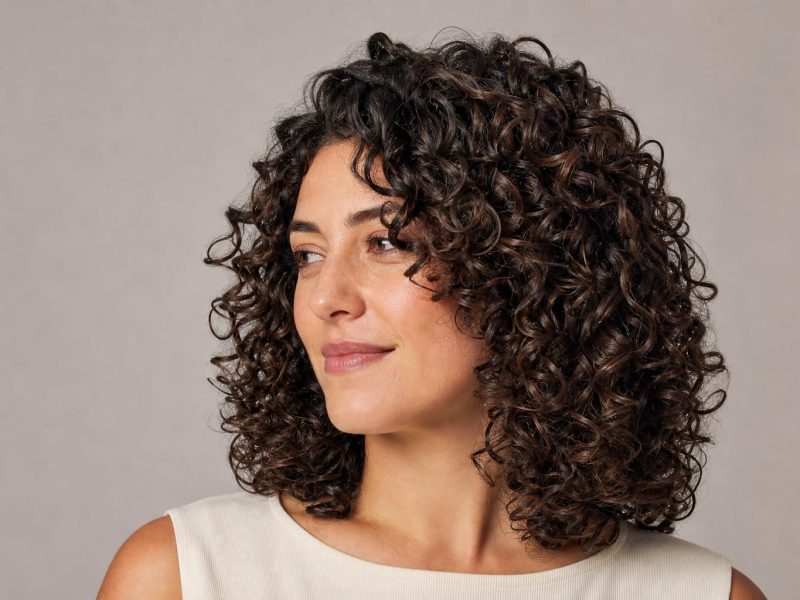
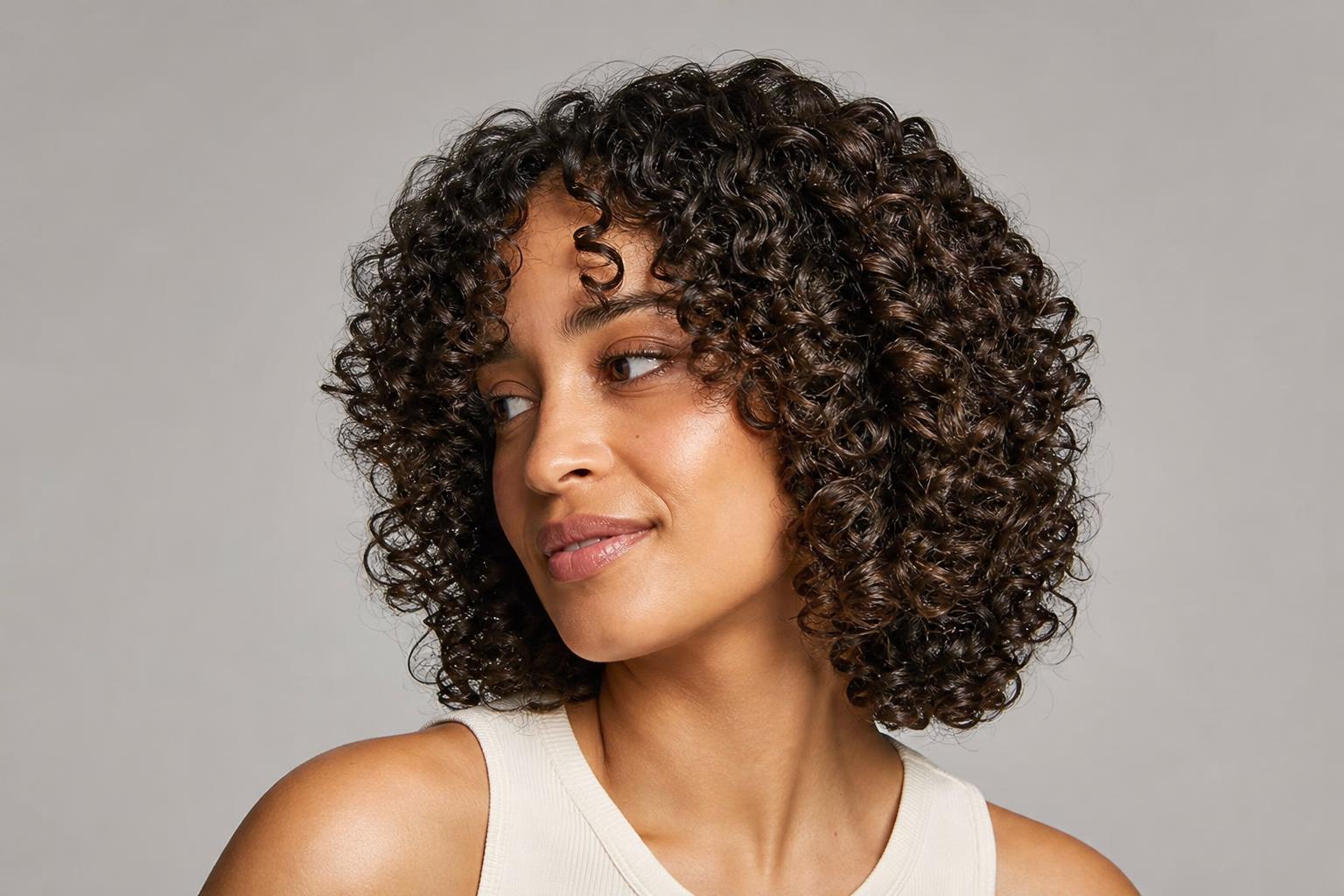
Most people with curls own eight products and use two of them correctly, because nobody explained that the category matters more than the brand.
Curly hair products fall into six categories that do six different jobs: a cleanser, a conditioner, a leave-in, a moisturizing styler (cream or milk), a hold styler (gel, mousse or foam), and a finisher (oil or serum). A 2c wave needs a light version of three of them, a 3b curl needs four, and a 4c coil usually needs all six. Choosing within each category comes down to two facts about your hair, its curl pattern and its porosity, not to the brand name on the bottle.
This guide explains what each product category actually does, matches categories and textures to your curl type and porosity, gives the layering order that stops products fighting each other, shows how to read a label for the ingredients that dry curls out, and includes a troubleshooting table for the routine that is not working. It names product types and textures throughout, never brands, because the same formula type from three different companies behaves the same way on your hair.
What Each Curly Hair Product Category Actually Does
Curly hair is dry by design. The bends in each strand stop scalp oil from traveling down it, and the raised cuticle at every bend lets moisture escape. Every curly product is either putting water back in, holding it there, or holding the curl shape while the water evaporates. Once you know which of those three jobs a product does, the shelf stops being confusing.
| Category | Job | Texture to look for | Who can skip it |
|---|---|---|---|
| Cleanser | Removes oil, sweat and product from the scalp without stripping the lengths | Sulfate-free shampoo, low-lather cleansing conditioner (co-wash), or a clarifier once a month | Nobody, but 3c to 4c hair can co-wash between shampoos |
| Conditioner | Puts water and slip back in so hair detangles and the cuticle lies down | Rinse-out with slip; a deep conditioner or mask weekly | Nobody |
| Leave-in | Keeps water in the strand after the shower and gives stylers something to grip | Spray or milk for 2c to 3a, cream for 3b to 4c | Fine 2c hair on wash days when a cream styler is used |
| Moisture styler | Softens, clumps curls together, reduces frizz, light hold | Curl cream, curl milk, or custard | Fine or low-porosity 2c to 3a hair, where it flattens the curl |
| Hold styler | Forms a cast around each curl clump so it dries in shape and stays frizz-free | Mousse or foam for light hold, gel for medium to strong, gelee for coils | Almost nobody; this is the product most people skip and the one that fixes frizz |
| Finisher | Seals the cuticle, adds shine, breaks the gel cast | Lightweight oil or serum, a few drops on dry hair | Fine hair and low-porosity hair, which oil coats rather than absorbs |
Stylist tip: If you only buy two products, make them a leave-in and a gel. The leave-in supplies moisture and the gel holds the curl while it dries. A cream on its own gives soft curls that frizz by lunch, and a gel on its own gives defined curls that feel dry. Together they cover 80 percent of what a full routine does.
How to Match Products to Your Curl Type
Curl type decides how much weight the hair can carry before the pattern collapses, and how much moisture it needs before it stops frizzing. Looser waves collapse under a rich cream, and tight coils drink one and ask for more. If you are not sure where your hair falls, the curl type chart with photos sorts it in a minute, and most heads have two adjacent types on them, so shop for the tighter one.
Waves and Loose Curls (2c to 3a) Need Light Products and Real Hold
This texture has the least natural volume and the least tolerance for weight, so the rule is water-based, lightweight, and applied to soaking-wet hair. A spray or milk leave-in, then a mousse or a light gel, is a complete routine. Curl creams and oils usually pull the wave straight or leave it stringy, and the frizz people blame on “not enough moisture” is more often too little hold. Fine 2c hair can go straight from conditioner to mousse and skip the leave-in entirely.
Curls (3b to 3c) Need Moisture First, Then Definition
Spirals the width of a marker or a pencil have enough pattern to hold product and enough dryness to need it. A cream leave-in, then a curl cream for clumping, then a medium-hold gel to set is the standard three-layer routine, applied in sections to hair that is wet, not damp. This is the texture where the cream-then-gel combination pays off most, and where skipping the gel produces the widest, frizziest result. A weekly deep conditioner keeps the mid-lengths from feeling rough between washes.
Coils (4a to 4c) Need Everything and the Richest Versions
Coily hair loses moisture fastest and shrinks the most, so products are richer and layered thicker. A cream leave-in, a butter or heavy cream for moisture, a gel or gelee for hold and elongation, and an oil to seal are the usual four, applied to wet hair in small sections and smoothed down each strand. Co-washing between shampoos stops the strip-and-dry cycle. The difference between curly and coily hair is real at the product shelf, because a formula that defines 3b curls barely registers on a 4c coil.
Porosity Changes the Answer as Much as Curl Type
Porosity is how easily water and product get into the strand and how easily they get out. Two people with identical 3b curls can need opposite products because one has a tight cuticle that repels everything and the other has a raised cuticle that drinks it and loses it an hour later. A porosity test at home takes a glass of water and five minutes and is the most useful thing you can do before buying anything.
| Porosity | How it behaves | Choose | Avoid |
|---|---|---|---|
| Low | Product beads on top, takes forever to wet and to dry, builds up fast | Water-based, lightweight, humectants like glycerin and aloe; apply with warm water or steam; clarify every 2 to 3 weeks | Heavy butters, coconut oil, protein-rich products more than monthly |
| Medium | Takes product well, holds a style, rarely surprises you | Almost anything matched to curl type; balance protein and moisture monthly | Nothing specific; overuse of any one thing |
| High | Wets instantly, dries fast, frizzes in humidity, feels rough by day two | Rich creams, sealing oils, protein every 1 to 2 weeks, anti-humectant stylers in summer | Glycerin-heavy gels in humid weather, which pull water in and swell the strand |
Most bleached, colored or heat-damaged curls are high-porosity regardless of what they were born as, and most virgin, coarse curls are low. If your hair feels mushy and stretchy when wet it needs protein, and if it feels stiff and snaps it needs moisture. Working out the protein and moisture balance is the fix for hair that gets worse the more product you add.
The Layering Order That Makes Products Work Together
Order matters because each product has to reach the strand through whatever went on before it. Water first, then the thinnest moisture product, then the thicker one, then hold, then a finisher only when the hair is dry. Reverse any two of those and one of them stops working. The full sequence takes 8 to 15 minutes on wash day and is the reason curly routines have a reputation for effort.
Step 1: Cleanse the Scalp, Not the Lengths
What you need: A sulfate-free shampoo or a co-wash, and a clarifying shampoo for once a month.
How: Apply to the scalp only and massage with fingertips for a full minute, letting the suds run through the lengths as you rinse. Use the clarifying shampoo every third or fourth wash to reset buildup, then deep condition afterward.
Why: The scalp is where oil and product collect; the lengths only need the rinse. Scrubbing the ends strips them and starts the frizz before you have even conditioned.
Common mistake: Co-washing only, for months. Cleansing conditioners do not remove gel, oil or hard-water minerals, and the scalp gets itchy and the curls go limp.
Step 2: Condition, Detangle, and Leave Some In
What you need: A rinse-out conditioner with slip and a wide-tooth comb or your fingers.
How: Saturate from ears down, detangle in sections from the ends up while the conditioner is in, then rinse most of it out with cool water. Leaving a little in the hair is fine and cuts the leave-in you need.
Why: Detangling with conditioner in is the only time curly hair should meet a comb. Dry detangling breaks the strand at every bend.
Common mistake: Rinsing with hot water, which reopens the cuticle you just smoothed.
Step 3: Apply Leave-In and Moisture Styler to Soaking-Wet Hair
What you need: A leave-in matched to your curl type and, for 3b and tighter, a curl cream.
How: Do not towel-dry first. Work a coin of leave-in through each section with a praying-hands motion, then the cream the same way, then rake fingers through once and scrunch upward to form clumps.
Why: Product applied to wet hair spreads evenly and locks in the water that is already there. On damp hair it lands in patches and stays on top.
Common mistake: Using the amount on the label. Start with half, and add only where the hair still feels rough.
Step 4: Add the Hold Styler and Do Not Touch the Hair
What you need: Mousse for waves, gel for curls, gelee or a stronger gel for coils.
How: Smooth the gel over the outside of each clump with flat palms, then scrunch upward once more. Let it air-dry or use a diffuser on low, and keep hands off until it is fully dry and the cast has formed. Learning how to use a diffuser without disturbing the clumps halves the drying time.
Why: The gel cast is what keeps humidity out and the curl shape in. Touching wet curls breaks clumps into single strands, which is what frizz is.
Common mistake: Wiping off the gel because the hair feels crunchy while drying. The crunch is the cast doing its job and it comes out in the next step.
Step 5: Scrunch Out the Crunch With a Finisher
What you need: Two or three drops of a lightweight oil or serum, or nothing for fine hair.
How: Once the hair is completely dry, rub the oil between your palms and scrunch the crunchy cast until it softens. Fluff the roots with fingertips only, never a brush.
Why: Breaking the cast on dry hair leaves the defined, soft curl underneath. Breaking it while damp reintroduces frizz.
Common mistake: Applying oil to wet hair as a leave-in, which blocks water instead of sealing it.
Stylist tip: Split every product test into two halves of the head. Apply your usual routine on one side and the new product on the other, then compare on day two, not day one. Almost everything looks good fresh from the diffuser. The product worth buying again is the one that still looks good after a night’s sleep and a morning refresh without washing.
How to Read a Curly Hair Product Label
Ingredients are listed in order of quantity, so the first five tell you what a product mostly is. Water first means a lightweight, hydrating formula. Butters or oils in the first three mean a rich, sealing one. The list below covers the handful of ingredient groups that decide whether a product suits curls, and it is more useful than any “curly girl approved” sticker.
- Sulfates (sodium lauryl sulfate, sodium laureth sulfate, ammonium lauryl sulfate) are strong cleansers that strip the oil curls cannot spare. Fine in a monthly clarifier, not in a daily shampoo. Gentler cleansers to look for are cocamidopropyl betaine, sodium cocoyl isethionate and decyl glucoside.
- Non-water-soluble silicones (dimethicone, amodimethicone, cyclopentasiloxane without a PEG prefix) coat the strand with a film that only sulfates remove. They give instant shine and slowly block moisture. Water-soluble versions, which carry a PEG or PPG prefix, rinse out and are fine.
- Short-chain drying alcohols (alcohol denat, isopropyl alcohol, SD alcohol 40) high on a styler’s list dry curls out. Fatty alcohols (cetyl, cetearyl, stearyl, behenyl) are the opposite, they condition, and their presence is a good sign.
- Humectants (glycerin, honey, aloe, propanediol) pull water into the strand. Excellent in dry climates and for low-porosity hair, a frizz trigger for high-porosity hair on humid days.
- Proteins (hydrolyzed keratin, wheat, silk, rice, quinoa) patch the cuticle and add strength. High-porosity and damaged curls want them weekly; low-porosity curls can get stiff and brittle from them within a month.
- Mineral oil and petrolatum seal so well that nothing gets in afterward. They suit 4c coils in a sealing step and almost nothing else.
Why Your Curly Hair Routine Is Not Working
Most product complaints have a specific cause, and it is usually the wrong category, the wrong order, or the wrong amount rather than a bad product. Match the symptom to the row before buying anything else.
| Symptom | Usual cause | Fix |
|---|---|---|
| Frizzy halo by midday | No hold styler, or the cast was broken while damp | Add a gel or mousse; wait until fully dry to scrunch |
| Curls limp and stringy | Too much cream or oil for the curl type; buildup | Clarify, drop the cream, switch to a mousse or lighter gel |
| Dry and rough even after conditioning | Silicone buildup blocking moisture, or sulfates in the shampoo | Clarify once, switch to sulfate-free, deep condition weekly |
| Mushy, stretchy, no bounce when wet | Moisture overload, no protein | A protein treatment, then rebalance with protein every 2 to 4 weeks |
| Stiff, straw-like, snaps | Protein overload, or too many drying alcohols | Stop protein for a month, use a moisture-only deep conditioner |
| White flakes on the hair, not the scalp | Products that do not mix, usually a cream under a gel with different bases | Use less of each; rub a dot of both between palms to test before applying |
| Great on wash day, gone by day two | No gel cast, cotton pillowcase, no refresh routine | Gel on wash day, satin bonnet or pillowcase, water and a little leave-in in the morning |
When More Product Is Not the Answer
Some curl problems are not product problems, and buying another bottle delays the real fix.
- Curls that used to form and now hang straight in sections. That is heat or chemical damage, and no styler restores a broken pattern. A trim to remove the damaged length and a break from heat is the only route back.
- A shape that is wide at the bottom and flat on top no matter what you apply. That is the cut, not the products. Curly hair needs layers cut into the dry, styled curl, and a stylist trained in a DevaCut or similar dry-cutting method fixes in one appointment what products never will.
- An itchy, flaky scalp under otherwise fine curls. That is a scalp condition or hard-water buildup, and rich curl products make it worse. Clarify, then see a dermatologist if it persists.
- Curls that look good with fifteen minutes of styling and bad with five. If your real routine is five minutes, build the product list for five minutes: a leave-in and a mousse, applied in the shower, nothing else.
- Hard water. Mineral deposits coat the strand and stop every product from working. A chelating shampoo monthly or a shower filter does more than any styler.
How Often to Use Each Product
Frequency is where most routines drift. Weekly steps become daily and daily steps get skipped, and the hair ends up either coated or dry. These are realistic numbers for a routine that washes twice a week, which suits most 3a to 4c hair; wavier and finer hair usually washes every two to three days and scales the rest down.
| Product | How often | Amount for shoulder-length hair |
|---|---|---|
| Sulfate-free shampoo or co-wash | Every wash, 1 to 3 times a week by curl type | A walnut, scalp only |
| Clarifying shampoo | Every 2 to 4 weeks | A walnut, whole head |
| Rinse-out conditioner | Every wash | Two to three walnuts |
| Deep conditioner or mask | Weekly for 3b to 4c, every 2 weeks for 2c to 3a | A golf ball, 15 to 30 minutes with heat |
| Protein treatment | Every 2 weeks for high porosity, monthly or less for low | As directed, followed by moisture |
| Leave-in, cream, gel | Every wash day; a diluted leave-in on refresh days | Coin, coin, walnut; halve all three for fine hair |
| Oil or serum | Dry hair only, wash day and refresh days | 2 to 4 drops |
FAQ
What Products Do You Actually Need for Curly Hair?
A sulfate-free cleanser, a conditioner with slip, a leave-in, and a hold styler such as gel or mousse cover the essentials for every curl type. Curls from 3b upward add a curl cream between the leave-in and the gel, and coils add a sealing oil at the end. Everything else on the shelf is a variation of one of those six categories.
Should Curly Hair Use Gel or Cream?
Both, in that order, for most curls, because the cream supplies moisture and the gel supplies hold. Waves and fine curls often do better with a mousse in place of the cream, since cream weighs them down. Coils need a heavier cream and a stronger gel. Using only cream is the most common reason curls look good wet and frizz as they dry.
How Do I Know if a Product Is Too Heavy for My Curls?
If the curls drop, separate into strings, or look greasy at the roots by the end of the day, the product is too heavy or there is too much of it. Halve the amount first, since most people over-apply. If the problem persists at half the amount, move down a texture, from cream to milk, from milk to spray, or from gel to mousse.
Why Does My Curly Hair Get Frizzy Even With Product?
The usual causes are no hold product, touching the hair while it dries, applying product to damp rather than wet hair, or a cuticle raised by sulfates or heat. Add a gel, apply it to soaking-wet hair in sections, and do not touch it until it is fully dry. If frizz persists after that, silicone or mineral buildup is blocking moisture and a clarifying wash resets it.
Can I Use Regular Shampoo on Curly Hair?
Occasionally, yes, and a sulfate shampoo is exactly what a monthly clarifying wash is. Using one every wash strips the oil that curly hair struggles to distribute in the first place, so the lengths dry out and frizz. Switching daily washing to a sulfate-free shampoo and keeping the sulfate one for buildup is the practical middle ground.
Is the Curly Girl Method Necessary?
No. The method’s useful ideas, which are cutting sulfates and heavy silicones, applying product to wet hair, and not brushing dry curls, work for almost everyone. Its strict rules, such as never shampooing and never using heat, leave many people with buildup, limp curls and an itchy scalp. Take the principles, keep a monthly clarify and an occasional diffuser, and ignore the rest.
What Is the Best Product for 4c Hair?
A rich cream leave-in followed by a strong-hold gel or gelee, applied to wet hair in small sections, gives 4c coils the most moisture and definition per wash. A butter or oil to seal the ends afterward reduces breakage. The heavier product textures that overwhelm 3a curls are the right ones here, and co-washing between shampoos keeps the coils from drying out.
The right curly hair products are the ones that match your curl type and porosity, applied in the right order and in smaller amounts than the label suggests. Start with a leave-in and a gel, add a cream or an oil only if the hair asks for it, and test any new bottle on half your head against your current routine before you commit. A shelf of six well-chosen categories does more for your curls than a shelf of twenty brands.
Hair results vary based on your natural hair type, texture, density, and condition. Always consult with a licensed hairstylist before making significant changes, especially with chemical treatments or dramatic length changes. Photos may show styled results that require professional tools and products to replicate.