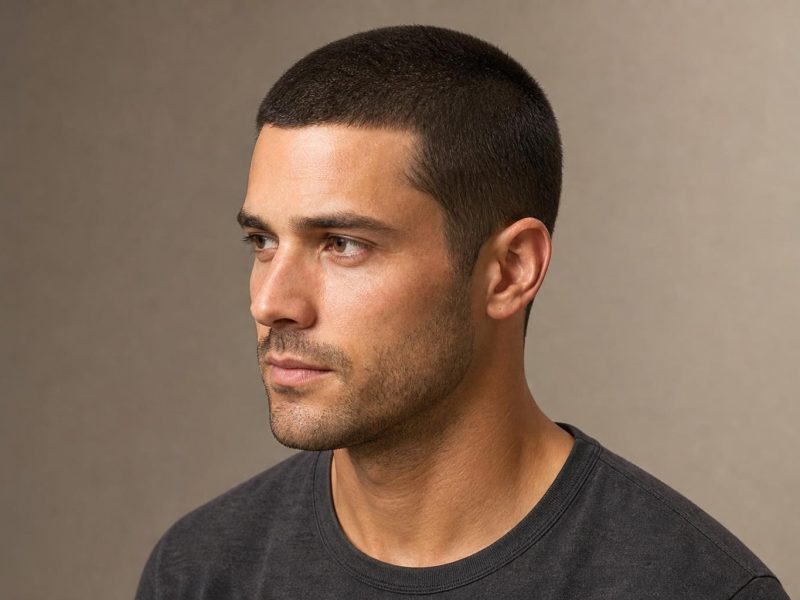


The right fringe haircut for men starts with where the fringe ends on your forehead, because that one measurement decides whether it hides, balances or exposes your hairline.
A fringe haircut for men is any cut where the hair at the front is combed or cut forward so it covers part of the forehead instead of being pushed up and back. The five main types are sorted by where the front edge lands: a cropped fringe ends an inch or more above the brow, a textured fringe stops around mid-forehead, a side-swept fringe runs diagonally, a curtain fringe splits in the middle, and a long fringe touches the eyebrows. Pick the landing point first and the rest of the cut follows from it.
Below are 22 fringe cuts grouped by those five types plus a curly section, followed by a forehead and hairline chart, a face shape table, the exact words to use with your barber, and honest upkeep numbers. If you already know you want the choppy version, our gallery of 30 textured fringe haircuts goes deeper on that single style.
| Fringe Type | Where the Front Edge Lands | Length Needed on Top | Trim Every |
|---|---|---|---|
| Cropped | 1 to 2 inches above the brow | 1 to 2 inches | 3 to 4 weeks |
| Textured | Mid-forehead | 2.5 to 3.5 inches | 4 to 5 weeks |
| Side-swept | Diagonal, from the part toward one temple | 3 to 4 inches | 4 to 6 weeks |
| Curtain | Split at the center, ends near the cheekbones | 4 to 6 inches | 6 to 8 weeks |
| Long | At or just over the eyebrows | 4 to 5 inches at the front | 3 to 5 weeks for the fringe alone |
Short Cropped Fringes
Cropped fringes are the most forgiving starting point because they need little product and still look neat on day five. The front edge stays well clear of the eyebrows, so they suit men who wear glasses, sweat through workouts, or have a hairline that has started to move back at the temples.
1. Classic French Crop Fringe
The barber leaves about an inch and a half on top, combs it all forward, and cuts one clean horizontal line across the front with scissors, then point cuts into that line so it does not look like a helmet. Sides are usually a mid skin fade. For the full range of fade heights and fringe weights, see these French crop variations.
2. Caesar Fringe Cut Straight Across
Oblong and long faces gain the most from a Caesar, because the short horizontal fringe breaks up the length between hairline and chin. Everything on top is cut to roughly one even length, around an inch, and brushed forward.
3. Textured Crop with a Skin Fade
Thick, coarse straight hair that refuses to lie flat is the ideal match here. The barber chips into the top with point cutting or texturizing shears so the hair breaks into short spiky pieces rather than one solid mass, and a high skin fade takes away bulk at the sides. Our textured crop guide covers the top-length options in detail.
4. Micro Fringe on a Short Clipper Top
Styling takes about 30 seconds: rub a pea-sized amount of matte paste between your palms and press the front forward with your fingertips. The top is clipper cut with a number 4 or 5 guard, and only the front inch is left slightly longer with scissors so it forms a tiny fringe. Men who like a buzz cut but want a softer front edge tend to stick with this one for years.
Textured and Messy Fringes
Textured fringes end around the middle of the forehead and are built from separated, uneven pieces instead of a solid line. They cover more of a tall forehead than a crop, and the choppy finish hides small unevenness in the hairline without looking like a cover-up.
5. Piecey Forward Fringe with a Low Taper
A low taper grows out slowly, so this cut still looks tidy four weeks after the barber visit. The fringe itself loses its shape first, usually around week five, when the pieces start dropping toward the brows. Book the fringe trim before the sides need attention.
6. Choppy Fringe on Salt-and-Pepper Hair
Gray and dark strands mixed together make choppy texture more visible, since each separated piece catches light differently. Gray hair is often wirier than the dark hair around it, which helps the fringe hold its pieces with less product. A matte clay works better than a shiny pomade, which can make gray look greasy.
7. Messy Fringe with a Disconnected Undercut
Ask for a disconnected undercut at a number 2 guard, with no blending between the sides and the top, and three inches left on top cut forward with texture. Say “disconnected” out loud, because many barbers blend by default.
8. Messy Fringe on Thick Straight Hair
Unlike a textured crop, which keeps everything short, a messy fringe keeps real length at the front so pieces can overlap and fall in different directions. On thick straight hair the barber has to remove a lot of weight from underneath, or the fringe will fall in one flat sheet by lunchtime.
9. Forward Fringe with a Shaved Hard Part
A hard part is a thin line shaved with a trimmer along the natural part, and it gives a forward fringe a clean start point on one side. The fringe is then cut slightly longer on the side away from the part so it angles gently. Expect the shaved line to blur within 10 to 14 days.
Side-Swept and Angled Fringes
Side-swept fringes run diagonally from the part toward one temple. They work well in offices and at any age because they look like a classic men’s cut from the side and only show the fringe from the front.
10. Side-Swept Fringe for the Office
Round and square faces get a helpful diagonal line from this cut, which breaks up width across the forehead. The top is left three to four inches long and scissor cut at the sides, rather than faded, for a softer outline.
11. Angular Fringe with a Longer Leading Edge
Straight and slightly wavy hair both hold this sharp angle, but very curly hair will spring out of it. The fringe is cut noticeably longer on one side, often reaching the outer corner of the eyebrow, and shorter toward the part. A light blow-dry across the forehead sets the direction.
12. Grown-Out Ivy League Fringe
Blow-dry the front across the forehead on medium heat with a vent brush, then work a small amount of cream through with your fingers and let a few pieces fall forward. The base is a classic Ivy League cut with the front grown about an inch past its normal length. It suits men who want a relaxed weekend look from a haircut that can still be combed neat for work.
13. Side Fringe Worked Around a Front Cowlick
Cowlicks at the front hairline usually decide the direction for you, so this fringe is swept the way the hair already grows. Leaving the fringe at least three inches long gives it enough weight to lie down over the swirl. Trims every four to five weeks keep it heavy enough to stay put, because a freshly shortened cowlick stands straight up.
Curtain and Split Fringes
Curtain fringes part down the center and fall to each side of the face, usually ending between the eyebrows and the cheekbones. They need the most length on top of any fringe here, so they are often the goal of a long grow-out. Our men’s curtain hairstyles collection covers the full grow-out timeline.
14. Middle-Part Curtain Fringe with Dark Roots and Lighter Ends
Sun-lightened or lightly highlighted ends make the two curtains more visible, since the lighter lengths frame the face against darker roots. Keep any lightening to the ends. Bleach near the part lifts the roots and makes the split look wide.
15. Two-Block Curtain Fringe
Tell the barber you want a two-block cut: the sides and back clipped short with a number 2 or 3 guard up to the temple line, and the top left long, around five inches, parted in the middle with no blending between the two sections. This is the version popular in Korea and Japan, where straight, thick hair holds the curtain shape well.
16. Wavy Curtain Fringe Tucked Behind the Ears
Straight curtains fall in a smooth arc, while wavy ones bend outward and form a loose S-shape at the temples. The advantage is that waves hide an uneven split, so there is no need to blow-dry it perfectly. Once the front reaches the jaw, most men start tucking it behind the ears.
Long and Heavy Fringes
Long fringes reach the eyebrows and cover most or all of the forehead. They make the strongest statement and hide a tall forehead completely, but they need the most frequent fringe trims, and they push into glasses and eyes if left too long.
17. Brow-Grazing Mod Fringe
Point cutting straight into the front edge keeps a heavy mod fringe soft enough to move instead of forming a solid block. The shape is round, following the curve of the head from ear to ear, with the longest point at the center of the brow. Barbers often call it a mod cut, and our mod cut styles show how it pairs with longer sides.
18. Heavy Forward Fringe with Scissor-Cut Sides
Tall foreheads and long faces are what this fringe was made for, because the thick front edge covers the forehead almost entirely and makes the face look shorter. The sides are scissor cut to about an inch over the ears so nothing looks shaved. On a very round face, keep it slightly shorter at the center.
19. Korean Comma Fringe
Thick, straight, dark hair holds the comma curl best, since fine hair drops the bend within an hour. The front section is cut to eyebrow length and curled under at one end with a round brush or a small flat iron, so it forms a comma shape at one temple. A light hold spray keeps the curve through the day.
Curly and Coily Fringes
Curly fringes shrink as they dry, so a fringe cut at the brow on wet curls can spring up to the hairline. The cuts here are shaped dry or measured with shrinkage in mind, and they keep the sides tighter so the curls on top have room to stack.
20. Curly Fringe with a Drop Fade
Scrunch a curl cream into soaking-wet hair, then leave it to air-dry or use a diffuser on low without touching it. The fringe is left about three inches long when stretched and cut into loose curls that fall toward mid-forehead, with a drop fade curving down behind the ears. More options for this texture are in our men’s haircuts for curly hair gallery.
21. Coily Sponge Top with a Forward Fringe
Sponge twists on a two-inch coily top hold for three to four days before they need redoing. The front edge is shaped slightly forward and left a touch longer than the rest of the top, with a line-up at the temples every two weeks to keep the frame sharp.
22. Loose Wavy Fringe Cut Dry
Arrive with your hair dry and styled the way you normally wear it, and ask the barber to cut the fringe dry at the length you want it to hang. Waves can drop or lift half an inch between wet and dry, so a dry cut is the only way to see the real landing point. This works especially well on 2b to 2c waves that are hard to predict.
Match the Fringe to Your Forehead and Hairline
Your forehead height and hairline shape matter more than face shape when choosing a fringe, because the fringe covers exactly that area. A tall forehead wants more length at the front, while receding temples call for a shorter, forward-cut crop that does not leave gaps at the corners.
| Forehead or Hairline | Best Fringe | Avoid | Why |
|---|---|---|---|
| Tall forehead | Textured or long fringe ending mid-forehead or lower | Very short crops | More coverage shortens the space between hairline and brows |
| Short forehead | Cropped fringe or side-swept fringe | Heavy brow-length fringes | A long fringe hides what little forehead shows and crowds the eyes |
| Receding temples | Short textured crop cut forward | Curtain fringe with a middle part | A center split opens up the corners exactly where hair is thinning |
| Widow’s peak | Textured fringe with separated pieces | Blunt straight-across line | The peak pushes a blunt line into a point at the center |
| Front cowlick | Side-swept fringe following the growth | Very short straight fringe | Short hair over a swirl stands up; longer hair has weight to lie down |
| Thinning at the front | Caesar or micro fringe | Long fringe grown to cover the thin spot | Long, fine strands separate and make the scalp more visible |
If your hairline is moving back, a forward crop is usually the better call than trying to grow a fringe over it, and this guide on haircuts for a receding hairline explains the top lengths that keep the corners covered. For the opposite problem, these hairstyles for a big forehead show how much front length you need.
Stylist tip: Push your hair straight back before the cut and let the barber see your bare hairline. Many men hide it at the consultation out of habit, and the barber then cuts a fringe that exposes a gap at the temple the moment it moves.
Fringe Choices by Face Shape
Face shape is the second filter once you know how much forehead to cover. The goal is simple: add a horizontal line on a long face, add angles or a diagonal on a round face, and soften a strong jaw with some movement at the front.
| Face Shape | Best Fringe | Avoid |
|---|---|---|
| Oval | Any type; choose by hairline and hair texture | Nothing specific |
| Round | Side-swept or angular fringe with height at the crown | Rounded bowl-shaped fringe |
| Square | Textured or messy fringe | Blunt Caesar with a skin fade |
| Oblong | Caesar or heavy forward fringe | High quiff or a tall textured top |
| Diamond | Curtain or long textured fringe | Tight high fade with a short crop |
| Triangle | Fuller textured fringe with scissor-cut sides | Skin fade with a flat micro fringe |
Round faces benefit most from avoiding symmetry at the front, which is why a diagonal fringe with some lift behind it works better than a straight crop. The round face hairstyles for men guide covers the full range of tops that add length.
What to Tell Your Barber
Barbers hear “a fringe” and picture different things, so give them three details: where the front edge should land, how the sides are finished, and whether the fringe is solid or broken up. Bring a photo of a fringe on hair that matches your texture, not just a style you like on someone with different hair.
A clear script sounds like this: “I want the fringe to land at mid-forehead when it’s dry. Leave about three inches on top, cut forward with point cutting so it breaks into pieces. Low taper on the sides at a number 2, and keep the weight line soft.” Swap the landing point and the guard number to match the cut you picked from the table above.
Ask two questions before the clippers come out: “Will my cowlick push this fringe up?” and “How long before the fringe needs trimming on its own?” A good barber answers both in specifics, and many will offer a quick fringe-only tidy between full cuts.
Stylist tip: Ask for the fringe to be cut a quarter inch longer than your target. A forward fringe on straight hair lifts slightly once product goes in, and it is easy to take off more at the end but impossible to put it back.
Styling and Upkeep
Most fringe cuts take two to five minutes a day. Cropped styles need only a dab of matte paste pressed forward, while side-swept and curtain fringes need a short blow-dry to set direction before any product goes in. Blow-drying on damp hair decides the shape; product on dry hair only holds it.
- Use a matte clay or paste on cropped and textured fringes, since shine makes piecey hair look wet and heavy.
- Use a light cream or sea salt spray on curtain and side-swept fringes, which need movement more than hold.
- Use a curl cream or leave-in conditioner on curly fringes, and skip heavy wax that flattens the curl.
- Keep product off the first half inch of the fringe near the forehead, where skin oil already adds weight by the afternoon.
Plan on a fringe trim before the full cut is due. Short fringes lose their line in three to four weeks, and longer ones start poking into the eyes by week five. For men who get a fade, the sides and fringe rarely grow out on the same schedule, so ask whether your barber offers a shorter fringe and neckline tidy between appointments. The rest of our barber-tested cuts are gathered in the men’s haircuts section.
When a Fringe Is Not the Right Call
A fringe does not fix every hairline or suit every routine, and a few situations make it more trouble than it is worth.
- Advanced thinning at the front: once the scalp shows through the front two inches, a fringe separates and draws attention to it; a short buzz cut or tight crop is more flattering.
- Very oily skin on the forehead: a long fringe resting on the forehead goes greasy and clumps within hours, so a cropped fringe that stays an inch clear of the skin is the practical choice.
- Tight curls with no time to style: a curly fringe cut long needs daily product and diffusing, so a short sponge top or crop is easier.
- Jobs that require a hat, helmet or hairnet: anything past mid-forehead gets flattened and bent, and a Caesar or micro fringe survives better.
- Strong double crown or front swirl you do not want to fight: if the hair grows straight up at the front, a quiff or brushed-back style works with it instead.
FAQ
How Long Does Hair Need to Be for a Fringe Haircut?
You need at least one inch on top for a cropped fringe and three to four inches for a textured or side-swept fringe. Curtain fringes need four to six inches before they split cleanly. If you are growing out from a fade, ask the barber to leave the top alone and only tidy the sides for two or three visits.
Does a Fringe Make a Receding Hairline More Noticeable?
A short forward fringe usually makes a receding hairline less noticeable, while a long fringe or a middle part makes it more obvious. The short crop covers the corners evenly without leaving gaps when the hair moves. Keep the top between one and two inches and ask for texture so the front edge looks natural.
What Is the Difference Between a Fringe and Bangs for Men?
Fringe and bangs mean the same thing, hair cut or styled forward over the forehead. Fringe is the usual term in the UK and among barbers, while bangs is more common in the US. For men, most barbers will understand “fringe” or “hair forward at the front” more clearly than “bangs.”
Can You Get a Fringe with a Fade?
Yes, most fringe cuts pair with a low, mid or high fade, and the fade height changes how much the fringe stands out. A high skin fade makes the fringe look bolder and the top look taller, while a low taper keeps the outline softer. For thin or fine hair, a taper is kinder than a high fade because it keeps more hair around the fringe.
How Do I Stop My Fringe from Sticking Up?
Blow-dry the fringe forward and down while it is still damp, pointing the nozzle from the crown toward the forehead. Hair sets in the direction it dries, so product on dry hair cannot fix a fringe that dried upward. If it still lifts, the fringe is likely too short over a cowlick and needs another half inch of length.
How Often Should a Men’s Fringe Be Trimmed?
Trim a short fringe every three to four weeks and a longer fringe every four to six weeks. The fringe usually needs attention before the rest of the cut, especially if it reaches the eyebrows. A quick fringe tidy between full appointments keeps the shape without resetting the whole cut.
The best fringe haircuts for men start with one decision: where the front edge should land relative to your hairline and eyebrows. Pick that from the forehead chart, choose the type that matches your hair texture, and bring a photo of that fringe on similar hair to your barber. Ask for a little extra length on the first cut, then fine-tune it at the next visit once you have seen how it behaves.
Hair results vary based on your natural hair type, texture, density, and condition. Always consult with a licensed barber or hairstylist before making significant changes, especially with dramatic length changes. Photos may show styled results that require professional tools and products to replicate.