
Having a fuller face and fine hair at the same time sets two pieces of standard advice against each other, because almost everything that makes fine hair look thicker also makes a round face look wider.
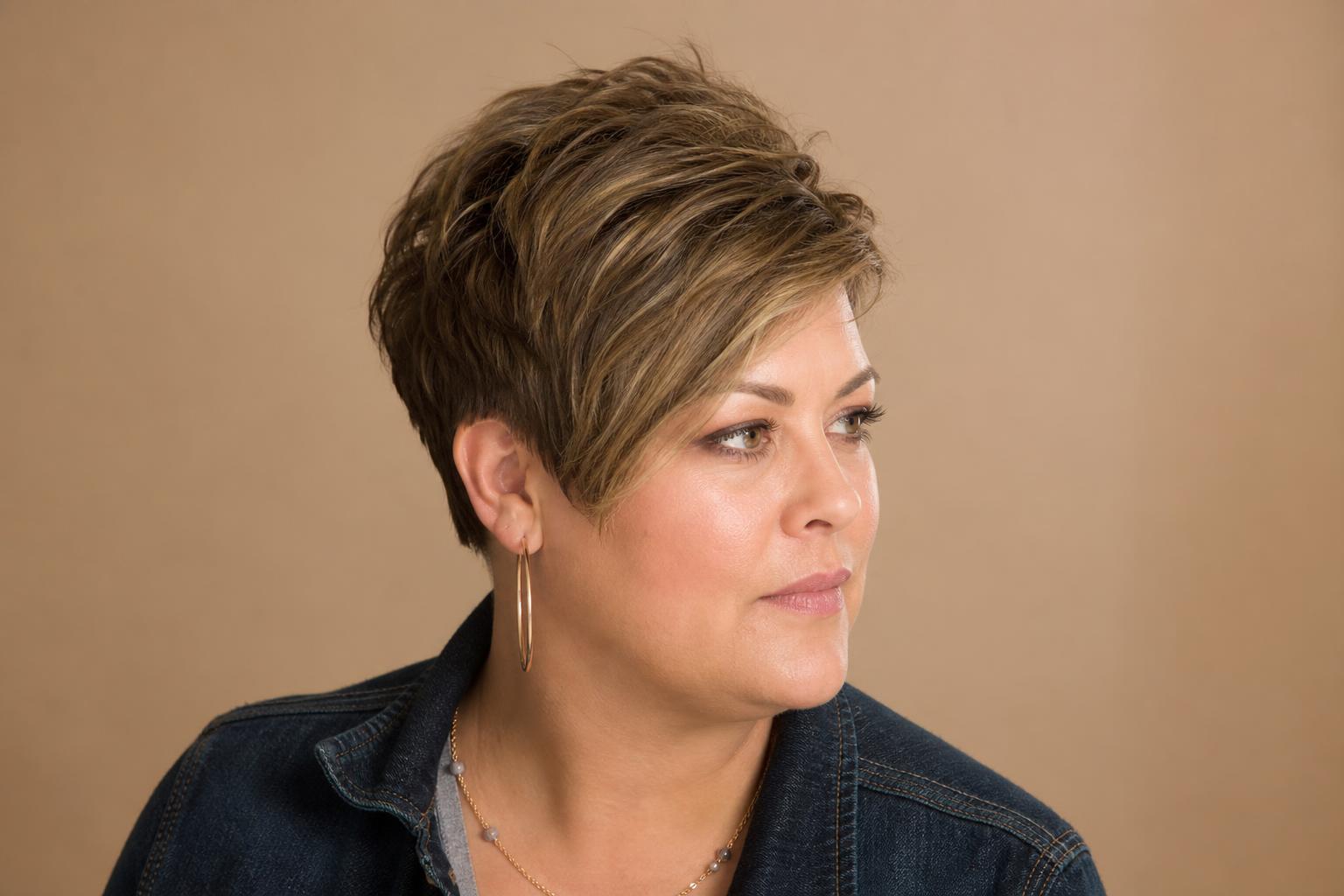
The resolution is that volume has to go up rather than out. A pixie that works here is tapered tight at the sides and back, lifted hard at the crown, and left long enough at the front to fall past the cheekbone on a diagonal. That combination adds height where it lengthens the face and removes width exactly where a fuller face does not want it.
This guide covers why the usual fine-hair advice backfires on a rounder face, the four measurements that decide whether a pixie will suit you, which shapes to ask for and which to refuse, how to style vertical volume without backcombing the sides, and the honest maintenance the cut demands.
Fine-Hair Advice and Full-Face Advice Point in Opposite Directions
Read any guide written for fine hair and you will be told to add layers throughout, keep weight in the perimeter, build body all over and use a blunt line to fake density. Read any guide written for a fuller or rounder face and you will be told to avoid width at the cheeks, skip blunt horizontal lines and keep the sides close. Follow both at once and the instructions cancel out.
The conflict is real rather than imagined. All-over volume on a short cut lands at ear and cheek level because that is where the head is widest, so fine hair that has been given body everywhere ends up framing the face with two soft wings exactly at its broadest point. The photographs that sell this cut are usually on people with one of the two traits, not both.
What resolves it is being specific about where volume is allowed. Height at the crown lengthens the face and costs nothing in width. Volume at the sides does the opposite. A stylist who understands the distinction will cut the sides shorter and tighter than they would on a fine-haired client with a narrow face, and build the missing fullness entirely into the top section.
Stylist tip: Say both things out loud in the same sentence. Fine hair and a full face separately produce two different haircuts, and a stylist told only one of them will optimize for the wrong problem.
Four Measurements Decide Whether a Pixie Will Suit You
Face shape alone is a poor predictor, which is why so many people follow round-face advice and still dislike the result. These four checks are what stylists actually look at, and you can do all of them at home with a mirror and a ruler.
| What to Check | How to Check It | Good Sign | Adjust the Cut If |
|---|---|---|---|
| Neck length | Fingers between jaw and collarbone | Three or more fingers fit | Two or fewer, so keep some length at the nape |
| Forehead height | Hairline to brow, in fingers | Two to three fingers | Four or more, so add a longer side-swept front |
| Widest point of the face | Cheekbone versus jaw in the mirror | Cheekbone widest | Jaw widest, so keep the taper higher up |
| Density at the crown | Part the top and look at scalp visibility | Scalp barely visible | Clearly visible, so keep the top longer for coverage |
The crown check matters most and gets skipped most often. A pixie relies on the top section for its entire shape, and fine hair that has thinned specifically at the crown cannot deliver the height the cut depends on. If the scalp shows clearly through a parted crown, a slightly longer cut that lets the top lie over itself will serve better than a true pixie.
The Shapes That Work and the Ones That Do Not
Within the pixie family the differences are large enough to change the outcome entirely. These four variations are the ones worth naming at a consultation, and the reasons they work are structural rather than a matter of taste.
A Deep Side Part with a Long Diagonal Front Does the Most Work
Parting well off-center throws the top section to one side and creates a diagonal line across the forehead, which cuts against the horizontal width of a fuller face. The front piece should fall past the cheekbone rather than stopping at it, since a piece that ends level with the cheek draws a line straight across the widest part. This single choice changes more than any amount of layering.
A Tapered Nape Beats a Stacked One Here
Graduated or stacked backs build rounded volume at the back of the head, which looks balanced on a narrow face and adds visual bulk on a fuller one. A clean taper that follows the head shape down to the nape keeps the silhouette close and lets the crown height stand out by comparison. Ask for the taper to start higher than usual, around the middle of the ear rather than at the bottom.
Point-Cut Texture at the Crown, Not Through the Sides
Texture in the top two inches creates pieces that stand away from each other and hold height without product. The same texturizing through the sides causes fine hair to separate and puff out at ear level, which is the width problem all over again. Say explicitly that you want the texture confined to the top section.
Longer Pixies and Bixies Are Often the Safer Start
A longer pixie or a pixie bob keeps some length at the nape and around the ears while still lifting at the crown, which suits anyone whose neck is on the shorter side or who is nervous about committing. It is also more forgiving during grow-out. The full range of these in-between lengths is covered in our comparison of the pixie bob and the bixie.
| Feature | Ask For | Refuse | Why It Matters Here |
|---|---|---|---|
| Part | Deep side part | Center part | A diagonal breaks up facial width; a center line doubles it |
| Front piece | Long, swept past the cheekbone | Blunt straight-across fringe | Horizontal lines shorten the face and widen it |
| Sides | Tapered close, taper starting high | Layered or texturized for volume | Side volume lands at the cheek, the widest point |
| Crown | Longer, point cut for lift | Cut short and flat with the sides | Height is the only volume that lengthens the face |
| Nape | Clean taper following the head | Stacked or graduated volume | A close back makes the crown height look taller |
| Sideburn area | A thin piece left in front of the ear | Shaved fully clean | A soft vertical wisp slims the cheek line |
Styling Vertical Volume on Fine Hair
The cut gives you the shape and the styling keeps it, which on fine hair means five to ten minutes rather than none at all. The goal throughout is to lift the top and keep the sides flat, which is the opposite of how most people instinctively dry short hair.
Work a root-lifting mousse or a volume powder into the damp top section only, then dry the crown by lifting sections straight up with your fingers and directing heat at the roots. Dry the sides downward and flat with the nozzle pointing toward the scalp. Finishing with a cool shot sets the height, and a light hairspray misted from underneath the top section holds it without the stiffness a heavy spray leaves on fine strands.
Stylist tip: Skip wax, pomade and anything described as a cream. Fine hair loses the lift the cut was built for the moment a heavy product touches the root, and a dry texture spray or powder does the same job without the weight.
Color can add apparent density too. A slightly lighter shade through the top section catches light and makes the crown appear fuller, while keeping the sides darker keeps them visually recessed. The techniques that build that contrast without a full head of highlights are covered in our guide to placing highlights on darker hair.
Maintenance Is the Trade-Off Nobody Mentions
A pixie is fast to style and expensive in salon visits, and the shorter the cut the faster it loses shape. Plan on a trim every four to six weeks, since the taper at the sides and nape is what controls width and it blurs within a month. Letting it go for ten weeks turns a tapered pixie into exactly the wide, soft shape the cut was meant to avoid.
Grow-out has a genuinely awkward stretch between weeks six and twelve, when the sides reach ear level and push outward before they are long enough to tuck. Anyone who wants to grow a pixie out should plan that phase deliberately rather than discover it, and our guide to growing out a pixie cut maps the stages and the trims that make each one bearable.
When a Pixie Is Not the Right Answer
A pixie is not the only short cut, and a few situations point clearly elsewhere. None of these are about face shape alone.
- Your crown has visibly thinned, since a pixie relies on top-section density and a longer cut gives more coverage for the same effort.
- You have two or fewer fingers between jaw and collarbone, where a very short nape shortens the neck further and a longer pixie or a bob works better.
- You will not style it, because fine hair on a short cut lies flat without product and the flat version adds width rather than height.
- You cannot commit to a trim every four to six weeks, which is what keeps the tapered sides from spreading.
- You have a strong cowlick at the front hairline, which fights a deep side part and needs to be assessed in person before committing.
- You are still deciding, in which case a long pixie or bixie gets you most of the effect and leaves a shorter path back.
What to Tell Your Stylist
Lead with the two facts and then the three instructions. Say that your hair is fine and that you want to avoid width at the cheeks, then ask for a deep side part, a front piece long enough to fall past the cheekbone, and the sides tapered close with the taper starting around mid-ear.
Add one line about the crown, which is that you want the top left long enough to lift and point cut for texture rather than thinned with thinning shears. Thinning shears on fine hair remove density the cut cannot spare and create fluff at the mid-lengths, and asking for point cutting by name avoids it.
Bring two photos with different purposes. One should show the front and the length of the side-swept piece you want, and one should show the back and how close the taper goes. Galleries make this easier to pick from, and our collections of pixie cuts shaped for round faces and pixies that make fine hair look thicker cover each side of the problem in detail.
FAQ
Does a Pixie Cut Make a Round Face Look Rounder?
Only when the sides are left full or the front is cut straight across. A pixie tapered close at the sides with height at the crown and a long diagonal front piece does the opposite, because it removes width at the cheeks and adds length at the top. The cut itself is neutral and the proportions within it decide the result.
Can Fine Hair Hold a Pixie Cut?
Yes, and fine hair often suits short cuts better than long ones because there is less weight pulling the roots flat. What matters is density at the crown rather than strand thickness, since the top section carries the shape. Check whether your scalp shows clearly through a parted crown, and if it does, ask for a slightly longer top for coverage.
How Often Does a Pixie Cut Need Trimming?
Every four to six weeks, which is more often than almost any other cut. The taper at the sides and nape controls the width of the whole silhouette and it softens within a month. Stretching to eight or ten weeks gradually turns a sharp shape into a soft one, which undoes the main benefit for a fuller face.
What Products Work Best on a Fine Pixie?
A root-lifting mousse or a volume powder at the crown and nothing heavier anywhere else. Waxes, pomades and styling creams weigh fine hair down at the root, which flattens the height the cut depends on and pushes the volume sideways. A dry texture spray gives grip and separation without the weight.
Should I Get Bangs with a Pixie If My Face Is Full?
A long, side-swept front piece works well and a blunt straight-across fringe generally does not. Horizontal lines across the forehead shorten the visible face and emphasize its width, while a diagonal sweep does the reverse. If you want the coverage of a fringe, ask for it cut on an angle and long enough to blend into the side section.
Is a Bixie Better Than a Pixie for a Fuller Face?
Often yes, particularly as a first step. A bixie keeps more length around the ears and at the nape while still allowing crown height, which suits shorter necks and makes grow-out far less awkward. The trade-off is that the extra length needs more deliberate styling to avoid widening at the jaw.
A pixie cut for a fuller face with fine hair works when the two problems are solved in different places rather than with one compromise, which means height built entirely into the crown and width removed entirely from the sides. Check your crown density before booking, ask for point cutting rather than thinning shears, and treat the four to six week trim as part of the cut rather than an optional extra.
Hairstyle results vary with hair texture, density, growth patterns and the skill of the individual stylist. Treat the guidance here as a starting point for a consultation rather than a guarantee.