
The best hairstyle for a girl is the one that survives a full school day without ever being pulled tight enough to hurt.
Most mornings you have between two and ten minutes, so the 30 hairstyles below are grouped by exactly that: how long each one takes once you have done it twice. Two-minute styles come first, then braided styles worth five to ten minutes, then the ones a girl can learn to do on her own, curly and coily options, and a short set for parties and photo days.
Every style list for girls online gives you the look and skips the part that matters most, which is tension. Traction alopecia, the hair loss caused by pulling, is estimated to affect around 17.1 percent of school-aged girls in populations where tight styling is routine, and it usually starts in childhood. So alongside the styles you get a tension check you can run in ten seconds, a rest schedule, and an honest section on when to leave her hair alone entirely.
Two-Minute Hairstyles for School Mornings
These are the styles you can finish while the toast is still in the toaster. None of them needs a mirror behind her head, a comb with a tail, or more than one elastic per section. They all work on straight through wavy hair that reaches at least the shoulders, unless the entry says otherwise.
1. Low Ponytail at the Nape
Gathering at the nape rather than the crown puts the elastic where the skull is flattest, so nothing pulls upward against the hairline all day. It is the single lowest-tension way to get hair off a child’s neck. Use a fabric-covered elastic and stop at two wraps, not three.
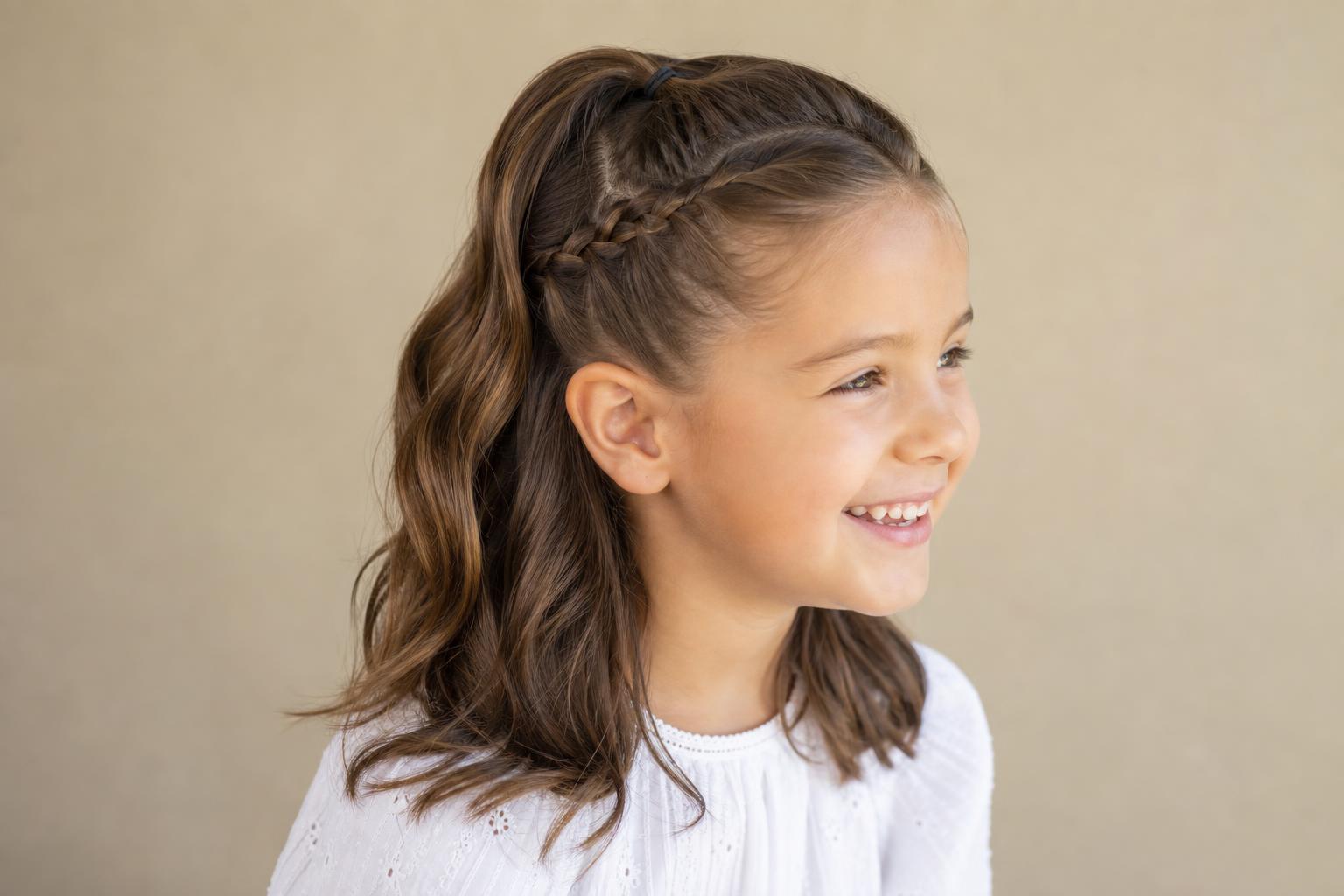
2. Half-Up Ponytail With the Rest Left Down
Only the top section gets gathered, which keeps hair out of her eyes while leaving the weight of the length hanging free. Round faces look longer with this than with a full pony, because the sides stay soft. Take the section from ear to ear, not from the temples, or the front pulls.
3. Side Ponytail Over One Shoulder
A ponytail gathered behind one ear and brought forward gives an asymmetric line that photographs well and takes no more effort than a center one. Alternate sides day to day so the same patch of scalp is not under tension twice in a row.
4. Two Low Pigtails
Splitting the hair down the middle and tying at jaw level halves the weight each elastic carries, which makes pigtails gentler than one ponytail of the same tightness. Fine hair especially benefits, since a single pony on fine hair has to be tightened more to stay put. Keep the part soft and slightly off-center to avoid wearing a groove into one line of scalp.
5. Messy Bun With a Spiral Elastic
Twist a low ponytail and wrap it around itself, then hold it with a spiral or coil elastic rather than a standard band. Spiral elastics spread the grip over a wider area and come out without dragging hair with them.
6. Claw Clip Twist
Twist all the hair once and clip it flat against the back of the head with a medium claw clip. The clip takes the load instead of an elastic, which means zero pulling at the roots, and it comes down in one second when she wants it loose. Our guide to claw clip styles and sizes covers which clip size holds which thickness.
7. Headband With Hair Left Loose
A soft fabric headband is the right answer on days when her scalp is tender, when she has just taken braids out, or when she is getting over an ear infection. Skip hard plastic headbands with teeth, which press on the same two points above each ear for hours.
Braided Hairstyles Worth Five to Ten Minutes
Braids earn their extra minutes by lasting: a braid put in on Monday morning often survives to Tuesday afternoon, while a ponytail is finished by lunchtime. The trade is that braids concentrate tension along the line where they are anchored, so the rule below matters more here than anywhere else. Anchor the braid loosely at the scalp and only tighten as you move down the length.
8. Single French Braid Down the Back
Adding hair as you work down keeps the whole head tidy rather than just the length, which is why it survives playground use better than a plain plait. Start the first crossings loose at the crown and firm up past the occipital bone. The step-by-step French braid method is worth learning on someone else’s hair first.
9. Dutch Braid That Stands Proud
Crossing the strands under instead of over makes the braid stand out from the head rather than lie flat, which looks chunkier on fine hair. Thin the finished braid by pulling gently at the outer edges of each crossing. A Dutch braid worked from the hairline back is the base for most of the fancier styles further down this list.
10. Two Dutch Braids Into Low Pigtails
Braiding each side to the ear and then tying off into loose pigtails gives a sporty result that holds through gym class. Because the tension is split across two braids and two elastics, it carries less load per section than one tight braid. Good for thick hair that overwhelms a single plait.
11. Crown Braid Across the Front
A braid running from one temple across the front and pinned behind the opposite ear keeps every stray front piece out of her face without touching the length. It works on shoulder-length hair and up. Pin it with two flat bobby pins crossed in an X, which holds better than three parallel ones.
12. Braided Headband With Hair Down
Take a one-inch section above each ear, braid both, and join them behind the head so they form a band across the top. The rest stays loose. This is the least damaging way to get a decorative braid, because nothing is anchored to the scalp under tension.
13. Fishtail Braid Over One Shoulder
Two sections passing thin strands back and forth produce a woven texture that looks far more complicated than it is. It takes longer than a French braid the first few times and then settles at about six minutes. Best on hair with a bit of grip, so second-day hair beats freshly washed.
14. Bubble Braid Ponytail
A ponytail segmented with elastics every two inches, each segment puffed out gently with your fingers, gives shape without any actual braiding skill. Bubble braids on longer hair can run five or six segments; on shoulder length, three is the limit before it looks cramped.
15. Braided Bun for Dance and Gymnastics
Braid a low ponytail, coil the braid around its own base, and pin it. A braided bun holds through a two-hour class far better than a twisted one, because the braid keeps its own structure when the pins shift. Use a hair net rather than more pins if it has to survive a competition.
Hairstyles a Girl Can Do Herself
Somewhere between six and nine, most children want to do their own hair, and the styles that make that possible are the ones that need no back-of-head mirror work. Teaching her a style she can manage alone is also the best protection against tension damage, because children naturally stop when something hurts and adults often do not notice. Start with the first two and add the others as her coordination catches up.
16. Front Twist Pinned Back
She takes a section at one temple, twists it away from her face, and clips it behind her ear. It needs one hand and no mirror. A good first style to teach at around five or six.
17. Rope Twist Ponytail
Split a ponytail in two, twist each half in the same direction, then wind the two halves around each other the opposite way. The twisting locks itself, so it holds without a second elastic if the hair has any texture. Easier for small hands than a three-strand braid.
18. Simple Three-Strand Plait Over the Shoulder
Bringing all the hair forward over one shoulder means she can see what she is doing the whole time. Most children can manage this by seven. Let her practice on a doll or a length of yarn taped to a chair before her own hair.
19. Sock Bun or Donut Bun
A foam donut slipped over a ponytail and rolled down gives a perfectly round bun with no pinning skill at all. It also distributes the hair evenly around the ring, so no single section carries the weight.
20. Scrunchie Half-Up With a Twist
The top section gets twisted once before the scrunchie goes on, which stops the flat sticking-up look a plain half-up gets on fine hair. Fabric scrunchies also grip without the snap that thin elastics deliver.
21. Two Front Braids Into a Loose Pony
She braids just the two front sections, which she can see, then gathers everything into a low ponytail she does by feel. It is the bridge style between a parent doing all of it and her doing all of it.
Hairstyles for Curly and Coily Hair
Curly and coily hair needs a different approach entirely, because the same styles that hold on straight hair either slip out or require far more tension to stay put. Work on damp hair with a leave-in conditioner rather than dry, use wider sections, and let the curl pattern do the holding wherever possible. Frequency matters too: restyling coily hair every single morning causes more breakage than one style worn for several days.
22. Two-Strand Twists Left Loose
Sectioned twists worn down give a defined result that lasts three or four days and needs nothing but a bonnet overnight. Larger sections mean fewer twists and a much shorter styling session, which for a six-year-old is the deciding factor. Take them out gently on damp hair for a twist-out the following day.
23. Puff With a Wide Fabric Band
All the hair gathered high with a wide stretchy band gives a round puff that needs no elastic at all. The width is the safety feature: a thin band cuts a line into the hair at the same point every day, while a wide one spreads the same hold. Never leave a puff in overnight.
24. Chunky Cornrows Straight Back
Four to six thick cornrows running straight back take about twenty minutes and then need nothing for a week. Tell whoever is braiding to keep the first inch at the hairline deliberately loose. Our collection of braided styles for Black girls sorts more patterns by age and wear time.
25. Bantu Knots for Overnight Curl
Sectioned coils wrapped into small knots set a spiral pattern while she sleeps and come down into defined curls in the morning. Fasten them by tucking the end under rather than with an elastic, which removes the tension question entirely. Six to eight knots is plenty on a child’s head.
26. Braided Pigtails With Beads at the Ends
Beads are the detail most children ask for, and they are fine as long as the total weight stays low and they hang on the braid rather than near the scalp. Two or three beads per braid, not a full row. Heavy beaded ends pull the braid down for days on end, which is exactly the load pattern that thins edges over time.
Party and Photo Day Hairstyles
These take fifteen to twenty-five minutes and are meant for a few hours, not a full day. Because they involve more pinning and more hold, take them down the same evening rather than leaving them in overnight. Everything here builds on a style from an earlier section.
27. Crown Braid All the Way Around
Two Dutch braids worked from the nape up and around the head, pinned where they meet, give a full halo. It needs hair that reaches at least the shoulder blades to go all the way round. Mist lightly with water rather than hairspray to tame flyaways on a child.
28. Half-Up Bun With Curled Lengths
The top half goes into a small bun and the loose length underneath gets waved with a large barrel or with overnight braids. Overnight braids are the better route for children, since they need no heat at all. Damp hair braided at bedtime gives a soft wave by breakfast.
29. Twisted Updo With Ribbon
Three low twists coiled and pinned into each other with a ribbon threaded through the middle looks formal but comes apart in seconds. Use a satin ribbon rather than grosgrain, which snags. Pin into the twists themselves, never into the scalp line.
30. Long Loose Waves With Two Front Braids
The simplest special-occasion answer is hair left down, waved overnight, with one small braid on each side taken back and pinned. Nothing is under tension, nothing needs holding, and it photographs better than a style she has been fidgeting with all afternoon.
How to Tell If a Hairstyle Is Too Tight
Traction alopecia is the only common form of childhood hair loss that is completely preventable, and it comes from the accumulated pull of ordinary styling rather than from any single tight ponytail. In a clinical series of girls with braid or ponytail-associated hair loss, 83.87 percent of the affected patches appeared along parting lines, and more than a third had first been misdiagnosed as something else. The reassuring part of that same study is that hair regrew within about a month and a half once the tension stopped. Use the checks below while the style is still going in.
| What You See or Hear | What It Means | What to Do |
|---|---|---|
| Small bumps at the hairline after styling | Follicles are inflamed from pull | Take it out now and leave hair loose for two days |
| She says it hurts or tugs | Too tight, no further judgment needed | Loosen or redo, never negotiate this one |
| Eyes or eyebrows pulled upward | Tension is reaching the skin, not just the hair | Drop the gather two inches lower on the head |
| Shiny widening skin along a part line | Repeated parting in the same place | Move the part weekly, see a doctor if it persists |
| Headache by mid-afternoon | Sustained scalp tension | Switch to clip or headband styles for a week |
| Short broken hairs at the temples | Breakage, not the fine baby hairs that belong there | Rest the area for a month before styling again |
Telling breakage from the fine short hairs that naturally frame a child’s hairline takes a second look, and the distinction matters because one needs rest and the other needs nothing at all. Our guide to real baby hairs versus thinning edges covers how to tell them apart by the way the ends taper.
Stylist tip: Run one finger flat under the elastic or the first crossing of the braid before she leaves the house. If you cannot slide it underneath without effort, the style is too tight, and no amount of “it will settle” makes that untrue.
Choosing a Style by Hair Length and Age
Length rules out more styles than hair type does, and age rules out more than either. A four-year-old will not tolerate a twenty-minute session regardless of how good the result would be. Match the style family to what you actually have on both counts.
| Style Family | Minimum Length | Time Once Practiced | Realistic Age |
|---|---|---|---|
| Clips and headbands | Chin length | Under 1 minute | Any age, including toddlers |
| Ponytails and pigtails | Just past the shoulders | 1 to 2 minutes | 3 and up |
| Buns and twists | Shoulder blade | 3 to 5 minutes | 4 and up |
| French and Dutch braids | Shoulder blade | 5 to 8 minutes | 5 and up, if she can stay still |
| Twists and cornrows on coily hair | Around 3 inches stretched | 20 to 45 minutes, worn for days | 3 and up, in short sittings |
| Pinned updos | Mid-back | 15 to 25 minutes | 7 and up, occasions only |
Length also depends on the cut she has, and a style list will not rescue a length that fights you every morning. If her hair is currently too short for most of this list, our guide to medium lengths for girls and how they behave covers what each length will and will not hold.
Giving Her Hair Rest Days
Rest is the part of the routine nobody schedules and everybody needs. A pediatric review of traction alopecia found the condition reversible in its early stages and permanent once scarring sets in, which makes the gaps between styles more protective than any product. The schedule below is what most stylists who work with children recommend in practice.
| Style Type | Maximum Wear | Rest Before the Next One |
|---|---|---|
| Daily ponytail or pigtails | School hours only | Down every evening, loose one day a week |
| Braids without extensions | 2 to 3 days | 1 loose day |
| Cornrows or twists, no added hair | 1 to 2 weeks | 3 to 7 loose days |
| Braids with added hair | 4 weeks at the outside | 2 weeks, no exceptions |
| Beaded ends | 1 week | Alternate with an unbeaded style |
Stylist tip: Put the rest day on the same weekday every week, usually the one with no sport and no photos. Children accept “Friday is loose hair day” far more easily than a decision made fresh each morning, and you stop having the argument.
When to Leave Her Hair Alone
Some days the right hairstyle is no hairstyle. These are the situations where styling does measurable harm and a headband or a simple clip is the whole answer.
- She has just come out of braids or twists. Hair that has been under tension for weeks needs at least three loose days before anything is gathered again, however good the next style would look.
- Her scalp is sore, flaky or broken anywhere. Styling over irritated skin turns a minor problem into a persistent one, and a doctor should see anything that does not clear in two weeks.
- The hair is soaking wet. Wet hair stretches and snaps at far lower force than dry hair, so a style put in straight out of the bath carries hidden breakage. Wait until it is damp at most.
- She is fighting you about it. A child who twists away for ten minutes ends up with an uneven, over-tightened result, and the association lasts. Do a clip today and try again tomorrow.
- You are already late. Rushed styling is tight styling, every single time. Loose hair and a headband cost thirty seconds and no damage.
FAQ
What Is the Easiest Hairstyle for a Girl in the Morning?
A low ponytail at the nape with a fabric elastic, which takes under a minute and puts the least tension on the hairline of any gathered style. If her hair is long enough to twist, a claw clip is even faster and involves no elastic at all. Both keep hair out of her face for a full school day without the pulling that a high ponytail creates.
How Tight Should a Child’s Ponytail Be?
Loose enough that you can slide one finger flat underneath the elastic without forcing it. If her eyebrows lift, if she mentions it hurting, or if small bumps appear along the hairline afterwards, it was too tight and needs to come out immediately. A ponytail that slips a little by the afternoon is doing its job correctly.
At What Age Can a Girl Do Her Own Hair?
Most children manage a front twist with a clip at five or six, a plait brought over the shoulder at around seven, and a reliable ponytail by eight or nine. Coordination varies far more than age does, so follow her hands rather than her birthday. Teaching her early also protects her hair, because children stop pulling the moment it hurts.
Do Braids Damage a Child’s Hair?
Braids themselves do not, but the tension used to install them and the length of time they stay in both can. Damage from pulling shows first as small bumps or broken hairs along the parting lines, and in early stages it reverses within about six weeks once the tension stops. Keep the first inch at the scalp deliberately loose, skip added hair before about age eight, and take braids out at four weeks at the latest.
How Do I Stop My Daughter Crying During Hair Brushing?
Detangle from the ends upward in small sections with a wide-tooth comb, on damp hair with a leave-in conditioner rather than dry. Most brushing pain comes from starting at the roots and dragging knots down the length, which tightens them. Holding the section above where you are combing takes the pull off her scalp entirely and usually ends the problem in one session.
What Hairstyles Work for Curly Hair on Girls?
Two-strand twists, a high puff with a wide fabric band, chunky cornrows and Bantu knots all hold on curly and coily hair without needing extra tightness. Style on damp hair with a leave-in, use larger sections than you would on straight hair, and wear each style several days rather than restyling every morning. Daily restyling causes more breakage on textured hair than any single style does.
Should a Young Girl Sleep With Her Hair Up?
Not in an elastic. A loose plait or a satin bonnet stops overnight tangling without holding the roots under tension for eight more hours on top of a full school day. Puffs, high ponytails and anything with beads should always come out before bed.
The right hairstyle for girls comes down to three questions: how many minutes you have, how long her hair actually is, and whether it can go in without a single pull. Work from the two-minute list on ordinary mornings, save the braids for days when the style has to survive a playground, and build a loose-hair day into the week so her hairline gets a rest it does not have to ask for. If you are also deciding on a cut rather than a style, our parent’s guide to children’s haircuts and appointments covers timing, readiness and what to tell the stylist.
Hair results vary based on your natural hair type, texture, density, and condition. Always consult with a licensed hairstylist before making significant changes, especially with chemical treatments or dramatic length changes. Photos may show styled results that require professional tools and products to replicate.