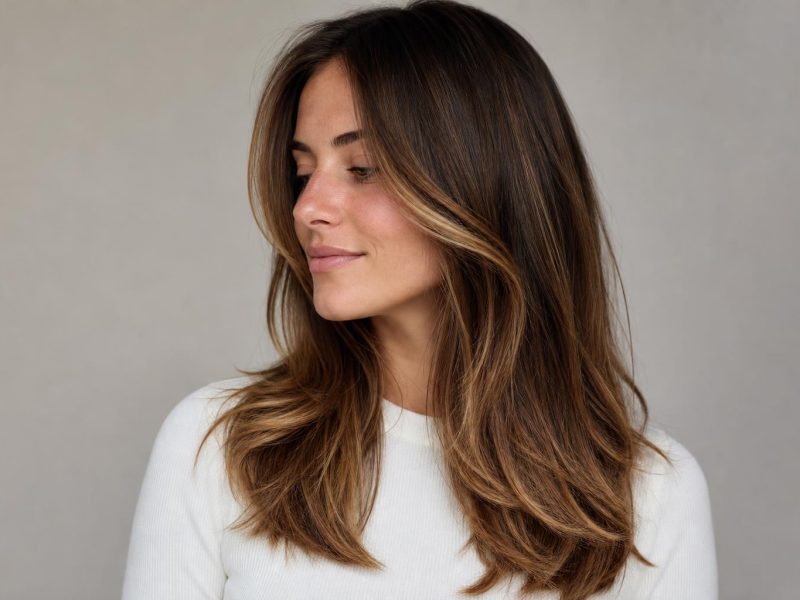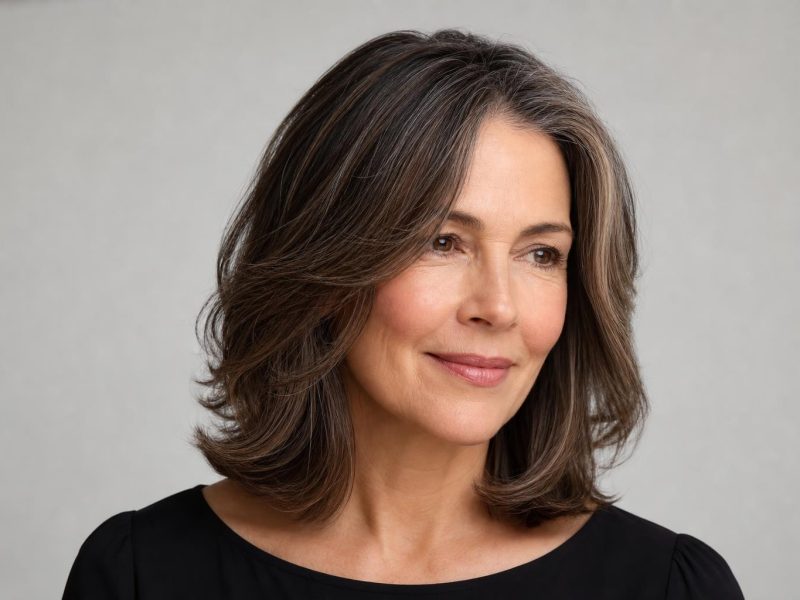

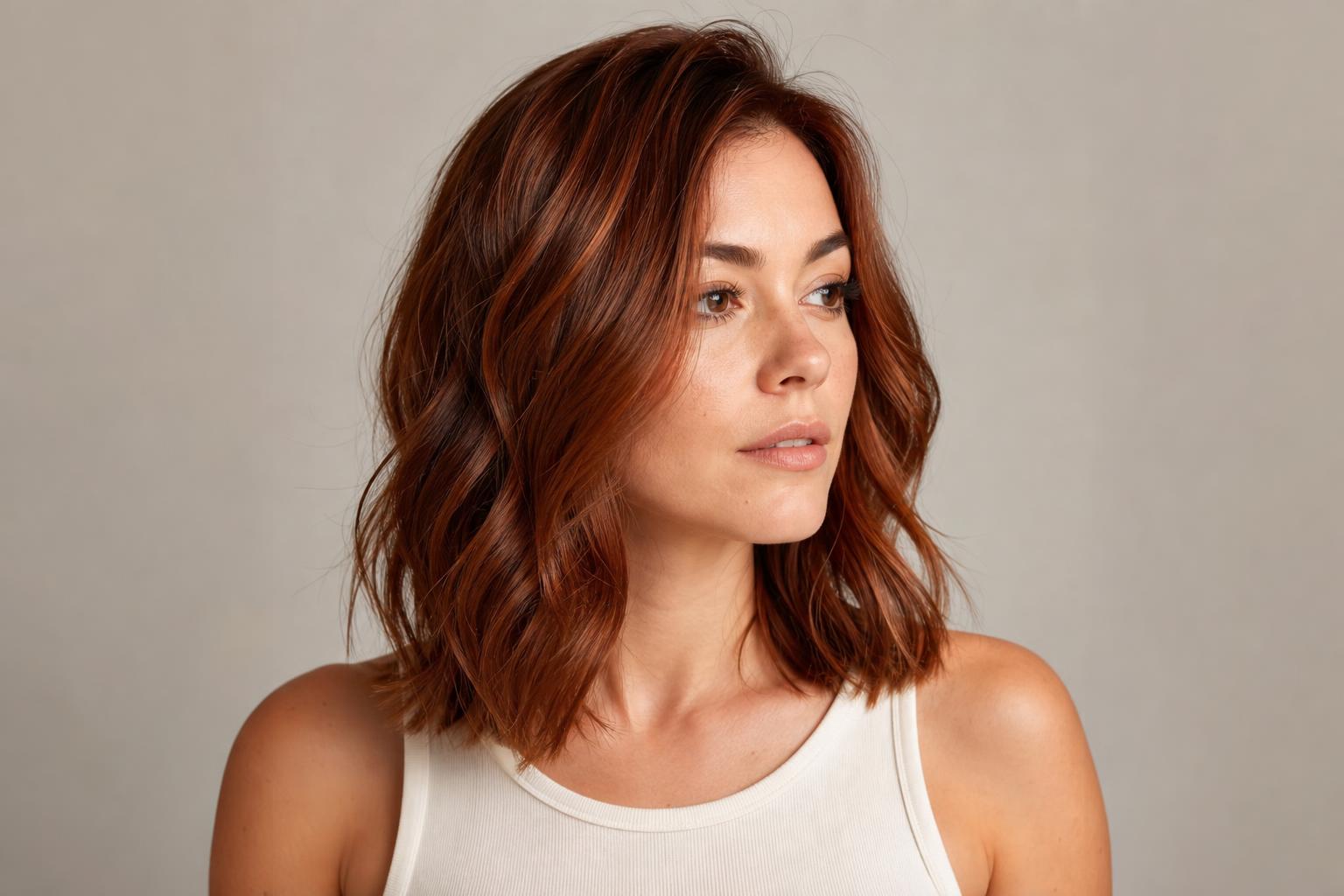
Auburn is the shade most people get wrong at the shop counter, because it is not a red and it is not a brown but a specific ratio of the two that only holds at certain depths.
Auburn hair color is a red-brown that lives between level 4 and level 7 on the professional depth scale, roughly medium brown through light brown, with enough red pigment to read as warm in daylight and enough brown to stay believable indoors. Take it lighter than level 7 and it becomes strawberry blonde. Take it darker than level 4 and the red disappears into near-black under anything but direct sun.
This guide covers what separates auburn from copper and mahogany, how to choose a shade by your undertone rather than by a swatch, what your colorist has to do depending on where your hair starts, why the color fades faster than any brunette shade, and what the upkeep genuinely costs in time and appointments.
| Factor | Details |
|---|---|
| Depth range | Level 4 to level 7, medium brown through light brown |
| Best for | Natural level 5 to 7 base hair; warm and neutral undertones most easily |
| Salon time | 90 minutes for a single process; 3 hours if lifting is needed first |
| Avoid if | You wash daily, swim regularly, or want under 4 salon visits a year |
| Refresh cycle | Gloss every 6 to 8 weeks; full color every 10 to 12 |
Auburn Sits Between Red and Brown on the Depth Scale
Professional color uses a two-part code: a number for depth and a letter or second number for tone. Depth runs from 1 at black to 10 at the lightest blonde, and auburn is defined by holding a red-orange tone at a medium depth. That is the whole definition. A colorist mixing auburn is choosing a level 5 or 6 base and adding a red-copper reflect, not reaching for a single tube marked auburn.
The confusion in most online guides comes from treating auburn, copper, ginger and mahogany as interchangeable words for red-brown hair. They are different tones at different depths, and asking for the wrong one is the most common reason people leave a salon with a color they did not picture. If the numbering system is new to you, our explainer on how hair color levels work covers the scale in full.
| Shade | Level | Dominant Tone | How It Differs from Auburn |
|---|---|---|---|
| Auburn | 4 to 7 | Red over a brown base | The reference point |
| Copper | 6 to 8 | Orange | Brighter and lighter, with no brown underneath |
| Ginger | 7 to 9 | Warm orange-gold | Lighter again, closer to natural redhead coloring |
| Mahogany | 3 to 5 | Red-violet | Cooler and deeper, with a purple cast rather than orange |
| Strawberry blonde | 8 to 9 | Pale gold-red | Too light to hold a brown base at all |
Stylist tip: Bring a photo taken in daylight, never one taken in a salon or a studio. Red-based color shifts more between light sources than any other family, and a mahogany that looks like auburn under warm indoor bulbs will look distinctly purple in the street.
Your Undertone Decides Which Auburn Works, Not Your Hair Color
Skin undertone is the reliable predictor here, and it is separate from how light or deep your skin is. Check the inside of your wrist in natural light: veins reading green indicate a warm undertone, veins reading blue or purple indicate cool, and a mix of both indicates neutral. The rule that follows is not the one most articles give, which is to match warm with warm. Matching exactly can leave warm skin looking flushed, so the more useful guidance is to match the temperature and then adjust the depth for contrast.
Warm Undertones Take Copper-Leaning Auburn Best
Golden and peach undertones carry a copper-heavy auburn at level 6 or 7 without competing with it, because both the skin and the hair sit on the same side of the color wheel. Going too deep here flattens the effect and makes the skin look sallow by contrast. If your skin is warm and you want depth rather than brightness, ask for a level 5 auburn with a copper reflect rather than a level 4 with a red one.
Cool Undertones Need a Red-Violet Auburn to Avoid Clashing
Blue and pink undertones sit opposite orange on the color wheel, so a copper-heavy auburn will pull the pink forward in the skin and read as redness in the face. A cooler auburn with a red-violet reflect at level 4 or 5, closer to the mahogany end, gives the contrast without the clash. This is the version that suits porcelain and cool deep skin equally.
Neutral Undertones Have the Widest Range
If your wrist veins read as a mix and you can wear both gold and silver jewelry comfortably, any auburn between level 4 and 7 will work on you. Choose by contrast instead: a deeper auburn against light skin makes a strong statement, while a level 6 or 7 close to your natural depth is the low-commitment version that grows out invisibly.
Deep Skin Tones Carry the Richest Auburns
Deeper skin holds a level 4 or 5 auburn with more saturation than lighter skin can, because there is enough depth in the complexion to balance a highly pigmented color. The mistake to avoid is choosing a level that is too close to your natural hair depth, which loses the red entirely under most lighting. Ask for the red to be placed through the mid-lengths and ends rather than at the root, which keeps the color visible without a heavy line at the regrowth.
What Your Colorist Does Depends on Where Your Hair Starts
Auburn is a deposit color, which means the red pigment is added to your hair rather than lifted out of it. That makes it one of the more forgiving color changes, but the starting point still determines how many steps the appointment takes and how much it costs. Three scenarios cover almost everyone.
Dark Brown Hair Needs Lifting Before Auburn Shows
On a natural level 3 or 4, adding red pigment produces almost no visible change, because there is not enough light passing through the strand for the red to reflect. Your colorist will lift one to two levels first, usually with a low-volume developer, then deposit the auburn on the lifted base. Budget three hours and expect the result to look richer in sunlight than under indoor lighting for the first few weeks.
Blonde and Highlighted Hair Grabs Red Unevenly
Previously lightened hair is porous, and porous hair absorbs red pigment fast and unevenly, so the ends can end up two shades deeper than the roots. A filler step, where the colorist deposits a warm gold base before the auburn goes on, is what prevents that patchiness. Skipping the filler is the single most common cause of auburn turning muddy on blonde hair, and it is worth asking directly whether one is being used.
Gray Hair Needs a Pre-Pigment Step to Hold Auburn
Gray strands have no remaining pigment and a tighter cuticle, so they resist red more than any other hair type and can come out translucent pink instead of auburn. Pre-pigmenting with a warm base before the target shade gives the red something to bind to. Coverage on more than 50 percent gray also fades faster, so the refresh cycle shortens to around six weeks.
Stylist tip: Ask for a strand test if you have any previous box color on your hair, particularly a dark one. Box dye deposits more pigment than salon formulas and layers unpredictably, so a strand test costs ten minutes and prevents the two-session color correction that otherwise follows.
Auburn Fades Faster Than Brunette for a Reason Worth Knowing
Red-based color loses its intensity faster than any other family, and the usual explanation given in salons and blog posts is that the red molecule is too large to stay inside the hair shaft. The research points the other way. Work published in the International Journal of Cosmetic Science on hair color fading during shampoo washing found that fading is driven by how readily a dye dissolves in water, and that red shades are both comparatively small in molecular size and more water soluble than other dye classes. Small and soluble is what lets them rinse out, not size alone.
The practical consequence is that every variable which increases water contact and cuticle swelling costs you color: hot water, frequent washing, sulfate surfactants, chlorine and UV exposure. It also explains why a color-depositing conditioner works so well on auburn specifically. You are not repairing anything, you are putting back the soluble pigment that the last few washes carried away, which is why the effect is immediate and why it needs repeating.
Practical version: wash two or three times a week rather than daily, use cool water for the final rinse, choose a sulfate-free formula, and wear a hat in strong sun. Those four habits are worth more to an auburn than any single salon treatment. If your color has already shifted orange rather than simply faded, the fix is tonal rather than habitual, and our guide to correcting brassy tones covers it.
Common Auburn Hair Color Myths
Auburn attracts more folk wisdom than most shades, partly because it behaves differently from the browns people are used to. Four claims come up repeatedly and are worth addressing directly.
Myth: Auburn Only Suits Pale Skin and Freckles
Reality: This comes from associating auburn with natural redheads rather than with the color itself. Auburn works across every skin depth, and deeper skin tones carry the saturated level 4 and 5 versions better than fair skin does. What matters is undertone temperature, not how light or deep the skin is.
Myth: You Have to Bleach Your Hair to Go Auburn
Reality: Auburn deposits pigment rather than removing it, so most people at a natural level 5 or above need no lightening at all. Only naturally very dark hair needs a lift, and that is usually one or two levels with a low developer rather than bleach. Anyone offering to bleach level 6 hair before an auburn is overworking it.
Myth: Red Shades Damage Hair More Than Other Colors
Reality: The damage comes from lifting, not from the red pigment, and auburn typically involves less lifting than going blonde. A deposit-only auburn on unbleached hair is one of the gentler color services available. Where auburn does cost you is in appointment frequency, not in condition.
Myth: A Box Dye Marked Auburn Will Match the Photo on the Box
Reality: Box formulas are mixed for an assumed starting level, usually a mid brown, and the printed result only appears if your hair happens to match that assumption. On lighter hair the same box comes out several shades brighter than pictured, and on darker hair it barely registers. The photo shows the dye, not your outcome.
Maintenance and Upkeep
Auburn asks for more salon visits than a brunette shade and fewer than a blonde, and most of the upkeep happens at home between appointments. The numbers below assume a level 6 auburn on hair with no gray and washing three times a week. Add roughly two weeks of urgency to every line if you have significant gray coverage or wash daily.
| Task | Frequency | What It Does |
|---|---|---|
| Full color or root touch-up | 10 to 12 weeks | Covers regrowth and resets the depth |
| Salon gloss or toner | 6 to 8 weeks | Restores the red reflect without touching depth |
| Color-depositing conditioner | Every 1 to 2 weeks | Replaces pigment lost to washing between salon visits |
| Sulfate-free shampoo | Every wash | Slows the dissolution that drives fading |
| Bond or protein treatment | Every 3 to 4 weeks | Keeps the cuticle closed so pigment stays put |
| UV protection spray | Daily in summer | Limits the sun bleaching that turns auburn brassy |
One structural change is worth considering if the schedule feels heavy. Asking for a softened root rather than a solid one, so the color starts a shade deeper at the scalp and blends down, stretches the regrowth window from ten weeks to closer to fourteen. The technique behind it is covered in our piece on shadow rooting for lower-maintenance color.
What to Tell Your Colorist
The word auburn on its own leaves too much room, so give a level and a tone direction instead. A complete request sounds like “a level 6 auburn with a copper reflect, deposit only, no lift at the root,” or “a level 5 auburn leaning red-violet rather than orange.” Naming the reflect is what separates the version you pictured from the one you are describing.
Three questions are worth asking in the consultation. Ask whether you need a filler, which matters if you have any previous lightening. Ask how many levels of lift the plan involves, since a deposit-only service and a two-level lift are different appointments with different aftercare. Ask what the color will look like at week eight, not just on the day, because the fade direction is the part you live with longest. Anyone considering the deeper end of the range should also look at dark red shades, which overlap with auburn at level 4.
FAQ
What Is the Difference Between Auburn and Copper Hair?
Auburn has a brown base with red laid over it, while copper is a straight orange tone with no brown underneath. Auburn also runs deeper on the level scale, typically 4 to 7 against copper at 6 to 8. In practice auburn looks more like natural hair in low light, and copper stays visibly bright in almost any lighting.
Will Auburn Hair Color Suit Me If I Have Cool Skin?
Yes, provided you choose a cooler auburn rather than a copper-leaning one. A level 4 or 5 with a red-violet reflect gives cool undertones contrast without pulling pink forward in the skin. The versions to avoid are the golden and copper auburns that suit warm undertones, since those are what create the flushed effect people blame on the color family as a whole.
How Long Does Auburn Hair Color Last?
A salon auburn holds its full intensity for around four to six weeks and stays wearable for ten to twelve before the regrowth and the fade both become obvious. Washing frequency moves that range more than anything else, since the pigment is water soluble. A gloss at week six roughly doubles the time before a full color is needed.
Can I Go Auburn Without Damaging My Hair?
If your natural level is 5 or lighter, yes, because the service is deposit-only and involves no lightening. Naturally dark hair needs one or two levels of lift first, which does open the cuticle, though far less than a blonde service. A bond treatment at the time of coloring and every three to four weeks afterward keeps the condition steady.
Why Did My Auburn Turn Orange?
Because the red pigment washed out faster than the underlying warm base it was sitting on, leaving the orange behind. This is normal fade behavior rather than a mistake by your colorist, and it happens sooner with hot water, daily washing and sun exposure. A red-toned color-depositing conditioner corrects it at home, and a salon gloss resets it fully.
Is Auburn a Good Choice for Covering Gray?
It covers gray well but needs a pre-pigment step, since gray strands have no base pigment for red to bind to and can turn out pink without one. Coverage also fades faster on gray than on pigmented hair, so plan on a six week rather than a ten week cycle. Ask your colorist to confirm they are pre-pigmenting rather than applying the target shade directly.
What Auburn Shade Should I Ask For If I Am Unsure?
A level 6 auburn with a soft copper reflect is the safest starting point, because it is close enough to most natural mid-brown bases to grow out gracefully and light enough for the red to be visible. Go deeper next time if you want more saturation. Starting deep and lightening later is the harder direction, since removing deposited red takes a color correction rather than a single appointment.
Choosing an auburn hair color is really two decisions rather than one: the depth, which controls how visible the red is and how gracefully it grows out, and the reflect, which decides whether the shade sits warm against your skin or cool against it. Get the level right for your natural base and the tone right for your undertone, then treat the fade as a scheduled maintenance item rather than a surprise. For a softer, lighter version of the same family, our look at golden auburn covers where the shade lands above level 7.
Hair results vary based on your natural hair type, texture, density, and condition. Always consult with a licensed hairstylist before making significant changes, especially with chemical treatments or dramatic length changes. Photos may show styled results that require professional tools and products to replicate.