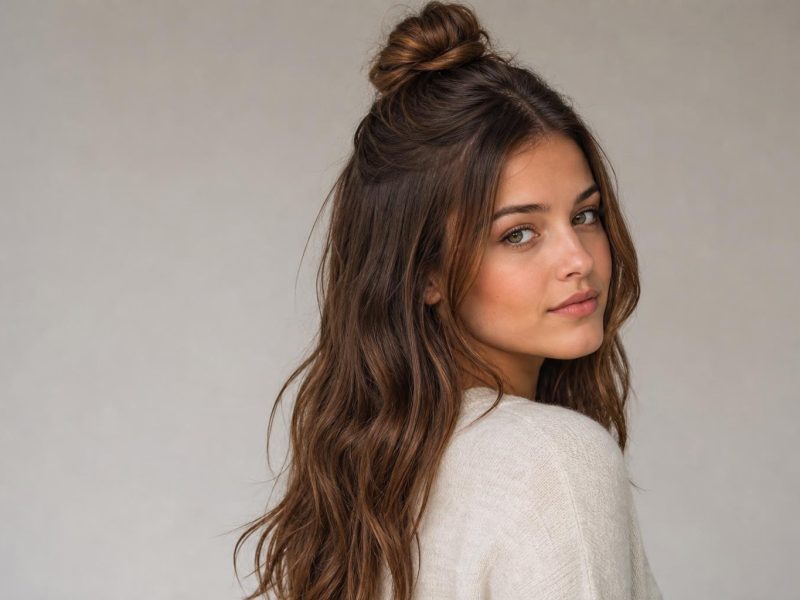


Soft layers, face-framing feathers, and a collarbone-length lob make the kitty cut the most wearable layered trend of 2026.
The kitty cut is a lob sitting between the shoulders and collarbone, defined by fine face-framing layers that feather toward the ends rather than chop through the mid-lengths. Unlike the wolf cut, which relies on heavy contrast between short crown layers and a longer perimeter, the kitty cut blends everything into a rounder, softer silhouette that works equally well air-dried or blow-dried to a polish. The 25 styles below are organized by variation and hair type, with guidance on face shapes, stylist language, and maintenance.
The gallery covers the full kitty cut range: the classic collarbone lob with feathered ends, curtain-bang versions, color-enhanced editions, and adaptations for straight, wavy, fine, and coarser hair. Guidance sections at the end cover face shape compatibility, how the kitty cut compares to its closest relatives, and exactly what to say at the salon.

| Factor | Details |
|---|---|
| Best for | Fine to medium hair; all face shapes; straight to wavy texture |
| Maintenance | Trim every 6–8 weeks; daily styling 5–10 minutes |
| Works with | Shoulder-to-collarbone length; straight, wavy, or lightly textured hair |
| Avoid if | Very thick coarse hair without internal thinning; very coily 4b–4c curl patterns |
| Salon time | 45–75 minutes for the cut; add 45–90 minutes for highlights or balayage |
Classic Kitty Cut: The Feathered Collarbone Lob
The base version of the kitty cut sits at collarbone length, with layers starting at cheekbone level and ending in razor-feathered tips. No curtain bangs, no color treatment, just the structural layering that defines the style. These eight entries cover the core cut across different hair textures and styling approaches.
1. Razor-Feathered Collarbone Lob
Razor-feathered ends are the structural signature of the kitty cut: the stylist works in small sections and skims the final inch of each strand with the razor, creating tips that reflect light and move independently rather than hanging as a blunt curtain. The result is a collarbone-length lob with a lived-in quality that no amount of texturizing spray fully replicates on a blunt cut.
2. Soft Kitty Cut for Oval Faces
Oval faces take this cut at any length within the kitty cut range — collarbone, slightly above, or slightly below — because balanced proportions do not need correcting in any direction. The face-framing layers draw attention to the cheekbones, flattering most faces but working particularly cleanly on oval shapes where there is no imbalance to address.
3. Fine-Hair Kitty Cut with Layered Mid-Lengths
Fine hair often collapses under heavy layering, but the kitty cut threads that needle: enough layers to create movement, not so many that the ends look thin and wispy. Layers on fine hair should start below the cheekbone and angle toward the face, concentrating weight at the perimeter and keeping fine hair looking full rather than sparse at the bottom of the cut. A volumizing mousse on towel-dried roots before blow-drying adds body without stiffening the feathered ends.
4. Blow-Dried Polished Kitty Cut
Achieve this smooth, slightly inward-curled version with a medium round brush and a blow-dryer: work in sections from the nape upward, rolling the brush toward the neck and holding for five seconds before releasing. One pump of smoothing cream through towel-dried hair beforehand controls frizz without weighing down the feathered ends.
5. Graceful-Grow-Out Kitty Cut
Grow-out on a kitty cut is more forgiving than on a wolf cut or a choppy shag; the feathered layers blend into each other as they lengthen rather than creating an obviously outgrown crown that flops or lifts. At weeks 7–8, the face-framing pieces tend to lose their shape before the rest of the cut does; trimming just those sections can extend the overall style to 10–12 weeks. Most salons charge $15–$25 for a quick face-framing refresh.
6. Kitty Cut with Honey Balayage
Honey-blonde balayage painted through the mid-lengths and ends echoes the feathered layering; both the color and the cut build dimension through movement rather than through blunt contrast. The face-framing sections benefit from slightly brighter pieces, which draw attention to the feathered tips where they frame the jaw and cheekbones. On natural brunette bases, this combination is one of the lower-maintenance color options because the balayage grows out without a hard root line.
7. The Salon-Ready Kitty Cut Request
Bring a reference photo and ask specifically for “feathered ends on a collarbone lob — razor-cut tips, not point-cut, with face-framing layers starting at cheekbone level.” The distinction between razor and point-cut matters: point-cutting produces a slightly choppier edge that reads as wolf cut territory, while the razor creates the finer, softer feather that defines the kitty cut. Confirm the layers are cut to fall forward toward the face rather than sweeping back.
8. Kitty Cut vs. Standard Collarbone Lob
A collarbone lob at the same length hangs heavier and flatter — same base length, but without the face-framing layering and feathered ends that give the kitty cut its softness and movement. For hair that has natural body and volume, a plain lob is the simpler choice; the kitty cut earns its extra 20 minutes in the chair for hair that needs lift, separation, and a shape that actively frames the face.
Kitty Cut with Curtain Bangs
Curtain bangs are the kitty cut’s most common companion, completing the face-framing effect that the feathered layers start at the cheekbones. These eight entries cover the curtain-bang variations: different weights, lengths, and behavior across hair types, from a barely-there fringe to a chunkier center-parted version with real presence.
9. Chunky Curtain-Bang Integration
Curtain bangs on a kitty cut tend to run heavier than the wispy curtain bangs associated with 1970s-inspired styling, they sit closer to a center-parted fringe graduated to fall on each side of the face rather than hanging straight across. The seamless blend from bang into face-framing layer is what distinguishes this from a bob with bangs simply tacked on; the stylist treats bang and face-framing as one continuous piece.
10. Curtain-Bang Kitty Cut for Round Faces
Round faces benefit from the curtain-bang version because the center part creates a vertical division across the face, the bangs frame the forehead, and the longer face-framing layers on either side build a narrowing visual line. Keep the bang length to eyebrow-grazing rather than letting it grow toward nose level, which adds visual width instead of removing it. The combination of vertical emphasis and cheekbone framing does more work here than most styling adjustments.
11. Wavy-Hair Curtain-Bang Kitty Cut
Medium-density wavy hair takes to this version naturally because the wave pattern lifts and separates the curtain bangs without product, and the feathered ends ride the texture rather than fighting it. The same waviness that makes a blunt lob look poufy and untamed works with the kitty cut’s layering, the layers give each wave somewhere specific to fall rather than all landing on top of each other.
12. Styling Curtain Bangs at Home
Curtain bangs need direction to find their shape, air-drying without any guidance often sends them in two different directions. Use a fine-tooth comb and a light hold spray to set the center part while the bangs are still damp, then diffuse or blow-dry the rest of the hair while the bangs fall naturally into the part. Once the held center line sets, the feathered ends of the bang frame the face without further effort; for more on this technique, the guide on soft curtain bangs covers the styling steps in detail.
13. Bang-Specific Maintenance Scheduling
The curtain-bang version needs the fringe trimmed every 5–6 weeks even if the rest of the cut can stretch to 8 weeks, bangs grow over the eyes noticeably faster than the perimeter length does. Ask your stylist to schedule a quick bang trim between full appointments; most salons offer this for $10–$20, far less than the full service.
14. Babylights Through the Curtain-Bang Section
Fine babylights placed through the curtain-bang section brighten the area around the eyes without a dramatic color change, the pale, subtle highlights read as natural sun-lightening on almost any base shade. Through the rest of the kitty cut, keeping the color richer than the bang section adds depth that makes the lighter face-framing pieces stand out further.
15. What to Ask for with Curtain Bangs
Ask for “chunky curtain bangs, center-parted, graduated so they frame the face rather than hanging straight down.” Adding “blend the bang seamlessly into the face-framing layers, no hard line between them” ensures the curtain reads as one integrated piece rather than a fringe tacked onto a lob. Confirm the bang length sits at eyebrow level so they have a few weeks to grow before becoming a distraction.
16. Curtain-Bang Kitty Cut vs Butterfly Cut
The butterfly haircut and the curtain-bang kitty cut share the same center-parted framing logic, but the butterfly cut builds visible crown height through layers that flip upward, while the kitty cut maintains a flatter, smoother crown and concentrates movement at the face-framing pieces. For readers who want the curtain-bang framing without the crown volume and daily restyling, the kitty cut is the lower-maintenance choice.
Kitty Cuts for Every Hair Type
The kitty cut adapts across hair types through technique adjustments rather than structural changes. Fine hair needs lighter internal layers and a more conservative perimeter treatment; wavy hair can air-dry into the cut’s shape naturally; thick hair needs internal bulk removal to prevent the silhouette from widening at the ends.
17. Thick Hair with Internal Bulk Removal
Thick hair needs the kitty cut’s feathering done through internal removal rather than surface layering alone: the stylist uses thinning shears or a razor inside the mid-section to reduce bulk while leaving the outer silhouette smooth and rounded. Without that internal work, the feathered ends on thick hair tend to flare outward rather than fall softly, replacing the rounded kitty cut shape with a triangular one.
18. Kitty Cut for Heart-Shaped Faces
Heart-shaped faces, wider at the forehead and narrowing toward the chin, benefit from collarbone-length kitty cuts where the face-framing layers add fullness at the jaw. On a heart face, those layers should start lower than the cheekbone, closer to jaw level, building visual volume where the face is narrowest rather than at the cheekbones where the face is already widest. Avoid jaw-length or shorter versions, which leave the narrower chin without framing.
19. Air-Dried Wavy Kitty Cut
Wavy hair in the 2a–2c range creates the most effortless air-dried kitty cut because the wave pattern naturally curves the ends inward and separates the layers into distinct pieces. A small amount of curl-enhancing cream worked through damp ends, then hands-off drying, produces the soft textured result without any heat. Leave it completely alone while drying; scrunching wet waves causes frizz.
20. Diffused Texture on Lightly Wavy Hair
Attach a diffuser to the blow-dryer and use low heat with low airflow to dry the kitty cut without disrupting the wave pattern: hold sections of hair in the diffuser cup and move upward in small pulses rather than side-to-side. The diffuser lifts the layers and dries them with the wave intact rather than blowing it flat.
21. Low-Product Daily Maintenance Routine
Between washes, a sea-salt texturizing spray is the lowest-effort way to refresh the kitty cut’s layered movement without a full wash-and-style cycle. Spray lightly through the mid-lengths and ends, scrunch once, and leave alone, the salt content adds grip and separates the feathered layers into soft individual pieces.
22. Lived-In Color for the Kitty Cut
A root-melt or shadow-root technique works particularly well with this cut because the color shifts where the layers shift, both the color and the cut look naturally effortless rather than deliberately constructed. The feathered ends read lighter at the tips, which amplifies the face-framing effect without a distinct highlight pattern that needs regular touch-ups. Most shadow-root colorings stay fresh for 10–14 weeks before the color boundary starts to look dated.
23. Fine-Hair Stylist Communication
Fine-haired clients should specify “no razor on the perimeter, feathered ends through the layers only, perimeter kept blunt or lightly point-cut.” Razor cutting the outer edge of very fine hair removes too much limited density and produces see-through tips that no styling product can correct. The feathering work should stay inside the face-framing layers, keeping the perimeter holding enough weight to look full.
24. Shorter Kitty Cut vs Full Collarbone Length
A jaw-length version reads closer to an airy bob than to the standard kitty cut, both share feathered face-framing layers, but the longer collarbone length gives those layers more room to graduate and creates a more complete visual frame for the face. Going collarbone rather than jaw keeps the cut clearly in kitty cut territory; the jaw-length version is softer than a standard bob but lacks the full face-framing drape of the longer style.
25. Coarse Hair Kitty Cut
Lightly coarse or medium-coarse hair needs the perimeter finished with a razor or thinning shears rather than scissors, a point-cut edge on coarser strands can look slightly bristly rather than softly feathered. A smoothing serum worked through damp ends before blow-drying tames the coarser texture without flattening the layered movement the cut was built to produce. Ask the stylist to “razor the face-framing layers and the tips, not scissors on the ends.”
What the Kitty Cut Actually Is
The name came from the feline quality of the movement: layers that fall forward, a face-narrowing shape, and feathered ends that separate like individual strands rather than clumping. Structurally, it is a razor-feathered lob where the internal layering angles toward the face rather than away from it or straight down.
The key technical distinction is the feathering approach. The stylist uses a razor or thinning shears on the final inch of the face-framing layers and the perimeter to create fine, light tips. This differs from both the wolf cut (where layers create visible contrast between a short textured crown and a longer perimeter) and a standard layered lob (where layers are cut with scissors and sit slightly thicker at the ends). The kitty cut’s result is smoother and rounder than either.
Stylist tip: The razor technique works best on dry or nearly-dry hair, wet hair shrinks significantly as it dries, and the feathering effect reads differently on damp versus dry strands. If your stylist cuts entirely wet, ask whether they will check the dry result before you leave the chair.

Kitty Cut vs Wolf Cut vs Shag
These three layered styles share a length range and are frequently confused because all three use some form of internal layering. The differences are in the contrast between crown and perimeter, the silhouette shape, and how much daily effort each requires to look intentional.
| Feature | Kitty Cut | Wolf Cut | Layered Shag |
|---|---|---|---|
| Layer contrast | Low, blended, smooth silhouette | High, short crown, long perimeter | Medium, graduated, softer than wolf |
| Defining feature | Razor-feathered ends, forward-falling layers | Heavy crown texture, choppy perimeter | Graduated layers, textured mid-lengths |
| Best hair type | Fine to medium; straight to wavy | Medium to thick; wavy to curly | Medium to thick; wavy to curly |
| Daily styling | 5–10 min; blow-dry or air-dry | 10–20 min; texturizing product needed | 5–15 min; diffuser or texturizing spray |
| Grow-out | Graceful, 6–10 weeks between trims | Shows quickly, 5–7 weeks to stay sharp | Very forgiving, 8–12 weeks |
The practical shorthand: the kitty cut is the most polished of the three; the shag is the most relaxed; the wolf cut sits between them but requires the most upkeep to look intentional rather than overgrown. A side-by-side in the layered bob vs choppy bob guide can also help narrow down the right cut for readers deciding between sharper and softer versions at this length.
Face Shape Compatibility
The kitty cut flatters most face shapes because the face-framing layers are adjustable, the starting point, length, and density of those layers can be tuned for each face. The general rule is that the layers should frame what needs framing and add length or visual weight where the face is narrowest.

| Face Shape | Best Version | Key Adjustment | Avoid |
|---|---|---|---|
| Oval | Any variation; most versatile for this cut | None needed; cheekbone-level layers work | Nothing to avoid |
| Round | Curtain-bang version at collarbone length | Center part; bang at eyebrow level; layers angled to elongate | Chin-length with center part (adds width) |
| Square | Softly feathered collarbone lob with side part | Layers starting slightly above the jaw to soften the angle | Very blunt ends that emphasize a square jaw |
| Heart | Collarbone lob with layers starting at jaw level | Lower layer start point to build jaw volume | Short versions that leave the narrow chin exposed |
| Oblong | Curtain bangs plus collarbone length | Eyebrow-length bangs break up a long vertical line | Very long lob versions without bangs (further elongate) |
What to Tell Your Stylist
The kitty cut is specific enough that a general “layered lob” request will not produce the right result, the face-framing direction and the razor feathering both require explicit instruction. Give your stylist the following language so there is no guesswork.
The complete request: “Collarbone-length lob, face-framing layers starting at cheekbone level and angled toward the face, razor-feathered ends, not point-cut, not scissors on the tips. Smooth crown, no heavy crown layering, layers blended so there is no visible weight line mid-length.”
With curtain bangs: add “chunky curtain bangs, center-parted, graduated to fall on either side of the face, blended into the face-framing layers without a hard separation line.”
Stylist tip: Bring two reference photos rather than one, a front-facing shot to show the face-framing shape and a side-angle shot to show how the ends feather. Natural-light photos where the texture of the feathered tips is visible are far more useful than dimly lit bathroom mirror shots where everything looks smooth and blunt.
When a Kitty Cut Is Not the Right Choice
The kitty cut works across most face shapes and hair types, but there are specific situations where it underperforms and a different cut serves the reader better.
- Very thick, dense hair without internal thinning: The feathered ends need bulk reduction inside the mid-section to fall softly. Without it, the cut triangles out and the face-framing layers lose their shape. If internal thinning is not part of the stylist’s approach, a textured lob or a structured layered bob is a more predictable alternative.
- Coily 4b–4c hair: The razor-feathering technique is designed for straight-to-wavy textures. On tightly coiled hair, shrinkage significantly alters the final silhouette and the feathering becomes invisible within the curl pattern. A specialized curly cut built for 4b–4c hair produces far better results at this length.
- Very fine hair with significant thinning: The face-framing layers remove weight at the areas where fine hair most needs it. If your hair is already thinning noticeably, a blunt or one-length lob preserves more visible density. The kitty cut suits fine hair that has enough density to spare a little weight at the ends without looking sparse.
- Minimal daily styling preference: The kitty cut looks best with at least minimal direction, either diffusing for natural texture or a quick blow-dry for polish. If you regularly air-dry and never touch it afterward, the cut can look slightly unfinished. A shag lob is more forgiving on genuine no-effort days.
Maintenance and Styling
The kitty cut sits in a reasonable maintenance window compared to other layered styles at this length, less frequent visits than a wolf cut requires, slightly more attentive than a basic lob.
| Aspect | Details |
|---|---|
| Trim frequency | 6–8 weeks for the full cut; 5–6 weeks if curtain bangs are included |
| Daily styling time | 5–10 minutes with blow-dryer; 0–5 minutes for air-dry on wavy hair |
| Key products | Smoothing cream (fine hair), curl-enhancing cream (wavy), sea-salt texturizing spray (refresh) |
| Tools | Medium round brush (polished finish), diffuser attachment (wavy texture), fine-tooth comb (curtain bang direction) |
| Grow-out behavior | Graceful, face-framing layers blend as they lengthen; ends stay relatively soft rather than blunt |
A 1.25-inch barrel curling iron used on the mid-lengths only, leaving the last two inches straight, adds a soft wave without curling the feathered tips into tight ringlets. A large flat iron with a slight inward roll at the ends gives the polished version its signature inward flip. Heat protectant is non-negotiable before either tool: the razor-feathered ends are finer than the rest of the strand and dry out faster under direct heat.
Stylist tip: A boar-bristle round brush distributes product more evenly through the hair than a plastic paddle brush and creates a smoother finish on feathered ends without snagging the lighter tips. On the kitty cut, where the ends are deliberately thinned, a plastic brush tends to catch and pull rather than glide.
FAQ
What exactly is a kitty cut and how is it different from a lob?
A kitty cut is a lob with specific razor-feathered ends and forward-falling face-framing layers, a standard lob can be cut with scissors without those face-framing elements, whereas the kitty cut’s defining detail is the feathering at the tips and the cheekbone-level layering that actively frames the face. The length range overlaps entirely (shoulder to collarbone), so the difference is in technique and structure rather than length.
Does the kitty cut work on fine hair?
Yes, but with one specific adjustment: on fine hair, the perimeter should be kept blunt or lightly point-cut rather than razor-cut all the way through. Too much razor work on fine perimeter hair produces see-through ends that look thin rather than feathered. The face-framing layers at the cheekbones can still be razor-feathered; the restriction applies to the outermost edge where the remaining weight matters most for visible density.
How long does a kitty cut take to grow out awkwardly?
The kitty cut grows out more gracefully than the wolf cut because there is no short crown layer to grow past the ears or the nape awkwardly. The face-framing layers lose their defined shape around weeks 7–8 but simply look like a slightly longer lob rather than an obviously outgrown cut. A quick trim of just the face-framing pieces at week 8 extends the overall style without requiring a full appointment.
Can I get a kitty cut if I have curly hair?
The kitty cut works on wavy hair (2a–2c) and lightly curly hair (3a) where the texture enhances the layering rather than fighting the feathering technique. On tighter curl patterns (3b–4c), the razor-feathering changes significantly with shrinkage and the face-framing layers may not fall in the intended direction once fully dry. A curl-specialist stylist can advise on a modified version that works with the specific curl pattern.
What is the difference between a kitty cut and a wolf cut?
The wolf cut has heavy contrast between a short, choppy crown and a longer perimeter, it is deliberately textured, high-volume, and needs product to look intentional. The kitty cut produces the opposite: a smooth, rounded silhouette with blended layers and feathered ends, no visible contrast between crown and perimeter, and lower daily product requirements. Both sit in a similar length range, which is why they are regularly confused despite looking quite different in person.
How much does a kitty cut cost at a salon?
A kitty cut typically costs $60–$120 at a mid-range US salon, similar to a standard layered lob, though the razor work sometimes adds $10–$20 to the base cut price. Color services (balayage, babylights) are priced separately and typically run $100–$250 depending on the technique and location.
The kitty cut earns its place in the 2026 trend conversation not because it is radically new, but because it addresses what heavy-textured cuts like the wolf cut leave behind, a softer, more polished kitty cut hairstyle that works on fine hair, grows out gracefully, and requires less daily effort to look intentional. Bring reference photos to your next appointment, specify the razor feathering and the forward-falling layer direction, and give your stylist the exact language from the What to Tell Your Stylist section above.
Hair results vary based on your natural hair type, texture, density, and condition. Always consult with a licensed hairstylist before making significant changes, especially with chemical treatments or dramatic length changes. Photos may show styled results that require professional tools and products to replicate.