

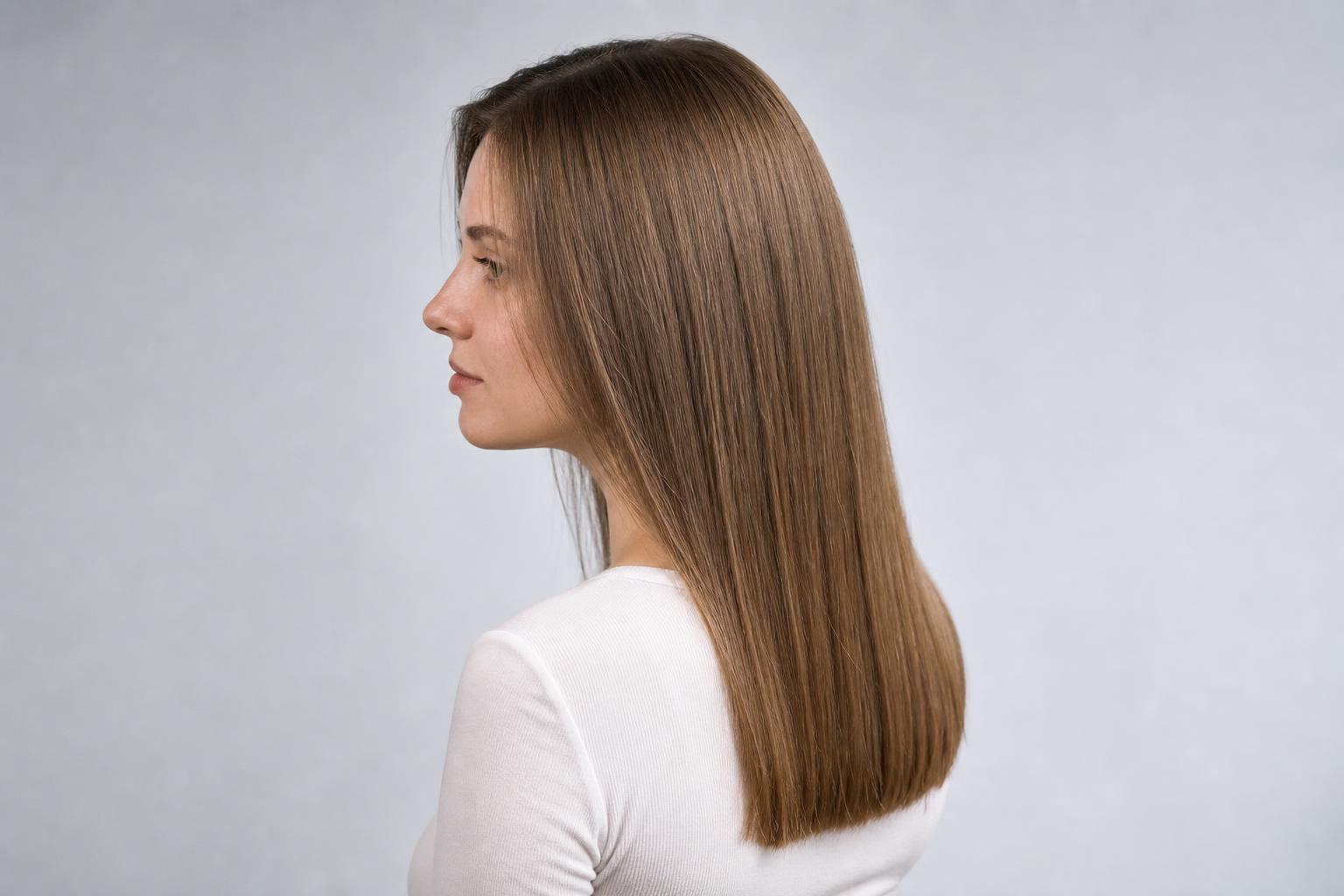
One of these layer types changes how your hair looks, the other changes how it moves, and asking for the wrong one is the most common cause of a haircut that feels off without looking wrong.
Internal layers are cut underneath the top section of the hair, so the outside stays one length and nothing about your silhouette changes. Visible layers are cut through the surface, so you can see where each length starts and stops. Internal layers create movement and lightness inside a shape you already like. Visible layers create the shape itself.
This guide covers what each technique does mechanically, why internal layers are constantly confused with thinning shears, which one your density and texture actually need, how differently the two grow out, and the wording that gets you the right one at the salon. It also covers the situations where internal layers make hair worse rather than better.
| Feature | Internal Layers | Visible Layers |
|---|---|---|
| Where they are cut | Beneath the top section, hidden from view | Through the outer surface of the hair |
| What changes | Weight and movement, not the outline | The silhouette itself |
| Visible when hair is down | No, the perimeter still looks blunt | Yes, the lengths are obvious |
| Best for | Thick hair that feels heavy but looks right | Hair that needs a different shape |
| Risk if done badly | Hollow patches and stringy ends you cannot see coming | Visible steps and a shape that fights your growth |
| Grow-out | Undetectable, weight returns gradually | Noticeable, the shape softens then drops |
| Trim frequency | Every 12 to 16 weeks | Every 6 to 10 weeks |
Internal Layers Are Cut Under the Surface, Visible Layers Cut Through It
Picture your hair as a shell with a filling. The shell is the top section, roughly the outer half inch that everyone sees when your hair is down. Internal layering leaves that shell completely intact and works only on the hair underneath, shortening interior sections so they support the shell from below instead of hanging as dead weight. Visible layering cuts through the shell itself, which is why you can see the lengths in the mirror.
The technique goes by several names depending on where your stylist trained. Invisible layers, interior layers, hidden layers, and internal debulking all describe the same idea, though “internal layers” is the wording most stylists prefer because it does not promise something impossible. The layers are not truly invisible, they are simply positioned where the eye does not land. Knowing a few of these standard salon terms before your consultation saves a lot of back and forth.
Stylist tip: Ask which section your stylist plans to leave out. A properly executed internal layer keeps at least the top half inch of the hair untouched all the way around, and a stylist who cannot tell you where that boundary falls is probably about to cut ordinary layers and call them internal.
Internal Layers Solve Weight Without Touching the Shape
The main job is bulk removal from the inside. Thick hair carries most of its weight in the interior, and that weight is what pulls a blowout flat by lunchtime, makes a ponytail feel like a rope, and turns any wave into a limp bend. Taking length out of the interior sections reduces the load while the surface keeps its clean line, so the hair moves more freely and dries faster without looking any different at rest.
The second job is expansion, which sounds contradictory but is not. Shorter interior sections push against the shell from underneath rather than dragging on it, so the hair holds a little more volume through the mid-lengths. On dense, coarse hair that means a shape that no longer widens at the bottom. Anyone whose cut collapses into a triangle by the second day will recognize the problem, and the fixes in our guide to layered cuts for thick hair nearly all rely on interior removal rather than surface layering.
Visible Layers Do the One Thing Internal Layers Cannot
If you want your haircut to look different, the cutting has to happen where people can see it. Face-framing pieces, a shag, a butterfly cut, and every version of a wolf cut are built from visible layers, because their whole point is a silhouette you can identify from across a room. Internal work is invisible by design, so no amount of it will give you the winged front or the fluffy crown from a photo.
Visible layers also handle a problem internal layers cannot touch, which is a perimeter that is too heavy or too blunt for the effect you want. Breaking up the outline is a surface job. If your goal is the two-tier structure of a modern long cut, that is visible layering with an internal component, and the way to ask for it is spelled out in our guide to requesting a butterfly cut rather than in an internal-layer conversation.
Common Myths About Internal Layers
This technique has picked up a lot of misinformation since it started trending, mostly because the results are hard to photograph. Three claims come up constantly and all three are wrong.
Myth: Internal Layers Are Just Thinning Shears With a Nicer Name
Reality: They are opposites in practice. Thinning shears remove random strands along the entire length, which shortens hairs at scattered points and creates the fuzzy, split regrowth most people know as the frizzy halo. Internal layering removes whole sections cleanly at a chosen length with regular scissors, leaving nothing broken behind. If your stylist reaches for texturizing shears when you ask for internal layers, ask them to use a straight blade instead.
Myth: Internal Layers Add Volume to Fine Hair
Reality: On genuinely fine, low-density hair they usually take volume away. Fine hair needs every strand it has filling out the perimeter, and shortening interior sections leaves fewer hairs reaching the ends. The exception is fine hair that happens to be very dense, where there are enough strands to spare and the technique works well. Density is the deciding factor, not strand thickness, and the distinction is covered further in our guide to layered cuts for thin hair.
Myth: You Cannot See Internal Layers, So There Is No Risk
Reality: Not seeing them is exactly the risk. A badly placed interior layer creates a hollow patch that you will only notice when you tie your hair up, flip your part, or the wind catches it. Because the damage is under the surface, it also cannot be corrected by trimming the ends, so the only fix is waiting for growth. Ask to see the interior in a hand mirror before the blow-dry.
Which Technique Your Hair Actually Needs
Start from the problem rather than the trend. If your hair looks right but feels heavy, the answer is internal. If your hair feels fine but looks flat, boxy, or shapeless, the answer is visible. Very few people need both in the same appointment, and asking for both at once on medium-density hair is how you end up with less hair than you meant to lose.
| Your Situation | What to Ask For | Why |
|---|---|---|
| Thick hair, love the shape, hate the bulk | Internal layers only | Removes the load without disturbing an outline that already works |
| Long one-length hair with no movement | Internal layers plus light face-framing | Adds swing while keeping the blunt perimeter you like |
| Fine, low-density hair that falls flat | Neither, ask for a blunt perimeter | Weight is what makes fine hair look full, so removing it backfires |
| Want a shag, wolf cut, or butterfly cut | Visible layers, internal as support | These shapes exist on the surface and cannot be built underneath |
| Curly hair that widens at the bottom | Internal layers, cut dry | Interior removal narrows the triangle without exposing short curls on top |
| Growing out old choppy layers | Internal layers to blend | Softens the old lines from beneath without shortening anything on top |
Internal Layers Grow Out Without Ever Announcing Themselves
This is the strongest practical argument for the technique. Because nothing was cut on the surface, there is no line to drop, no step to blend, and no awkward middle phase. The interior sections simply lengthen over four to six months, weight returns gradually, and one day you notice your hair feels heavy again. That is your signal to book, not a visible change in the mirror.
Visible layers behave the other way around. The shape is at its sharpest for the first six weeks, softens through weeks seven to ten as the shorter pieces drop, then reaches an in-between phase where the layers have lost their purpose but not yet merged. That difference in upkeep is worth more than most people expect, since it can mean three fewer salon visits a year. The related question of how high on the head those visible layers should start is covered separately in long layers versus short layers.
Stylist tip: Book internal layering as a standalone appointment on hair you already like rather than adding it to a cut where you are also changing the length. Two variables at once makes it impossible to tell which change caused the result you did or did not want.
When Internal Layers Are the Wrong Choice
The technique is genuinely useful and genuinely oversold. Skip it in these situations.
- Your hair is fine and low density, since the interior is already carrying very little and there is nothing to spare.
- Your hair is shorter than shoulder length, because a short shape has almost no interior to work with and the layers surface immediately.
- You are unhappy with the shape of your cut, in which case internal work will not change the thing that is bothering you.
- Your hair has been over-thinned before, where adding more interior removal stacks damage on damage.
- You are seeing a stylist for the first time, since the technique depends heavily on judgment you cannot verify until months later.
There is also a tool question worth raising in the chair. Some stylists create interior layers with a razor, which produces a softer, more feathered end than scissors and behaves very differently on coarse or dry hair. The trade-offs between razor cutting and scissor cutting apply with extra force here, because a razored interior that frays is hidden until it has already caused the frizz you are trying to avoid.
What to Tell Your Stylist
Describe the outcome and let your stylist choose the technique. Useful wording sounds like this, “My hair feels heavy and takes forever to dry, but I like the shape and the blunt ends. Can you take weight out of the interior without changing my outline?” That sentence tells a stylist everything they need, and it protects the perimeter you like at the same time.
Add one specific constraint about tools, since it is the single most common thing to go wrong. Say, “Please use scissors rather than thinning shears.” If you also want a little surface movement, ask for it separately and by name, for example face-framing pieces starting at the jaw, so the two requests do not blur into a generic layering job. More reference shapes are in the women’s haircut collections if you want a photo to point at.
FAQ
The questions that come up most often when people are deciding between the two.
Can You See Internal Layers When Hair Is Up?
Sometimes, and that is the honest answer most articles skip. A ponytail or a bun pulls the interior sections toward the surface, so shorter pieces can show around the elastic or escape at the nape. Well-placed internal layers keep the shortest interior piece long enough to reach a ponytail, so tell your stylist if you wear your hair up most days.
Do Internal Layers Work on Curly Hair?
They work very well on 3a through 3c patterns, where the usual problem is curls stacking on top of each other and widening the silhouette at the bottom. Removing interior bulk narrows that shape while leaving the top curls intact, which keeps definition where it matters. The cut has to be done dry, since shrinkage makes wet placement unreliable on any curl pattern.
How Much Hair Comes Off With Internal Layers?
Nothing comes off your visible length at all, which is the point. Interior sections are typically shortened by two to four inches depending on your total length, but since they live beneath the shell, your outline is unchanged. Ask for the ends to be dusted separately if you also want the perimeter tidied.
Will Internal Layers Fix Frizz?
They can reduce the puffiness caused by too much bulk, but they will not fix frizz caused by damage, porosity, or humidity. If the halo of short broken hairs around your part is your main complaint, that is usually old thinning-shear work growing back rather than a weight problem. A hydrating routine and a blunt perimeter do more for that than any cutting technique.
Are Internal Layers More Expensive Than Regular Layers?
They are usually charged as a standard women’s cut, though the work takes longer because it is done in small sections. Some salons add a bulk-removal charge on very thick hair, so ask when you book. The savings show up in frequency instead, since interior layers hold for three to four months against six to ten weeks for visible ones.
Can I Ask for Both Internal and Visible Layers?
Yes, and on thick hair it is often the best answer, with interior removal handling the weight and a few surface pieces handling the shape. Say which one is doing which job so your stylist can balance them. On medium or fine hair, pick one, because doing both at once removes more than you intended.
The choice between internal layers and visible layers is really a choice between changing how your hair feels and changing how it looks. Bring the complaint rather than the technique name, protect your perimeter out loud, and ask for scissors over thinning shears. A stylist who hears the actual problem will pick the right approach faster than any trend term will get you there.
Hair results vary based on your natural hair type, texture, density, and condition. Always consult with a licensed hairstylist before making significant changes, especially with chemical treatments or dramatic length changes. Photos may show styled results that require professional tools and products to replicate.




2 responses