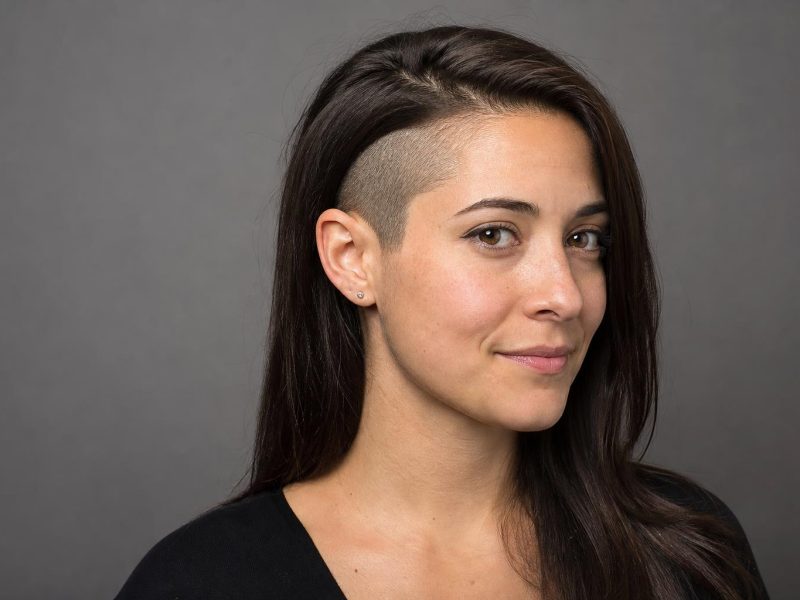

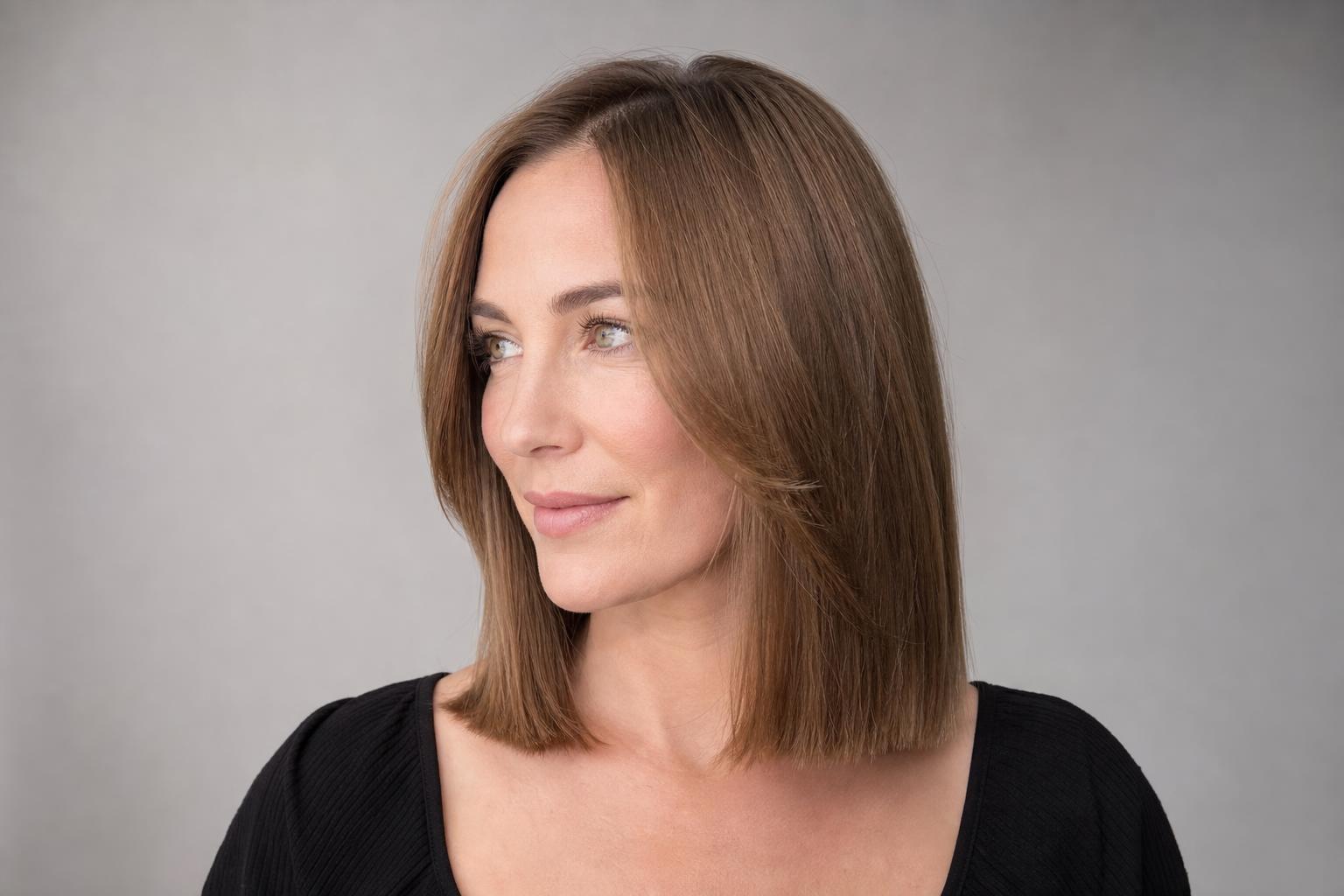
On fine hair at medium length, every layer you add subtracts from the perimeter, which is the only thing creating the illusion of density.
The workable rule for fine hair between the collarbone and the shoulder blade is two lengths, not a cascade: a solid unbroken perimeter, plus one set of interior layers whose shortest point falls no higher than your cheekbone at the face and no more than two inches above the baseline anywhere else. Everything past that trades visible thickness for movement you did not need. The 20 cuts below are ranked by exactly how much weight each one removes, starting with the cuts that remove almost none.
Most advice on this topic stops at “ask for subtle layers” and leaves you to guess what subtle means in inches. This guide gives the numbers instead: where the shortest layer lands, which cutting tools to refuse, how the fine-hair answer differs from the thin-hair answer, what to say at the consultation, and which of the popular layered shapes genuinely survive on hair that has nothing to spare.
Fine Hair and Thin Hair Are Two Different Problems
Fine describes the diameter of each individual strand. Thin describes how many strands you have per square inch of scalp. They are measured separately, they look different in the mirror, and layering affects them in opposite directions. In quantitative trichoscopy work, mean hair shaft diameter ran around 74 microns with density between 134 and 163 follicles per square centimeter depending on where on the scalp the measurement was taken, which is why two people with the same apparent thickness can need opposite cuts.
| Question | Fine Hair | Thin Hair |
|---|---|---|
| What it actually is | Narrow strand diameter | Low follicle density |
| How to test it | Roll one strand between finger and thumb. Barely felt means fine. | Part the hair in three places. Visible scalp in all three means thin. |
| What layers do | Break up flatness, add movement, help a lot in small amounts | Remove the perimeter mass that was hiding the scalp |
| Ponytail circumference | Can still be thick if density is normal | Under two inches around, regardless of strand width |
| Layering verdict | Yes, interior only, one length of layer | Almost none, and never at the perimeter |
Most people reading this are fine and not thin, which is good news, because fine hair with normal density takes layering well as long as the baseline stays intact. If your parts show scalp everywhere and your ponytail is under two inches around, treat this as a density problem rather than a texture one and cut the layer count further than anything recommended here.
Why Medium Length Is the Hardest Place to Layer Fine Hair
Long hair forgives layering because there are ten or twelve inches below the shortest layer to close the gap again. A chin-length bob forgives it because a blunt line at that length supports its own shape without needing any weight underneath. Medium length has neither advantage. At the collarbone, the perimeter is simultaneously the only source of apparent density and too short to recover from having pieces taken out of it.
That is why so many fine-haired clients leave the salon with a cut that looked full in the chair and wispy by day three. The blow-dry held the layers apart; ordinary hair behavior let them collapse back into the length, where they now look like thinner ends rather than movement. The fix is structural, not a product.
Stylist tip: Ask to see the cut air-dried before the blow-dry, or at minimum ask the stylist to rough-dry it flat with fingers only halfway through. A fine-hair layered cut that looks good without a round brush will look good every day. One that needs the brush will disappoint you every day but one.
The Layering Rules That Hold Up on Fine Medium-Length Hair
Four decisions determine whether a layered medium cut adds fullness or removes it, and all four get made in the first five minutes of the appointment. None of them is about how many layers you want. They are about where the shortest one lands, what cuts it, and whether the bottom edge stays intact.
The Perimeter Stays Blunt and Untouched
The bottom edge does the heaviest lifting in the whole cut, because a solid line photographs and reflects light as one continuous mass. Point cutting, notching or texturizing the last inch turns that single edge into dozens of separate ends, and on fine hair the effect is immediate. Say the words “leave the baseline blunt” and repeat them before the final check.
The Shortest Layer Lands at the Cheekbone or Lower
Face-framing that starts above the cheekbone puts short pieces where they have nothing to blend into, and on fine hair they separate rather than sweep. Cheekbone is the ceiling for most people, jawline is the safer choice, and anything cut at eyebrow level belongs to a fringe, not to layers.
Interior Layers Beat Visible Ones on Fine Hair
Layers cut underneath the top section create lift without any short ends appearing on the surface, which is the whole point when the surface is what looks sparse. The difference between internal layering and visible layering is the single most useful thing to understand before a consultation, because the two techniques produce opposite results on the same head.
Refuse the Razor and the Thinning Shears
A razor tapers each strand to a point, which is exactly wrong on hair that is already narrow, and thinning shears remove strands at random depths so the ends feather out within two washes. Both are useful tools on thick coarse hair. On fine hair they produce the wispy result people then blame on the layers themselves.
Medium Cuts That Remove Almost No Weight
These seven are the safest options at this length, and they are where anyone who has been burned by over-layering should start. Each one keeps a fully solid perimeter and limits shaping to the front or to a single interior section. The trade is that they need a little more styling effort to avoid looking static.
1. One-Length Collarbone Cut With a Blunt Perimeter
No layers at all, cut to a single line at the collarbone, with the ends taken off straight across rather than point cut. It is the densest-looking result fine hair can achieve at medium length, and it is the benchmark every other cut here trades against. Ask for a trim every six to eight weeks, because the whole effect depends on the line staying clean.
2. Blunt Lob With Two Face-Framing Pieces
One piece on each side, cut at the jaw and blended down into the length, adds enough shape around the face that the cut no longer looks like a helmet. Nothing behind the ears is touched. Oval and square face shapes get the most from this, since the softened front breaks a strong jaw line without shortening anything.
3. Collarbone Cut With Invisible Layers Only
The stylist takes layers out of the underneath sections only, so the top layer of hair stays full length and covers everything. You get lift at the root and swing at the ends with no short pieces visible anywhere. This is the cut to ask for when you want movement and have been told repeatedly that you cannot have layers.
4. Shoulder-Length Blunt With a Soft Cheekbone Curtain
A curtain that opens from a center part at cheekbone level gives the front real shape while the perimeter stays entirely solid. Fine hair holds a curtain better than a blunt fringe because there is less weight fighting the sweep. Blow the two front sections away from the face with a flat brush for thirty seconds and it holds all day.
5. Blunt Midi With a Slight Front Angle
The whole perimeter is one line, but that line is cut half an inch longer at the front than at the back, which looks like deliberate shaping without removing anything. Heart-shaped faces benefit most, since the extra length at the front narrows a wider forehead. It is the least noticeable change on this list and the hardest to get wrong.
6. Collarbone Cut With a Single Interior Layer
One layer, cut at about two inches above the baseline through the mid-section only, adds just enough separation to keep the length from hanging flat. Two layers do not double the effect, they halve the density. Stop at one and let the styling do the rest.
7. Shoulder Blunt With Underneath Layering Only
Weight is removed from the nape section and nowhere else, which fixes the specific problem of fine hair going triangular at the bottom when it is cut to the shoulder. The top and sides keep every inch. Worth asking for if your hair flips out at the shoulder and you have always assumed that was unavoidable.
Medium Cuts With Moderate Interior Layering
These seven introduce a real layer structure while keeping the baseline solid, and they suit fine hair with normal density rather than fine hair that is also sparse. Each entry names where the shortest layer falls, because that measurement is the difference between them. If your hair has ever gone wispy after a layered cut, start in the previous section instead.
8. Two-Length Layered Lob
Two distinct lengths, the baseline at the collarbone and a single layer at the jaw, produce visible movement with only one cut line removing weight. Because the layer is one clean length rather than a graduated series, the hair falls into two tidy masses instead of dozens of separate ends. This is the layered cut most fine-haired clients should be asking for and almost never do.
9. Medium Cut With Cheekbone Face-Framing
Face-framing starts at the cheekbone and connects into the length by the collarbone, so the front has shape and the back has none. Round faces gain the most, as the vertical sweep from cheekbone downward narrows the widest part of the face. Keep the framing pieces on the heavier side, since thin wispy framing on fine hair disappears by lunchtime.
10. Collarbone Layers With a Heavy Baseline
Layers run through the mid-lengths while the bottom two inches are left deliberately over-weighted, which is the opposite of how most stylists are trained to finish a cut. The heavy bottom anchors everything above it. Ask explicitly for the perimeter to stay uncut in the final tidy-up, or it will get point cut out of habit.
11. Medium Butterfly-Style Layers Kept Short
The butterfly shape uses a short top tier and a long bottom tier, and on fine hair it only works if the gap between them is small. Three inches of separation looks layered; six inches looks like two different haircuts. Our guide on how layer length changes the shape of a cut covers why that gap matters more than the layer count.
12. Shoulder-Length Layers With a Rounded Bottom
The perimeter curves slightly shorter at the sides than at the back, which stops the shoulder flick without cutting any actual layers into the sides. Combined with a single interior layer, it gives shape from two directions. Fine wavy hair suits this better than fine straight hair, which can look scooped.
13. Medium Cut With a Slight C-Shape Bevel
Beveling means the ends are cut to curve gently inward as one mass rather than being layered apart. It gives fine hair a rounded, finished bottom edge and takes almost nothing off. Achieve it at home with a medium round brush rolled under once on the last two inches.
14. Collarbone Layers With Curtain Bangs
Curtain bangs supply the face shape that heavy layering would otherwise be asked to provide, which lets the rest of the cut stay conservative. On fine hair, ask for the bangs to be cut thicker than feels right at the time, taking the section from further back on the crown. A thin curtain on fine hair separates into strands instead of falling as a curtain.
Medium Layered Cuts for Fine but Dense Hair
If your strands are narrow but you have plenty of them, you can carry a genuine layered shape, and this is the group where the more recognizable cuts live. The perimeter rule still applies. What changes is that the interior can take two layer lengths instead of one without going see-through.
15. Medium Shag With a Solid Perimeter
A shag built on an uncut baseline keeps the choppy top movement and loses the wispy bottom that makes most shags unwearable on fine hair. Tell the stylist you want shag layering above the shoulders and nothing below it. It grows out over about ten weeks without an awkward stage.
16. Long Bixie Grown to Collarbone
A bixie that has been left to grow into medium length keeps short crown layering from the original cut while the length catches up, which produces crown lift that a fresh cut cannot easily replicate. Anyone growing out a short cut should ask their stylist to shape rather than start over. Trims every eight weeks on the perimeter only.
17. Medium Layers With a Deep Side Part
A deep part moves a mass of hair across the crown, and on fine hair that redistribution alone adds noticeable height at the root. Pair it with layers cut at the jaw rather than the cheekbone, since the heavier side needs weight to hold the sweep. Change the part side every few weeks so the root lift does not train itself flat.
18. Collarbone Cut With Crown Layering Only
Short layers confined to the crown section create lift exactly where fine hair goes flattest, while the sides and back stay one length. It is the most targeted cut on this list and the least likely to disappoint. Blow-dry the crown section upward against its natural fall for the full effect.
19. Medium Wolf-Adjacent Cut on Fine Wavy Hair
A softened wolf shape, with the crown layered and the perimeter left blunt, gives fine wavy hair the texture it can actually hold. The full version of the cut removes far too much weight for this hair type. Use a salt-free texture cream rather than a texturizing spray, which on fine hair leaves grit without body.
20. Shoulder-Length Layers With Blunt Ends and a Middle Part
A middle part with equal layers on both sides is the most symmetrical option here, and symmetry makes fine hair look deliberately styled rather than flat. The blunt ends keep the bottom dense while the layers above give the sides shape. Avoid this one if your hair parts naturally to the side, since fighting a growth pattern daily costs more time than the look is worth.
Where the Shortest Layer Should Land for Your Face Shape
Face shape decides the height of the shortest face-framing layer, and on fine hair that single measurement changes the result more than the overall length does. The table gives the landing point rather than a style name, because the same cut placed two inches higher or lower produces a different face entirely.
| Face Shape | Shortest Layer Lands | Best Baseline Length | Avoid |
|---|---|---|---|
| Oval | Cheekbone or jaw, either works | Collarbone | Nothing structural, choose on styling time |
| Round | Jaw or just below | Collarbone to shoulder blade | Layers at the cheekbone, which widen the face |
| Square | Cheekbone, softly blended | Collarbone | A hard blunt line level with the jaw |
| Heart | Jaw, heavier at the ends | Collarbone, longer at the front | Volume above the cheekbone |
| Oblong | Cheekbone, plus curtain bangs | Collarbone, no longer | One-length hair past the shoulder blade |
| Diamond | Chin, with crown layering above | Shoulder | A flat crown with all the weight at the ends |
If the face-framing piece is the part of the cut you care most about, it is worth booking around that alone. The placement logic for face-framing layers by face shape applies at any length and is the same conversation whether you are at the collarbone or the waist.
What to Tell Your Stylist
Bring the specification, not the adjective. “Subtle layers” means something different to every stylist who hears it, and on fine hair the gap between two interpretations is the difference between a cut you keep and one you grow out. Say the four things that actually control the outcome.
The sentence to use: “Fine hair, normal density. Keep the perimeter blunt at the collarbone with no point cutting on the baseline. One interior layer, shortest point at my jaw. No razor, no thinning shears anywhere.” Then ask the stylist to confirm each of those back to you before the first section is taken.
Two questions worth asking at the consultation. First, whether they cut fine hair wet or dry, since dry cutting a fine blunt line gives a more accurate edge. Second, how they plan to remove weight if they think weight needs removing, because the answer tells you immediately whether the shears are coming out.
Stylist tip: Bring a photo of a cut you disliked as well as one you want. The disliked photo is more informative, because it shows the stylist which failure mode you are trying to avoid, and on fine hair almost every bad outcome comes from the same two causes.
Maintenance and Styling
A blunt-perimeter medium cut needs trimming every six to eight weeks, and the trim is genuinely about the line rather than about split ends. Once the baseline softens, the density effect goes with it, and no amount of product brings it back. Layered versions stretch to eight or ten weeks because the layers disguise their own grow-out. The same trim logic applies across the wider set of medium layered cuts by texture, though thicker hair tolerates a softer line.
Daily styling runs five to fifteen minutes. Use a mousse the size of a golf ball worked into damp roots, rough dry with fingers to about eighty percent, then finish the crown section only with a medium round brush. Skip conditioner above the ears entirely, since conditioning fine roots is the most common reason a good cut goes flat by midday. A dry shampoo used on clean hair at the roots, before it needs it, holds lift better than one used to rescue day-three hair.
Grow-out is graceful on the one-length and single-layer cuts and awkward on the shag and bixie versions, which lose their crown lift at around week seven. If you want to stretch appointments, choose from the first section rather than the third.
Common Myths About Layering Fine Hair
Myth: More Layers Create More Volume
Reality: Volume comes from root lift and from a dense perimeter, not from layer count. Each additional layer removes mass from the ends, so past one or two layers the hair gets lighter and flatter at the same time. What people mistake for volume in a heavily layered photo is usually a blow-dry.
Myth: Fine Hair Cannot Have Layers at All
Reality: Fine hair takes layering well when the layers are internal and the perimeter is untouched. The advice to avoid layers entirely comes from people who have only seen the visible, perimeter-thinning version. Interior layers on fine hair add lift with no cost to apparent thickness.
Myth: Thinning Shears Remove Bulk Without Changing the Shape
Reality: They remove strands at scattered depths, which on fine hair creates short broken-looking pieces throughout the length rather than a lighter version of the same cut. On thick coarse hair the same tool works exactly as advertised. Hair type decides whether the tool is right, not the stylist’s preference.
Myth: A Shorter Cut Always Looks Thicker on Fine Hair
Reality: Density gains flatten out below the collarbone, and going shorter than the jaw on fine hair without enough natural density can expose the scalp at the crown instead. Medium length with a solid baseline often looks thicker than a short cut does. If you are weighing a shorter option, the shape rules for bobs cut for fine hair are a useful comparison before committing.
FAQ
Should Fine Hair Be Layered at Medium Length?
Yes, but with one layer rather than several, and only in the interior. Keep the perimeter blunt and put the shortest layer at cheekbone level or below, and the cut gains movement without losing the mass that makes it look full. Layers cut into the perimeter itself are what produces the wispy result fine-haired clients complain about.
How Many Layers Should Fine Hair Have?
One, or at most two if your density is normal and your strands are simply narrow. A graduated cascade of four or five layer lengths splits fine hair into too many separate masses, none of which has enough weight to hang properly. Two clean lengths look deliberate; five look thin.
What Length Is Best for Fine Hair?
Collarbone is the sweet spot at medium length, because the perimeter is still short enough to hold its own weight and long enough to be versatile. Past the shoulder blade, fine hair starts to taper visibly at the ends. Shorter than the jaw and you rely on density at the crown that fine hair may not have.
Do Layers Make Fine Hair Look Thinner?
Visible layers cut into the perimeter do, because they replace one solid edge with many separate ends. Interior layers cut underneath do not, since the surface length stays intact and covers them. The direction of the effect depends entirely on the technique, which is why the same word produces opposite results in two different salons.
Are Curtain Bangs Good for Fine Hair?
They work well as long as the section is taken from further back on the crown than it would be on thicker hair. A thin curtain on fine hair separates into strands within an hour instead of falling as one soft shape. Ask for the section to start about two inches behind the hairline, and expect to trim them every four weeks.
Can Fine Hair Handle a Shag or a Wolf Cut?
A modified version, yes, with the shag layering confined above the shoulders and the perimeter left completely blunt. The standard versions of both cuts remove weight throughout the length, which is the one thing fine hair cannot spare. Ask for the shape of the shag and the baseline of a blunt cut.
How Often Should I Trim a Layered Medium Cut on Fine Hair?
Every six to eight weeks for a blunt perimeter, eight to ten for a layered one. The blunt version needs it more often because its whole effect depends on the line staying sharp, and fine ends soften faster than coarse ones. Book a perimeter-only trim between full cuts if budget is the constraint, since it costs less and preserves the part that matters.
Getting layered fine hair right at medium length comes down to protecting the perimeter and spending your one layer wisely, rather than asking for more shape and hoping. Decide on your baseline length first, choose where the shortest layer lands second, and bring both numbers to the appointment. The full range of medium cuts sorted by hair type is worth scanning if you are still choosing a length, but on fine hair the rules above matter more than the style name you walk in with.
Hair results vary based on your natural hair type, texture, density, and condition. Always consult with a licensed hairstylist before making significant changes, especially with chemical treatments or dramatic length changes. Photos may show styled results that require professional tools and products to replicate.