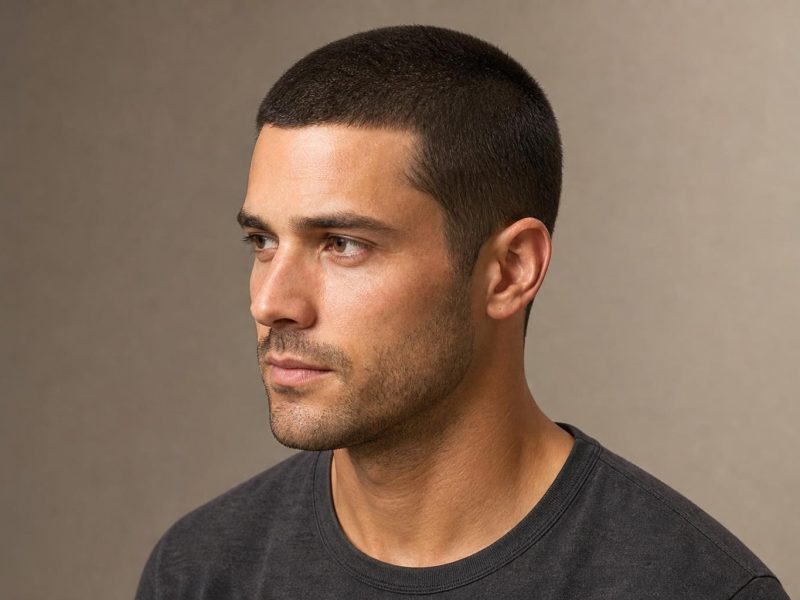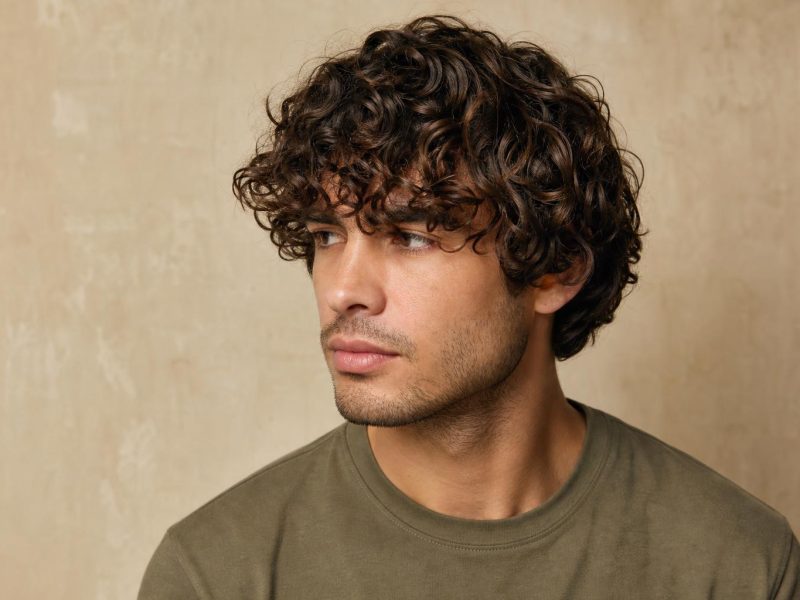


A crew cut is a short haircut whose top slopes from longest at the front hairline to shortest at the crown, and that slope is the one detail that separates it from every other short back and sides.
A crew cut haircut keeps the sides and back short, usually a #2 to #4 guard tapered toward the neck, while the top is left between half an inch and two inches and graded so the front is the longest point. That forward-weighted top is why a crew cut can be pushed up or to the side at the hairline instead of lying flat like a buzz cut hairstyle. It works on most face shapes and hair types, and on straight or wavy hair it needs almost no styling beyond a fingertip of matte product.
Below are 22 crew cut ideas grouped into classic versions, crew cuts with a fade, longer and textured tops, and versions built for specific hair types. After the gallery you will find a guard number chart, a comparison with the buzz, Ivy League, Caesar and French crop, a face shape table, an exact barber script and an honest maintenance schedule.
| Factor | Details |
|---|---|
| Best for | Oval, square, oblong and diamond faces; straight, wavy and coarse hair of medium to thick density |
| Typical lengths | Sides and back #2 to #4 guard; top 0.5 to 2 inches, longest at the front |
| Maintenance | Sides every 3 to 4 weeks, full cut every 4 to 6 weeks; 1 to 3 minutes of styling |
| Avoid if | You have a strong double crown with fine hair, or you want a style you can wear long and flat |
| Chair time | 20 to 30 minutes; add 10 to 15 minutes for a skin fade |
What Makes a Haircut a Crew Cut
The crew cut started as a practical short cut for college rowing crews in the 1920s and spread widely through the military in the 1940s. What defines it has not changed: the top is graded in length, longest at the front and shortest at the crown, and the sides are short enough that the head looks tidy from every angle. Barbers get there with clipper-over-comb or scissor-over-comb on the top, and a guard taper or fade on the sides.
Most crew cuts that disappoint are not bad cuts, they are the wrong cut. When the top is left one length, you get a butch cut or a long buzz. When the front is left long enough to part and comb over, you have moved into Ivy League territory. Both are relatives, and both come up in the comparison table further down.
Stylist tip: Ask your barber to check the top in profile before finishing. On a true crew cut, the outline of the top runs close to flat or slightly forward from crown to front; if it bulges at the crown, weight has been left in the wrong place and the cut will look rounder by week two.
Classic Crew Cuts
These are the versions that match what most people picture: short tapered sides, a top that is short enough to towel-dry into place, and no hard lines. They suit office dress codes and grow out without any awkward stage for the first three weeks.
1. Traditional Short Crew Cut
Sides go down to a #2 at the neck and blend into a #3 above the ears, while the top is cut to about an inch at the front and three-quarters of an inch at the crown. It is the lowest-effort version on this list: towel-dry, push the front up with your fingers and leave it.
2. Military Crew Cut
Square and oblong faces carry the shortest crew well because the jaw already gives the head structure. Here the top drops to half an inch and the sides to a #1 or #2, which leaves almost nothing to style. Expect the shape to look blunt after about three weeks.
3. Crew Cut With a Tapered Nape
Ask for the neckline to be tapered instead of cut straight across. A tapered nape grows out softly, so the back of the cut still looks neat at week four, which matters more on crew cuts than most people expect because the sides are where the grow-out shows first.
4. Crew Cut With a Side Part
Leaving the front at around an inch and a half gives just enough length to comb it to one side. Straight, medium-density hair holds a part best at this length; very coarse hair tends to stand straight up instead. Use a light cream on damp hair and a fine comb.
5. Salt and Pepper Crew Cut
Gray and white strands are often coarser and drier than the original color, which helps a crew cut hold its forward shape without product. Keeping the sides slightly longer, around a #3, lets the salt-and-pepper mix stay visible instead of disappearing into scalp.
6. Crew Cut With a Rounded Neckline
Unlike a blocked or squared neckline, a rounded one follows the natural curve of the head at the back corners. It softens a thick neck and suits men who wear collared shirts daily, since the corners do not catch the collar as they grow.
Crew Cuts With a Fade
Adding a fade trades some maintenance for more contrast. The crew cut top stays the same; what changes is how short the sides go and where the transition starts. Faded crew cuts look sharpest for about two weeks, so they suit people who already see a barber often.
7. Low Fade Crew Cut
The fade starts about an inch above the ear and drops to skin or a #0.5 at the neck, keeping most of the side length intact. Bring a photo and say “low fade, keep the weight above the temple,” or the barber may take it higher than you want. A low fade haircut is the most forgiving fade to grow out.
8. Mid Fade Crew Cut
Round faces gain some length when the fade starts at the temple, because the narrower sides make the top look taller. Keep the front at an inch or more to finish the effect.
9. High Skin Fade Crew Cut
Taking the sides to skin up to the parietal ridge leaves the crew top as a short, flat-looking block. It shows every bump and scar on the scalp, so run a hand over your head before committing. The sharpest point lasts about ten days.
10. Drop Fade Crew Cut
A drop fade curves down behind the ear so the back line falls lower than the sides. With a crew cut, that curve stops the top from looking like it is floating on a skinned head.
11. Crew Cut With a Line-Up
Dark hair on light skin shows a sharp edge-up more than any other combination, which is why this version draws the eye to the forehead and temples. The line grows fuzzy within five to seven days, so plan on a quick edge-up between full cuts.
Longer and Textured Crew Cuts
Leaving the top at one and a half to two inches turns the crew cut into something you can style. These versions need a little product, but they carry more personality and cover a thinning crown better than the shorter cuts above.
12. Long Crew Cut
Ask your barber to keep two inches at the front and one inch at the crown, scissor-cut rather than clippered. The extra length gives movement without needing blow-drying, and the grade from front to back still keeps it recognizably a crew cut.
13. Textured Crew Cut
Point cutting on the top breaks up the solid surface so the hair separates into small, piece-y sections. Thick hair benefits most, since it would otherwise puff up as one dense mass. A pea-sized amount of matte clay worked through dry hair keeps the texture visible.
14. Crew Cut With a Short Quiff
Blow-dry the front upward with a vent brush for 60 seconds, then set it with a light paste. The front needs at least an inch and a half to lift, so this is a longer crew by default.
15. Messy Crew Cut
Unlike the polished version, the messy crew is towel-dried roughly and finished with sea salt spray, then left alone. It looks better at day two than day one, which makes it a practical pick for men who wash their hair every other day.
16. Crew Cut With a Short Beard
Ask the barber to fade the sideburns into the beard at the same guard as the lower sides, usually a #2. That single connection makes the haircut and beard look planned as one shape, and it balances a round face by adding length at the chin.
Crew Cuts by Hair Type
The same guard numbers give very different results on fine, curly, coily and thinning hair. These versions adjust the length or the technique so the crew cut still looks the way it should on your texture.
17. Crew Cut on Thick Coarse Hair
Coarse hair stands up on its own, so the barber can take the top shorter than the photo suggests and still keep the forward slope. Ask for weight removal with thinning shears at the crown, or the top will spread wide by week three.
18. Crew Cut for Fine Hair
Fine hair looks fuller at a short, blunt length than at a long, wispy one. Keeping the top under an inch with square, clipper-cut ends makes each strand look denser. Skip thinning shears completely.
19. Curly Crew Cut
Curls shrink, so ask for the top to be cut dry at the length you want to see, typically an inch to an inch and a half of curl. Scrunch a small amount of curl cream into damp hair and let it air-dry. A taper on the sides keeps the shape from rounding out into a ball.
20. Coily Crew Cut With a Taper
On 4a to 4c hair, the crew cut becomes a short, even top shaped with a slightly longer front and a clean taper at the temples and nape. Brushing or sponging the top in the direction you want it to grow sets the shape, and a line-up every two weeks keeps it sharp.
21. Crew Cut for a Receding Hairline
Pushing the short front slightly forward instead of up hides the corners of the hairline without looking like a comb-over. Keep the top under an inch; longer hair draws attention to the gap as it separates. The haircuts for a receding hairline guide covers more options if the recession is past the temples.
22. Crew Cut for a Thinning Crown
Grading the crown very short, around half an inch, removes the contrast between the scalp and longer hair that makes a thin spot stand out. The front can stay longer. For a thin spot that is clearly visible in photos, see these haircuts for a thinning crown.
Crew Cut Guard Numbers by Length
Guard numbers are the fastest way to get the same crew cut twice. The numbers below are standard for most clipper brands, but combs vary slightly, so tell your barber the length in inches as well. The full hair clipper sizes chart lists every guard if you trim at home.
| Crew Cut Version | Sides and Back | Top at the Crown | Top at the Front |
|---|---|---|---|
| Military | #1 to #2 (1/8 to 1/4 inch) | #4 (1/2 inch) | #5 to #6 (5/8 to 3/4 inch) |
| Traditional | #2 to #3 (1/4 to 3/8 inch) | #6 (3/4 inch) | #8 or scissors (1 inch) |
| Faded | Skin or #0.5 at the bottom, #2 at the top of the fade | 3/4 inch | 1 to 1.5 inches |
| Long | #3 to #4 (3/8 to 1/2 inch) | 1 inch, scissors | 1.5 to 2 inches, scissors |
Crew Cut vs Buzz Cut, Ivy League, Caesar and French Crop
These five short cuts get mixed up constantly, and the difference usually comes down to two things: whether the top is graded, and which direction the front falls. The Caesar haircut and the French crop both push the fringe forward, while the crew cut and Ivy League lift it up or to the side.
| Cut | Top | Front Direction | Can You Part It? |
|---|---|---|---|
| Buzz cut | One length all over, clippers only | None, too short to move | No |
| Crew cut | Graded, longest at the front | Up or slightly to the side | Only at the longer end (1.5 inches or more) |
| Ivy League | Graded, front long enough to comb (2 to 3 inches) | Side-swept | Yes, that is the point |
| Caesar | Even, short, combed forward | Straight forward to a short horizontal fringe | No |
| French crop | Textured, longer fringe than a Caesar | Forward with a blunt or choppy fringe | No |
If you like the crew cut but want it to look a little softer, the Ivy League is the natural next step: grow the front for four to six weeks and ask for a side part. If you want forward texture instead, a textured crop haircut keeps the same short sides with a choppy fringe.
Which Crew Cut Suits Your Face Shape
Because a crew cut leaves so little hair, it shows the shape of your face and head clearly. The goal is to use top height and side length to balance proportions.
| Face Shape | Best Crew Cut | Top Length | Avoid |
|---|---|---|---|
| Oval | Any version | 0.5 to 2 inches | Very little; balanced proportions carry most lengths |
| Round | Mid or high fade with height at the front | 1 to 2 inches | Full sides at a #4, which add width |
| Square | Military or traditional | 0.5 to 1 inch | A tall quiff that makes the head look boxy |
| Oblong | Traditional with fuller sides, front pushed forward | 0.5 to 1 inch | High skin fades and extra height, which add length |
| Heart | Textured crew with a short beard | 1 to 1.5 inches | Very tight sides that exaggerate a wide forehead |
| Diamond | Low fade, textured top pushed slightly forward | 1 to 1.5 inches | Skin sides at the cheekbones |
A long, narrow head profile also benefits from keeping the sides at a #3 or longer, even if the face itself is oval. If you are unsure which shape you have, the face shape measuring guide takes about two minutes with a mirror.
What to Tell Your Barber
“Short back and sides” alone will not get you a crew cut, because it says nothing about the top. Give the barber the side guard, the top length at the front and crown, the neckline, and whether you want a taper or a fade. Here is a script that works for the traditional version:
“I’d like a crew cut. Number 2 on the sides and back, tapered at the neck, blending up to a 3 above the ears. On top, leave about an inch at the front and grade it down to three-quarters of an inch at the crown. Rounded neckline, and please don’t thin out the top.”
For a faded version, swap the first sentence for “low fade starting just above the ear, down to skin at the nape.” Bring one photo taken from the side as well as the front, since the slope of the top only shows in profile.
Stylist tip: If you have a cowlick at the front hairline, say so before the cut starts. The barber will leave that section a quarter-inch longer so its weight holds it down; cutting it to match the rest makes it stand straight up.
Maintenance and Styling
Head hair grows roughly half an inch a month, and on a cut this short that is enough to change the shape. The sides lose their clean look first, while the top can usually wait a little longer.
| Aspect | Details |
|---|---|
| Taper crew cut | Full cut every 4 to 6 weeks |
| Faded crew cut | Sides every 2 to 3 weeks; top every 5 to 6 weeks |
| Daily styling | 1 to 3 minutes; towel-dry and finger-style |
| Products | Matte clay or paste for texture; light cream for a side part; sea salt spray for a messy finish |
| Grow-out | Looks fine to week 3; sides start to puff over the ears by week 5 |
Use far less product than you think. A crew cut top needs a pea-sized amount rubbed flat between the palms first; too much makes short hair clump and look wet. If the top starts to look flat by afternoon, a quick pass with a damp hand and a push upward usually resets it.
When a Crew Cut Is Not the Right Choice
A crew cut is one of the easiest cuts to wear, but a few situations work against it.
- A strong double crown on fine hair: the short graded top exposes both whorls and the hair splits at the crown; ask for the crown left at an inch or more, or try a longer textured crop instead.
- Several scars or bumps on the scalp: faded crew cuts show every irregularity, so keep the sides at a #3 or longer with a taper instead of a fade.
- You want a style with length to play with: even the long crew cut stops at around two inches, so a longer short haircut for men like a quiff or side part suits you better.
- You cannot get to a barber every month: the grade on top blurs by week six and it turns into an uneven short cut, so a one-length buzz is easier to keep up at home.
FAQ
What Is the Difference Between a Crew Cut and a Buzz Cut?
A buzz cut is one length all over, while a crew cut has short sides and a graded top that is longest at the front. The buzz is done entirely with clippers at one guard; the crew usually needs clipper-over-comb or scissors on top. The crew cut also leaves enough length at the front to push up or to the side.
What Guard Number Is a Crew Cut?
Most crew cuts use a #2 to #4 guard on the sides and back, with the top left between half an inch and two inches. The top length is often given in inches or as a #6 to #8 guard at the front. Tell your barber both numbers so the grade is clear.
How Long Does a Crew Cut Take to Grow Out?
A crew cut grows out enough to style as a short side part in about two to three months. At roughly half an inch of growth a month, the top reaches two to three inches in that time. Keep trimming the sides while the top grows so the transition stays neat.
Is a Crew Cut the Same as an Ivy League Haircut?
An Ivy League is a longer crew cut with enough length at the front to part and comb to the side. The sides and the graded top are the same idea; the front is simply left two to three inches long.
Does a Crew Cut Work on Curly Hair?
Yes, as long as the top is cut dry to account for shrinkage and the sides are tapered to keep the shape narrow. An inch to an inch and a half of visible curl on top usually looks best. A little curl cream on damp hair keeps the curls defined without frizz.
Is a Crew Cut Good for Thinning Hair?
A crew cut is one of the better choices for thinning hair because it reduces the contrast between scalp and hair. Keep the crown very short and the front slightly longer, pushed forward rather than up. Avoid thinning shears on the top.
The right crew cut haircut comes down to three numbers: the side guard, the front length and the crown length. Pick the version from this list that matches your hair type and face shape, save a side-profile photo, and give your barber those three numbers so you get the same cut every time.
Hair results vary based on your natural hair type, texture, density, and condition. Always consult with a licensed barber or hairstylist before making significant changes, especially with dramatic length changes. Photos may show styled results that require professional tools and products to replicate.